Tilt a knee implant 3 degrees and the plastic insert takes the strain
A computer simulation shows how small alignment changes move stress inside a knee replacement.
Knee replacement usually works well, but some implants wear out and have to be redone. Small details of alignment may be part of the story.
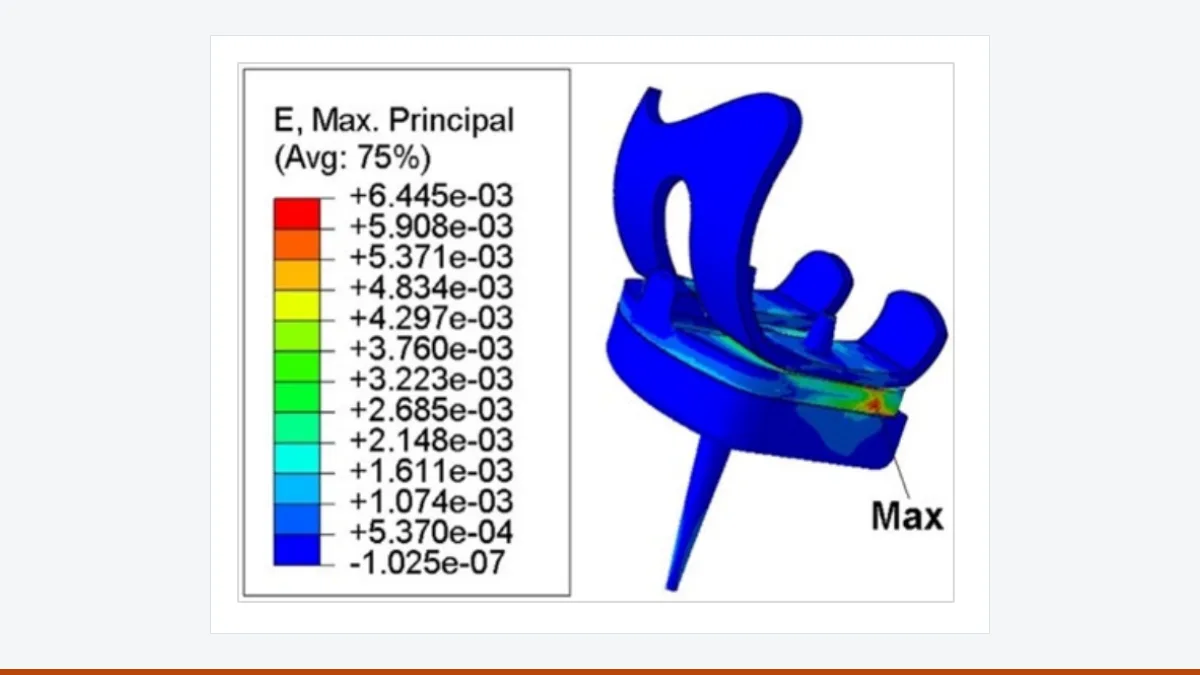
In The Ulutas Medical Journal, researchers built a 3D computer model of the thigh bone, shin bone and a total knee implant, then used finite element analysis, an engineering method that splits a structure into tiny pieces, to map stresses.
They first checked the load in the standard surgical alignment. Then they reduced the valgus angle, the knee's slight outward tilt, by 3 degrees.
That change shifted extra load onto the inner side of the joint, with the polyethylene insert between the metal parts bearing much of it. The authors read this as a warning sign for early wear.
They argue that such modelling can help surgeons cut revision rates and leave patients more satisfied.
Caveat: these are simulation results from one model, not outcomes measured in patients.
Source: Javid Azarabadi. Evaluation of Total Knee Arthroplasty Surgery with Finite Element Analysis. Ulutas Med J 2024. doi:10.5455/umj.20240305070048.
Image: Figure 3 of the article, CC BY-NC 4.0.