The Ulutas Medical Journal · ISSN 2149-0430 (印刷版), 2149-388X (在线版) · https://www.ulutasmedicaljournal.com/?mno=193156
原创论著 · 开放获取
评价膝盖外科手术总数和有限元素分析
标题、摘要和全文为机器翻译。 英文原文
- Institute of Faculty of Medicine, Department of Orthopaedics and Traumatology, University of Başkent, Konya, Turkey ROR
- 开放获取
- CC BY-NC 4.0
- ORCID
- 资助
- 伦理批准
- 数据可用性
摘要
导言: 本研究旨在表明有限元素法(FEM)在总膝关节成形术(TKA)中的重要性,以尽量减少修改的必要性。 材料和方法: 在我们的研究中,植入于股骨和骨骼中的TKA系统已经被三维FEM进行了数字分析. 结果和TKA模型已经转移到3D SolidWorks 3D软件. 本研究的应用方面侧重于膝关节骨骼部位与TKA部位相互作用中的压力分布. 我们的研究介绍了植入物的载荷分布和正常手术过程中应用的演示数据. 对负载分布也进行了分析,华氏度降低3度. 这种情况帮助我们预测未来早期聚乙烯腐蚀和失败. 结果: 当Valgus角度减小3°时,植入物上的负载分布在介质区间增加,特别是在聚乙烯插入物中. 这导致了未来早期聚乙烯磨损和故障的预测. 结论:FEM强调TKA期间生物机械载荷分布的重要性. 这也是在TKA之后降低TKA修订率和提高患者满意度的好方法.
关键词
全文
全文为机器翻译;以英文原文为准。 英文原文
导言
总膝关节切除术的主要目标是缓解现有的膝关节疼痛,重组下垂的结扎,恢复膝关节的运动功能,恢复联动稳定. (1)虽然膝关节整形术的临床结果一般良好,但据文献报告,十年修订率为5%。 (2)这些结果是由于早期聚乙烯腐蚀、畸形、感染和化脓松弛 (3). 有限要素法研究环境的复杂几何结构,通过输入计算机程序现有机械结构的物理性质和计算将起作用的力量,提供不同的特性和作用力。 它还提供材料建模,无论材料是同质的还是异质的,还是异质的。 材料建模由两个阶段组成. 这些是处理前和处理后阶段。 第一阶段是选择有限元素,第二阶段是模拟选定材料之间的应力条件. 因此,出现了参数化结果并指导临床医生 (4)因此,其目的是通过系统化修订理由,尽可能减少修订膝盖总节肢手术的必要性。 目的是通过系统化修订理由,尽可能减少修改膝盖节肢全面切除术的必要性.
在通过计算成像法来保存扫描的骨模型后,建模经常使用Cosmos,Catia,Abaqus等程序,特别是Ansysy创建. 在建模时,必须考虑骨物体的异构性和异构性. 这对于取得最佳结果很重要 (5)未能考虑到骨骼的异位性导致对数字数据的误解 (6). 节肢成形术中应用的假肢材料用微激光器扫描,通过被整合到所选软件的结果中,利用3D元件创建模型. 在软件的最后一部分,使用的植入物的骨骼特性和金属特性的压力条件是模拟的 (7)。 。 。
本研究旨在通过展示有限元素在总膝关节成形术中的重要性,最大限度地减少修订的必要性。
材料和方法
日常生活因素产生的生物力学因素对确定膝盖总节肢手术的健康和寿命至关重要。 (8). 采用有限分析方法,假肢成分表面接触之间的机械接触以数字方式确定 (9). 对模型中产生的骨组织进行FE分析,可以计算研究中应用于结构的力的压力和压力反应 (10)另一方面,这种方法还被用来预测肌肉骨骼结构的变形,并调查细胞一级的生物物理刺激。 (11)。 。 。
模式的设计
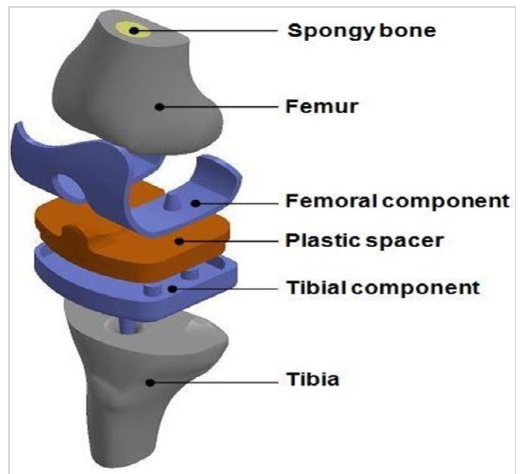
通过计算机化的扫描技术扫描了Femur和tibia骨骼。 结果和总膝盖节肢造型被转移到3D SolidWorks软件(Dassault Systèmes,Vélizy-Villacoublay,法国,2012年). 创建的模式如图1所示.
本研究的应用方面侧重于股骨的分骨部位与t骨的近缘骨部位与全膝节切片的相互作用中的压力分布. 因此,膝关节骨骼的凹陷部位和近缘部位的压力因素被清楚地理解. 尺寸在0.3至1毫米之间,以确保数字数据的准确性 (12)。 。 。
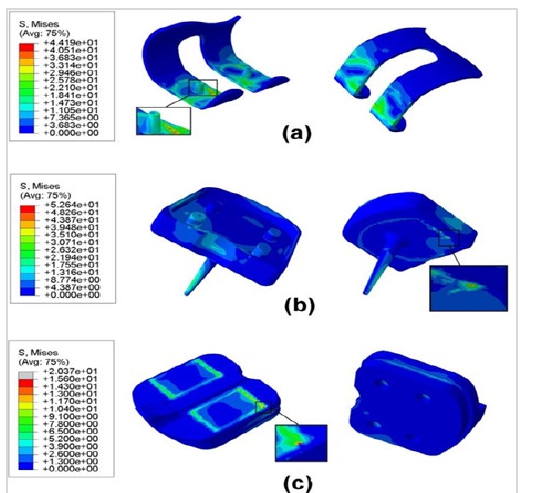
根据适当的预定义参数,通过数字分析计算每个系统组成部分的机械数据是可能的。 为了使结果对用户有意义,出现了不同的颜色梯度. 这些梯度从蓝色到红色不等. 梯度颜色为红色,其中应力点高. 图2显示节肢手术的负荷分布情况 (13)。 。 。
结果
最小位置变化在节肢手术放置过程中可能产生更为重大的后果 (14)有人指出,膝盖节肢手术应当个性化,以确保最大限度的遵守,其效果值应当更高。 (15). 膝盖节肢整形已显示对模型中的肌肉有不同的影响,有和没有切割后十字韧带 (16)已经发现,节肢手术期间5-10度的恶性肿瘤对中间隔间造成更显著的影响和更大的压力。 (17)。 。 。
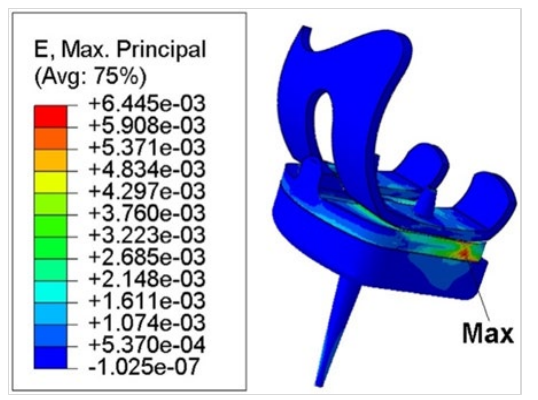
图2披露了正常手术过程中应用的植入物的负荷分布和演示数据。 同时,还检查了负载分布,将Valgus度降低3度. 这一次,在介质区间,特别是在聚乙烯的插入中观察到负载分布增加. 图3显示了这一点。 这种情况帮助我们预测未来早期聚乙烯腐蚀和失败.
讨论情况
在矫形外科学科中,预计在患者剧烈疼痛和功能衰竭时将实施总膝盖节肢手术. 许多临床研究表明,膝盖节肢手术的总成功率很高。 (18–20)然而,节肢手术之后的失败通常是生物力学的. (21)这些因素影响膝盖节肢整形和支撑骨骼各部分的机械坚韧性,恢复关节上的力量规模,以及负荷分布. 因此,已经证明任何不良的排列都会完全改变应用节肢手术中关节上的负载分布. (22–24)此外,还显示,将对联合行动加以限制。 (25)。 。 。
膝盖节肢整形术是具有敏感区域的核心价值,可防止接触压力大、磨损大、以及防止磨损风险。 (26)通过有限要素分析进行评价,以计算接触压力和以数字方法观测高压区域,以调查这种联合机械载荷可能产生的影响,计算接触压力,并以数字方法观测高压区域。 (27)通过这种非侵入性方法,迅速向文献提供诊所的辅助数据。
在这一研究中,FEM分析被证明对刺激总膝盖节肢手术的各种条件和并发症是有效的. 有限元素建模强调在总膝关节成形过程中生物机械载荷分布的重要性. 这也是在膝盖节肢整形后,降低膝盖节肢整形的发生率,提高患者的满意度的极佳方法.
声明
- 作者贡献(CRediT)
- 所有作者对全部 14 项 CRediT 角色贡献均等(Conceptualization, Data curation, Formal analysis, Funding acquisition, Investigation, Methodology, Project administration, Resources, Software, Supervision, Validation, Visualization, Writing – original draft, Writing – review & editing)。
- 资助
-
No financial support was provided from any institution or organization within the scope of the research.
- 利益冲突
- The authors declared no conflict of interest.
- 伦理批准
- Since the present research was completely virtual scanning and is not done on any living thing (human or animal), ethical institution approval is not required.
- 数据可用性
- A data availability statement was not reported in the published version of this article.
参考文献 (27)
27 条参考文献中有 23 条已链接 DOI。
- Çeliktaş M, SARPEL DY. Enfekte total diz protezlerinde iki aşamalı revizyon yapilan hastalarda orta ve uzun dönem sonuçlar. Çukurova Üniversitesi. 2007. PubMed Google Scholar
- Khan M, Osman K, Green G, Haddad F. The epidemiology of failure in total knee arthroplasty: avoiding your next revision. The bone & joint journal. 2016;98(1_Supple_A):105-12. DOI Crossref PubMed Google Scholar
- Bülbül AM, Batmaz AG. Diz artroplastisinin revizyon komplikasyonları. TOTBID Dergisi. 2015;14(2):140-4. DOI Crossref PubMed Google Scholar
- Popescu R, Haritinian EG, Cristea S. Relevance of finite element in total knee arthroplasty-Literature Review. Chirurgia (Bucharest, Romania: 1990). 2019;114(4):437-42. DOI Crossref PubMed Google Scholar
- Au AG, Liggins AB, Raso VJ, Amirfazli A. A parametric analysis of fixation post shape in tibial knee prostheses. Medical Engineering & Physics. 2005;27(2):123-34. DOI Crossref PubMed Google Scholar
- Latypova A, Pioletti D, Terrier A. Importance of trabecular anisotropy in finite element predictions of patellar strain after total knee arthroplasty. Medical Engineering & Physics. 2017;39:102-5. DOI Crossref PubMed Google Scholar
- Sahu NK, Kaviti AK. A review of use FEM techniques in modeling of human knee joint. Journal of Biomimetics, Biomaterials and Biomedical Engineering. 2016;28:14-25. DOI Crossref PubMed Google Scholar
- Hutter EE, Granger JF, Beal MD, Siston RA. Is there a gold standard for TKA tibial component rotational alignment? Clinical Orthopaedics and Related Research®. 2013;471(5):1646-53. DOI Crossref PubMed Google Scholar
- Henak CR, Anderson AE, Weiss JA. Subject-specific analysis of joint contact mechanics: application to the study of osteoarthritis and surgical planning. Journal of biomechanical engineering. 2013;135(2). DOI Crossref PubMed Google Scholar
- Li J, Hua X, Jin Z, Fisher J, Wilcox RK. Influence of clearance on the time-dependent performance of the hip following hemiarthroplasty: A finite element study with biphasic acetabular cartilage properties. Medical engineering & physics. 2014;36(11):1449-54. DOI Crossref PubMed Google Scholar
- Boccaccio A, Ballini A, Pappalettere C, Tullo D, Cantore S, Desiate A. Finite element method (FEM), mechano-biology and biomimetic scaffolds in bone tissue engineering. International journal of biological sciences. 2011;7(1):112-32. DOI Crossref PubMed Google Scholar
- Mahajan S, Patil R. Optimizing dental implant model by comparison of three dimensional finite element. Int J Innov Res Sci Eng Technol. 2015;4:11223-31. PubMed Google Scholar
- Arab AZE-A, Merdji A, Benaissa A, Roy S, Bouiadjra B-AB, Layadi K, et al. Finite-element analysis of a lateral femoro-tibial impact on the total knee arthroplasty. Computer methods and programs in biomedicine. 2020;192:105446. DOI Crossref PubMed Google Scholar
- Mou Z, Dong W, Zhang Z, Wang A, Hu G, Wang B, et al. Optimization of parameters for femoral component implantation during TKA using finite element analysis and orthogonal array testing. Journal of Orthopaedic Surgery and Research. 2018;13(1):1-12. DOI Crossref PubMed Google Scholar
- Azam N, Daud R, Ayu HM, Ramli J, Hassan M, Shah A, et al., editors. The effect of knee flexion angle on contact stress of total knee arthroplasty. MATEC Web of Conferences; 2018: EDP Sciences. DOI Crossref PubMed Google Scholar
- Kang K-T, Son J, Kwon O-R, Koh Y-G. Malpositioning of prosthesis: patient-specific total knee arthroplasty versus standard off-the-shelf total knee arthroplasty. Journal of the American Academy of Orthopaedic Surgeons Global Research & Reviews. 2017;1(4). DOI Crossref PubMed Google Scholar
- Moewis P, Checa S, Kutzner I, Hommel H, Duda GN. Physiological joint line total knee arthroplasty designs are especially sensitive to rotational placement–A finite element analysis. PLoS One. 2018;13(2):e0192225. DOI Crossref PubMed Google Scholar
- Healy WL, Della Valle CJ, Iorio R, Berend KR, Cushner FD, Dalury DF, et al. Complications of total knee arthroplasty: standardized list and definitions of the Knee Society. Clinical Orthopaedics and Related Research®. 2013;471(1):215-20. DOI Crossref PubMed Google Scholar
- Çalbıyık M. Clinical outcome of total knee arthroplasty performed using patient-specific cutting guides. Medical Science Monitor: International Medical Journal of Experimental and Clinical Research. 2017;23:6168. DOI Crossref PubMed Google Scholar
- Robertsson O, Dunbar M, Pehrsson T, Knutson K, Lidgren L. Patient satisfaction after knee arthroplasty: a report on 27,372 knees operated on between 1981 and 1995 in Sweden. Acta Orthopaedica Scandinavica. 2000;71(3):262-7. 43 77 Total Knee Arthroplasty with Finite Element Analysis Javid Mohammadzadeh Azarabadi DOI Crossref PubMed Google Scholar
- Abolghasemian M, Samiezadeh S, Sternheim A, Bougherara H, Barnes CL, Backstein DJ. Effect of patellar thickness on knee flexion in total knee arthroplasty: a biomechanical and experimental study. The Journal of arthroplasty. 2014;29(1):80-4. PubMed Google Scholar
- Norman TL, Hutchison JD, Gardner MR, Blaha MD J. Knee loading due to varus and external rotation in gait supports medial compartment wear in total knee arthroplasty. Journal of Orthopedics and Rheumatism. 2017;1(1):8. PubMed Google Scholar
- Browne C, Hermida JC, Bergula A, Colwell Jr CW, D'Lima DD. Patellofemoral forces after total knee arthroplasty: effect of extensor moment arm. The Knee. 2005;12(2):81-8. DOI Crossref PubMed Google Scholar
- Ostermeier S, Stukenborg-Colsman C. Quadriceps force after TKA with femoral single radius: an in vitro study. Acta orthopaedica. 2011;82(3):339-43. DOI Crossref PubMed Google Scholar
- Gallo J, Goodman SB, Konttinen YT, Wimmer MA, Holinka M. Osteolysis around total knee arthroplasty: a review of pathogenetic mechanisms. Acta biomaterialia. 2013;9(9):8046-58. DOI Crossref PubMed Google Scholar
- Sathasivam S, Walker PS, Campbell PA, Rayner K. The effect of contact area on wear in relation to fixed bearing and mobile bearing knee replacements. Journal of Biomedical Materials Research: An Official Journal of The Society for Biomaterials, The Japanese Society for Biomaterials, and The Australian Society for Biomaterials and the Korean Society for Biomaterials. 2001;58(3):282-90. DOI Crossref PubMed Google Scholar
- Tanska P, Mononen ME, Korhonen RK. A multi-scale finite element model for investigation of chondrocyte mechanics in normal and medial meniscectomy human knee joint during walking. Journal of biomechanics. 2015;48(8):1397-406. DOI Crossref PubMed Google Scholar
阅读全文
在此打开 PDF
正在加载 PDF…
若 PDF 未在此显示,请使用上方的下载按钮。
如何引用本文
Azarabadi JM. Evaluation of Total Knee Arthroplasty Surgery with Finite Element Analysis. Ulutas Med J. 2024;10(2):39-43. doi:10.5455/umj.20240305070048
Azarabadi, J. M. (2024). Evaluation of Total Knee Arthroplasty Surgery with Finite Element Analysis. The Ulutas Medical Journal, 10(2), 39–43. https://doi.org/10.5455/umj.20240305070048
Azarabadi, J.M. (2024) 'Evaluation of Total Knee Arthroplasty Surgery with Finite Element Analysis', The Ulutas Medical Journal, 10(2), pp. 39–43. doi: 10.5455/umj.20240305070048.