The Ulutas Medical Journal · ISSN 2149-0430 (print), 2149-388X (online) · https://www.ulutasmedicaljournal.com/?mno=103771
Original Article · Open access
The Agents Isolated from Cerebrospinal Fluid and Antibiotic Susceptibility of Adult Patients in a Training and Research Hospital
- Department of Medical Microbiology, Erzincan Binali Yıldırım University, Erzincan, Turkey ROR
- Department of Neurology, Erzincan Binali Yıldırım University, Erzincan, Turkey ROR
Abstract
- Introduction
- This study aims to investigate the antibiotic resistance of the agents isolated from cerebrospinal fluid (CSF) samples of adult patients in our hospital for five years to contribute to surveillance data.
- Materials and Methods
- 121 CSF samples were included in the study between January 2015 and January 2020. Identification of isolates and determination of antibiotic susceptibility profile was performed according to EUCAST criteria with VITEK 2 (bioMérieux, France) automated system.
- Results
- Microorganisms (n=39) were isolated in 37 (30.6%) 121 cerebrospinal fluid cultures. The most frequently isolated agent is coagulase-negative staphylococci (CNS) by 30.8%. It is followed by Micrococcus spp (%15.4), Streptococcus pneumoniae (%10.3), Klebsiella pneumoniae (%10.3), Acinetobacter baumanii (%10.3), S. aureus (%5.1) and Corynebacterium spp (%5.1). 29 (74.4%) of the agents were isolated from hospitalized patients and 10 (25.6%) outpatients. Oxacillin resistance was found at 83.3% in CNS, and penicillin resistance was found at 25% in Streptococcus pneumoniae. Antibiotics to which K. pneumoniae and A.baumannii isolates are most sensitive are tigecycline and amikacin, respectively.
- Conclusion
- Different regions and patient populations might cause differences in isolated agents and antimicrobial susceptibility. Retrospective analysis of regional data will assist the clinician in treating patients diagnosed with meningitis, where empirical and agent-oriented therapy is vital.
Keywords
Full text
Introduction
Bacterial meningitis, an acute infection of the meninges, subarachnoid space, and brain parenchyma is a clinical picture characterized by rapidly developing headache, nuchal rigidity, and neurological findings. Although successful treatment is possible in most cases with early diagnosis and treatment, the morbidity and mortality of bacterial meningitis are still high (1). In bacterial meningitis, a medical emergency, the therapeutic goal is to initiate antibiotic therapy within 60 minutes of the patient's arrival in the emergency department. Cerebrospinal fluid (CSF) should be obtained for cultures in patients suspected of having bacterial meningitis, and empiric antimicrobial therapy should be initiated without delay. CSF culture is the gold standard in diagnosis and treatment for the agent (2, 3).
Although Haemophiles influenza (H. influenza), Neisseria meningitidis (N. meningitidis), and
Streptococcus pneumoniae (S. pneumoniae)
are responsible for most acute bacterial meningitis worldwide, it has been observed that microorganisms isolated from CSF and their antimicrobial susceptibility may differ in populations. In addition, the agent profile has changed after the use of new vaccines (4). Detection of the causative agents of meningitis and antibiotic resistance guides clinicians in choosing empirical treatment. This can only be achieved by following the resistance profiles of the bacteria over the years and following the treatment of the patients closely (5).
Our study evaluated bacteria isolated within five years from CSF samples sent to the laboratory with a preliminary diagnosis of meningitis and antibiotic susceptibility results.
Materials and Methods
Ethical Statement
This study is retrospective and was conducted in a local medical microbiology laboratory. The study was approved by local ethics committee and was carried out following the Declaration of Helsinki Principles (21.07.2020, 08/16).
Study Design
The study included one hundred and twenty-one CSF samples taken from adult patients and sent to the laboratory between 01.01.2015 and 01.01.2020. Demographic data and culture results were analyzed retrospectively. Samples coming to the laboratory in an automated blood culture media bottle (Biomerieux, France) were loaded into BacT/Alert 3D (Biomerieux, France) device without waiting and left to incubate for five days. Bottles with positive signals were inoculated into 5% sheep blood, Eosin Methylene Blue (EMB), and chocolate medium. Sheep blood and EMB media were incubated at 37°C in an aerobic environment; chocolate media were incubated at 37°C in an environment with 5-10 % CO2 for 24-48 hours. The automated Vitek 2 Compact (Biomerieux, France) system identified the growing colonies and antibiotic susceptibility studies. The isolates with carbapenem resistance were confirmed with the E-test method. Reporting of sensitivity results is based on EUCAST guidelines (6).
Statistical analysis
Statistical analysis was performed using the IBM SPSS v. 19 package program (IBM Corp., Armonk, USA). The significance level of for all tests was considered to be 0.05. The normality of distribution for continuous variables was confirmed with the Shapiro-Wilk test. The homogeneity of variances was confirmed with Levene’s test. In order to compare samples, an independent sample t-test and Mann-Whitney U test were used for quantitative data, Pearson chi-square test and Fisher's exact test was used for qualitative data.
Results
When the relationship between gender and age distribution of the patients from the outpatient and inpatient was examined, it was similar in the samples (p=0,522, p=0,143, respectively). The distribution of samples taken from outpatients and inpatients by the year was similar (p>0.05) (Table-1).
During the five-year study period, 84 (69.4%) of the 121 CSF samples sent to our laboratory did not reproduce, while 39 agents were grown in 37 (30.6%) samples. Klebsiella pneumoniae (K. pneumoniae) and Alcaligenes faecalis were grown in a female patient, and two types of coagulase-negative staphylococci (CoNS) were grown in a male patient. The youngest of the patients with reproduction are 22, the oldest is 89, and the average age is 48.9 years. 19 (51.4%) of the patients with reproduction were male, and the mean age was 46.1 years. Eighteen (48.6%) of the patients with reproduction were female, and the mean age was 49,7. Of the 39 reproducing agents, twelve were CoNS, six were Micrococcus spp., 4 were S. pneumoniae, 4 were K. pneumoniae, 4 were A. baumannii, 2 were Coryne-bacterium spp. and 2 were Staphylococcus aureus (S. aureus). A small number of other factors reproduced. Of the factors, 29 were isolated from inpatients who underwent shunt, trauma, and central nervous system operations, and ten were isolated from outpatients who applied to the outpatient clinic. While CoNS was the most common reproducing agent in inpatient samples (n=11), S. pneumoniae (n=4) was the most common in outpatients.
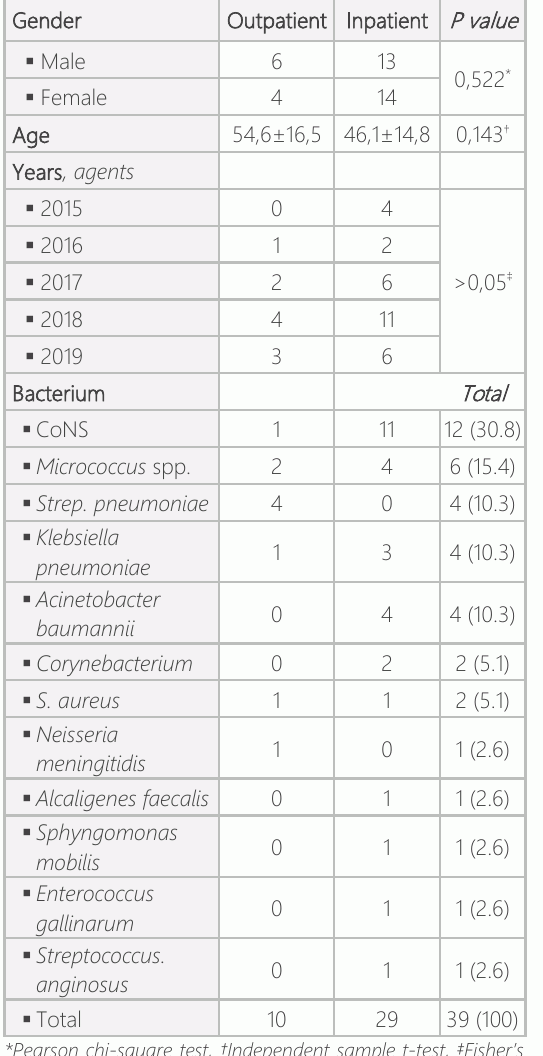
The distribution of agents isolated from inpatient and outpatient clinic patients is given in Table 1. Of the isolates, 14 were isolated from Intensive Care, ten from Neurosurgery, ten from Infection, four from Neurology, and one from patients from the Emergency. Considering the distribution of the factors by years, the most reproduction was in 2018 (n=15), and the lowest was in 2016 (n=3). The distribution of the agents by year is given in Table-1.
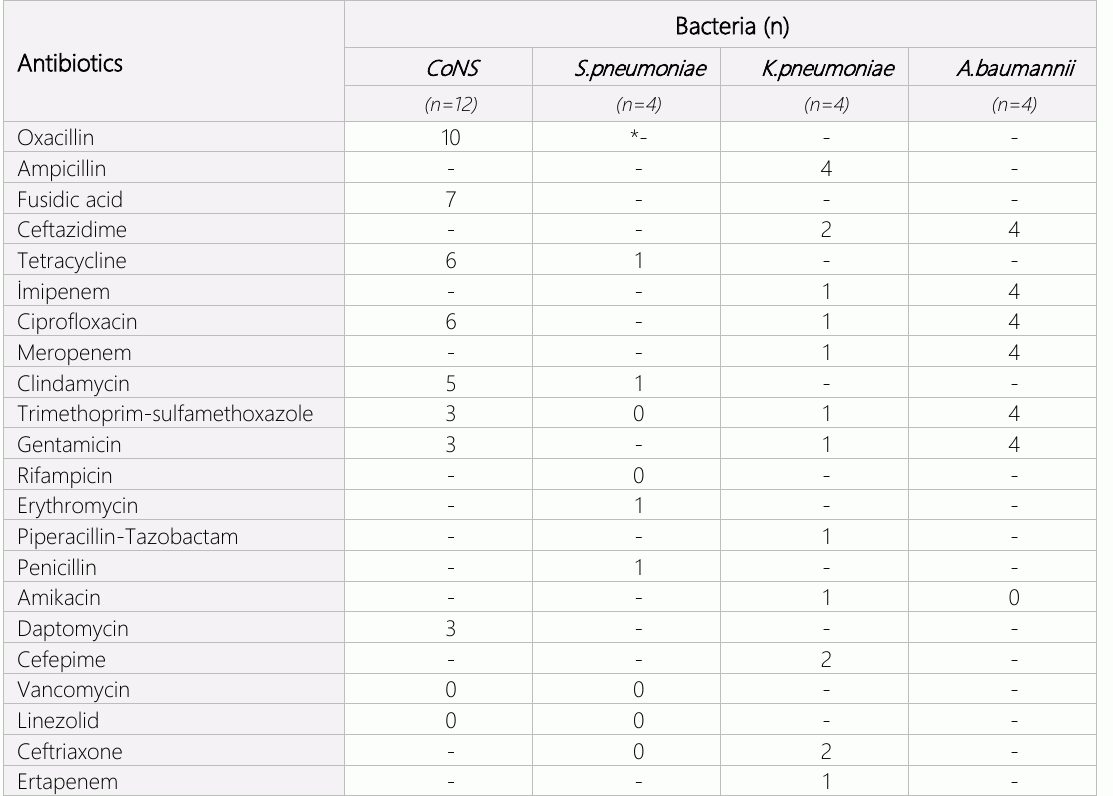
Oxacillin resistance in CoNS was 83.3% (10/12x100). Penicillin resistance was 25% in S. pneumoniae isolates (n=4). Two isolated S. aureus strains were sensitive to oxacillin. The susceptibility of CoNS and S. pneumoniae isolates are shown in Table-2. Micrococcus and Corynebacterium bacteria, two types of CoNS growing in one sample, those antibiotic susceptibility studies were not performed because there was no demand from the clinics. 2 (50%) of K. pneumoniae isolates were positive for extended-spectrum β-lactamase (ESBL), and one (25%) was positive for carbapenemase - carbapenem resistance confirmed by the E-test method. Antibiotics to which K. pneumoniae and A. baumannii isolates are most sensitive are tigecycline and amikacin, respectively (Table-2).
Discussion
In bacterial meningitis, an inflammation of the meninges of the brain, clinical findings such as altered consciousness, headache, fever, and neck stiffness are observed. Bacterial meningitis requires immediate attention (2). The age of the patients, the most common factors in age groups, regional differences of the agents, and antibiotic susceptibility should be considered in the selection of empirical treatment. These data contribute to the increase in the success of the treatment and the earlier and sequela-free recovery of the disease (7).
In our study, 39 bacteria were detected in 37 (30.6%) of 121 CSF sent to our laboratory. 12 of them were CoNS, 6 were Micrococcus spp., 4 were S. pneumoniae, 4 were K. pneumoniae, 4 were A. baumannii, 2 were Coryne-bacterium spp. and 2 are S. aureus. Yanık et al., in their study conducted between 2006-2011, determined the reproduction rate as 7% in 10,632 CSF samples. The most common reproducing agents were CoNS (60.4%), Acinetobacter spp (10.6%), and Enterobacter spp. (9.8%)(3). CoNS, which are found as a flora element in many parts of our body, cause meningitis, especially after surgical applications for the central nervous system, trauma, and shunt applications. In studies, CoNS is generally in the top three, and oxacillin resistance rates are up to 82% (8, 9). Consistent with the literature in our study, CoNS was the most frequently isolated factor, with a rate of 30.8%, and oxacillin resistance was 83.3%.
Micrococci, which can be found as a skin flora element, may rarely cause meningitis in the presence of immunosuppression, catheter, or shunt in the body (10). Micrococci, detected in our study with a rate of 15.4%, were considered skin contamination, and no antibiotic sensitivity was performed. The lack of clinical feedback for these bacteria has increased the likelihood of skin contamination. K. pneumoniae meningitis can spontaneously cause meningitis after head trauma, and after neurosurgical procedures, with the distant spread in patients with liver abscesses. It has been determined that 50-68 % of intensive care patients with diabetes mellitus may be the cause of meningitis (11). Among the agents of postoperative meningitis, the frequency of A. baumanii is relatively high, at 34.8% (12). In our study, K. pneumoniae and A. baumannii, in the first place among Gram-negative agents, were detected at a lower rate (10.3%) than in the literature. Ceftriaxone, cefepime, and meropenem treat meningitis cases caused by enteric bacteria (13). In our study, two of K. pneumoniae isolates (n:4) were ESBL(+), one was resistant to carbapenems, and tigecycline resistance was not found in any isolate by the literature (11). In 2011, Çıkman et al. found tigecycline resistance to be 14 % in Acinetobacter isolates. In our study, tigecycline resistance in A. baumannii isolates was 25%, and it was higher than in the literature (14). In our study, in which we did not find H. influenzae, S. pneumoniae was isolated in four outpatients, and N. meningitidis was isolated in one patient. It has been reported that the most common bacterial meningitis agents in Western countries are S. pneumoniae in adults, and In newborns and children, S. pneumoniae, H. influenzae and N. meningitidis (15). Our rates are lower than the literature may be due to the decrease in the rates of meningitis in childhood and over 65 years of age with the use of the vaccine and the that our youngest patient with reproduction was 22 years (7). N. meningitidis is seen at a rate of 2.5% in adults, which was 2.6% in our study (16). The most commonly used antibiotics in S. pneumoniae meningitis are penicillin and other β-lactam antibiotics. However, increasing resistance worldwide reduces the effect of these antibiotics and increases mortality. There is a linear relationship between the proportion of S. pneumoniae isolates that are not penicillin-susceptible and the use of penicillin in outpatients, and this ratio ranges from 1 to 40% (7, 17). The present study observed penicillin resistance in 25% of S. pneumoniae strains.
Conclusion
Rapid diagnosis and treatment of bacterial meningitis are life-saving. When deciding on early treatment, the differences in regional factors according to age and time and knowing their antibiotic susceptibility are the agents that increase the success of the treatment. As a result, we think the data obtained will contribute to selecting empirical/causative antibiotics and surveillance data.
Declarations
- Author contributions (CRediT)
- All authors contributed equally to all 14 CRediT roles (Conceptualization, Data curation, Formal analysis, Funding acquisition, Investigation, Methodology, Project administration, Resources, Software, Supervision, Validation, Visualization, Writing – original draft, Writing – review & editing).
- Funding
-
Funding information was not reported in the published version of this article.
- Conflicts of interest
- The authors declare no conflict of interest for the present study.
- Ethics approval
- The study was approved by local ethics committee and was carried out following the Declaration of Helsinki Principles (21.07.2020, 08/16).
- Data availability
- A data availability statement was not reported in the published version of this article.
References (17)
11 of 17 references are linked to their DOI.
- Willke Topçu A, Söyletir G, Doğanay M. Enfeksiyon hastalıkları ve mikrobiyolojisi sistemlere göre enfeksiyonlar 3, Baskı, İstanbul: Nobet Tıp Kitabevleri. 2008 PubMed Google Scholar
- Mengistu A, Gaeseb J, Uaaka G, Ndjavera C, Kambyambya K, Indongo L, et al. Antimicrobial sensitivity patterns of cerebrospinal fluid (csf) isolates in namibia: Implications for empirical antibiotic treatment of meningitis, Journal of pharmaceutical policy and practice. 2013; 6(1):1-10 DOI Crossref PubMed Google Scholar
- Yanik K, Yilmaz H, Karadağ A, Ercan Ü, Günaydin M. Nozokomiyal ve toplumsal kökenli menenjit şüpheli hastaların beyin omurilik sıvısı’ndan İzole edilen mikroorganizmalar ve antibiyotik duyarlılıkları, International Journal of Basic and Clinical Medicine. 2014; 2(3):131-37 PubMed Google Scholar
- Duman Y, Yakupoğulları Y, Tekerekoğlu MS, Güçlüer N, Otlu B. Bir üniversite hastanesi laboratuvarında beyin omurilik sıvısı’nda izole edilen mikroorganizmaların üç yıllık geriye dönük analizi, Dicle Tıp Derg. 2012; 39(1):70-4 PubMed Google Scholar
- Pehlİvanoğlu F, Yaşar KK, Şengöz G. Beyin omurilik sivisindan izole edilen mikroorganizmalar ve antibiyotik duyarliliklari, Ankem Derg. 2011; 25(1):1-5 PubMed Google Scholar
- Cusack T, Ashley E, Ling C, Rattanavong S, Roberts T, Turner P, et al. Impact of clsi and eucast breakpoint discrepancies on reporting of antimicrobial susceptibility and amr surveillance, Clinical Microbiology and Infection. 2019; 25(7):910-11 DOI Crossref PubMed Google Scholar
- Mcgill F, Heyderman RS, Panagiotou S, Tunkel AR, Solomon T. Acute bacterial meningitis in adults, The Lancet. 2016; 388(10063):3036-47 DOI Crossref PubMed Google Scholar
- Couffin S, Lobo D, Cook F, Jost P, Bitot V, Birnbaum R, et al. Coagulase-negative staphylococci are associated to the mild inflammatory pattern of healthcare-associated meningitis: A retrospective study, European Journal of Clinical Microbiology & Infectious Diseases. 2018; 37(4):755-63 DOI Crossref PubMed Google Scholar
- Mashaly GE-S, El-Mahdy RH. Vancomycin heteroresistance in coagulase negative staphylococcus blood stream infections from patients of intensive care units in mansoura university hospitals, egypt, Annals of clinical microbiology and antimicrobials. 2017; 16(1):1-5 DOI Crossref PubMed Google Scholar
- Altuntas F, Yildiz O, Eser B, Gündogan K, Sumerkan B, Çetin M. Catheter-related bacteremia due to kocuria rosea in a patient undergoing peripheral blood stem cell transplantation, BMC infectious diseases. 2004; 4(1):1-3 DOI Crossref PubMed Google Scholar
- Ku Y-H, Chuang Y-C, Chen C-C, Lee M-F, Yang Y-C, Tang H-J, et al. Klebsiella pneumoniae isolates from meningitis: Epidemiology, virulence and antibiotic resistance, Scientific reports. 2017; 7(1):1-10 29 77 Cerebrospinal Fluid and Antibiotic Susceptibility Sümeyye Akyüz & Hasan Yaşar DOI Crossref PubMed Google Scholar
- Kurtaran B, Kuşçu F, Ulu A, İnal A, Kömür S, Kibar F, et al. The causes of postoperative meningitis: The comparison of gram-negative and gram-positive pathogens, Turkish neurosurgery. 2018; 28(4) DOI Crossref PubMed Google Scholar
- Uzun Ö, Ünal S, editors.BookGüncel bilgiler ışığında infeksiyon hastalıkları i. Place: Bilimsel Tıp Kitabevi, 2002. pages PubMed Google Scholar
- Çikman A, Parlak M, Gültepe B, Güdücüoğlu H, Berktaş M. Hastane kökenlİ acinetobacter baumannii izolatlarında duyarlılığın e-test yöntemİyle araştirilmasi, ANKEM Derg. 2011; 25(2):79-83 PubMed Google Scholar
- Oordt-Speets AM, Bolijn R, Van Hoorn RC, Bhavsar A, Kyaw MH. Global etiology of bacterial meningitis: A systematic review and meta-analysis, PloS one. 2018; 13(6): e0198772 DOI Crossref PubMed Google Scholar
- Erdem H, Kilic S, Coskun O, Ersoy Y, Cagatay A, Onguru P, et al. Community-acquired acute bacterial meningitis in the elderly in turkey, Clinical microbiology and infection. 2010; 16(8):1223-29. DOI Crossref PubMed Google Scholar
- Dewé TC, D’aeth JC, Croucher NJ. Genomic epidemiology of penicillin-non-susceptible streptococcus pneumoniae, Microbial genomics. 2019;5(10): e000305 DOI Crossref PubMed Google Scholar
Respond to this article
Comments on a published article are welcome as a Letter to the Editor.
Get an e-mail when new articles in your fields are published
Questions to the authors
Questions are moderated: an editor approves each question, the authors answer, and an editor approves the answer before both appear here.
No answered questions yet.
Ask the authors a question
Discussion
Comments are moderated: they appear after the writer confirms the e-mail address and an editor approves them. Each comment carries a conflict-of-interest statement.
No comments yet.
Write a comment
Read the full text
Open the PDF here
Loading the PDF…
If the PDF does not show here, use the download button above.
How to cite this article
Akyuz S, Yasar H. The Agents Isolated from Cerebrospinal Fluid and Antibiotic Susceptibility of Adult Patients in a Training and Research Hospital. Ulutas Med J. 2023;9(1):24-29. doi:10.5455/umj.20221215051347
Akyuz, S., & Yasar, H. (2023). The Agents Isolated from Cerebrospinal Fluid and Antibiotic Susceptibility of Adult Patients in a Training and Research Hospital. The Ulutas Medical Journal, 9(1), 24–29. https://doi.org/10.5455/umj.20221215051347
Akyuz, S. and Yasar, H. (2023) 'The Agents Isolated from Cerebrospinal Fluid and Antibiotic Susceptibility of Adult Patients in a Training and Research Hospital', The Ulutas Medical Journal, 9(1), pp. 24–29. doi: 10.5455/umj.20221215051347.