The Ulutas Medical Journal · ISSN 2149-0430 (print), 2149-388X (online) · https://www.ulutasmedicaljournal.com/?mno=283453
Original Research · Open access
High Preoperative Fibrinogen Level is Closely Associated with Receipt of Chemotherapy and Advanced Disease in Patients with Colorectal Cancer
- Bulent Ecevit University Medical Faculty, Department of Gastroenterology ROR
Abstract
- Background
- There is still lack of a preoperative simple, reliable and non-invasive blood marker predicting the stage of the disease (luminal or extraluminal) and the need for chemotherapy at the time of diagnosis in patients with colorectal cancer (CRC). The study aimed to investigate any relationship between the preoperative fibrinogen level and CRC disease stage as well as the receipt of chemotherapy before surgery.
- Method
- A total 297 CRC patients undergoing surgical resection for any reason (curative or palliative) enrolled in this study. The serum fibrinogen level was calculated in the preoperative period. The need for chemotherapy was assessed by two different expert oncologists. Comparisons were made between the fibrinogen level with disease stage as well as the chemotherapy.
- Results
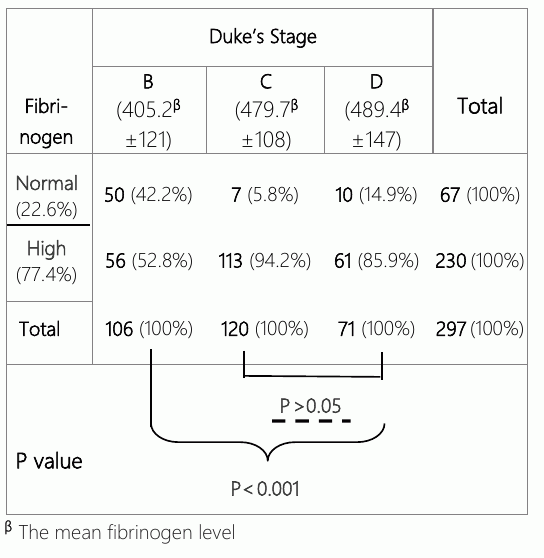
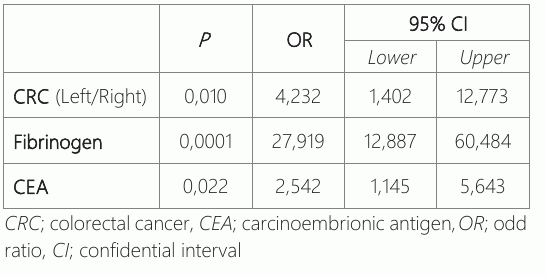
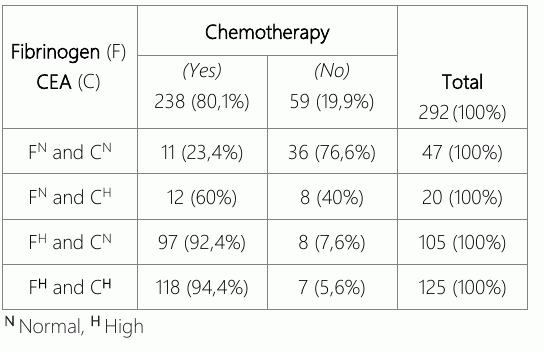
- The mean fibrinogen level was 455±128,5 mg/dL with high level in 77,4% of all CRC patients. The level of fibrinogen in both Duke’s C and D significantly were higher than Duke’s B (p<0,001). High preoperative fibrinogen level had a 27.9-fold increase the risk of receiving chemotherapy (Hazard Ratio:27.9, P<0.0001, 12.8-60.4; 95% C.I). The majority of CRC patients receiving chemotherapy (94,4%) had both high fibrinogen and CEA levels.
- Conclusion
- High preoperative fibrinogen is closely linked with receipt of chemotherapy and advanced disease in patients with CRC. Notable, this association is more prominent when fibrinogen and CEA are both high.
Keywords
Full text
Introduction
Colorectal cancer (CRC) is still a significant clinical problem leading high cancer-related mortality in all over the world countries due to inadequate colonoscopic screening and surveillance program (1). Surgical removal of potentially resectable CRCandadjuvant chemotherapy are mainstay of curative treatment (2). At the time of the CRC diagnosis, the current preoperative evaluators including radiologic, pathologic assessments and blood-markers are unable to measure the actual stage of disease correctly (first: operable or inoperable, second: luminal disease or extraluminal) and need for chemotherapy (pre or postoperative period), especially in a patient without radiologically apparent metastasis. The preoperative measurement of carcinoembryonic antigen (CEA) has been used for many years to predict the prognosis, survival rate, and recurrence, but is a normal range in more than half of CRC patients at the time of diagnosis and has been claimed more frequently not to be a perfect indicator in recent years (3–5). Despite these improvements concerning the host inflammatory response to tumor development and progression in recent years, there is still a lack of a simple, non-invasive and reliable method that accurately measured to disease stage and the need for chemotherapy (6, 7). Consequent-ly, a substantial number of new research has been launched to find a new blood-marker for CRC.
In this context, the association of systemic activation of coagulation factors such as fibrinogen, d-dimer and cancer behaviors such as growth, deep invasion, and distant metastasis has been shown in recent years, mainly arising from the pathway of cancer-related thromboembolic events (8). Fibrinogen, an inflammatory featured major protein that has recently been linked frequently to tumor progression and metastasis as well as mortality in many cancers, seems to be one of the most promising markers in colorectal cancer, but few number of studies have been conducted with itself (9). In preliminary studies, elevated fibrinogen level has been associated with lymph node metastasis in advanced gastric cancer with no serosal invasion (4). Preoperative fibrinogen has been commonly studied in the field of predicting of prognosis, life expectancy and disease recurrence of CRC (9, 10).
Unlike previous studies, our purpose is to investigate any relationship between preoperative fibrinogen level and both tumor stage and the need for chemotherapy in patients with CRC. This paper is the first study to investigate whether high preoperative fibrinogen, a simple, noninvasive and reliable blood test, is associated with receipt of chemotherapy and advanced disease in patients with CRC.
Materials and Methods
A total of 5200 colonoscopic reports were investigated regarding CRC diagnosis retrospectively, from September 2010 to May 2014. Soon after, all medical documents were investigated carefully, and 55 cases with CRC excluded from this study because of insufficient information. A total of 297 patients were eligible for this study. All patients underwent a surgical operation, whether curative or palliative and curative or palliative. Tumor localization and stage were confirmed by radiological, surgical and pathological reports. In the postoperative period, detailed pathological examination, tumor cell type differentiation, depth and lymph node invasion, and immunohistochemistry examination were made by two different pathologists by using modified Astler-Coller's classification (11). The need of chemotherapy was assessed by expert oncological medical council decision via current guidelines. In preoperative period, a CT scan was performed to all patients and the puncture biopsies, if necessary, were made in case of metastatic disease suspicion. The preoperative fibrinogen samples were taken in the early morning of surgery and were measured by the Clauss standard method with bovine thrombin. The reasons that may affect the levels of fibrinogen such as chronic inflammation, hematological diseases were also investigated by a medical report and detailed physical examination in living patients. All participants signed the informed consent form. The local ethics committee approved this study via number 245-36589. Statical analyses were made by SPSS 15 software (SPSS, Chicago, IL), p<0,05 was accepted as statistically significant.
Results
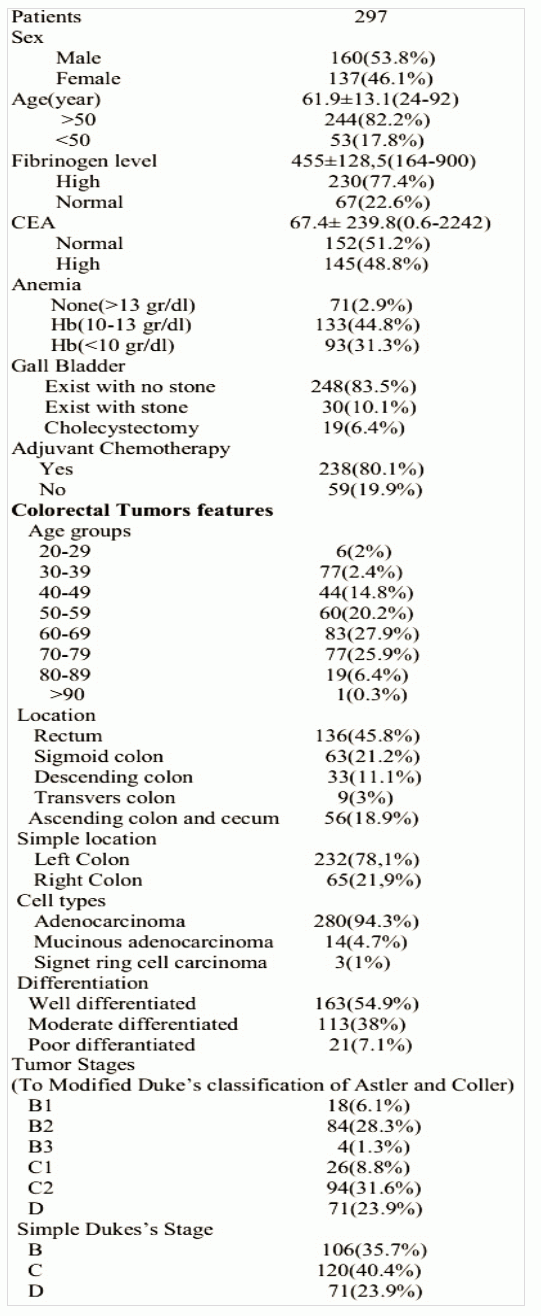
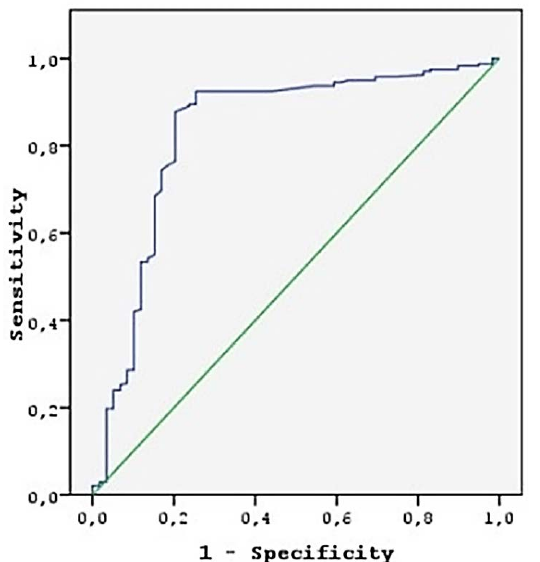
The comprehensive demographic data of this study are shown in Table-1. Some of the most notable findings are briefly summarized as below. The mean age of CRC patients was 61.9±13.1 (24-92) with slightly male 160 (53.8%) dominant feature, and most of the patients were over the age of fifty 244 (82.2%). Anemia was seen 97.1% of all patient with most commonly as mild-type (HB:10-13 mg (44.8%) anemia. The most cited of the tumor was rectum (45.8%), and the left-side CRC (described as between rectum and splenic flexure) was significantly common than right-side CRC (described as between distal transverse colon and cecum) (78.1%/21.9%, p<0,001). The mean fibrinogen levels of Duke’s C (479.7) and Duke’s D (489.4) were significantly higher than Duke’s B (405.2) (p<0,001) (Table-2). According to Cox logistic regression analyze, the most critical factors affecting the status of chemotherapy were tumor location (left or right), high fibrinogen and CEA leves (Table-3). The risk of receipt of chemotherapy increased 27.9 times in patients with high fibrinogen level (Hazard ratio:27.9; p<0,001; 12.8-60.4; CI 95%) (Table-3). Approxi-mately 95% of CRC patients with high fibrinogen and CEA levels received chemotherapy (Table-4). The optimal cut-off of preoperative fibrinogen level regarding advan-ced disease stage (Duke’s C and D) and the need for chemotherapy was analyzes with receiver operating characteristic (ROC) curve that demonstrated a 361.5 mg/dL level had an 88% sensitivity and 80% specificity, area under curve=0.84 (Figure-1).
Discussion
Unlike the previous studies, to best of our knowledge, this study is the first report to investigate the relationship between serum fibrinogen and both disease stage (limited to luminal or extra-luminal) and especially the need for chemotherapy in patients with CRC. The most critical finding we found in this study is that high preoperative fibrinogen level is greatly associated with receipt of chemotherapy and advanced disease stage. Notably, this association is more prominent when both fibrinogen and CEA are high together. Again firstly, we have found that high fibrinogen level increases 27.9 fold the risk of receiving chemotherapy with 95% confidence interval. We have also determined a cut-off level for preoperative serum fibrinogen (361.5 mg/dL) that is highly associated with advanced stage and high risk of chemotherapy.
Up to now, the pre and postoperative CEA measurements have still been used for CRC patients evaluation. However, it is detected at the normal limit in two-thirds of the patients with CRC, and also is influenced by many benign factors, such as pregnancy, smoking, and intra-abdominal inflammatory events(12). After understanding the low value of the potential use of CEA in the evaluation of colorectal cancer patients, the search for new tumor markers has begun to gain a big momentum in recent years (5, 10).
With increased knowledge about the mechanisms of molecular pathways of CRC growth, deep invasion, and extended metastasis that is commonly known as hematologic, the new relationship between coagulation factors and cancer behaviors has increasingly been the subject of lots of cornerstone manuscript in recent years (13, 14). Of these, especially fibrin-related products are frequently associated with advanced disease, prognosis and cancer-related venous thromboembolism (6, 15–17). Also, it is shown that these factors show dynamic changes during anti-tumor treatment (8, 18). The determination of the effect of these factors on colon cancer growth and spread is very striking finding. From these factors, the fibrinogen is now being considered a major determinant of colon cancer growth and dissemination (7). In all previous studies, the significance of preoperative fibrinogen is often studied mainly regarding a predictor of therapeutic response, prognostic value, and survival rate in patients with CRC (3, 18–21). High preoperative fibrinogen is often associated with advanced disease stage, poor tumor differentiation, more deep invasion and lymph node metastasis (9, 22). Up to now, there is no a unique study investigating the relationship between preoperative fibrinogen and receipt of chemotherapy.
Apart from other studies, in this paper, we studied the relationship between preoperative fibrinogen and the receipt of chemotherapy as well as disease stage. As in previous studies, we firstly found that high preoperative fibrinogen correlates with advanced stage. Our second finding, high preoperative fibrinogen is greatly associated with receipt of chemotherapy, has not been investigated before. We also determined a useful cut-off level for preoperative fibrinogen with high sensitivity and specificity.
Conclusion
Despite the improvements in the field of tumor growth, development and metastasis pathways in recent years, there is still a lack of a simple, non-invasive and reliable method that accurately measured to disease stage and the need for chemotherapy. Our study revealed some new information to clinicians and a patient who has a new CRC diagnosis at the time of diagnosis. If a patient with CRC has high preoperative fibrinogen and CEA, this patient is most probably advanced disease (extraluminal) and will high probably receipt chemotherapy.
Declarations
- Author contributions (CRediT)
- All authors contributed equally to all 14 CRediT roles (Conceptualization, Data curation, Formal analysis, Funding acquisition, Investigation, Methodology, Project administration, Resources, Software, Supervision, Validation, Visualization, Writing – original draft, Writing – review & editing).
- Funding
-
There is no conflict of interest and financial support for the study.
- Conflicts of interest
- There is no conflict of interest and financial support for the study.
- Ethics approval
- Ethics approval details were not reported in the published version of this article.
- Data availability
- A data availability statement was not reported in the published version of this article.
References (22)
21 of 22 references are linked to their DOI.
- Lin CC, Bruinooge SS, Kirkwood MK, Olsen C, Jemal A, Bajorin D, et al. Association Between Geographic Access to Cancer Care, Insurance, and Receipt of Chemotherapy: Geographic Distribution of Oncologists and Travel Distance. J Clin Oncol. 2015;33(28):3177-85. Fibrinogen In Colorectal Cancer Patients Akar, et al. DOI Crossref PubMed Google Scholar
- Vogel JD, Eskicioglu C, Weiser MR, Feingold DL, Steele SR. The American Society of Colon and Rectal Surgeons Clinical Practice Guidelines for the Treatment of Colon Cancer. Dis Colon Rectum. 2017;60(10):999-1017. DOI Crossref PubMed Google Scholar
- Yamashita H, Kitayama J, Taguri M, Nagawa H. Effect of preoperative hyperfibrinogenemia on recurrence of colorectal cancer without a systemic inflammatory response. World J Surg. 2009;33(6):1298-305. DOI Crossref PubMed Google Scholar
- Yamashita H, Kitayama J, Kanno N, Yatomi Y, Nagawa H. Hyperfibrinogenemia is associated with lymphatic as well as hematogenous metastasis and worse clinical outcome in T2 gastric cancer. BMC Cancer. 2006;6:147. DOI Crossref PubMed Google Scholar
- Becerra AZ, Probst CP, Tejani MA, Aquina CT, González MG, Hensley BJ, et al. Evaluating the Prognostic Role of Elevated Preoperative Carcinoembryonic Antigen Levels in Colon Cancer Patients: Results from the National Cancer Database. Ann Surg Oncol. 2016;23(5):1554-61. DOI Crossref PubMed Google Scholar
- Kołodziejczyk J, Ponczek MB. The role of fibrinogen, fibrin and fibrin(ogen) degradation products (FDPs) in tumor progression. Contemp Oncol (Pozn). 2013;17(2):113 -9. DOI Crossref PubMed Google Scholar
- Adams GN, Rosenfeldt L, Frederick M, Miller W, Waltz D, Kombrinck K, et al. Colon Cancer Growth and Dissemination Relies upon Thrombin, Stromal PAR-1, and Fibrinogen. Cancer Res. 2015;75(19):4235-43. DOI Crossref PubMed Google Scholar
- Reitter EM, Kaider A, Ay C, Quehenberger P, Marosi C, Zielinski C, et al. Longitudinal analysis of hemostasis biomarkers in cancer patients during antitumor treatment. J Thromb Haemost. 2016;14(2):294-305. DOI Crossref PubMed Google Scholar
- Sun ZQ, Han XN, Wang HJ, Tang Y, Zhao ZL, Qu YL, et al. Prognostic significance of preoperative fibrinogen in patients with colon cancer. World J Gastroenterol. 2014;20(26):8583-91. DOI Crossref PubMed Google Scholar
- Perisanidis C, Psyrri A, Cohen EE, Engelmann J, Heinze G, Perisanidis B, et al. Prognostic role of pretreatment plasma fibrinogen in patients with solid tumors: A systematic review and meta-analysis. Cancer Treat Rev. 2015;41(10):960-70. DOI Crossref PubMed Google Scholar
- Web Page 2017 [Available from: https://www.medscape.com /viewarticle/439788_5. PubMed Google Scholar
- Liska V, Treska V, Skalicky T, Fichtl J, Bruha J, Vycital O, et al. Evaluation of Tumor Markers and Their Impact on Prognosis in Gallbladder, Bile Duct and Cholangiocellular Carcinomas - A Pilot Study. Anticancer Res. 2017;37(4):2003-9. DOI Crossref PubMed Google Scholar
- Lee S, Huh SJ, Oh SY, Koh MS, Kim SH, Lee JH, et al. Clinical significance of coagulation factors in operable colorectal cancer. Oncol Lett. 2017;13(6):4669-74. DOI Crossref PubMed Google Scholar
- Battistelli S, Stefanoni M, Lorenzi B, Dell'avanzato R, Varrone F, Pascucci A, et al. Coagulation factor levels in non-metastatic colorectal cancer patients. Int J Biol Markers. 2008;23(1):36-41. DOI Crossref PubMed Google Scholar
- Yamashita Y, Wada H, Nomura H, Mizuno T, Saito K, Yamada N, et al. Elevated fibrin-related markers in patients with malignant diseases frequently associated with disseminated intravascular coagulation and venous thromboembolism. Intern Med. 2014;53(5):413-9. DOI Crossref PubMed Google Scholar
- Kilic L, Yildiz I, Sen FK, Erdem MG, Serilmez M, Keskin S, et al. D-dimer and international normalized ratio (INR) are correlated with tumor markers and disease stage in colorectal cancer patients. Cancer Biomark. 2015;15(4):405 -11. DOI Crossref PubMed Google Scholar
- Son HJ, Park JW, Chang HJ, Kim DY, Kim BC, Kim SY, et al. Preoperative plasma hyperfibrinogenemia is predictive of poor prognosis in patients with nonmetastatic colon cancer. Ann Surg Oncol. 2013;20(9):2908-13. DOI Crossref PubMed Google Scholar
- Kawai K, Kitayama J, Tsuno NH, Sunami E, Nagawa H. Hyperfibrinogenemia after preoperative chemoradiotherapy predicts poor response and poor prognosis in rectal cancer. Int J Colorectal Dis. 2011;26(1):45-51. DOI Crossref PubMed Google Scholar
- Lee JH, Hyun JH, Kim DY, Yoo BC, Park JW, Kim SY, et al. The role of fibrinogen as a predictor in preoperative chemo radiation for rectal cancer. Ann Surg Oncol. 2015;22(1):209-15. DOI Crossref PubMed Google Scholar
- Motavaf E, Sunesen KG, Stender MT, Thorlacius-Ussing O. Prognostic value of preoperative D-dimer and carcinoem bryonic antigen levels in patients undergoing intended curative resection for colorectal cancer: a prospective cohort study. Int J Colorectal Dis. 2014;29(11):1427-32. DOI Crossref PubMed Google Scholar
- Lu K, Zhu Y, Sheng L, Liu L, Shen L, Wei Q. Serum fibrinogen level predicts the therapeutic response and prognosis in patients with locally advanced rectal cancer. Hepatogastro enterology. 2011;58(110-111):1507-10. DOI Crossref PubMed Google Scholar
- Rasic I, Radovic S, Aksamija G. Relationship Between Chronic Inflammation and the Stage and Histopathological Size of Colorectal Carcinoma. Med Arch. 2016;70(2):104-7. DOI Crossref PubMed Google Scholar
Respond to this article
Comments on a published article are welcome as a Letter to the Editor.
Get an e-mail when new articles in your fields are published
Questions to the authors
Questions are moderated: an editor approves each question, the authors answer, and an editor approves the answer before both appear here.
No answered questions yet.
Ask the authors a question
Discussion
Comments are moderated: they appear after the writer confirms the e-mail address and an editor approves them. Each comment carries a conflict-of-interest statement.
No comments yet.
Write a comment
Read the full text
Open the PDF here
Loading the PDF…
If the PDF does not show here, use the download button above.
How to cite this article
Akar T. High Preoperative Fibrinogen Level is Closely Associated with Receipt of Chemotherapy and Advanced Disease in Patients with Colorectal Cancer. Ulutas Med J. 2017;3(4):72-77. doi:10.5455/umj.20171115091720
Akar, T. (2017). High Preoperative Fibrinogen Level is Closely Associated with Receipt of Chemotherapy and Advanced Disease in Patients with Colorectal Cancer. The Ulutas Medical Journal, 3(4), 72–77. https://doi.org/10.5455/umj.20171115091720
Akar, T. (2017) 'High Preoperative Fibrinogen Level is Closely Associated with Receipt of Chemotherapy and Advanced Disease in Patients with Colorectal Cancer', The Ulutas Medical Journal, 3(4), pp. 72–77. doi: 10.5455/umj.20171115091720.