The Ulutas Medical Journal · ISSN 2149-0430 (print), 2149-388X (online) · https://www.ulutasmedicaljournal.com/?mno=187358
Case Report · Open access
A Case of Chickenpox with Complication of Cellulites Leading to Respiratory Distress
Also available in: العربية · Türkçe · 中文
- Department of Pediatric, Şevket Yılmaz Training and Research Hospital, Bursa, Turkey ROR
- Department of Pediatric Intensive Care Unit, Dörtçelik Children's Hospital, Bursa, Turkey ROR
- Department of Radiology, Dörtçelik Children's Hospital, Bursa, Turkey ROR
Abstract
Chickenpox is a common disease worldwide caused by the Varicella Zoster Virus (VZV) as a causative agent with a prominent contagious property causing severe itching and rash. The secondary viremia results in itching skin lesions. Forming an entrance gate, these vesicles lead to secondary infections. A 15 months old male infant, referred to the emergency ward with swollen neck and skin rash throughout the body, was admitted to the Pediatric Intensive Care Unit. Respiratory rate was 26/min, body temperature was 37oC, and pulse was 132/min. Pathological examination findings were facial edema and edematous neck and diffuse rash. No abnormal laboratory findings other than anemia and elevated CRP were found. The patient was diagnosed with secondary bacterial infection - cellulite. The respiratory distress was associated with the edema resulting from the infection. We presented the case of cellulite that was advanced to an extent to cause respiratory problems following the itchy vesicle. Measures to be taken for children as the carriers of the disease can be listed as local antiseptic applications, antihistaminic to prevent itching and avoidance of non-steroidal anti-inflammatory (NSAI) administration. We wanted to remind that taking simple measures could reduce the secondary bacterial complications of the commonly encountered disease.
Keywords
Full text
Introduction
Varicella Zoster Virus (VZV) from the herpes family of viruses is the causative agent for Chickenpox and Herpes zoster or Shingles. The disease is often characterized by fever, vesicular rash that causes diffuse itching in children, usually a moderate progression and a highly contagious nature (1). Since the disease is transmitted by contact and air, it is especially common to an equal extent in both, males and females during the initial years of kindergarten and school across the globe (2). 80 to 90% of the individuals known to be sensitive become ill with the clinical findings after contact with chickenpox that is highly contagious (3).
While the body temperature is slightly elevated during both the prodromal term and the early stages of the disease, fever higher than 39°C is also detected frequently. The lesions start at the scalp and progress in line with gravity, eventually spreading across the face and body (1). The clear fluid inside the highly itching lesions becomes remarkably blurry during the initial 24-48 hours in particular while the center of the vesicle becomes slightly collapsed and onset of infestation is seen with umbilication. These lesions can be identified at different stages simultaneously.
Chickenpox lesions can be frequently seen in the form of small ulcers on the mucous surfaces (such as the oropharynx, conjunctiva and vagina, etc.) (1, 2). While more intensive during the initial days, new lesions continue to appear until day seven in healthy individuals (1, 4). Secondary bacterial infections are the most frequent issues encountered in healthy individuals. Such infections where Staphilococcus aureus and Streptococcus pyogenes (S. pyogenes) are active may result in the development of scars despite appropriate treatments (1). Cellulitis is frequently among the secondary bacterial infections of the skin, and lymphadenitis and subcutaneous abscesses may also develop on rare occasions. In addition, with the gained importance of the life-threatening varicella gangrenosa, exotoxin A-producing S. pyogenes during the recent years, other infections of the subcutaneous tissue and necrotizing fasciitis in particular, can be also encountered following chickenpox (5).
Case Presentation
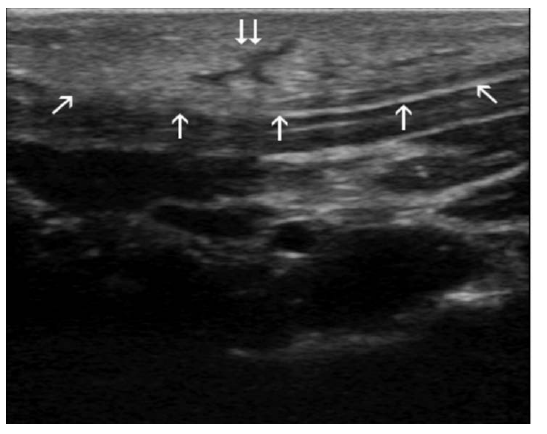
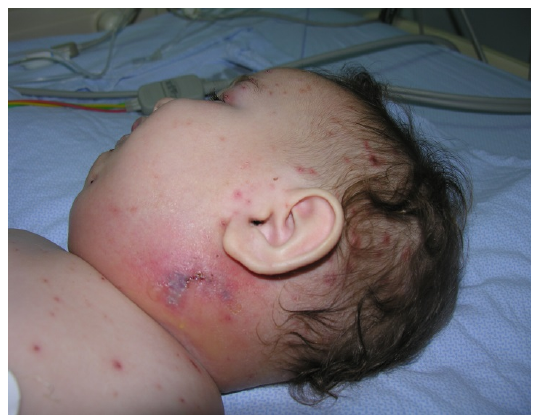
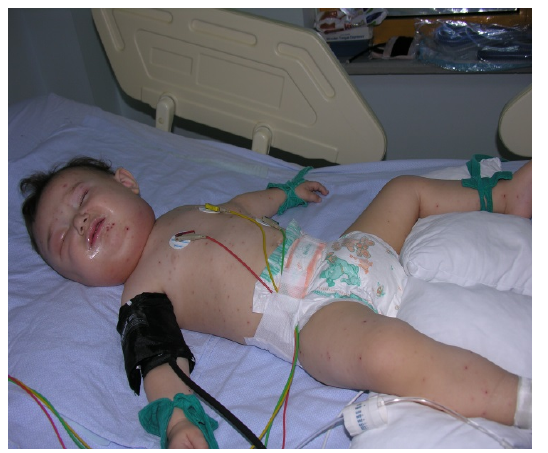
The 15 months old male patient who had no previous complaints developed body rash and itching 3 days before referral. The patient, who scratched his rash, developed a swollen neck in the morning of referral and he was taken to our Pediatric Emergency Ward for these complaints. The examination resulted a medium general condition, a body temperature at 37oC, pulse at 132/min, respiratory count 26/min, facial and neck edema, diffuse lymphadenomegaly in the neck, and infested papillovesicular rash throughout the body (Figure-1). There was an ulcerous necrotic lesion in the region concordant to the left mandibular angulus (Figure-2). Recurrent blood gas follow-up of the patient who suffered respiratory distress did not reveal any pathology other than borderline low SO2 (Day 1 89%, day 2 86% and day 3 85%). Laboratory examinations did not identify any pathology than anemia associated with iron deficiency, elevated sedimentation (64mm/h) and CRP (13.1mg/dl). Since neither the physical examination of the respiratory tract, nor the lung radiographies yielded any pathology, the respiratory problem was associated with the effect of edema and compression. Lesion culture and direct analysis results were concordant with S. pyogenes. The daily USG examinations did not reveal any pathology other than submandibular and cervical lymphadenomegaly, and inflammation and edema of the subcutaneous tissue (Figure-3).
The patient diagnosed secondary bacterial infection cellulite, received antibiotic therapy concordant with antibiogram, O2 support, and antiviral therapy. On day four of hospitalization, the patient was referred to the third stage center specialized in Pediatric Infections. It was reported that while his treatment was in progress at the institution, the patient developed fistule abscess on the skin. He received plastic surgery intervention.
The patient whose treatment was continued was reported for recession of the signs of edema and lymphadenopathy, and his rash had improved on day 14 of hospitalization.
Discussion
Skin infections secondary to VZV infections are not uncommon (6). Culture results of these cases often present S. pyogenes (1, 6). The patient in follow-up was diagnosed with S. pyogenes bacteria reproducing in culture and cellulite. Complications that are usually frequent and cause respiratory difficulties in patients recovered of chickenpox are pathologies that relate to the lungs (6). However, the respiratory distress suffered by our patient was not lung pathology but the subcutaneous inflammation and edema caused by the secondary bacterial infection.
There is no doubt that preventing chickenpox infection would also prevent secondary bacterial infections. Both, a patient cost and benefit analysis has been performed in this regard, and vaccine applications have been found beneficial (7).
Secondary bacterial infections developed by the pediatric patients in spite of vaccination or those in countries where vaccines are unavailable are a life threatening risk factor (1). Measures to be taken for children as the carriers of the disease can be listed as local antiseptic applications, antihistaminic to prevent itching and avoidance of non-steroidal anti inflammatory (NSAI) administration (6–9). Except for the avoidance of NSAI use, no measures were taken for our patient.
Conclusion
Widespread vaccination programs and the few simple measures described above for individuals who had developed the disease should be particularly initiated in order to avoid secondary bacterial infections that might be fatal.
Declarations
- Author contributions (CRediT)
- All authors contributed equally to all 14 CRediT roles (Conceptualization, Data curation, Formal analysis, Funding acquisition, Investigation, Methodology, Project administration, Resources, Software, Supervision, Validation, Visualization, Writing – original draft, Writing – review & editing).
- Funding
-
Funding information was not reported in the published version of this article.
- Conflicts of interest
- The authors declare that no conflict of interest exists in publishing this article.
- Ethics approval
- Ethics approval details were not reported in the published version of this article.
- Data availability
- A data availability statement was not reported in the published version of this article.
References (9)
7 of 9 references are linked to their DOI.
- Gershon AA. Varicella zoster virus. In: Feigin RD, Cherry JD, eds. Tex tbook of pediatric Infectious Diseases. 4th ed. Philadelphia: WB Saunders, 1998: 1769-77. PubMed Google Scholar
- Seward JF. Update on varicella. Pediatr Infect Dis J 2001; 20: 619-621. DOI Crossref PubMed Google Scholar
- CDC. Preventetion of varicella: update recommendations of the Advisory Committee on Immunization Practices (ACIP). MMMR 1999; 48 (No. RR-6). DOI Crossref PubMed Google Scholar
- Drwal-Klein LA, O'Donovan CA. Varicella in pediatric patients. Ann Pharmacother 1993; 27:938-49. DOI Crossref PubMed Google Scholar
- Vugia DJ, Peterson CL, Meyers HB, et al. Invasive group A streptococcal infections in children with varicella in southern California. Pediatr İnfect Dis J 1996; 15:146-50. DOI Crossref PubMed Google Scholar
- Külcü NU, Değirmenci S, Güven F, Sezer RG, Sabuncu TA, Say A. Chicken pox and Complications: Zeynep Kamil Hospital Experience. J Pediatr Inf 2011; 5 (Suppl 1): 267-93 PubMed Google Scholar
- Dinleyici EC, Kurugol Z, Turel O, e t al. The epidemiology and economic impact of varicella-related hospitalizations in Turkey from 2008 to 2010: a nationwide survey during the pre-vaccine era (VARICOMP). Eur J Pediatr. 2012 May;171(5): 817-25. DOI Crossref PubMed Google Scholar
- Fleisher G, Henry W, McSorley M, Arbeter A, Plotkin S. Life-threatening complications of varicella. Am J Dis Child. 1981 Oct;135(10):896-9. DOI Crossref PubMed Google Scholar
- Dubos F, Hue V, Grandbastien B, et al. Bacterial skin infections in children hospitalized with varicella: a possible negative impact of non-steroidal anti-inflammatory drugs? Acta Derm Venereol. 2008;88(1):26-30. DOI Crossref PubMed Google Scholar
Respond to this article
Comments on a published article are welcome as a Letter to the Editor.
Get an e-mail when new articles in your fields are published
Questions to the authors
Questions are moderated: an editor approves each question, the authors answer, and an editor approves the answer before both appear here.
No answered questions yet.
Ask the authors a question
Discussion
Comments are moderated: they appear after the writer confirms the e-mail address and an editor approves them. Each comment carries a conflict-of-interest statement.
No comments yet.
Write a comment
Tell me when this article is cited
Leave your e-mail address and confirm it. These notices are not being sent yet; your confirmed address is kept for them and used for nothing else.
Read the full text
Open the PDF here
Loading the PDF…
If the PDF does not show here, use the download button above.
How to cite this article
Tutanc M, Dorum BA, Senyurt M, Yildiz H. A Case of Chickenpox with Complication of Cellulites Leading to Respiratory Distress. Ulutas Med J. 2015;1(2):47-49. doi:10.5455/umj.20150511024108
Tutanc, M., Dorum, B. A., Senyurt, M., & Yildiz, H. (2015). A Case of Chickenpox with Complication of Cellulites Leading to Respiratory Distress. The Ulutas Medical Journal, 1(2), 47–49. https://doi.org/10.5455/umj.20150511024108
Tutanc, M. et al. (2015) 'A Case of Chickenpox with Complication of Cellulites Leading to Respiratory Distress', The Ulutas Medical Journal, 1(2), pp. 47–49. doi: 10.5455/umj.20150511024108.
@article{umj187358,
  title = {A Case of Chickenpox with Complication of Cellulites Leading to Respiratory Distress},
  author = {Tutanc, Murat and Dorum, Bayram Ali and Senyurt, Mustafa and Yildiz, Harun},
  journal = {The Ulutas Medical Journal},
  year = {2015},
  volume = {1},
  number = {2},
  pages = {47--49},
  doi = {10.5455/umj.20150511024108},
  url = {https://www.ulutasmedicaljournal.com/?mno=187358},
  issn = {2149-388X}
}