The Ulutas Medical Journal · ISSN 2149-0430 (print), 2149-388X (online) · https://www.ulutasmedicaljournal.com/?mno=219681
Case Report · Open access
A Multiple Sclerosis Case Presenting Mixed State Bipolar Affective Disorder as Initial Sign
- Department of Psychiatry, Kilis State Hospital, Kilis, Turkey ROR
Abstract
- Introduction
- Multiple sclerosis (MS) is a chronic, progressive, inflammatory and demyelinating disease of the central nervous system that commonly affects young adults and which may lead to various physical disabilities. It has been reported that bipolar disorder is twice more common among MS patients compared to the normal population. The comorbidity of MS and bipolar disorder, which has not been sufficiently studied until now, is a relatively common state. A variety of mechanisms have been proposed to explain this comorbidity. It has been suggested that bipolar disorder in MS patients may be a sign of the disease, a concurrently diagnosed condition, or a side effect of the drugs (such as corticosteroids) used for therapeutic purposes.
- Conclusion
- The aim of this manuscript was to describe a case of multiple sclerosis that presented mixed state bipolar affective disorder as its initial sign, and to discuss this case in light of the literature.
Keywords
Full text
Introduction
Multiple sclerosis (MS) is a chronic, progressive, inflammatory and demyelinating disease of the central nervous system that frequently affects young adults, and which may lead to various physical disabilities (1). MS is associated not only with physical and neurological problems, but also with problems relating to the individual’s mental health and quality of life. The overall lifelong prevalence of mental disorders in the patients with MS was found to be higher than in controls by 66%, and it has been reported that about four-fifths of individuals with MS have at least a mental/psychological sign, which are primarily anxiety and depression (2, 3). It is reported that 40% of MS patients have a mood disorder at the time of admission to neurology clinic, and that major depression is the most common mental disorder in cases with MS, with overall life prevalence of 40%-50% (4, 5). It has also been reported that bipolar affective disorder (BAD) is twice more common among MS patients compared to the normal population (6). The comorbidity of MS and BAD, which has not been sufficiently studied until now, is commonly observed condition, and various mechanisms have been proposed to explain it. It has been suggested that BAD in MS patients may be a sign of the disease (6, 7), a concurrently diagnosed condition (8), or a side effect of the drugs (such as corticosteroids) used for therapeutic reasons. The aim of this manuscript was to describe a case of multiple sclerosis that presented mixed state bipolar affective disorder as its initial sign, and to discuss this case in light of the literature.
Case Presentation
Mrs. C.A. is 31 years old, married, and an elementary school graduate. Her complaints have been persisting for two months, and she admitted to our outpatient clinic with complaints of headache, dizziness, sudden episodes of laughing and crying, nervousness, weakness, fatigue, reduced sleeping time, disturbance, increased libido, unhappiness, and periods of discomfort or euphoria, which had especially intensified within the last one week. Her mental examination did not reveal hallucinations or delusions, while affective lability and irritability were predominating. Her neurological examination did not reveal any pathologies. There were no psychiatric or neurological diseases or drug use in her personal and family history. Routine blood tests were within normal limits.
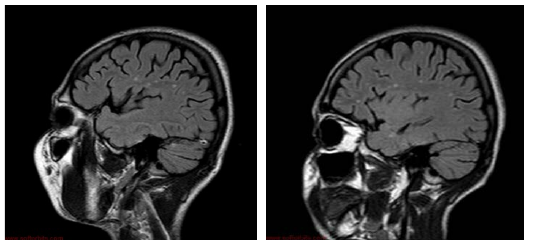
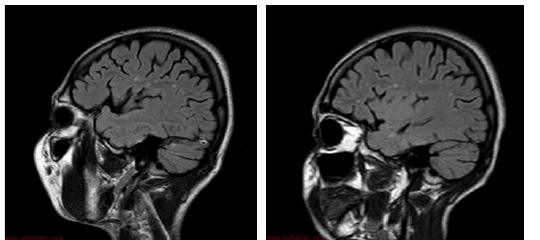
Electroencephalogram test results were also within normal limits. Results of the brain magnetic resonance imaging revealed numerous hyperintense foci in the frontal lobe and bilateral periventricular areas, which were more extensive especially in the subcortical regions. Following intravenous injection of contrast material, no pattern of pathological contrast enhancement was visualised (Figure-1 and Figure-2). Based on the DSM-4 diagnostic criteria, the patient was diagnosed with mixed state BAD and comorbid MS. The patient was started on a treatment of carbamazepine 400 mg/day and amisulpride 400 mg/day. She is still being followed-up at regular intervals at outpatient clinic, with no BAD or MS episode being observed in one-year clinical follow-up.
Discussion
Similarly to other diseases involving the central nervous system, demyelinating diseases may trigger almost any type of psychiatric disorder. While the comorbidity of MS and depressive (9) or manic (6, 7) period BAD is frequently observed, comorbidity with mixed state BAD is far less common. We consider our case important, in that she was a mixed state BAD patient. The mechanism explaining the comorbidity of MS and BAD has not been fully elucidated or sufficiently investigated. There are various studies reporting that, depending on the anatomical region involved, BAD may be the first sign of MS prior the appearance of neurological signs, and that these two diseases might stem from a common genetic cause (6). In a study conducted with 56 MS patients, major mood disorders were identified in 31 (approximately 55%) of the cases, about 87% (n:27) of whom were female. It was also concluded that gender and genetic factors such as HLA-DR antigens are associated with the affective signs in MS (9). Our case was in line with the literature in that she was female and had a comorbidity of MS and BAD. Furthermore, transcriptome studies on BAD indicate abnormal bioenergetic function, myelin sheath defects and increased immune system activity in BAD. This triad of pathological anomalies is also the focus of MS studies (10). We consider that this aspect is important regarding the comorbidity of two diseases. Especially in MS patients with lesions located in frontal lobe due to demyelinated foci, a nonsignificant provocation may lead to laughing and crying independently of the patient’s affective state. This was also observed in our case, who easily exhibited episodes of laughing and crying. In the series of Pratt, laughing easily and crying easily are described in 22% and 29% of MS patients, respectively, from the onset of disease (11, 12). As observed with this case, MS patients may exhibit emotional lability and exaggerated emotional expression; Langworthy et al. reported that this association is observed in 7 to 10% of the patients (11). It is noted that exaggerated emotional expressions as well as laughing and crying easily might be due to a lack of communication between the centers associated with emotions (12). In other words, demyelinated foci in MS patients may lead to signs such emotional lability and improper laughing-crying that are considered to be related with the pathologies of frontal lobe, without causing an evident mood disorder (13). If this is not taken into consideration during diagnosis, exaggerated emotional expression and improper laughing-crying might be confused with mania or depression, or they might present as a mixed state bipolar affective disorder or a comorbid BAD, as was the case with our patient.
In conclusion; it is important to bear in mind that in patients admitted for signs of BAD, it is essential to use neuro-visualisation methods in addition to detailed patient history and physical examination findings if clinical neuropsychiatric signs are present; and that the treatment and course of BAD may vary depending on the existing concurrent neurological disease.
Declarations
- Author contributions (CRediT)
- All authors contributed equally to all 14 CRediT roles (Conceptualization, Data curation, Formal analysis, Funding acquisition, Investigation, Methodology, Project administration, Resources, Software, Supervision, Validation, Visualization, Writing – original draft, Writing – review & editing).
- Funding
-
Funding information was not reported in the published version of this article.
- Conflicts of interest
- A conflict of interest statement was not reported in the published version of this article.
- Ethics approval
- Ethics approval details were not reported in the published version of this article.
- Data availability
- A data availability statement was not reported in the published version of this article.
References (13)
8 of 13 references are linked to their DOI.
- Childs 1.Gilroy JM. Basic Neurology. 3th ed. Mc Graw Hill 2000; 199-224. PubMed Google Scholar
- Figved N, Klevan G, et al. Neuropsychiatric symptoms in patients with multiple sclerosis. Acta PsychiatrScand 2005;112:463-8. DOI Crossref PubMed Google Scholar
- Galeazzi GM, Ferrari S, Giaroli G, et al. Psychiatric disorders and depression in multiple sclerosis out patients: impact of disabilityand interferon-beta therapy. NeurolSci 2005; 26:255-62. DOI Crossref PubMed Google Scholar
- Uguz F, Akpinar Z, Ozkan I, Tokgoz S. Mood and anxiety disorders in patients with multiple sclerosis. Int J Psychiatry Clin Pract 2008; 12:19-24. DOI Crossref PubMed Google Scholar
- Siegert RJ, Abernethy DA. Depression in multiple sclerosis: a review. J Neurol Neurosurg Psychiatry 2005; 76:469-75. DOI Crossref PubMed Google Scholar
- Oral ET, Yalçıner B, Karadağ F, Sarı H, Verimli A. Monopolar Mania and/or Multiple Sclerosis: A case report. Düşünen Adam. 1994; 7:30-3. PubMed Google Scholar
- Heila H, Turpeinen P, Erkinjuntti T. Case study: mania associated with multiple sclerosis. J Am Acad Child Adolesc Psychiatry. 1995; 34:1591-5. DOI Crossref PubMed Google Scholar
- Ybarra MI, Moreira MA, Araújo CR, Lana-Peixoto MA, Teixeira AL. Bipolar disorder and multiple sclerosis. Arq Neuro psiquiatr 2007; 65:1177-80. DOI Crossref PubMed Google Scholar
- Schiffer RB, Weitkamp LR, Wineman NM, Guttornsem S. Multiple sclerosis and affective disorder: family history, sex, and HLA-DR antigens. ArchNeurol. 1988; 45:1345-8. DOI Crossref PubMed Google Scholar
- Konradi C, Sillivan SE, Clay HB. Mitochondria, oligoden-drocytes and inflammation in bipolar disorder: evidence from transcriptome studies points to intriguing parallels with multiple sclerosis. Neurobiol Dis. 2012; 45:37-47. DOI Crossref PubMed Google Scholar
- Irkec C, Isık E. Multiple Sclerosis. Organic Psychıatry. 1999;219-248. PubMed Google Scholar
- Minden SL, Schiffer RB. Affective disorders in multiple sclerosis. ArchNeurol 1990; 47:98-104. PubMed Google Scholar
- Boland R. Depression in Medicalillness (Secondary Depression). I n: Textbook of Mood Disorders. 1.ed. Stein DJ, Kupfer DJ, Schatzberg AF eds. American Psychiatric Publis-hing, Washington 2006; 642-3. To submit your manuscript, please click on http://ulutasmedicaljournal.com PubMed Google Scholar
Read the full text
Open the PDF here
Loading the PDF…
If the PDF does not show here, use the download button above.
How to cite this article
Sahpolat M. A Multiple Sclerosis Case Presenting Mixed State Bipolar Affective Disorder as Initial Sign. Ulutas Med J. 2016;2(1):52-54. doi:10.5455/umj.20160322030336
Sahpolat, M. (2016). A Multiple Sclerosis Case Presenting Mixed State Bipolar Affective Disorder as Initial Sign. The Ulutas Medical Journal, 2(1), 52–54. https://doi.org/10.5455/umj.20160322030336
Sahpolat, M. (2016) 'A Multiple Sclerosis Case Presenting Mixed State Bipolar Affective Disorder as Initial Sign', The Ulutas Medical Journal, 2(1), pp. 52–54. doi: 10.5455/umj.20160322030336.