The Ulutas Medical Journal · ISSN 2149-0430 (print), 2149-388X (online) · https://www.ulutasmedicaljournal.com/?mno=142048
Original Article · Open access
The Relationship of Endocan to Disease Severity in Psoriasis: Effect of Endocan on VGEF, CXCL12 and NGF Levels
- Department of Biochemistry, S.B.Ü. Şanlıurfa Mehmet Akif Inan Education and Research Hospital, Şanlıurfa, Turkey ROR
- Department of Dermatology, S.B.Ü. Şanlıurfa Mehmet Akif Inan Education and Research Hospital, Şanlıurfa, Turkey ROR
Abstract
- Introduction
- Psoriasis is a chronic disease accompanied by angiogenesis and inflammation, significantly affecting patients' quality of life. Its pathophysiology has not been fully elucidated. Endocan, VEGF, CXCL12, and NGF are molecules involved in inflammation and angiogenesis. There is a restricted size of studies investigating the relationship of these molecules with psoriasis. The study aims to determine the levels of endocan, VGEF, CXCL12, and NGF in psoriasis patients, identify the relationship of these parameters with illness intensity and define the correlation between serum endocan level and VGEF, CXCL12, and NGF.
- Materials and Methods
- In this study, endocan, VGEF, CXCL12, and NGF levels were determined in the serum of 100 healthy persons and 94 psoriasis patients using the ELISA method and compared with the control group. Illness violence was grouped with the Psoriasis Area and Severity Index (PASI); Endocan, VGEF, CXCL12, and NGF levels were compared according to disease severity. Correlation analysis was performed between endocan and VGEF, CXCL12, and NGF in psoriasis.
- Results
- Endocan, VGEF, CXCL12, and NGF levels were high in psoriasis. It was determined that as the severity of the disease increased, the serum levels of these parameters increased. A moderate positive correlation was found between Endocan and CXCL12 and NGF.
- Conclusion
- Serum Endocan and NGF levels increase with disease severity; Endocan and NGF can be used as target molecules in psoriasis treatment.
Keywords
Full text
Introduction
Psoriasis is the most common chronic inflammatory immune-mediated skin sickness with hyperproliferation in the epidermis (1). Psoriasis affects people negatively physically, emotionally, and psycho-socially (2). The etiology of psoriasis, a disease affecting approximately 0.33-0.6% of the population, has not been fully elucidated. Its severity, characteristics, and prognosis differ between patients (3). In addition to the genetic predisposition, it plays an essential role in the emergence and recurrence of the disease in infections. Inflammation, atherosclerosis, and the development of vascular endothelial damage are effective in the etiopathogenesis of the disease, independent of conventional risk factors such as hypertension, age, diabetes, alcohol use, obesity, and smoking (2).
Endocan is an organ-specific molecule expressed in vascular endothelial cells called endothelial-specific marker-1 (ESM-1) (4). It is also observed in serum where angiogenesis is predominant, especially in inflammatory diseases such as psoriasis and malignancy (4, 5). ESM-1 gene expression, which plays a role in endothelium-dependent pathology, is regulated by cytokines. It has been shown that ESM1 expression increases in the being of pro-angiogenic growth factors such as nerve growth factor (NGF) (6), stromal cell-derived factor-1 (CXCL12) (7), and vascular endothelial growth factor (VEGF) (8), VEGF (9), CXCL12 (10), and NGF (6) levels are thought to be effective in the etiopathogenesis of psoriasis. These molecules are involved in inflammation and/or angiogenesis pathways. Since endocan is a molecule involved in angiogenesis and inflammation pathways, it can be thought that there may be a relationship between VEGF, CXCL12, and NGF.
The study aims to determine the endocan level in psoriasis and to reveal the correlation between endocan and VEGF, CXCL12, and NGF, which are reported to be involved in the pathogenesis of psoriasis. It is also to determine the relationship between these parameters and the severity of the disease.
Materials and Methods
Study Design
This study was conducted on 94 consecutive patients diagnosed with psoriasis in the Department of Dermatology of Harran University Medical Faculty Hospital (Jan 2020).
Ethical Statement
Permission for the present study was obtained from the Harran University Clinical Research Ethics Committee (Decision No: HRU.19.08.16). The authors declare that the patients included in the study signed informed consent forms to use their medical information in the studies.
Participant Selection
Inclusion criteria in the patient group; (i) be over 18 years old; (ii) to be diagnosed with psoriasis clinically and histopathologically; (iii) not having received systemic treatment for psoriasis in the last six months; (iv) not having received topical treatment for psoriasis in the last three months. The control group (n=100) was selected from patients who applied to the dermatology outpatient clinic and did not have any inflammatory disease (atherosclerotic heart disease, ulcerative colitis, psoriasis, Crohn's disease, connective tissue disease, etc.) for both groups; Diabetes, hypertension, dyslipidemia, cardiovascular disease, chronic liver disease, hypothyroidism diagnosis, those using anti-hyperlipidemic, anti-diabetic, antipsychotic drugs and those who did not approve the voluntary consent form were excluded from the study. In psoriasis and control groups, whole blood collected in a flat tube without anti-coagulant and gel was centrifuged at 4000 rpm for 10 minutes, then separated into tubes and stored at -80ºC.
Laboratory Analysis
Serum ESM-1 (Human Mouse ESM1 ELISA Kit), VEGF (Human Vascular Endothelial Growth Factor A (VEGFA) ELISA Kit), CXCL12 (Human Stromal Cell Derived Factor 1 (SDF1) ELISA Kit) and NGF (Human Nerve Growth Factor (NGF) ELISA Kit) levels were measured by ELISA method following the manufacturer's (MyBio Source, USA) instructions.
The Psoriasis Area and Severity Index (PASI) score was used to determine disease severity (11). According to PASI, patients were disunited into four groups as mild (n=11), moderate (n=46), severe (n=22), and very severe psoriasis patients (n=15).
Statistical Analysis
Data were analyzed with GraphPad Prism version 8 (USA). Shapiro Wilk, Mann Whitney, and Dunnett, multiple comparison tests, were used where appropriate. Results were accepted as significant at p<0.05 at a 95% confidence interval. The correlation was analyzed with Spearman Correlation. Correlation coefficient performed as described by Koo et al. (12).
Results
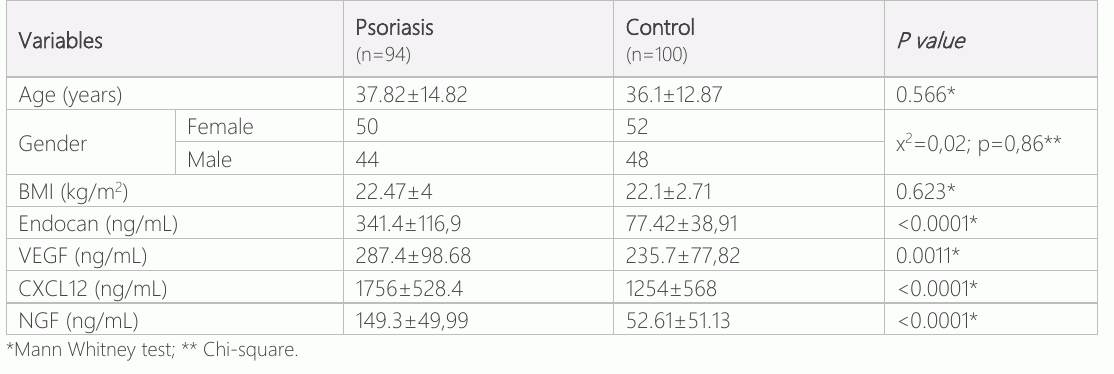
A total of 194 subjects, including 94 psoriasis patients (50 females and 44 males) and 100 healthy controls (52 females and 48 males), were included in the study. There was no significant difference between the control group and the patient in the study regarding gender, age, and BMI (Table-1). Compared to the control group, serum endocan, VEGF, CXCL12, and NGF levels were found to be significantly higher in the psoriasis patient group (Table-1 and Figure-1). Psoriasis patients were grouped according to PASI.
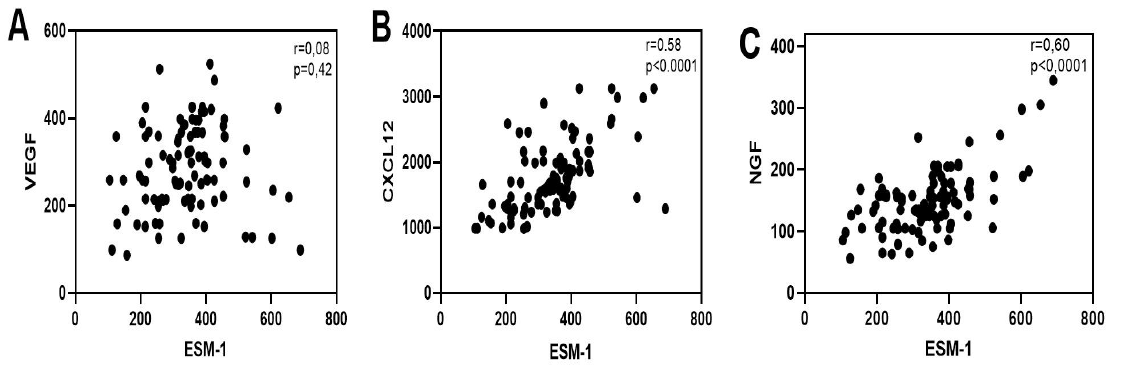
Compared to the control, endocan and NGF were higher in the mild and moderate groups. In the very severe psoriasis, VEGF was higher in the moderate and severe psoriasis group, and CXCL12 and FGF2 were higher in moderate, severe, and severe psoriasis groups (Table-2). In psoriasis, there was no correlation between endocan and VEGF (r=0.08; p=0.42). There was a moderate correlation between CXCL12 (r=0.58; p<0.0001) and NGF (r=0.60; p<0.0001) when compared with endocan (Figure-2).
Discussion
The present study showed for the first time that endocan, VGEF, CXCL12, and NGF levels were high in the serum of psoriasis patients, and the level of these parameters increased as the disease severity increased. Moreover, a positive correlation between serum endocan level and CXCL12 and NGF was revealed for the first time. The serum endocan level was higher in psoriasis patients than in the control group. There are limited studies investigating the endocan level in psoriasis patients.
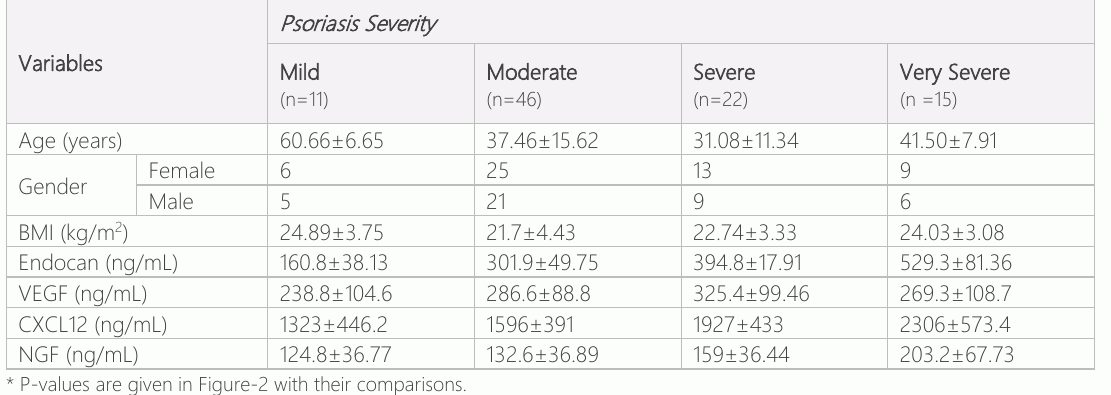
The results of the studies have reported different results regarding the endocan level in psoriasis patients. Although Erek Toprak et al. (13) declared that the endocan level did not change in this harvesting group, this was very limited. Conversely, Sigurdardottir et al. (14) reported that the endocan level was low in psoriasis patients compared to the healthy control. In the same study, UVB treatment increased the endocan level (14). In a study conducted with immunohistochemical staining of endocan by taking skin biopsies from 40 healthy subjects and 36 psoriatic patients (15), endocan was reported to be overexpressed from inflammatory cells, dermal endothelial and epidermal keratinocytes in psoriatic skin. In this study, endocan was suggested to enhance the proliferation and angiogenesis of psoriatic skin, which contributes to pathogenic mechanisms of psoriasis (15). Studies conducted with psoriasis vulgaris patients reported that the serum endocan was higher than that of healthy controls (16–19). The findings of this study also support these studies. In addition, when the endocan level of psoriasis disease severity (mild, moderate, severe, and very severe) was compared with healthy individuals, it was observed that as the disease severity increased, the endocan level increased.
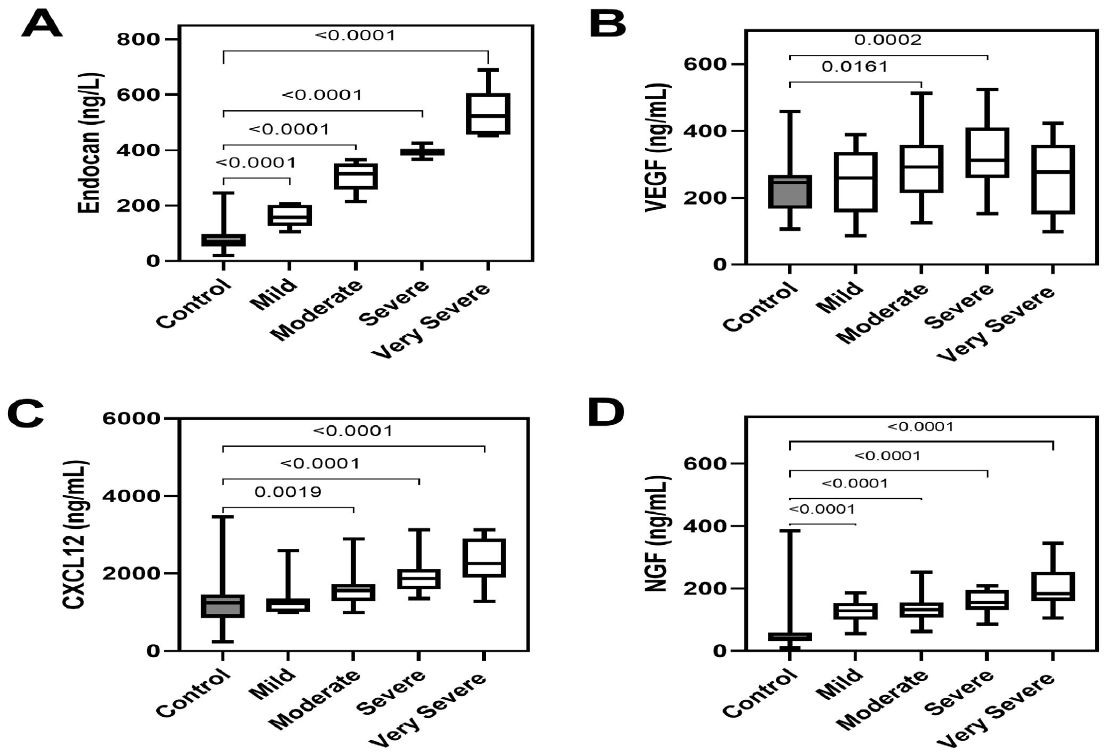
In this study, the level of VEGF was high in psoriasis patients. In a study conducted on skin biopsies of psoriasis patients, high VEGF mRNA expression was reported (20). In another study, the serum level of VEGF was reported to be high in psoriasis patients (21). VEGF is a crucial growth factor regulating neovascularization during pathological processes, reproductive functions and embryogenesis (9). Angiogenesis is initiated by the activation of vascular endothelial cells by various agents. VEGF production and consequent excessive dermal vascularity are markers of psoriasis (9). VEGF, a critical angiogenic factor, is thought to play an essential role in the pathogenesis of psoriasis, and VEGF is suggested to be a promising target for the treatment of this disease (22). The findings obtained in this study support these results. In addition, VEGF was higher in moderate and severe psoriasis patients compared to healthy individuals according to the severity of psoriasis disease. There was no difference in other groups (mild and very severe psoriasis). It is thought to be important in revealing the relationship between disease severity and VEGF level in psoriasis patients for the first time. It is thought to be interesting to demonstrate that VEGF levels are not high in mild and severe patient groups. This was interpreted as neovascularization did not occur in the disease's mild to very severe stage. Considering the findings obtained in this study, the increase in VEGF level as the severity of the disease increases indicates that this molecule may be the target molecule that can be used to treat psoriasis. More comprehensive studies are needed on this subject.
As far as is known, no studies investigating serum CXCL12 levels in psoriasis patients have been reported. We think that our study is the first in this field. According to this study, serum CXCL12 level was higher in psoriasis patients than in healthy individuals. It was also shown for the first time that there is a relationship between disease severity and CXCL12 level. According to the PASI grouping, the CXCL12 level was higher in patients with moderate, severe, and severe psoriasis. Inflammation is essential in the pathogenesis of psoriasis. CXCL12 has a vital role in skin homeostasis and inflammation (10). High expression of CXCL12 mRNA was reported in a study conducted on skin biopsies of psoriasis patients (10). Considering the findings, it comes to mind that CXCL12 may play an active role in forming inflammation in the pathogenesis of psoriasis.
NFG level increases in psoriasis (23, 24). The findings obtained in this study support these studies. We also found that all groups' NGF levels increased as disease severity increased. This shows that NGF can be a candidate molecule for treating psoriasis. It has been shown that NGF protein levels are higher in psoriatic keratinocytes than in normal keratinocytes. Our findings support this study when evaluated in terms of serum (6).
In this study, there was no correlation between serum VEGF and endocan. This is the first time this condition has been reported in psoriasis patients. Psoriasis is an inflammatory disease. Similarly, inflammation is vital in pathogenesis of Behçet's disease. Kul et al. (25) reported a correlation between VEGF and endocan in Behçet's disease.
This study found a moderate positive correlation between serum endocan and NGF in psoriasis patients for the first time. Chen et al. (26) showed that ESM1 expression increased when NGFR+ murine OSCC cells were incubated with NGF. This finding supports our results. When the two studies are evaluated together, the increase in the NGF level may cause an increase in the endocan level.
This study showed a positive correlation between endocan and CXCL12 levels in psoriasis patients for the first time. CXCL12 has an essential role in skin homeostasis and inflammation (10). Similarly, endocan is a molecule involved in vascularization and inflammation. The existence of a correlation between these two molecules is thought to be compatible.
Conclusion
Consequently, endocan and NGF increased with disease severity. Considering these findings, endocan and NGF may be target molecules in the treatment of psoriasis. The positive correlation of serum endocan level with NGF supports this situation. The number of patients included in this study was based on a more significant number of patients than their peers. Since the center where the study was conducted is a region with a high population rate, the number of psoriasis patients is high. Therefore, the results are considered to be more reliable.
Declarations
- Author contributions (CRediT)
- All authors contributed equally to all 14 CRediT roles (Conceptualization, Data curation, Formal analysis, Funding acquisition, Investigation, Methodology, Project administration, Resources, Software, Supervision, Validation, Visualization, Writing – original draft, Writing – review & editing).
- Funding
-
Funding information was not reported in the published version of this article.
- Conflicts of interest
- The authors declare no conflict of interest for the present study.
- Ethics approval
- Permission for the present study was obtained from the Harran University Clinical Research Ethics Committee (Decision No: HRU.19.08.16).
- Data availability
- A data availability statement was not reported in the published version of this article.
References (26)
21 of 26 references are linked to their DOI.
- Hugh JM, Weinberg JM. Update on the pathophysiology of psoriasis. Cutis. 2018;102(5S):6-12 PubMed Google Scholar
- Langley RG, Krueger GG, Griffiths CE. Psoriasis: epidemiology, clinical features, and quality of life. Ann Rheum Dis. 2005;64 Suppl 2:ii18-23; discussion ii4-5 DOI Crossref PubMed Google Scholar
- Bu J, Ding R, Zhou L, Chen X, Shen E. Epidemiology of Psoriasis and Comorbid Diseases: A Narrative Review. Front Immunol. 2022;13:880201 DOI Crossref PubMed Google Scholar
- Li C, Geng H, Ji L, Ma X, Yin Q, Xiong H. ESM-1: A Novel Tumor Biomaker and its Research Advances. Anticancer Agents Med Chem. 2019;19(14):1687-94 DOI Crossref PubMed Google Scholar
- Yucel M, Kotan D, Gurol Ciftci G, Ciftci IH, Cikriklar HI. Serum levels of endocan, claudin-5 and cytokines in migraine. Eur Rev Med Pharmacol Sci. 2016;20(5):930-6 PubMed Google Scholar
- Pincelli C. Nerve growth factor and keratinocytes: a role in psoriasis. Eur J Dermatol. 2000;10(2):85-90 PubMed Google Scholar
- Maurage CA, Adam E, Mineo JF, Sarrazin S, Debunne M, Siminski RM, et al. Endocan expression and localization in human glioblastomas. J Neuropathol Exp Neurol. 2009;68 (6):633-41 DOI Crossref PubMed Google Scholar
- Rocha SF, Schiller M, Jing D, Li H, Butz S, Vestweber D, et al. Esm1 modulates endothelial tip cell behavior and vascular permeability by enhancing VEGF bioavailability. Circ Res. 2014;115(6):581-90 DOI Crossref PubMed Google Scholar
- Marina ME, Roman, II, Constantin AM, Mihu CM, Tataru AD. VEGF involvement in psoriasis. Clujul Med. 2015;88(3):247- DOI Crossref PubMed Google Scholar
- Abdelaal NH, Elhefnawy NG, Abdulmonem SR, Sayed S, Saleh NA, Saleh MA. Evaluation of the expression of the stromal cell- derived factor-1 alpha (CXCL 12) in psoriatic patients after treatment with Methotrexate. J Cosmet Dermatol. 2020;19(1):253-8 DOI Crossref PubMed Google Scholar
- Mattei PL, Corey KC, Kimball AB. Psoriasis Area Severity Index (PASI) and the Dermatology Life Quality Index (DLQI): the correlation between disease severity and psychological burden in patients treated with biological therapies. J Eur Acad Dermatol Venereol. 2014;28(3):333-7 DOI Crossref PubMed Google Scholar
- Koo TK, Li MY. A Guideline of Selecting and Reporting Intraclass Correlation Coefficients for Reliability Research. J Chiropr Med. 2016;15(2):155-63 DOI Crossref PubMed Google Scholar
- Erek Toprak A, Ozlu E, Uzuncakmak TK, Yalcinkaya E, Sogut S, Karadag AS. Neutrophil/Lymphocyte Ratio, Serum Endocan, and Nesfatin-1 Levels in Patients with Psoriasis Vulgaris Undergoing Phototherapy Treatment. Med Sci Monit. 2016;22:1232-7 DOI Crossref PubMed Google Scholar
- Sigurdardottir G, Ekman AK, Verma D, Enerback C. Decreased Systemic Levels of Endocan-1 and CXCL16 in Psoriasis Are Restored following Narrowband UVB Treatment. Dermatology. 2018;234(5-6):173-9 DOI Crossref PubMed Google Scholar
- Abdou AG, Hammam M, Saad E, Hassan RAA. The significance of endocan immunohistochemical expression in chronic plaque psoriasis. J Cosmet Dermatol. 2022;21(1):380-6. DOI Crossref PubMed Google Scholar
- Balta I, Balta S, Demirkol S, Mikhailidis DP, Celik T, Akhan M, et al. Elevated serum levels of endocan in patients with psoriasis vulgaris: correlations with cardiovascular risk and activity of disease. Br J Dermatol. 2013;169(5):1066-70 7 77 Effect of Endocan on VGEF, CXCL12 and NGF Yurekli et al. DOI Crossref PubMed Google Scholar
- Elkamshoushi AM, Omar SS, El Abd AM, Hassan SZ, Sultan EA, Abd Elkawy E. Subclinical atherosclerosis in psoriatic disease: relation to endocan, TNF-alpha, age of onset, and body fat. Int J Dermatol. 2019;58(4):456-64 DOI Crossref PubMed Google Scholar
- Ozden HK, Polat M, Ozturk S, Bugdayci G. Assessment of subclinical cardiac damage in chronic plaque psoriasis patients: a case control study. Arch Med Sci Atheroscler Dis. 2016;1(1):e126- e32 DOI Crossref PubMed Google Scholar
- Flisiak I, Zaniewski P, Rogalska M, Mysliwiec H, Jaroszewicz J, Chodynicka B. Effect of psoriasis activity on VEGF and its soluble receptors concentrations in serum and plaque scales. Cytokine. 2010;52(3):225-9 DOI Crossref PubMed Google Scholar
- Sankar L, Arumugam D, Boj S, Pradeep P. Expression of Angiogenic Factors in Psoriasis Vulgaris. J Clin Diagn Res. 2017;11(3):EC23- EC7 DOI Crossref PubMed Google Scholar
- Flisiak I, Zaniewski P, Rogalska -Taranta M, Chodynicka B. Effect of psoriasis therapy on VEGF and its soluble receptors serum concentrations. J Eur Acad Dermatol Venereol. 2012;26(3):302-7 DOI Crossref PubMed Google Scholar
- Li W, Man XY, Chen JQ, Zhou J, Cai SQ, Zheng M. Targeting VEGF/VEGFR in the treatment of psoriasis. Discov Med. 2014;18(98):97-104 PubMed Google Scholar
- Raychaudhuri SP, Raychaudhuri SK. Role of NGF and neurogenic inflammation in the pathogenesis of psoriasis. Prog Brain Res. 2004;146:433-7 DOI Crossref PubMed Google Scholar
- Raychaudhuri SK, Raychaudhuri SP. NGF and its receptor system: a new dimension in the pathogenesis of psoriasis and psoriatic arthritis. Ann N Y Acad Sci. 2009;1173:470-7 DOI Crossref PubMed Google Scholar
- Kul A, Ates O, Alkan Melikoglu M, Ugur M, Ozturk N, Erkayhan G, et al. Endocan Measurement for Active Behcet Disease. Arch Rheumatol. 2017;32(3):197-202 PubMed Google Scholar
- Chen C, Shin JH, Eggold JT, Chung MK, Zhang LH, Lee J, et al. ESM1 mediates NGFR-induced invasion and metastasis in murine oral squamous cell carcinoma. Oncotarget. 2016; 7(43):70738-49 DOI Crossref PubMed Google Scholar
Respond to this article
Comments on a published article are welcome as a Letter to the Editor.
Get an e-mail when new articles in your fields are published
Questions to the authors
Questions are moderated: an editor approves each question, the authors answer, and an editor approves the answer before both appear here.
No answered questions yet.
Ask the authors a question
Discussion
Comments are moderated: they appear after the writer confirms the e-mail address and an editor approves them. Each comment carries a conflict-of-interest statement.
No comments yet.
Write a comment
Read the full text
Open the PDF here
Loading the PDF…
If the PDF does not show here, use the download button above.
How to cite this article
Yurekli UF, Akkus MR. The Relationship of Endocan to Disease Severity in Psoriasis: Effect of Endocan on VGEF, CXCL12 and NGF Levels. Ulutas Med J. 2023;9(1):1-7. doi:10.5455/umj.20230127061036
Yurekli, U. F., & Akkus, M. R. (2023). The Relationship of Endocan to Disease Severity in Psoriasis: Effect of Endocan on VGEF, CXCL12 and NGF Levels. The Ulutas Medical Journal, 9(1), 1–7. https://doi.org/10.5455/umj.20230127061036
Yurekli, U.F. and Akkus, M.R. (2023) 'The Relationship of Endocan to Disease Severity in Psoriasis: Effect of Endocan on VGEF, CXCL12 and NGF Levels', The Ulutas Medical Journal, 9(1), pp. 1–7. doi: 10.5455/umj.20230127061036.