The Ulutas Medical Journal · ISSN 2149-0430 (print), 2149-388X (online) · https://www.ulutasmedicaljournal.com/?mno=59302
Original Article · Open access
The Transmission Panorama and Epidemic Characteristics of SARS-CoV-2 of Jining City of China
- Medical Laboratory, Affiliated Hospital of Jining Medical University, Jining City, Shandong Province, PR China ROR
- Nursing Department, Affiliated Hospital of Jining Medical University, Jining City, Shandong Province, PR China ROR
- Medical College, Jining Medical University, Jining City, Shandong Province, PR China ROR
Abstract
- Introduction
- Severe acute respiratory syndrome coronavirus 2 (SARS-CoV-2) has spread in hundreds of countries and made millions of people infected and more than two hundred thousands of death.
- Methods
- This study retrospectively analyzed the data for the SARS-CoV-2 epidemic which ranged from Jan 24 to Feb 16, 2020. The source of the data was the reports about SARS-CoV-2 issued by the authority of Jining City. The materials, the traveling history, the transmission, the gender, and the age of the infected persons were deeply analyzed.
- Results
- There were 52 cases with SARS-CoV-2 infection in Jining City, including 20 females (38.5%). The average age for the infected persons was 45.3 years, and the cases numbers of the age stage of 31-40 and 41-50 years were all 14 cases with a total proportion of 53.8%. 23 cases were the primary infectors and 14 persons had obvious traveling experience in other provinces. There was one event of four generations of transmission; most of the primary infectious persons did not transmit the virus to others.
- Conclusion
- Jining City has the relative specific epidemic characteristic of SARS-CoV-2. This character of restricted transmission indicates that the prevention strategy is effective and worthy to learn.
Keywords
Full text
Introduction
Currently, severe acute respiratory syndrome coronavirus 2 (SARS-CoV-2) has spread in hundreds of countries and made millions of people infected and more than two hundred thousands of death (1). In this pandemic, lots of cities in the world have been invaded by the virus; and among them, there are some cities of China at the primary stage of the epidemic. As we have known, Wuhan is the epidemic epicentral in China, and many other cities of and out of Hubei Province are involved (2), such as Huanggang, Shanghai, Hangzhou, and so on. The epidemic and clinical characteristics of SARS-CoV-2 infection in first-tier cities have been described in some reports (3, 4). However, relatively few reports about virus transmission in the little cities.
As one of sixteen prefecture-level cities of Shandong province, Jining City belongs to a third-tier city in China. However, it is famous in the world for Confucius’ hometown – Qufu which is a county that belongs to Jining. In this pandemic of SARS-CoV-2, Jining can not escape by a piece of sheer luck. In this article, we retrospectively collected and analyzed the epidemic data related to SARS-CoV-2, further presented the transmission panorama and demographic characteristics of the city, and hope to pose some information or ideas for future relative researches on the aspects of prevention, control, and epidemic analysis.
Materials and Methods
According to the reports of Jining Municipal Health Committee, Rencheng District Health Committee of Jining City, and other local authority’s media, the detailed information relates to the cases infected with SARS-CoV-2 was collected, and analyzed. The date range was from Jan 24 to Feb 16, 2020. The informed consent form was signed by all the objects.
Ethical Statement
This study is supported by the Research Fund for Academician Lin He New Medicine (JYHL2018FMS08), and the Project of scientific research support fund for teachers of Jining Medical University (JYFC2018FKJ023). The study has been approved by the Ethic Committee.
Results
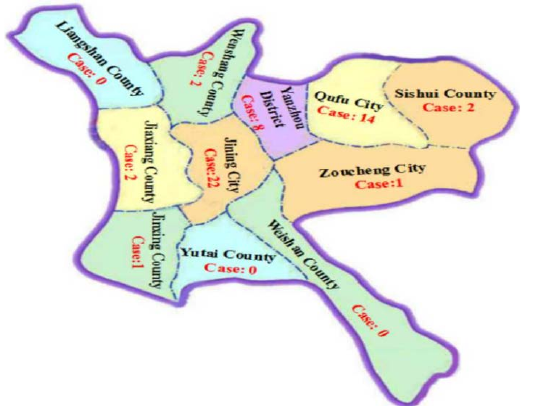
The Distribution of the Cases with SARS-CoV-2 Twenty-two cases with SARS-CoV-2 infection were reported in Jining City to date. In the total 11 counties or districts, except Weishan, Liangshan, and Yutai County, there were different numbers of infectious cases in the remainder 8 administrative regions. The urban district of Jining City, Qufu City, and Yanzhou District were the top three regions with a higher number of infected cases, and the cases number was 22, 14, and 8, respectively (Figure 1).
The Basic Materials
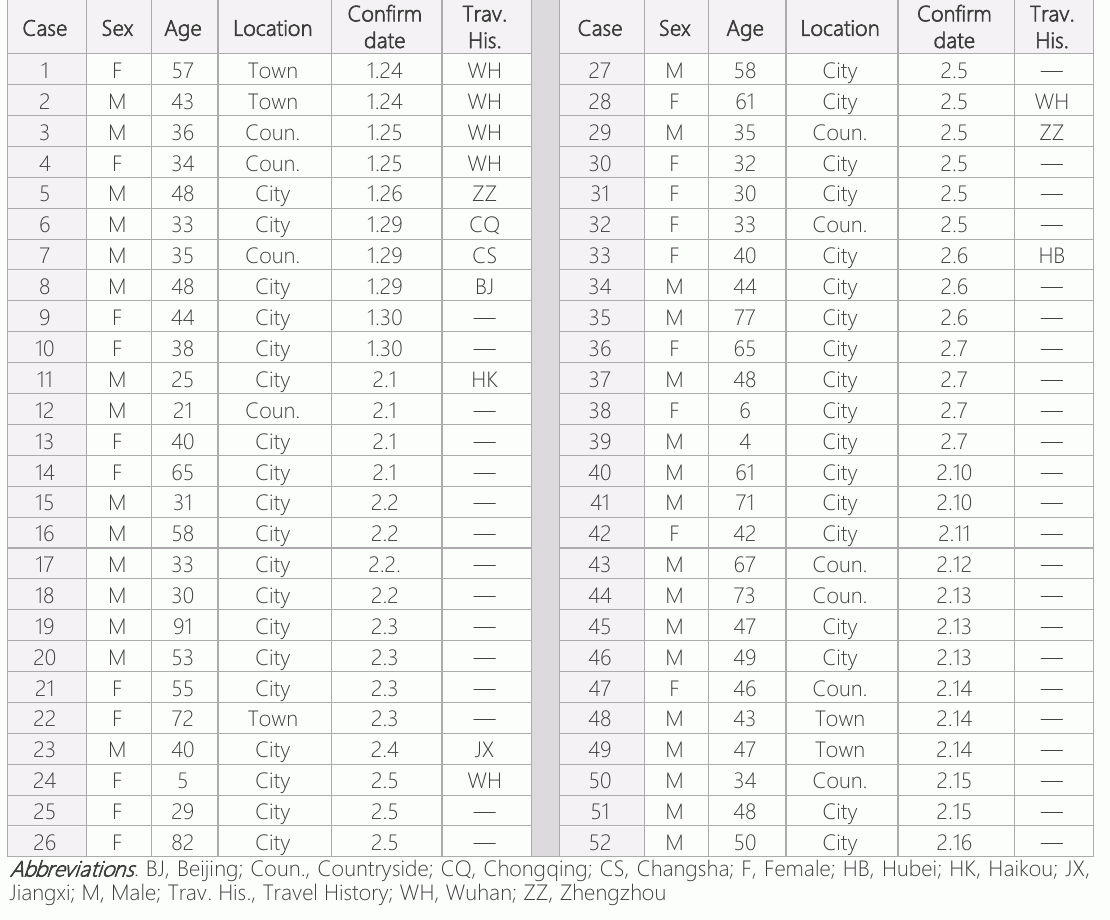
The confirmed dates for 52 cases with SARS- CoV-2 infection were ranged from Jan 24 to Feb 16, 2020. Among the cases, 14 infected persons had traveling experiences in the cities out of Shandong Province, and the involved cities included Wuhan, Chongqing, Zhengzhou, Hankou, Beijing, Chengdu, and so on (Table 1).
The Membership Analysis
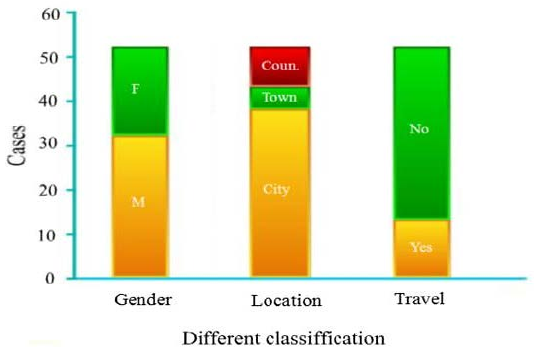
There was 20 female in 52 cases, and the percentage was 38.5%. 37 persons infected with SARS-CoV-2 came from the city including Jining City and its affiliated counties and districts; the ratio was high to 71.2%. 5 persons came from town (9.6%) and 10 persons (19.2%) came from the countryside. Most of the infected cases had no traveling history to other provinces (38, 73.1%). The detailed analysis was shown in Figure 2.
The Age Distribution
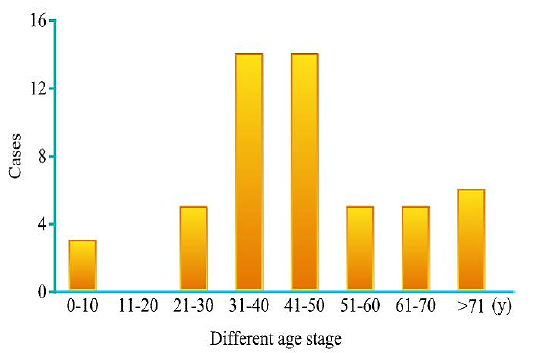
In the infected population, the eldest age was 91, and the youngest age was only 4. The cases numbers of the age stage of 31-40 and 41-50 years were all 14 cases, and the total proportion was 53.8%. 16 persons were older than 50 years and the percent was 30.7%. The sum for the persons aged older than 71 years and less than 10 years was 6 (11.5%) and 3 (5.8%), respectively. There was no case at the age stage of 11-20 years (Figure-3).
The Graphics for the Infection Route
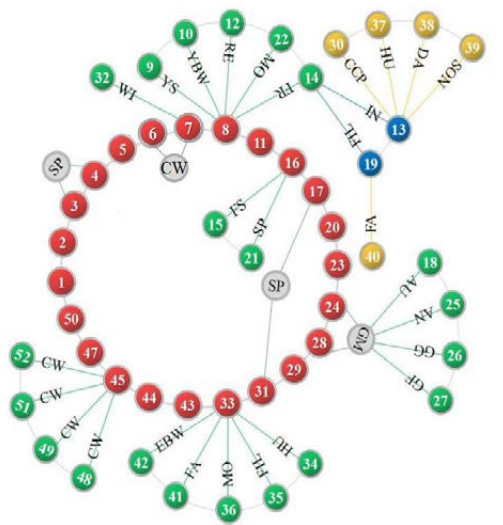
According to the infectious source, confirmed date, and the relationship between the infected persons, graphics were drawn out to reflect the transmission of SARS-CoV-2 in Jining City (Figure 4). There were 23 cases in the primary generation. The number for the second, third and fourth generation was 21, 2, and 4 cases, respectively.
Discussion
The pandemic of SARS-CoV-2 has been a severe concern threatening the human health of the whole world (5). In China, the novel coronavirus spread in many cities at the beginning of 2020. Except for Dongying City, the cases of SARS-CoV-2 emerged in the other fifteen cities of Shandong Province. This study puts the eyes on one of the prefecture-level cities — Jining City which is famous for Qufu city where is the hometown of Confucius, a well-known thinker, and educator (6).
As the results have shown, there were 52 cases with SARS-CoV-2 infection in nine counties or districts of Jining City. The urban district of Jining City, Qufu City, and Yanzhou District were the top three regions with a higher number of infected cases. The reason for this status is that Jining, Qufu, and Yanzhou are the prefecture-level, the traveling, and the railway transport city, respectively, and the number of infection cases is associated with the degree of population mobility (7). In the gender analysis of 52 cases, the percent of the female and male was 38.5% and 61.5%, respectively. This was similar to Chan’s report in which the female and male ratios were 32% and 68%(8). In Ryu’s investigation (9), more than two-third (10 in 15) of persons infected with SARS-CoV-2 were male. In Huang’s study (10), the percent of the male was high to 73.2%, while the rate in Wang’s paper was only 54.3% (11). Although there were differences in the ratios of the male in different reports, it was obvious that the case number of the male was generally more than that of the female. In the infected population, the age almost covered every phase: from elder men to little children, and the average age was 45.3 years. This was very near to Fang’s report, in which the average age of the patients with SARS-CoV-2 infection was 45.1 years (12). It is also consistent with the mean age of 47.0 years in Guan’s study (13). Certainly, there were inconsistent references about the average age of the infected person: 37 years for Yang’s report (4) about Chongqing and 32.5 years for a study on Nanjing (14). As the epicenter of this epidemic, the mean age was reported as 55.5 and 56 years in two reports focused on Wuhan (8, 15), and it was obvious that the data were higher than in others cities. Whether the average age of the people infected with SARS- CoV-2 in non-epicenter usually is younger than that of the epicenter area needs further observation.
To analyze the cases with different age stages, we found that the percent of 31-50 years stage was 53.8%, which was significantly higher than another report (47.3% & 36.3%)(4, 16). However, all the percents of this age stage were more than one-third and higher than those of other age stages in these studies. The ratio for the age more than 71 years was 11.5%, which was similar to another report in which the corresponding ratio of 12% (16). In the range of fewer than 10 years, there were only 3 cases with SARS-CoV-2 infection in this study, and the percentage was 5.8%. It was obviously higher than 1.2%, 0.1% and 3.85% reported in other references (16–18). Interestingly, there was no case aged 11-20 years in all the objects of Jining City. Although the rate of this age stage was more than zero in other studies, the value was rather low that it always was less than 2% (17, 19). These findings probably indicated that the youngster was not easy to be infected with SARS-CoV-2, and the reason possibly was that this population has consisted of the students of primary and middle school. They usually lived in a relatively small space and had very little social activity, and hence, they had very low chance to be infected with SARS-CoV-2.
Of 52 cases, 71.2% came from the city which including Jining City and the affiliated counties and district of the city; while less than 30% of the persons with SARS-CoV-2 infection came from town and countryside. This finding was consistent with Chen’s and Lin’s reports (15, 17). This point was determined by the relatively greater popular mobility of city dwellers. According to such a character, it is suggested that the city is of the primary importance for controlling the transmission of SARS-CoV-2. According to an investigation reported by the local health authority (20), graphics were drawn out to describe the transmission of SARS-CoV- 2 in this study. 23 index persons were taken as the initial transmission source. These index cases were responsible for the local epidemic of SARS-CoV-2 to some extent. Among them, 14 cases had clear travel histories out of Shandong Provinces. These indicated that the inputting cases were the main infectious source for a city of non-epicenter (4) such as Jining City. In all of the spread brought by 23 index infectors, there was only one time for the four generations of transmission, two generations of transmission happened five times, and most of the primary infectious person did not transmit the virus to others. The reality strongly proved that the preventing strategies against SARS-CoV-2 infection were very effective, such as home isolation, collective centralization quarantine, keeping social distance, wearing face masks (21, 22). Besides, from Figure 4 we could found that the transmission usually happened between the relatives of a family, so the family cluster was the main element for virus spreading in Jining City. Therefore, the prevention and control of SARS-CoV-2 transmission between the family members or relatives are rather important during the SARS-CoV-2 epidemic (23).
Conclusion
According to the panorama and epidemic characteristics of SARS-CoV-2 in Jining City, it is obvious that the prevention and control are effective. Although these data are extracted from the primary period of the epidemic, this study again indicates that the strategy for the fight against SARS-CoV-2 is effective to some extent and worthy to learn by the members of the global village.
Declarations
- Author contributions (CRediT)
- All authors contributed equally to all 14 CRediT roles (Conceptualization, Data curation, Formal analysis, Funding acquisition, Investigation, Methodology, Project administration, Resources, Software, Supervision, Validation, Visualization, Writing – original draft, Writing – review & editing).
- Funding
-
This study is supported by the Research Fund for Academician Lin He New Medicine (JYHL2018FMS08), and the Project of scientific research support fund for teachers of Jining Medical University (JYFC2018FKJ023).
- Conflicts of interest
- A conflict of interest statement was not reported in the published version of this article.
- Ethics approval
- The study has been approved by the Ethic Committee.
- Data availability
- A data availability statement was not reported in the published version of this article.
References (23)
14 of 23 references are linked to their DOI.
- WHO. WHO Coronavirus Disease (COVID-19) Dashboard - Data last updated: 2021/1/23, 4:57 pm CET. 2021, https:// covid19.who.int DOI Crossref PubMed Google Scholar
- Du W, Han S, Li Q, Zhang Z. Epidemic update of COVID-19 in Hubei Province compared with other regions in China. Int J Infect Dis. 2020;95:321-325 DOI Crossref PubMed Google Scholar
- Wan S, Xiang Y, Fang W, Zheng Y, Li B, Hu Y, et al. Clinical features and treatment of COVID-19 patients in northeast Chongqing. J Med Virol. 2020; 92(7):797-806 DOI Crossref PubMed Google Scholar
- Yang K, Ren MH, Xiao LY, Liu YF, Shi DY, Lu H, et al. Epidemiological and clinical characteristics of 57 cases of new coronavirus pneumonia in non-epidemic areas. Journal of Third Military Medical University, 2020,42(6),555-559 PubMed Google Scholar
- Yin X, Riva L, Pu Y, Martin-Sancho L, Kanamune J, Yamamoto Y, et al. MDA5 Governs the Innate Immune Response to SARS-CoV-2 in Lung Epithelial Cells. Cell Rep. 2021;34(2):108628 DOI Crossref PubMed Google Scholar
- Dong X. Confucious vs Einstein: Who would be a better gerontologist? Innov Aging. 2018, 2(Suppl 1):347 PubMed Google Scholar
- Than LT, Nguyen TV, Luong QC, Nguyen TV, Ngyyen HT, Le HQ, et al. Importation and Human-to-Human Transmission of a Novel Coronavirus in Vietnam. N Engl J Med. 2020;382(9): 872-874 PubMed Google Scholar
- Zhou F, Yu T, Du R, Guan F, Liu Y, Liu Z, et al. Clinical course and risk factors for mortality of adult inpatients with COVID-19 in Wuhan, China: a retrospective cohort study. Lancet. 2020; 395(10229):1054-1062 DOI Crossref PubMed Google Scholar
- Ryu S, Chun BC, Korean Society of Epidemiology 2019-nCoV Task Force Team. An interim review of the epidemiological characteristics of 2019 novel coronavirus. Epidemiol Health. 2020; 42:e2020006 DOI Crossref PubMed Google Scholar
- Huang C, Wang Y, Li X, Ren L, Zhao J, Hu Y, et al. Clinical features of patients infected with 2019 novel coronavirus in Wuhan, China. Lancet 2020; 395:497-506 DOI Crossref PubMed Google Scholar
- Wang D, Hu B, Hu C, Zhu F, Liu X, Zhang J, et al. Clinical characteristics of 138 hospitalized patients with 2019 novel coronavirus- infected pneumonia in Wuhan, China. JAMA. 2020;323(11):1061-1069 DOI Crossref PubMed Google Scholar
- Fang XW, Mei Q, Yang TJ, Zhang L, Yang Y, Wang YZ, et al. Clinical characteristics and treatment strategies of 79 patients with COVID-19. Chinese Pharmacological Bulletin. 2020; 36(4):12-18 PubMed Google Scholar
- Guan WJ, Ni ZY, Hu Y, Liang WH, Ou CQ, He JX. Clinical Characteristics of Coronavirus Disease 2019 in China. N Engl J Med. 2020; 382(18):1708-1720 DOI Crossref PubMed Google Scholar
- Hu Z, Song C, Xu C, Jin G, Chen Y, Xu X, et al. Clinical characteristics of 24 asymptomatic infections with COVID-19 screened among close contacts in Nanjing, China. Sci China Life Sci. 2020 DOI Crossref PubMed Google Scholar
- Chen N, Zhou M, Dong X, Qu J, Gong F, Han Y, et al. Epidemiological and clinical characteristics of 99 cases of 2019 novel coronavirus pneumonia in Wuhan, China: a descriptive study. Lancet. 2020; 395(10223):507-513 DOI Crossref PubMed Google Scholar
- Epidemiology Working Group for NCIP Epidemic Response, Chinese Center for Disease Control and Prevention. The epidemiology characteristics of an outbreak of 2019 novel coronavirus disease (COVID-19) in China. Chin J Epidemiol. 2020; 41(2):145-151 PubMed Google Scholar
- Lin JF, Wu MN, Wu HC, Zhang T, Wu C, Li FD. Epidemiological characteristics of coronavirus diseases 2019 in Zhejiang Province Preventive Medicine. 2020, 32(3):217-221,225 PubMed Google Scholar
- Zhuang YJ, Chen Z, Li J, Yang XL, Li J, Yuan Y, et al. Clinical and epidemiological characteristics of 26 patients diagnosed with novel coronavirus pneumonia. Chin J Nosocomiol. 2020; 30(6): 817-820 PubMed Google Scholar
- Liang JR, Wei SH, Qian XF, Liu YM, Yang HY, Yang Y, et al. Epidemiological and clinical characteristics of 14 cases of COVID-19.Chinese Journal of Infection Control. 2020;19(3):1 -5 PubMed Google Scholar
- (20) Jining Municipal Health Commission. The epidemic status of SARS- Cov-2 in Jining City. 2020; http://wjw.jining.gov.cn/ art/2020/2/18/art_59856_2452811.html PubMed Google Scholar
- Chu DK, Akl EA, Duda S, Solo K, Yaacoub S, Schünemann HJ. COVID-19 Systematic Urgent Review Group Effort (SURGE) study authors. Physical distancing, face masks, and eye protection to prevent person-to-person transmission of SARS- CoV-2 and COVID-19: a systematic review and meta-analysis. Lancet. 2020; 395(10242):1973-1987 DOI Crossref PubMed Google Scholar
- Liu W, Yue XG, Tchounwou PB. Response to the COVID-19 Epidemic: The Chinese Experience and Implications for Other SARS-CoV-2 of Jining City of China Zhou et al. Countries. Int J Environ Res Public Health. 2020 Mar 30;17(7): DOI Crossref PubMed Google Scholar
- Chan JF, Yuan S, Kok KH, To KK, Chu H, Yang J, et al. A familial cluster of pneumonia associated with the 2019 novel corona virus indicating person-to-person transmission: a study of a family cluster. Lancet. 2020; 395(10223):514-523 DOI Crossref PubMed Google Scholar
Respond to this article
Comments on a published article are welcome as a Letter to the Editor.
Get an e-mail when new articles in your fields are published
Questions to the authors
Questions are moderated: an editor approves each question, the authors answer, and an editor approves the answer before both appear here.
No answered questions yet.
Ask the authors a question
Discussion
Comments are moderated: they appear after the writer confirms the e-mail address and an editor approves them. Each comment carries a conflict-of-interest statement.
No comments yet.
Write a comment
Read the full text
Open the PDF here
Loading the PDF…
If the PDF does not show here, use the download button above.
How to cite this article
Zhou J, Kong C, Li Y. The Transmission Panorama and Epidemic Characteristics of SARS-CoV-2 of Jining City of China. Ulutas Med J. 2021;7(2):108-114. doi:10.5455/umj.20210226075839
Zhou, J., Kong, C., & Li, Y. (2021). The Transmission Panorama and Epidemic Characteristics of SARS-CoV-2 of Jining City of China. The Ulutas Medical Journal, 7(2), 108–114. https://doi.org/10.5455/umj.20210226075839
Zhou, J., Kong, C. and Li, Y. (2021) 'The Transmission Panorama and Epidemic Characteristics of SARS-CoV-2 of Jining City of China', The Ulutas Medical Journal, 7(2), pp. 108–114. doi: 10.5455/umj.20210226075839.