The Ulutas Medical Journal · ISSN 2149-0430 (print), 2149-388X (online) · https://www.ulutasmedicaljournal.com/?mno=244296
Original Research · Open access
Triple Antiretroviral Therapy Effectively Eliminates HIV Transmission from Mother to Child
- Department of Obstetrics and Gynecology, University of Sumatera Utara, Medan, Indonesia ROR
Abstract
- Introduction
- HIV transmission can be reduced by practicing appropriate prevention. Every centers have their own standardized regimens for antiretroviral therapy. The study aimed to determine HIV transmission after practicing standardized triple antiretroviral therapy adapted in Haji Adam Malik Hospital.
- Method
- This is an cohort-analytic study conducted in Haji Adam Malik hospital. Medical records of HIV-positive mothers who did the antenatal care and delivered at Haji Adam Malik Hospital in 2009-2014 were collected. The standardized antiretroviral therapy adapted in Haji Adam Malik Hospital were applied. Follow up was done to all of the born children in order to determine HIV tranmission rate. Diagnosis of HIV in children under the age of 18 months were done by PCR (Polymerase Chain Reaction). If the child has been aged ≥ 18 months, the method of diagnosis is Rapid Test.
- Results
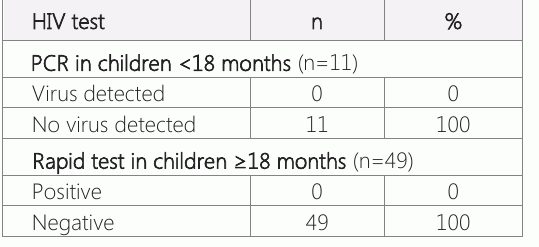
- Of the 60 infants examined, 11 infants aged <18 months enrolled in PCR tests, while 49 others children were tested using rapid test. However, no virus were detected in all infants.
- Conclusion
- The triple antiretroviral effectively prevent the HIV transmission from mother to children.
Keywords
Full text
Introduction
There are 35.9 to 44.3 million people living with HIV in worldwide. This number is growing in about 15,000 patients per day (1). In South Asia and Southeast Asia, there are estimated 7.4 million people living with HIV. In Indonesia, the incidence of HIV has increased since 1999. Data of Ministry of Health of Indonesiain 2002 showed that there were about 130,000 cases of HIV infection. In fact, this amount was certainly far away from the real number of people infected with HIV (2).
Almost half of the 42 million people living with HIV are women in their reproductive age. In addition, more than 2 million HIV-infected peoples are pregnant women, while up to 90% of them live in developing countries. From worldwide data, the highest incidence of HIV infection are in East and Southern Africa (3). HIV transmission from mother to child can occur through intrauterine, during delivery, and during breastfeeding. The prevalence of children suffering from HIV was 330,000 in 2011, doubling in 2003, but lowering 24% in 2009. PMTCT (Prevention of Mother to Child Transmission), by administering antiretroviral therapy (ART) for pregnant women and new born child, can reduce HIV transmission up to 90% (4). Highly effective antiretroviral therapy (HAART) during pregnancy can reduce the HIV transmission rate to as low as 1-2%, even in developing countries, which is now recommended by the World Health Organization as the package of prevention of mother to child transmission (PMTCT) (5).
Haji Adam Malik Hospital is the care center for HIV-positive patients in Sumatera Province, Indonesia. The protocol care specific to pregnant women with HIV need a comprehensive collaboration between Department of Obstetrics and Gynecology and Department of Inter-nal Medicine. The goal for this program is to ensure that HIV patients receiveappropiate antiretroviral therapy and educated about preventing transmission to future newborns. They also must be informed about routine follow-up of their future newborns at least until the age of 18 months. The main problems were that the patients have just come to hospital during active stage of labor, in which optimal HIV prevention prior to and during the labor, can not be applied. Then, after birth, only about 30% of these babies were coming for routine follow-up.
Methods
This is an cohort-analytic study conducted in H.Adam Malik hospital. Medical records of HIV-positive mother who did antenatal care and delivered at Haji Adam Malik Hospital, starting in 2009-2014 were collected.The standardized antiretroviral therapy adapted in Haji Adam Malik Hospital were applied both to the mothers in pregnancy and the newborns. In this study, HIV status of children after the standardized antiretroviral therapy Haji Adam Malik Hospital were investigated. There are four drug regimens choice given to pregnant women. The first regimen was tenofovir, lamivudine, nevirapine that contraindicated for patients with kidney disorders. The second regimen was tenofovir, lamivudine, efavirenz, preferably in patients with tuberculosis or central nervous system disorders. Three regimen was zidovudine, lamivudine, and nevirapine, that contraindicated anemia (Hb<10 g/dL) and CD4+ above 250/mm3. The fourth regimen was zidovudine, lamivudine, and efavirenz. The first and second regimens given 2 times daily while the third and fourth regimen given 4 times daily. Cotrimoxazole was given to patients (CD4+) less than 200/mm3. Newborns are given zidovudine to 6 weeks. Diagnosis of HIV in children under the age of 18 months were done by PCR (Polymerase Chain Reaction). PCR was conducted in the laboratory Prodia Medan because Haji Adam Malik Hospital not have facilities for PCR. If the child has been aged ≥18 months, the method of diagnosis is rapid test.
Results
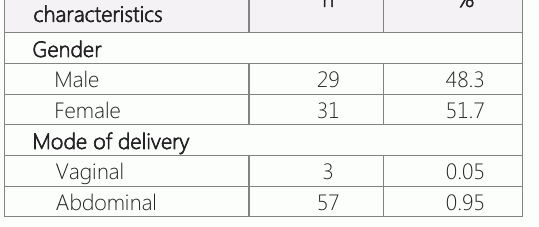
There were 60 HIV-positive medical records that eligible for this study. Author collected blood samples from all infants that born from HIV-positive mothers in their follow-up visit to the hospital. The rest infants who did not show up were phoned and asked to come for follow up. All the babies were not breastfed. Of all infants, only three were born by spontaneous vaginal delivery. All babies born with normal weight (>2500 g) in range of 3164.5±238.8 g. Of the 60 children examined, 11 children aged The indivduals <18 months were tested using PCR tests, while 49 others children were tested using rapid test. Of all children who used PCR, no virus were detected. Similarly, in the examination of 49 children with a rapid test, all showed negative results.
Discussion
Tenofovir disoproxil fumarate(TDF) is a potent nucleotide analogue reverse transcriptase inhibitor (NRTI) that has excellent efficacy and tolerability profiles (6). Baroncelli et al, did not find any obstetrics and fetal outcomes in pregnant women who received tenofovir (7). Nevirapine is a HIV-1 specific non-nucleoside reverse transcriptase inhibitor that binds directly to the viral reverse transcriptase of HIV-1 to block polymerase activity by causing disruption of the enzymes catalytic site (8). Lamivudine is a nucleoside reverse transcriptase inhibitor that is widely used for the treatment of HIV-1 infection in combination with other antiretrovirals. It is a highly effective agent that can be dosed once or twice daily due to its long intracellular half-life (9). Efavirenz is a non-nucleoside reverse transcriptase inhibitor that in most treatment guidelines is recommended to be taken combined with two nucleoside analogue reverse transcriptase inhibitors (10). GS903 study showed that in 144 weeks comparison between tenofovir vs stavudine (plus lamivudin and efavirenz, 71 of 86 (83%) patients originally randomized to efavirenz plus tenofovir and lamivudine had viral load of <400 copies/mL and 69/86 (80%) had a viral load of <50 copies/mL, regimen was being switched from stavudine to tenofovir (plus efavirenz and lamivudine) also showed maintained virological suppression and continued CD4 cell increases over 144 weeks (11). Zidovudine is a nucleoside transcriptase inhibitor that compete with the endogenous nucleotides at the catalytic, i.e., substrate-binding, site of RT and are incorporated into the elongating proviral deoxyribonucleic acid (DNA) strand (12).
The four line regimens are the same regimen that adapted bycurrent WHO guidelines recommendation: tenofovir+3TC+nevirapine, tenofovir/FTC+nevirapine,tenofovir+3TC+ efa virenz, and tenofovir/FTC/efavirenz. The first regimen: tenofovir, lamivudine, nevirapine was contraindicated for patients with kidney disorders. However, tenofovir+3TC+nevirapine regimen showed high rates of failure in the latest study. Lapadula et al. have reported that regimens consisting of tenofovir, emtricitabine, and nevirapine are associated with a risk of early virologic failure in antiretroviral-naive, HIV-infected patients.The second regimen: tenofovir, lamivudine, efavirenz, preferably in patients with tuberculosis or central nervous system disorders. Three regimens: zidovudine, lamivudine, and nevirapine with contraindications anemia (Hb<10g/dL) and CD4+ above 250/mm3. Four regimens: zidovudine, lamivudine, and efavirenz. The first and second regimens were given 2 times daily while the third and fourth regimen were given 4 times daily. Cotrimoxazole is given to patients with CD4+ less than 200/mm3. Newborns are given zidovudine to 6 weeks (13).
The current WHO recommended regimen is as follows: where the pregnant woman does not yet need to start ART for therapeutic reasons, she should start Zidovudine (AZT) from 28 weeks or as soon as possible thereafter, be provided with single-dose Nevirapine (NVP) when entering labour, and be given AZT+3TC for one week following delivery. Meanwhile, whether the mother was on the above or standard ART, the child should be given single dose NVP immediately after delivery and daily AZT until one week old (14). In this study, 11 infants aged <18 months were tested with PCR and 49 infants aged >18 months were tested with rapid test. However, all infants showed negative HIV status.This rate is similar to the clinical trial that addressed less than 2% HIV can be transmitted if PMTCT administered properlyas long as good counseling services and follow-up (15). Although inade-quate continuum of care was the one of main problem that first observed in this study, surprisingly, no newborn suffered from HIV (16). Author strongly recommend the adapatation of this clinical treatment to other clinical settings. Further study on long term effects of antiretroviral drugs is needed.
Conclusion
The triple antiretroviral effectively prevents the HIV transmission from mother to child.
Declarations
- Author contributions (CRediT)
- All authors contributed equally to all 14 CRediT roles (Conceptualization, Data curation, Formal analysis, Funding acquisition, Investigation, Methodology, Project administration, Resources, Software, Supervision, Validation, Visualization, Writing – original draft, Writing – review & editing).
- Funding
-
Funding information was not reported in the published version of this article.
- Conflicts of interest
- The authors declare that they have no conflict of interest.
- Ethics approval
- The study protocol was approved by local research ethics committee and written informed consent was obtained from patients.
- Data availability
- A data availability statement was not reported in the published version of this article.
References (16)
10 of 16 references are linked to their DOI.
- Drake AL, Wagner A, Richardson B & Stewart GJ. Incident HIV during Pregnancy and Postpartum and Risk of Mother-to-Child HIV Transmission: A Systematic Review and Meta-Analysis. PloS 2014; 1-14. DOI Crossref PubMed Google Scholar
- WHO. Global HIV/AIDS response: epidemic update and health sector progress towards universal access.WHO,2011. PubMed Google Scholar
- UNAIDS. Treatment 2015. UNAIDS:WHO,2015. PubMed Google Scholar
- UNAIDS. Global plan towards the elimination of new HIV infections among children by 2015 and keeping their mother alive. UNAIDS, 2011. DOI Crossref PubMed Google Scholar
- Chasela CS, Hudgens MG, Jamieson DJ, et al. Maternal or infant antiretroviral drugs to reduce HIV-1 transmission. N Engl J Med 2010;362:2271-81. DOI Crossref PubMed Google Scholar
- Gallant JE, Staszewski S, Pozniak AL, et al. Efficacy and safety of tenofovir DF vs stavudine in combination therapy in antiretroviral-naive patients: a 3-year randomized trial. JAMA 2004;292:191-201. DOI Crossref PubMed Google Scholar
- Baroncelli S, Tamburrini E, et al. Antiretroviral treatment in pregnancy: a six-year perspective on recent trends in prescription patterns, viral load suppression, and pregnancy outcomes. AIDS Patient Care STDS2009;23:513-20. DOI Crossref PubMed Google Scholar
- Harris M, Montaner JS. Clinical uses of non-nucleoside reverse transcriptase inhibitors. Rev Med Virol 10:217-229. DOI Crossref PubMed Google Scholar
- Ziakas, PD, Karsaliakos P, Mylonakis E. Effect of prophylactic lamivudine for chemotherapy-associated hepatitis B reactivation in lymphoma: a meta-analysis of published clinical trials and a decision tree addressing prolonged prophylaxis and maintenance. Haematologica, vol. 94, no. 7, pp. 998–1005, 2009. DOI Crossref PubMed Google Scholar
- Vrouenraets SM, Wit FW, Van Tongeren J, Lange JM. Efavirenz: a review. Expert Opin Pharmacother. 2007 Apr; 8(6):851-71. PubMed Google Scholar
- Madruga JR, Cassetti I, Suleiman JM, et al. The safety and efficacy of switching stavudine to tenofovir DF in combination with lamivudine and efavirenz in HIV-1-infected patients: three-year follow-up after switching therapy. HIV Clin Trials.2007;8:381– 90. DOI Crossref PubMed Google Scholar
- Wooding AM. Antiviral efficacy of nine nucleoside reverse transciptase inhibitor against feline immunodeficiency virus in feline peripheral blood mononuclear cells.Available:https://edoc.ub.uni-muenchen.de/18251/1/Wooding_Anita.pdf PubMed Google Scholar
- Lapadula G, Costarelli S, Quiros-Roldan E, et al. Risk of early virological failure of once-daily tenofovir-emtricitabine plus twice-daily nevirapine in antiretroviral therapy-naive HIV-infected patients. Clin Infect Dis 2008;46:1127-9. DOI Crossref PubMed Google Scholar
- WHO. Global update on HIV treatment 2013: result, impact, and opportunities. WHO, 2013: 1-126. PubMed Google Scholar
- Cooper E, Charurat M, Mofenson L, et al: Combination antiretroviral strategies for the treatment of pregnant HIV-1-infected women and prevention of perinatal HIV-1 transmission. Acquir Immune Defic Syndr. 2002,29:484 -494. DOI Crossref PubMed Google Scholar
- WHO,UNAIDS and UNICEF:Towards universal access: scaling up priority HIV/AIDS interventions in the health sector. Progress report, 2005, 2006, 2007, 2008, 2009, 2010,WHO, UNAIDS, UNICEF. 2009, Available a t http://data. unaids.org/ pub/Report/2009/20090930/tuapr2009_en.pdf PubMed Google Scholar
Read the full text
Open the PDF here
Loading the PDF…
If the PDF does not show here, use the download button above.
How to cite this article
Lumbanraja SN. Triple Antiretroviral Therapy Effectively Eliminates HIV Transmission from Mother to Child. Ulutas Med J. 2016;2(4):176-179. doi:10.5455/umj.20161215092116
Lumbanraja, S. N. (2016). Triple Antiretroviral Therapy Effectively Eliminates HIV Transmission from Mother to Child. The Ulutas Medical Journal, 2(4), 176–179. https://doi.org/10.5455/umj.20161215092116
Lumbanraja, S.N. (2016) 'Triple Antiretroviral Therapy Effectively Eliminates HIV Transmission from Mother to Child', The Ulutas Medical Journal, 2(4), pp. 176–179. doi: 10.5455/umj.20161215092116.