The Ulutas Medical Journal · ISSN 2149-0430 (print), 2149-388X (online) · https://www.ulutasmedicaljournal.com/?mno=47328
Letter to the Editor · Open access
Impact of Breast Cancer Campaigns in the Last 5 Years: A Global Assessment with Google Trends
- Faculty of Health Sciences, University of Sucre ROR
- Faculty of Health Sciences, Simon Bolivar University ROR
Abstract
All this panorama revealed by the study highlights the importance of campaigns against breast cancer, as well as the commitment of international health organizations in the fight against this public health problem, but at the same time it also motivates a reflection based on the following hypothesis: the implementation of campaigns against breast cancer on additional dates to those already established would generate greater interest in the world population and therefore greater knowledge, awareness and sensitization about it, which would probably allow accelerating the decrease in annual mortality, which would allow completing in less time the objectives proposed with this type of campaigns.
Keywords
Full text
Dear Editor, The human Breast cancer is the most common type of cancer, affecting an estimated 7,790,717 people. In 2020, there were 2.2 million new cases (1), and a total of 685,000 deaths. What is worrying about the situation is that the highest figures correspond to countries with low or medium resources, in which 5-year survival is only 40-60%, while in developed countries it reaches 90% (2).
For all the above reasons, this type of cancer is of great interest worldwide as a public health problem, which is why the month of October has been designated as Breast Cancer Awareness Month (3) and the 19th of that month as World Breast Cancer Awareness Day, with the aim of raising awareness and reducing annual mortality worldwide by up to 2.5%, which is expected to prevent 2.5 million deaths between 2020 and 2040 (2). This type of campaign can generate an impact on the interest of the world population in this topic, this can be determined retrospectively using Google Trends, a tool that provides information on Internet search trends on any topic; some of the data provided include: queries related to the topic, geographic location where the search was performed, as well as the time in which it was performed; records that have been previously used in studies related to health topics (4, 5).
Using Google Trends on November 8 of the current year, the authors evaluated the global interest in breast cancer over the last 5 years using the terms "breast cancer", in the category "search topic" on dates between 13-November 2016 and 7-November 2021. The platform returned search phrases in the <related queries> section highlighting: "breast cancer awareness month 2017", "breast cancer symptoms", "breast cancer", "breast cancer", "breast cancer screening", "breast cancer prevention week", among others.
The country with the highest search interest during this time was Japan, followed by Syria, Lebanon, Ghana and Paraguay, while the countries with the lowest search interest were Kazakhstan, Italy and Ukraine (Figure 1A).
Regarding the rate of interest in global searches, the authors found that it remained stable with a value close to 45% in the years studied; however, two situations stood out for their notable variability during this time; the first referred to the increase in searches found in the periods between the end of each September to the end of each October with a maximum peak in the week of October 19 (World Breast Cancer Day) so that for the year 2017 a value of approximately 92% was obtained, in 2018 100%, 2019, 2020 and 2021 values close to 93%, 86% and 91% respectively (Figure 1B), on the other hand the second situation denotes the maximum decrease in searches found during the period studied with an interest rate of approximately 30% (Figure 1B), corresponding to dates close to March 11, 2020, the day when the World Health Organization declared the COVID-19 (6).
The data found reveal a greater population interest in this topic during the Breast Cancer Awareness Month, being this more evident in the celebration of World Breast Cancer Awareness Day, however it is notorious for these dates the decrease of searches in 2020 (Figure 1B) compared to the rest of the years analyzed; situation that evidences the influence of the pandemic by COVID-19 in the decrease of interest in breast cancer search. (7) Despite this, for the current year the search interest rate (for the end of September and the month of October) returned to values close to those of previous years (2017, 2018 and 2019).
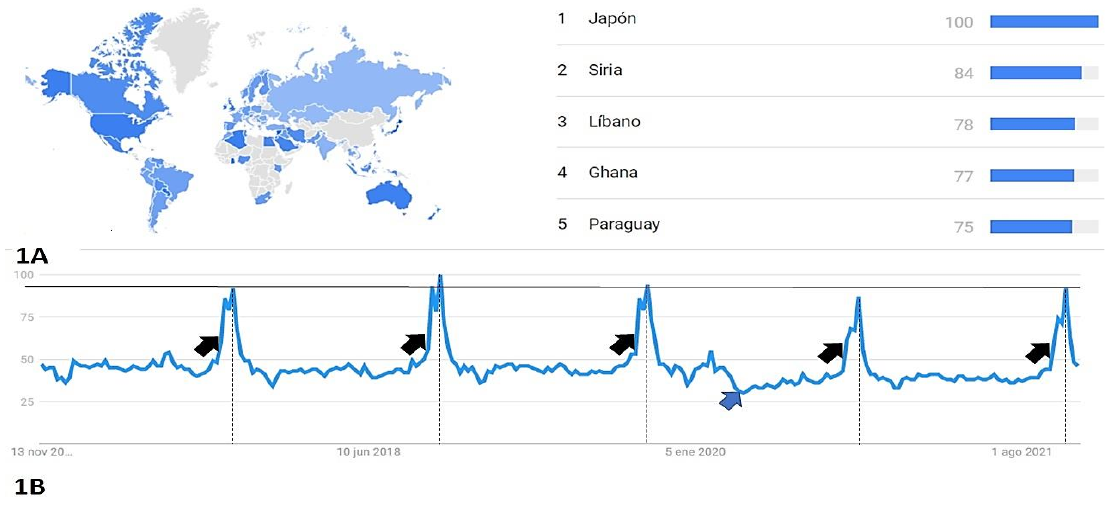
The data found during the evaluation denote two situations; The first indicates that the campaigns carried out during the period studied have generated a significant impact on the population's interest in breast cancer, so that many people around the world are interested in this topic, thus allowing greater knowledge about it, which leads to the generation of awareness and sensitization towards it; The second situation demonstrates the work of international health agencies in the search to generate a greater global impact with breast cancer campaigns in this year, despite the current pandemic.
All this panorama revealed by the study highlights the importance of campaigns against breast cancer, as well as the commitment of international health organizations in the fight against this public health problem, but at the same time it also motivates a reflection based on the following hypothesis: the implementation of campaigns against breast cancer on additional dates to those already established would generate greater interest in the world population and therefore greater knowledge, awareness and sensitization about it, which would probably allow accelerating the decrease in annual mortality, which would allow completing in less time the objectives proposed with this type of campaigns.
Declarations
- Author contributions (CRediT)
- All authors contributed equally to all 14 CRediT roles (Conceptualization, Data curation, Formal analysis, Funding acquisition, Investigation, Methodology, Project administration, Resources, Software, Supervision, Validation, Visualization, Writing – original draft, Writing – review & editing).
- Funding
-
Funding information was not reported in the published version of this article.
- Conflicts of interest
- A conflict of interest statement was not reported in the published version of this article.
- Ethics approval
- Ethics approval details were not reported in the published version of this article.
- Data availability
- Data sharing is not applicable to this article as no new data were created or analysed in this study.
References (7)
3 of 7 references are linked to their DOI.
- Cancer today [Internet] [citado 20 de octubre de 2021]. Disponible en: http://gco.iarc.fr/today/home PubMed Google Scholar
- Cáncer de mama [Internet] [citado 20 de octubre de 2021]. Disponible en: https://www.who.int/es/news-room/fact-sheets/detail/breast-cancer PubMed Google Scholar
- Una cita importante: octubre es el Mes de Sensibilización sobre el Cáncer de Mama [Internet]. [citado 9 de noviembre de 2021]. Disponible en: https://www.who.int/es/news-room/ commentaries/detail/a-month-to-remember-breast-cancer -awareness-month PubMed Google Scholar
- Tejada-Llacsa PJ. Qué se busca sobre el aborto en Internet? Una evaluación con Google Trends en Perú. Gac Sanit. 1 de julio de 2016;30(4):319 DOI Crossref PubMed Google Scholar
- Nuti SV, Wayda B, Ranasinghe I, Wang S, Dreyer RP, Chen SI, et al. The Use of Google Trends in Health Care Research: A Systematic Review. PLOS ONE. 22 de octubre de 2014;9(10): e109583 DOI Crossref PubMed Google Scholar
- La OMS caracteriza a COVID-19 como una pandemia - OPS/ OMS Organización Panamericana de la Salud [Internet]. [citado 29 de noviembre de 2021]. Disponible en: https:// www.paho.org/es/noticias/11-3-2020-oms-caracteriza-covid -19-como-pandemia PubMed Google Scholar
- Adelhoefer S, Berning P, Solomon SB, Maybody M, Whelton SP, Blaha MJ, et al. Decreased public pursuit of cancer-related information during the COVID-19 pandemic in the United States. Cancer Causes Control. 2021;1-9 DOI Crossref PubMed Google Scholar
Respond to this article
Comments on a published article are welcome as a Letter to the Editor.
Get an e-mail when new articles in your fields are published
Questions to the authors
Questions are moderated: an editor approves each question, the authors answer, and an editor approves the answer before both appear here.
No answered questions yet.
Ask the authors a question
Discussion
Comments are moderated: they appear after the writer confirms the e-mail address and an editor approves them. Each comment carries a conflict-of-interest statement.
No comments yet.
Write a comment
Read the full text
Open the PDF here
Loading the PDF…
If the PDF does not show here, use the download button above.
How to cite this article
Salas MAL, Jimenez MCM, Coronel MB, Acosta JPM, Salas EAL. Impact of Breast Cancer Campaigns in the Last 5 Years: A Global Assessment with Google Trends. Ulutas Med J. 2022;8(2):73-75. doi:10.5455/umj.20211211075900
Salas, M. A. L., Jimenez, M. C. M., Coronel, M. B., Acosta, J. P. M., & Salas, E. A. L. (2022). Impact of Breast Cancer Campaigns in the Last 5 Years: A Global Assessment with Google Trends. The Ulutas Medical Journal, 8(2), 73–75. https://doi.org/10.5455/umj.20211211075900
Salas, M.A.L. et al. (2022) 'Impact of Breast Cancer Campaigns in the Last 5 Years: A Global Assessment with Google Trends', The Ulutas Medical Journal, 8(2), pp. 73–75. doi: 10.5455/umj.20211211075900.