The Ulutas Medical Journal · ISSN 2149-0430 (print), 2149-388X (online) · https://www.ulutasmedicaljournal.com/?mno=257768
Case Report · Open access
Multiple Burns Associated with the Alternative Treatment: Cupping Therapy
- Department of Emergency Medicine, Adıyaman University, Research and Educational Hospital, Adıyaman, Turkey ROR
- Department of Plastic and Reconstructive Surgery, Adıyaman University, Research and Educational Hospital, Adıyaman, Turkey ROR
Abstract
- Background
- The cupping process fundamentally includes producing a compact section of low air pressure beside the epidermis. This therapy gained credibility within some biomedical health care centers in Turkey.
- Case Presentation
- The 57-year-old woman applied to our emergency polyclinic with complaints of painful back and second-degree multiple burns. The case had six different burned areas with similar sizes. In her history, she had taken medication and that symptom did not improve. On the proposition of its neighbors, she attempted a single method called "Cupping" among the public, by placing a piece of paper burned with fire into a wide tea cup and placing it on his back, for a few times.
- Conclusion
- Burns as a result of cupping are avoidable, and thereby the initial stage is improving the consciousness of the community and medical treatment specialists of the liability of those wounds. We expect the case presentation will contribute in improving consciousness of the risks included in the treatment of cupping.
Keywords
Full text
Introduction
Supplementary and optional treatmentsare becoming remarkably common and it has acquired credibility within various biomedical health-care facilities in Turkey (1). The cupping technique, one of the widest alternative therapy, is utilized in numerous traditions for several issues like hypertension, microbial infection, aches and pains, psychological ailments, cardiovascular diseases and various disease problems, and dermis problems (2). The cupping process fundamentally includes producing a compact section of low air pressure beside epidermis. The procedure may be via utilizing a cup as equipment over the skin. Used cup may differ in patterns and can vary in dimensions from 1-3 inches (equal to 2-8 cm) across the beginning (3).
Plastic material and glass are the most frequent resources nowadays, exchanging the horn, pottery, bronze and bamboo cups utilized formerly. The minimal air pressure needed can be produced by warming the cup or a shower with warm perfumed essential oil, after that positioning that against epidermis (4). Since inside air of cup gets cooler, shrinks in proportions and pulls epidermis moderately inside of it. In the procedure, cups are typically utilized solely on softer tissue that may shape a great deal with border of glass. A sizeable cup can be beneficial to ensure a wider region (5). The epidermis may be lubricated, letting it to shift across epidermis gradually (6).
The back, abdominal area, and buttock; regions of sufficient muscle tissue, are typical areas on which cup was utilized. Cups are usually remained in position for 5 to 10 mins. The following consequences of cupping regularly contain complaints of ecchymosis, edema and erythema in a conventional circular combination. All these bruises might obtain days to a few weeks to diminish (7).
Case Presentation
The 57-year-old woman applied to our emergency polyclinic with complaints of painful back and second degree multiple burns (Figure-1).
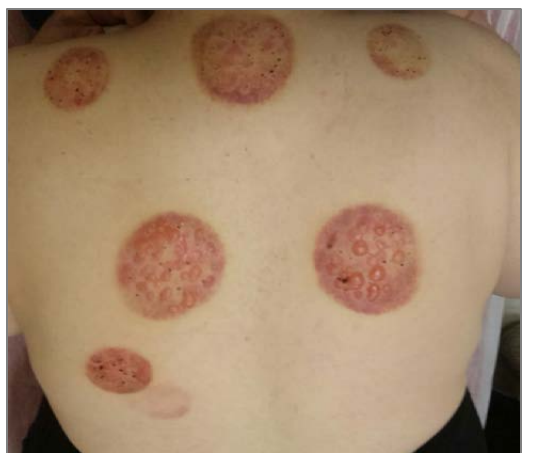
During examination, the patient had six different burned areas with similar sizes. In her history, she had taken medication and that symptoms did not improve. On the proposition of its neighbors, she attempted a single method called “Cupping” among the public, by placing a piece of paper burned with fire into a wide tea cup and placing it on his back, for a few times.
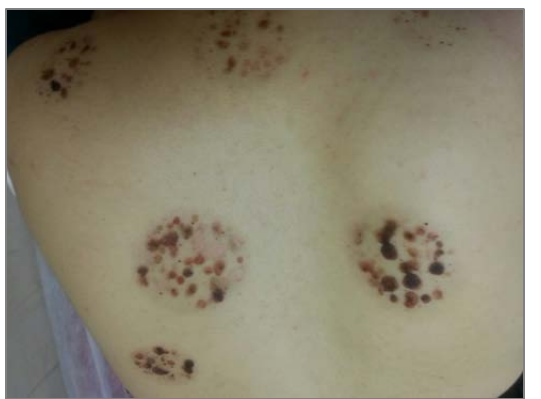
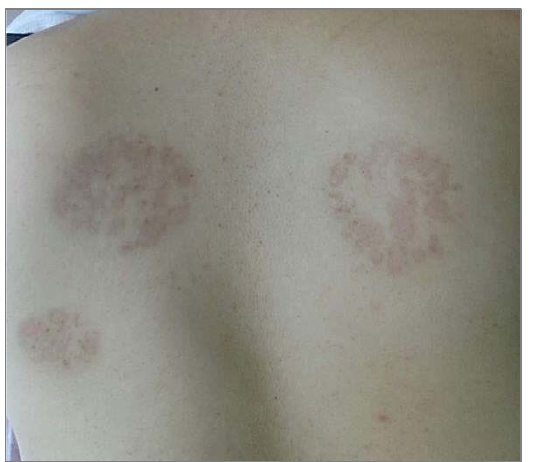
After the initial assessment, the burns were washed with serum without opening current value (Figure-2). Those are all dressed with silver sulfadiazine cream. She took her treatment in Plastic Surgery service for 3 days. Decephin antibiotic and tiocillin pomad were used for enfection suspect with high fever. After a total of 8 days of treatment, all burns healed with minimal scarring area (Figure-3).
Conclusion
The cupping is a popular medicine for the various health problems. It really is a reliable and non-invasive, as well as economical (6). Dermatology specialists need to acknowledge the specific morphology produced from this technique. The cupping is not related to severe unwanted situations in the event that performed in completely sterile circumstance. The majority of the local skin alters subside within a couple of days (3). Histological alterations in the skin layers originate from vasodilatation and edema without cellular infiltrate.
Farhadi et al. situated that cupping treatment was related to the medically considerable alleviation of ache at three months (8). Treatment by cupping enhanced lower-back aches severity, handicap of pain severity, and tablets use compare to heatlhy. Cupping is regarded as to stimulate pain receptors which bring about raise occurrence of stimulation, thus eventually causing closure of the ache gates and accordingly ache decrease (3).
Burn injuries is not a frequent complication of cupping at present since plastic type cups and physical section are utilized as an alternative for the older training of utilizng cotton at foundation of brassmaking, metal, or glass. Severe as negative consequences were not presented (1).
Burns as a result of cupping are avoidable, and thereby the initial stage is improving the consciousness of the community and medical treatment specialists of the liability of those wounds. We expect the case presentation will contribute in improving consciousness of the risks included in the treatment of cupping.
Declarations
- Author contributions (CRediT)
- All authors contributed equally to all 14 CRediT roles (Conceptualization, Data curation, Formal analysis, Funding acquisition, Investigation, Methodology, Project administration, Resources, Software, Supervision, Validation, Visualization, Writing – original draft, Writing – review & editing).
- Funding
-
Funding information was not reported in the published version of this article.
- Conflicts of interest
- All authors declare that there was no conflict of interest in the presented case report.
- Ethics approval
- Ethics approval details were not reported in the published version of this article.
- Data availability
- A data availability statement was not reported in the published version of this article.
References (8)
6 of 8 references are linked to their DOI.
- Kulahci Y, Sever C, Sahin C, Evinc R. Burn caused by cupping therapy. Journal of burn care & research: official publication of the American Burn Association. 2011;32(2):e31. DOI Crossref PubMed Google Scholar
- Iblher N, Stark B. Cupping treatment and associated burn risk: a plastic surgeon's perspective. Journal of burn care & research: official publication of American Burn Association. 2007,28(2):355-8. DOI Crossref PubMed Google Scholar
- Jiang CG, Liang LA. [Samples for therapeutic errors in cupping therapyl. Zhongguo zhen jiu = Chinese acupuncture & moxibustion. 2005;25(9):671-2. PubMed Google Scholar
- Hon KL, Luk DC, Leong KF, Leung AK. Cupping Therapy May be Harmful for Eczema: A PubMed Search. Case reports in pediatrics. 2013;2013:605829. DOI Crossref PubMed Google Scholar
- Chen B, Guo Y, Li MY, Chen ZL, Guo Y. Standardization of cupping therapy may reduce adverse effects. QJM: monthly journal of the Association of Physicians. 2016;109(4):287. DOI Crossref PubMed Google Scholar
- Chen B, Li MY, Liu PD, Guo Y, Chen ZL. Alternative medicine: an update on cupping therapy. QJM: monthly Jjournal of the Association of Physicians. 2015;108(7):523-5. DOI Crossref PubMed Google Scholar
- Jing-Chun Z, Jia-Ao Y, Chun-ling X, Kai S, Lai-Jin L. Burns induced by cupping therapy in a burn center in northeast china. Wounds: a compendium of clinical research and practice. 2014;26(7):214-20. PubMed Google Scholar
- Farhadi K, Schwebel DC, Saeb M, Choubsaz M, Mohammadi R, Ahmadi A. The effectiveness of wet-cupping for nonspecific low back pain in Iran: A randomized controlled trial. Complementary Therapies in Medicine. 2009;17(1):9-15. DOI Crossref PubMed Google Scholar
Read the full text
Open the PDF here
Loading the PDF…
If the PDF does not show here, use the download button above.
How to cite this article
Algin A, Aydin I, Sen H, Poyraz MK. Multiple Burns Associated with the Alternative Treatment: Cupping Therapy. Ulutas Med J. 2017;3(1):20-22. doi:10.5455/umj.20170205020025
Algin, A., Aydin, I., Sen, H., & Poyraz, M. K. (2017). Multiple Burns Associated with the Alternative Treatment: Cupping Therapy. The Ulutas Medical Journal, 3(1), 20–22. https://doi.org/10.5455/umj.20170205020025
Algin, A. et al. (2017) 'Multiple Burns Associated with the Alternative Treatment: Cupping Therapy', The Ulutas Medical Journal, 3(1), pp. 20–22. doi: 10.5455/umj.20170205020025.