The Ulutas Medical Journal · ISSN 2149-0430 (print), 2149-388X (online) · https://www.ulutasmedicaljournal.com/?mno=34085
Original Article · Open access
Is There Any Relationship Between Circulating Serum 25-Hydroxyvitamin D Level and Presence of Helicobacter Pylori As Well As Gastric Inflammation Severity?
- Bulent Ecevit University Medical Faculty, Gastroenterology ROR
Abstract
- Background
- Helicobacter Pylori (H. Pylori) and ongoing chronic gastric inflammation are the most crucial factors leading to gastric cancer. The serum 25 Hydroxyvitamin D is the fundamental keys to the proper functioning of the immune system and reduction of inflammation. The primary aim of this study is to evaluate the association between the serum level of 25 Hydroxyvitamin D and the presence of H. Pylori as well as gastric inflammation.
- Materials and Methods
- A total of 91 (18-85 years old) dyspeptic patients having a standard laboratory parameter (hematologic, liver and kidney) without chronic medical problems and were enrolled in this study. During an upper endoscopy, at least four stomach biopsies were taken and evaluated according to Sydney classification. The serum 25-Hydroxyvitamin D level was also calculated at the same time endoscopy.
- Results
- In population, 48 (52.7%) were H. Pylori positive, while 41 (47.3%) were H. Pylori negative. The mean age, gender, hemoglobin, mean corpuscular volume, mean platelet volume, CRP, ferritin, red cell distribution width, endoscopic findings, and iron were similar in two groups (p<0.05). The mean serum 25-Hydroxyvitamin D level was not different between the two groups (p=0.375). The mean serum 25-Hydroxyvitamin D vitamin level was also not different in gastric inflammation sub-groups (p>0.05). The serum 25-Hydroxyvitamin D levels were similar in groups of H. Pylori positive and negative.
- Conclusion
- This is the first study investigating the relationship between the serum 25-Hydroxyvitamin D level and H. Pylori as well as gastric inflammation sub-groups. Consequently, we found no relationship between serum 25 Hydroxyvitamin D level and H. Pylori as well as gastric inflammation severity.
Keywords
Full text
Introduction
Helicobacter pylori (H.Pylori) is still a common health problem in all over the world country, especially in developing countries (1, 2). Pylori and its related problems are still not solved even in developed countries. The main reasons are that, first; the sanitation conditions are still not corrected. Consequently, the new contaminations and transmissions cannot be prevented sufficiently. The second is the low eradication rate due to antibiotic resistance caused by the inability to use the drugs given in sufficient amount and duration and the inadequate use of these drugs due to toxic side effects (2). H. Pylori can cause many diseases ranging from a mild problem such as simple ulceration to gastric cancer in some individuals according to genetic predisposition, as well as problems in many organs outside of the stomach in various degrees of tissue (3, 4). According to the World Health Organization, if an individual has an H. Pylori virus, it is recommended to be eradicated in high-risk patients, and those with an average risk should be eradicated after the patient is informed (5). Benefits of eradication are mainly that not only the shortening of clinical problems such as ulcers within a short period but also the preventing effect against to development of gastric cancer in a long period (2).
The main transmission of H. Pylori is by oral ingestion, and after the ingestion of infected food and water, it is settled in the host. The most important factors in settlement of the host to the natural immunity, as well as the immunity, obtained later in immunity is of great importance (5). Some factors are particularly important in ensuring and adapting this adaptive immunity. One of them is the 25- Hydroxyvitamin D level (6). According to the old information; while it is known that the serum 25-Hydroxyvitamin D level plays a major role in our body's bone and calcium mineral balance circle, it is known that the immune system plays a critical role in sustaining the immune system, preventing chronic infections and even preventing the formation of cancer in recent years (7).
In recent studies, it was found that the serum 25-Hydroxyvitamin D level was significantly lower in cancer patients compared to healthy subjects in many cancer studies (7–9). Similarly, in many chronic inflammatory diseases, a similar 25-Hydroxyvitamin D deficiency has been demonstrated (10–12). The H. Pylori induced chronic gastric inflammation is known to decrease the levels of vitamins such as iron, vitamin B-12, and folic acid. However, there is no information in the literature as to any relationship between the presence of H. Pylori and serum 25-Hydroxyvitamin D. Moreover, there is no data about whether serum 25- Hydroxyvitamin D levels affect the H. Pylori condition or gastric inflammation severity. In this study, we wanted to investigate whether the serum 25-Hydroxyvitamin D levels are different in patients with H. Pylori positive and negative as well as whether there is a relationship between the severity of gastric inflammation severity and the serum 25-Hydroxyvitamin D level. This study is the first study investigating the relationship between H. Pylori and stomach inflammation as well as serum 25-Hydroxy vitamin D level for the first time in the literature.
Materials and Methods
The current study was carried out in the Gastroenterology Clinic of Bülent Ecevit University Medical Faculty, which was accepted as the reference center in the region, between September 2017 and February 2018. Sample group, which was planned to be studied, consisted of a special patient population that was applied to this clinic and whose medical records had no important chronic disease such as diabetes mellitus, cancer, and inflammatory disease. A total of 750 case files were analyzed retrospectively. The main criteria for inclusion in this study are as follows; first, patients aged between 18-85 years old without any other chronic problem (anemia, iron deficiency, thrombocytopenia, elevation of liver enzyme, height of C-reactive protein), second, those have dyspeptic complaint that was performed an upper endoscopy (at least four biopsy specimens were taken from the stomach and evaluated according to Sydney classification), third, patients were documented serum 25- Hydroxyvitamin D level, which did not receive vitamin D replacement therapy, at the same time with endoscopic examination. The routine blood examinations and serum 25-Hydroxy vitamin D level was analyzed with a commercial technique during admission. The level of serum 25-Hydroxyvitamin D level was calculated in the standardized laboratory compatible with the literature. Initially, hemoglobin, the mean erythrocyte volume, red cell distribution width, C-reactive protein, platelet count and mean platelet volume values were evaluated, and patients with abnormal values were left out. The endoscopy procedure was performed by a single operator by the recommendations of the guidelines. Pathological examination was performed according to Sydney classification with hematoxylin and eosin dye and other required dyes (4). The study was carried out by the International Helsinki Declaration by the ethical rules, and local ethics committee approval was obtained (2017-06-22;2017-113).
Statistical Analyze
Statistical analysis was performed with SPSS-18. After investigation of the distribution of the values was normal or not with at least three different tests, chi-square, one-way ANOVA, and the correlation tests were performed. A p-value <0.05 was considered significant.
Results
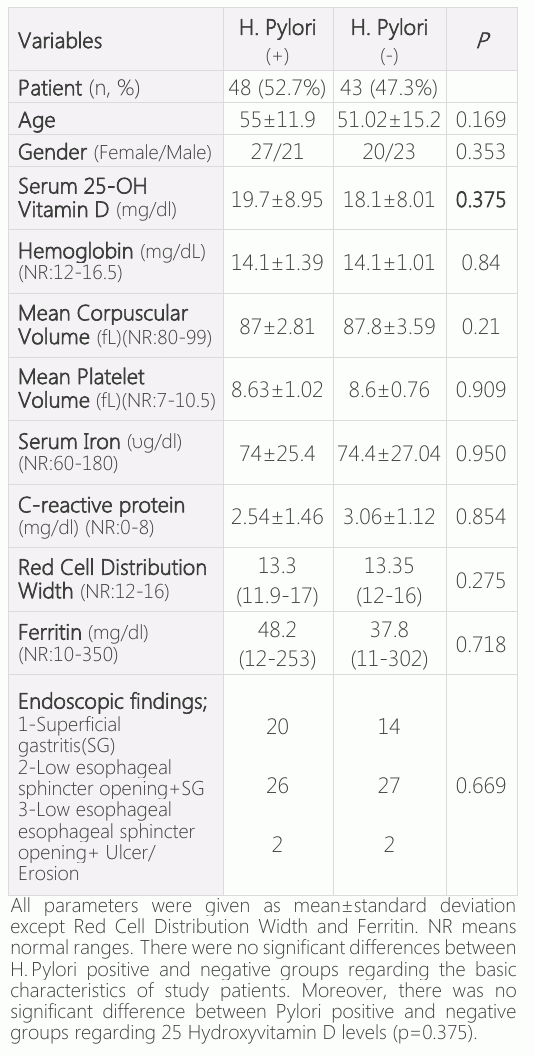
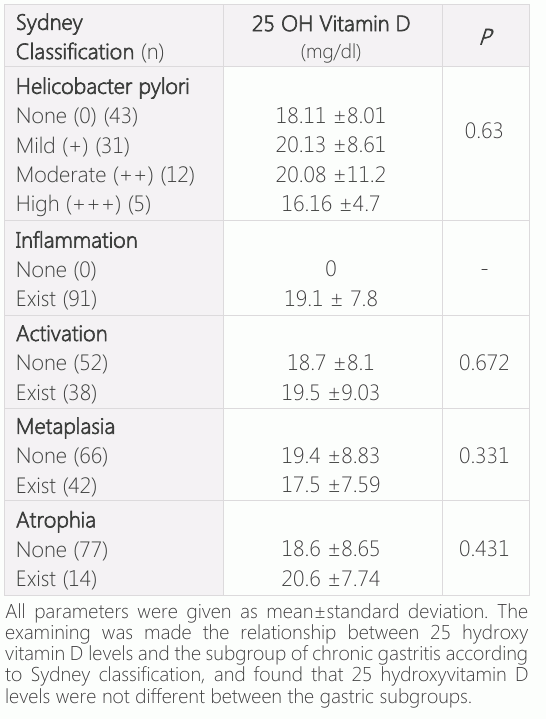
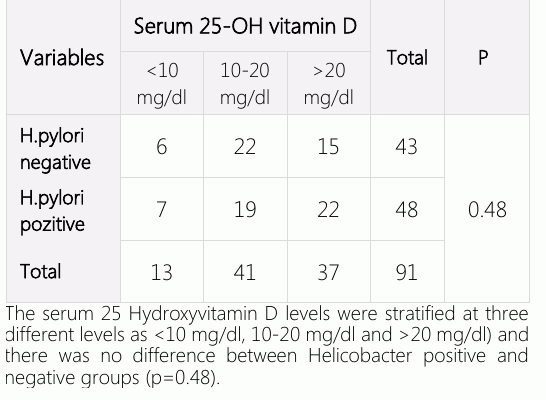
A total of 91 patients were admitted to the study. The study group was first divided into two groups as Hp positive and Hp negative. While 48 (52.7%) patients were Hp positive, 43 (47.3%) patients were Hp negative. There was no significant difference between the two groups(p>0.05). The mean erythrocyte volume, red cell distribution width, C-reactive protein, platelet count, mean platelet volume and ferritin values were not different in both groups (p>0.05). There was also no difference between the two groups in terms of endoscopic findings. The serum 25-Hydroxyvitamin D level, which is the main subject of study, was 19.7±8.95 and 18.1±8.01 in H.Pylori positive and negative patients, respectively, and no difference was seen between two groups (p=0.375)(Table-1). When subject of gastritis is examined according to Sydney classification, there is no difference in serum 25-Hydroxyvitamin D levels according to the severity of gastric inflammation. Similarly, the serum 25-Hydroxy vitamin D levels were similar in subgroups of gastric inflammation as activation, intestinal metaplasia, and atrophy (Table-2). When the serum 25-Hydroxyvitamin D investigated as 25-Hydroxyvitamin D<10 mg/dl significantly low, 10-20mg/dl incomplete and >20 mg/dl normal, there is no statistical differences between HP positive and negative (Table-3).
Discussion
In this study, we investigated whether there is a relationship between 25-Hydroxyvitamin D levels and the presence of H. Pylori as well as the severity of gastritis according to Sydney Classification. Unfortunately, we found that there was no relationship between the presence of H. Pylori and 25-Hydroxyvitamin D levels as well as chronic gastric severity. To our best knowledge, this study is the first study on this subject in the literature.
Many H. Pylori related clinical outcomes, including gastric cancer, is still being a significant health problem in the worldwide especially for developing countries (1, 2). The main reason for this is the increasing severity of chronic gastric inflammation due to the long-term presence of H. Pylori. Chronic stomach inflammation may get the tissues to lose their natural state and enter a pathway towards cancer (4). In this pathway, some subgroups of H. Pylori related inflammation contribute significantly. Therefore, both H. Pylori and H. Pylori related low-grade chronic gastric inflammation is still the subject of essential articles published important journals (13–15). The most important factors leading to gastric cancer are H. Pylori density, the presence of intestinal metaplasia, atrophy and dysplasia. In these factors, while H. Pylori can be eliminated, other factors cannot be removed precisely. Therefore, regular follow-up is recommended at specific time intervals to catch a premature malignant lesion in early stage (2). Although the primary function of vitamin D in the organism is known to be only calcium metabolism in the past, its relationship with cancer and other chronic inflammatory diseases has been increasing in recent years. In recent years, vitamin D is an important key molecule that has been learned in the immune system and many important pathways in the cell (6). The level of serum vitamin D circulating in the blood is best examined as 25 (OH) vitamin D. In many recent studies, serum 25-Hydroxyvitamin D levels are low in many different cancer types and inflammatory patients compared to the control group (5, 16). In this context, the vitamin D level in gastrointestinal tract cancers (such as the stomach, large intestine) was found lower than the control group and were associated with poor prognosis (17). In the same way, it is claimed that there is a low vitamin D level in chronic inflammation and there is a connection between inflammation severities (18). Similarly, it is claimed that vitamin D and vitamin D receptor alteration play important roles in the cell and as a result, it can be claimed that it can facilitate cancer and chronic inflammation diseases (18, 19).
Antico et al. reported that serum 25-Hydroxy vitamin D levels were significantly lower in autoimmune gastritis groups compared to 21 H. Pylori gastritis and therefore he was claimed that low vitamin D levels might be a risk factor for autoimmune gastritis (8). Yıldırım et al. found that the rate of vitamin D was lower in those who failed H. pylori eradication (9.13±4.7 vs. 19.03±8.13; p=0.001). It was suggested in the discussion part of this study that vitamin D deficiency may be an important risk factor for H. Pylori eradication and it may be necessary to increase the eradication rates of vitamin D supplementation (20).
In a study performed by Archontogeorgis et al, 107 patients with respiratory sleep apnea were divided into two parts according to the presence of metabolic syndrome and vitamin D levels and serum 25-Hydroxyvitamin D level was found significantly lower in patients with metabolic syndrome (21). In a study conducted by Bae et al., 85 type 1 diabetic patients and 518 healthy control groups were compared according to serum 25-Hydroxyvitamin D level and it was found that serum 25-Hydroxyvitamin D levels were significantly lower in type-1 diabetic patients (9). In the study of Costanza et al., it was emphasized that the vitamin D supplementation significantly suppressed the inflammation, indicating that many infectious markers such as Tumor Necrosis Factor-alpha, Interleukin 8, Interleukin 6 and Interleukin 10 decreased after D-vitamin supplementation (22). In the review of D'Aurizio et al., the vitamin D level has been shown to be affected by many inflammatory diseases such as Graves, Hashimoto thyroiditis, multiple sclerosis, type 1 diabetes, and rheumatoid arthritis are the most common ones (11). In the study of Wallbaum et al., it was shown in mouse pancreas that serum 25-Hydroxyvitamin D had an anti-fibrinolytic property (23). A similar molecular effect was demonstrated by Costanzo et al. in their study on the intestinal mucosa. In this study, it was also found that vitamin D supplementation decreased microflora in intestine by decreasing harmful bacterium and inflammatory cytokines (22). In a study performed by Liop and et al. in patients with 333 uveitis and 329 control groups, he suggested that vitamin D deficiency increases the risk of uveitis 1.92 times and vitamin D deficiency is a risk factor for uveitis formation (24). Jiménez-Sousa et al. reported that there was a link between vitamin D deficiency and immune system weakness, which might predispose to viral infections. In fact, it is emphasized that vitamin D supplementation can be achieved by contributing to the development of the immune system (14). In the study of Wallbaum et al., they have been found to have anti-fibrinolytic properties of vitamin D in their study in mouse pancreas (23).
Consequently, 25-Hydroxyvitamin D and its relationship with cancer and inflammation have been increasing of matter in recent years. We have studied the relationship between serum Hydroxyvitamin D and H. Pylori as well as gastric inflammation severity, but no data was found to be an association. In our opinion, this may be due to the fact that inflammation of the stomach caused by Helicobacter pylori is not affected by systemic events.
This study revealed that the Helicobacter pylori did not directly reduce the serum 25- Hydroxyvitamin D or serum 25-Hydroxyvitamin D level had no effect on H. Pylori positivity.
Declarations
- Author contributions (CRediT)
- All authors contributed equally to all 14 CRediT roles (Conceptualization, Data curation, Formal analysis, Funding acquisition, Investigation, Methodology, Project administration, Resources, Software, Supervision, Validation, Visualization, Writing – original draft, Writing – review & editing).
- Funding
-
Funding information was not reported in the published version of this article.
- Conflicts of interest
- The author declared no conflict of interest with the present article.
- Ethics approval
- The study was carried out by the International Helsinki Declaration by the ethical rules, and local ethics committee approval was obtained (2017- 06-22;2017-113).
- Data availability
- A data availability statement was not reported in the published version of this article.
References (24)
21 of 24 references are linked to their DOI.
- Shetty V, Ballal M, Balaraju G, Shetty S, Pai GC, Lingadakai R. Helicobacter pylori in Dyspepsia: Phenotypic and Genotypic Methods of Diagnosis. J Glob Infect Dis. 2017; 9(4):131-4 DOI Crossref PubMed Google Scholar
- Moayyedi PM, Lacy BE, Andrews CN, Enns RA, Howden CW, Vakil N. ACG and CAG Clinical Guideline: Management of Dyspepsia. Am J Gastroenterol. 2017;112 (7):988-1013 DOI Crossref PubMed Google Scholar
- Muhammad JS, Zaidi SF, Saeed SA, Ishaq M. Current status of Helicobacter pylori association with haematological and cardiovascular diseases: A mini review. J Pak Med Assoc. 2017;67(6):907-11 PubMed Google Scholar
- Badary DM, Rahma MZAA, Ashmawy AM, Hafez MZ. H. pylori infection increases gastric mucosal COX2 and mTOR expression in chronic gastritis: Implications for cancer progression? Pathophysiology. 2017;24(3):205-11 DOI Crossref PubMed Google Scholar
- Dolak W, Bilgilier C, Stadlmann A, Leiner J, Püspök A, Plieschnegger W, et al. A multicenter prospective study on the diagnostic performance of a new liquid rapid urease test for the diagnosis of Helicobacter pylori infection. Gut Pathog. 2017;9:78 DOI Crossref PubMed Google Scholar
- Guo L, Chen W, Zhu H, Chen Y, Wan X, Yang N, et al. Helicobacter pylori induces increased expression of the vitamin d receptor in immune responses. Helicobacter. 2014;19(1):37-47 PubMed Google Scholar
- Walker RE, Bartley J, Camargo CA, Flint D, Thompson JMD, Mitchell EA. Higher serum 25(OH)D concentration is associated with lower risk of chronic otitis media with effusion: a case-control study. Acta Paediatr. 2017;106 (9):1487-92 DOI Crossref PubMed Google Scholar
- Antico A, Tozzoli R, Giavarina D, Tonutti E, Bizzaro N. Hypovitaminosis D as predisposing factor for atrophic type A gastritis: a case-control study and review of the literature on the interaction of Vitamin D with the immune system. Clin Rev Allergy Immunol. 2012;42(3):355-64 DOI Crossref PubMed Google Scholar
- Bae KN, Nam HK, Rhie YJ, Song DJ, Lee KH. Low levels of 25-hydroxyvitamin D in children and adolescents with type 1 diabetes mellitus: a single center experience. Ann Pediatr Endocrinol Metab. 2018;23(1):21-7 DOI Crossref PubMed Google Scholar
- Caraba A, Crişan V, Romoşan I, Mozoş I, Murariu M. Vitamin D Status, Disease Activity, and Endothelial Dysfunction in Early Rheumatoid Arthritis Patients. Dis Markers. 2017;2017:5241012 DOI Crossref PubMed Google Scholar
- D'Aurizio F, Villalta D, Metus P, Doretto P, Tozzoli R. Is vitamin D a player or not in the pathophysiology of autoimmune thyroid diseases? Autoimmun Rev. 2015;14 (5):363-9 DOI Crossref PubMed Google Scholar
- Jokar A, Ahmadi K, Taherinia A, Didgar F, Kazemi F, Bahramian M. The Effects of Injected Vitamin D on Prognosis of Patients with Urosepsis. Horm Metab Res. DOI Crossref PubMed Google Scholar
- De Pergola G, Triggiani V, Bartolomeo N, Giagulli VA, Anelli M, Masiello M, et al. Low 25 Hydroxyvitamin D Levels are Independently Associated with Autoimmune Thyroiditis in a Cohort of Apparently Healthy Overweight and Obese Subjects. Endocr Metab Immune Disord Drug Targets. 2018 DOI Crossref PubMed Google Scholar
- Jiménez-Sousa M, Martínez I, Medrano LM, Fernández-Rodríguez A, Resino S. Vitamin D in Human Immuno deficiency Virus Infection: Influence on Immunity and Disease. Front Immunol. 2018;9:458 DOI Crossref PubMed Google Scholar
- Jolliffe DA, Greenberg L, Hooper RL, Griffiths CJ, Camargo CA, Kerley CP, et al. Vitamin D supplementation to prevent asthma exacerbations: a systematic review and meta-analysis of individual participant data. Lancet Respir Med. 2017;5(11):881-90 25-Hydroxyvitamin D and Helicobacter Pylori Tarık Akar DOI Crossref PubMed Google Scholar
- Minalyan A, Benhammou JN, Artashesyan A, Lewis MS, Pisegna JR. Autoimmune atrophic gastritis: current perspectives. Clin Exp Gastroenterol. 2017;10:19-27 DOI Crossref PubMed Google Scholar
- Navarrete-Dechent C, Del Puerto C, Molgó M, González S, Pérez-Mateluna G, Uribe P, et al. Circulating vitamin D-binding protein and free 25-hydroxyvitamin D concentrations in patients with melanoma: A case-control study. J Am Acad Dermatol. 2017;77(3):575-7 DOI Crossref PubMed Google Scholar
- Rafiq R, Thijs W, Prein R, de Jongh RT, Taube C, Hiemstra PS, et al. Associations of Serum 25(OH)D Concentrations with Lung Function, Airway Inflammation and Common Cold in the General Population. Nutrients. 2018;10(1) DOI Crossref PubMed Google Scholar
- Moschonis G, Androutsos O, Hulshof T, Dracopoulou M, Chrousos GP, Manios Y. Vitamin D insufficiency is associated with insulin resistance independently of obesity in primary schoolchildren. The Healthy Growth Study. Pediatr Diabetes. 2018 DOI Crossref PubMed Google Scholar
- Yildirim O, Yildirim T, Seckin Y, Osanmaz P, Bilgic Y, Mete R. The influence of vitamin D deficiency on eradication rates of Helicobacter pylori. Adv Clin Exp Med. 2017;26(9):1377-81 DOI Crossref PubMed Google Scholar
- K, Nena E, Papanas N, Rizzo M, Voulgaris A, Xanthoudaki M, et al. Metabolic Syndrome and Vitamin D Levels in Patients with Obstructive Sleep Apnea Syndrome. Metab Syndr Relat Disord. 2018 PubMed Google Scholar
- Costanzo M, Cesi V, Palone F, Pierdomenico M, Colantoni E, Leter B, et al. Krill oil, vitamin D and Lactobacillus reuteri cooperate to reduce gut inflammation. Benef Microbes. 2018:1-12 DOI Crossref PubMed Google Scholar
- Wallbaum P, Rohde S, Ehlers L, Lange F, Hohn A, Bergner C, et al. Antifibrogenic effects of vitamin D derivatives on mouse pancreatic stellate cells. World J Gastroenterol. 2018;24(2):170-8 DOI Crossref PubMed Google Scholar
- Llop SM, Davoudi S, Stanwyck LK, Sathe S, Tom L, Ahmadi T, et al. Association of Low Vitamin D Levels with Noninfectious Uveitis and Scleritis. Ocul Immunol Inflamm. 2018:1-8 DOI Crossref PubMed Google Scholar
Read the full text
Open the PDF here
Loading the PDF…
If the PDF does not show here, use the download button above.
How to cite this article
Akar T. Is There Any Relationship Between Circulating Serum 25-Hydroxyvitamin D Level and Presence of Helicobacter Pylori As Well As Gastric Inflammation Severity?. Ulutas Med J. 2019;5(1):84-90. doi:10.5455/umj.20190227101537
Akar, T. (2019). Is There Any Relationship Between Circulating Serum 25-Hydroxyvitamin D Level and Presence of Helicobacter Pylori As Well As Gastric Inflammation Severity?. The Ulutas Medical Journal, 5(1), 84–90. https://doi.org/10.5455/umj.20190227101537
Akar, T. (2019) 'Is There Any Relationship Between Circulating Serum 25-Hydroxyvitamin D Level and Presence of Helicobacter Pylori As Well As Gastric Inflammation Severity?', The Ulutas Medical Journal, 5(1), pp. 84–90. doi: 10.5455/umj.20190227101537.