The Ulutas Medical Journal · ISSN 2149-0430 (印刷版), 2149-388X (在线版) · https://www.ulutasmedicaljournal.com/?mno=55300
荟萃分析 · 开放获取
Iclaprim Versus Vancomycin 治疗急性细菌皮肤和皮肤结构感染:随机控制试验的系统审查和元分析
标题、摘要和全文为机器翻译。 英文原文
- Pharmaceutical Sciences and Medical Technology, Putian University, Putian, China ROR
- Intensive Care Medicine, Chi Mei Medical Center, Liouying, Taiwan ROR
- Yijia Pharmacy, Tainan, Taiwan
- School of Management, Putian University, Putian, China ROR
- Orthopedic Surgery, Tung’s Taichung MetroHarbor Hospital, Wuqi District, Taichung City, Taiwan ROR
- 开放获取
- CC BY-NC 4.0
- ORCID
- 资助
- 伦理批准
- 数据可用性
摘要
这一元分析评估了在治疗急性细菌皮肤和皮肤结构感染(ABSSSI)时,与香肠霉素相比,白喉的功效和安全性。 仅列入了随机控制试验(RCTs),比较了Iclaprim和vancomycin对患有ABSSI的成年患者的影响. 共招收了3名成人病人,涉及1 260名成人病人。 Iclaprim与vancomycin相比,临床反应率为非地狱。 在以下分组中也观察到类似趋势:主要皮肤骨折、细胞内炎/红血球、伤口感染、MRSA、MSSA、链球菌发炎。 最后,在甲型六氯环己烷、与毒品有关的乙型六氯环己烷、严重乙型六氯环己烷、因乙型六氯环己烷而停止学习药物和死亡率的风险方面,未发现乙型六氯环己烷和含香素之间有任何差异。 最后,在对ABSSI的处理中,Iclaprium与vancomycin相比表现出非烈性疗效. 此外,Iclaprium与vancomycin一样受到普遍容忍.
关键词
全文
全文为机器翻译;以英文原文为准。 英文原文
导言
自2000年以来,急性细菌皮肤和皮肤结构感染的发病率逐步上升,成为最常见的感染类型之一。 (1–4)使用适当的抗生素是治疗ABSSI的关键,包括细胞内炎/红血球病、大皮疹和伤口感染;因此,这一临床实体也是全世界抗微生物处方的一个常见原因。 (5, 6)与肺炎、腹腔内感染、尿道感染和细菌性贫血等其他类型的感染一样,多种抗药生物的出现在很大程度上限制了抗生素治疗的选择,并对ABSSI患者的结果产生不利影响。 在ABSSSI中,抗甲基西林的Staphyllo coccus aureus(MRSA)是最臭名昭著的MDRO. (7, 8)美国传染病协会建议对急性肺炎和重症性ABSSI的MRSA进行初步覆盖 (9)除了用于治疗MRSA感染的常规静脉注射抗生素的梵科霉素、大肠杆菌素和线粒体素之外,林业发展局还批准了几种抗MRSA活动的新抗生素,包括甲酰胺环素、黄素、黄素素、黄素、黄素和特拉万霉素。 (10–14)Iclaprim是一种二聚氰胺类抗生素,可以抑制细菌二氢叶酸还原酶(DHFR),在高浓度时对人类酶的抑制很少,甚至没有表现出来,这至少需要比细菌DHFR抑制所需的4个数量级. (15, 16)许多体外研究显示,脑浆具有抗克(+)病原体(包括MRSA)的强活性。 (17, 18) 然而,这些新药的疗效和安全性只在有限的临床研究中得到报告,而现实世界临床实践的经验仍然很少。 (19–22)此外,目前仍不清楚的是,iclaprim的临床疗效和不良事件风险是否低于诸如vancomycin等常用抗MRSA剂。 因此,我们对随机控制试验(RCTs)进行了这一元分析,以便在处理ABSSSI时比较Iclaprium和vancomycin。
材料和方法
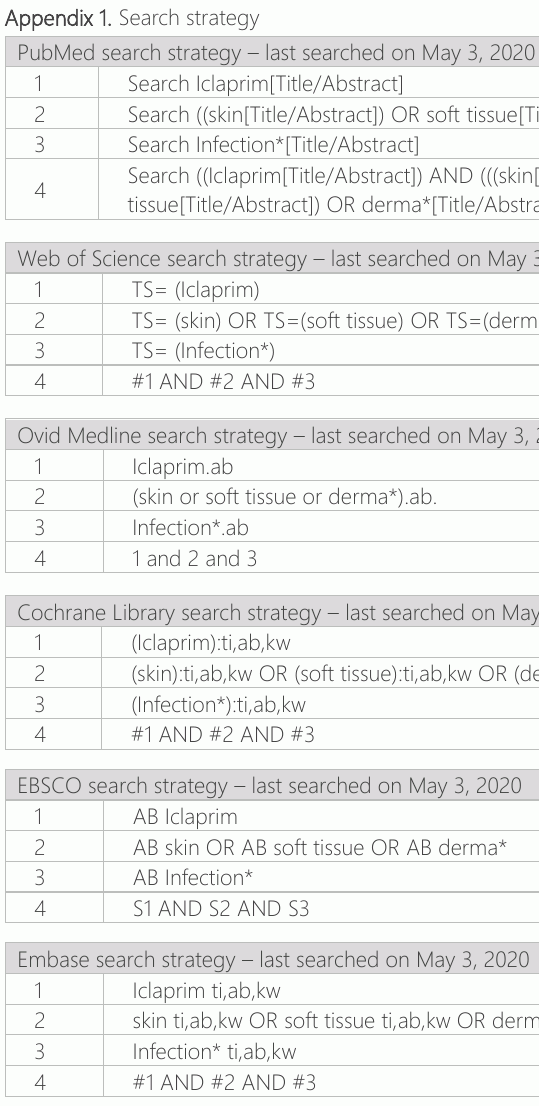
在2020年5月3日之前,通过对数据库,即PubMed、Web of Science、EBSCO、Cochrane图书馆、Ovid Medline和Embase数据库进行系统审查,通过使用下列术语,初步确定了所有候选研究:“Iclaprim”、“皮肤”、“软组织”、“derma”、“感染”。 只有将治疗成年病人(18岁)的临床疗效和乙酰丙胺和香血霉素的AE的临床疗效和风险与ABSSI作比较的RCT包括在内。 排除标准如下:(1)案例报告或案例汇编, (2) 单臂研究, (3) 接受儿科病人或新生儿入学学习; (4) 会议摘要或海报, (5) 药物动力学研究,以及 (6) 在体外学习。 为避免偏见,两名作者(Chan & Lan)负责搜索和审查文章。 如果这两人不同意,另一提交人(Lai)将帮助解决问题并作出最后决定。 所收集的数据包括作者、出版年份、研究设计和持续时间、病人的人口特征、临床反应和有酬企业的风险。 Cochrane Bias评估工具用于评估本元分析中RCTs的偏差风险 (23)由于研究作者刚刚收集并综合了以前临床试验中的数据,在临床试验中,审判调查员已经获得知情同意,因此此项研究不受Chi Mei医疗中心的道德认可。 这一系统审查遵循了系统审查和元分析的优先报告项目准则,并在PROSPERO登记。
定义和结果 主要结果是临床对治疗试验(TOC)的反应. 二级结果包括早期临床反应(ECR),以及AE的风险,即治疗-激酶(TEAE),研究与药物有关的TEAE,严重AE,因AE而中止,以及死亡率。 与基线相比,ECR被定义为损伤大小减少20%,ETP被定义为第一次注入研究药物后48至72小时。 使用5.3版软件审查管理员进行了统计分析。 以 X 生成的Q 统计数据评价了异质性的程度(2) 测试。 采用I2计量法评估了统计异性的比例。 当P值小于0.1或I2大于50%时,异质性被定义为显著. 在数据被分别视为同质或异质时,采用了固定效应模型和随机效应模型。 计算了集合风险比率(RR)和95%的置信间隔(CI),P值 < 0.05被认为具有统计意义。
结果
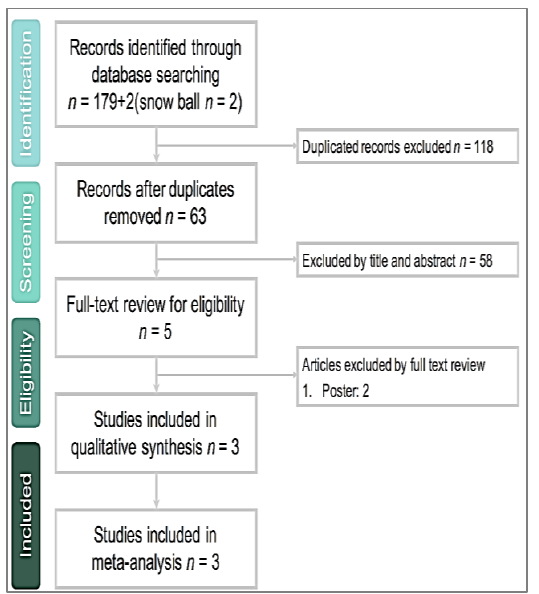
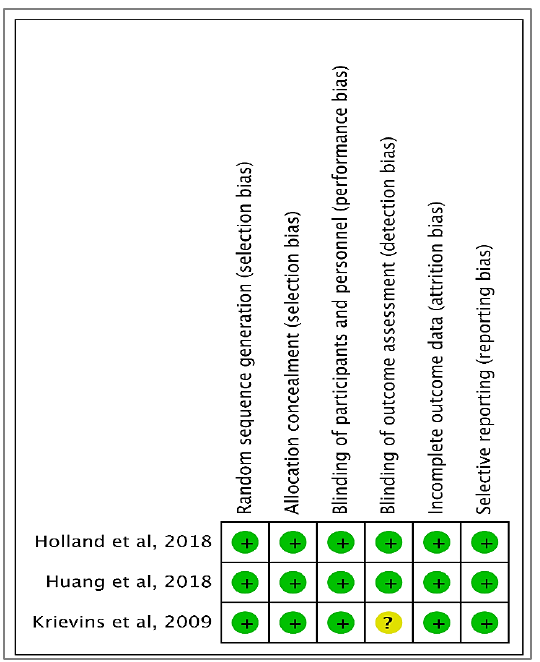
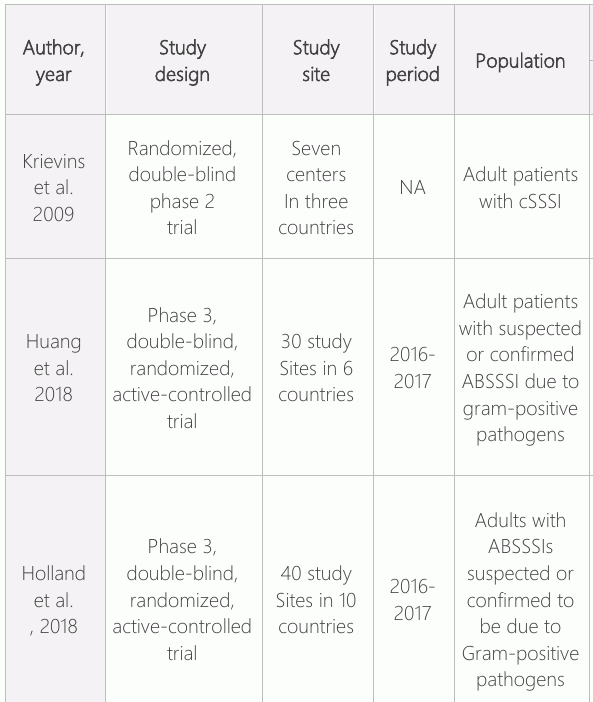
学习选择和特点 搜索程序最初获得了181个参考文献,之后在排除118个重复文章后筛选了63篇文章. 最后,确定了5条供审查资格的全文。 总共只有3项研究 (19–21) 本元分析(图1和附录1)中包括了用于比较治疗ABSSSI的丙氨酸和香氨酸的临床疗效和安全性。 总的来说,这一元分析共涉及1,260名患者,包括Iclaprim组的625名患者和vancomycin组的635名患者. 所有研究都是多中心研究和多国研究。 一个是第二阶段的试验, (19) 其他2个是第三阶段的审判 (20, 21) (见表1)。 一项研究的抗生素使用时间为10天 (19) 其他2项研究中的5-14天 (20, 21)共有324名病人和268名病人分别鉴定了Iclaprium和vancomycin组的病原体。 在第二阶段的审判中, (19) 评估了2次剂量-0.8毫克/千克和1.6毫克/千克的阴唇。 在分析临床疗效时,我们使用了给定的1.6毫克/千克的环肺炎——即治疗剂量,并在评估安全性时使用了这两个组(0.8毫克/千克和1.6毫克/千克)。 在受感染的患者中,S. Aureus是最常见的病原体,分别占Iclaprium组和vancomycin组的68.5%(n=222)和71.3%(n=191). 在S.Aureus感染中,MRSA分别感染了Iclaprium和vancomycin组的100(40.1%)和82(35.6%)。 每项研究中存在偏见的风险如图2所示,其中大多数与偏见风险较低有关。
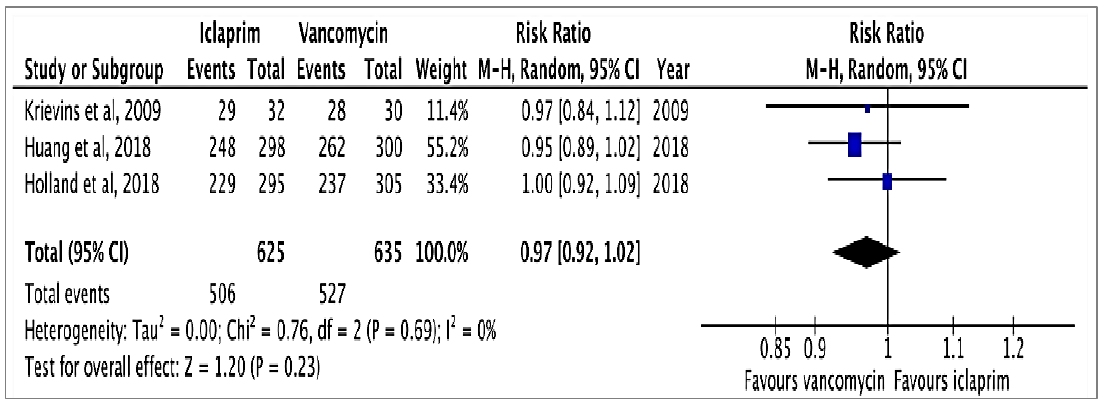
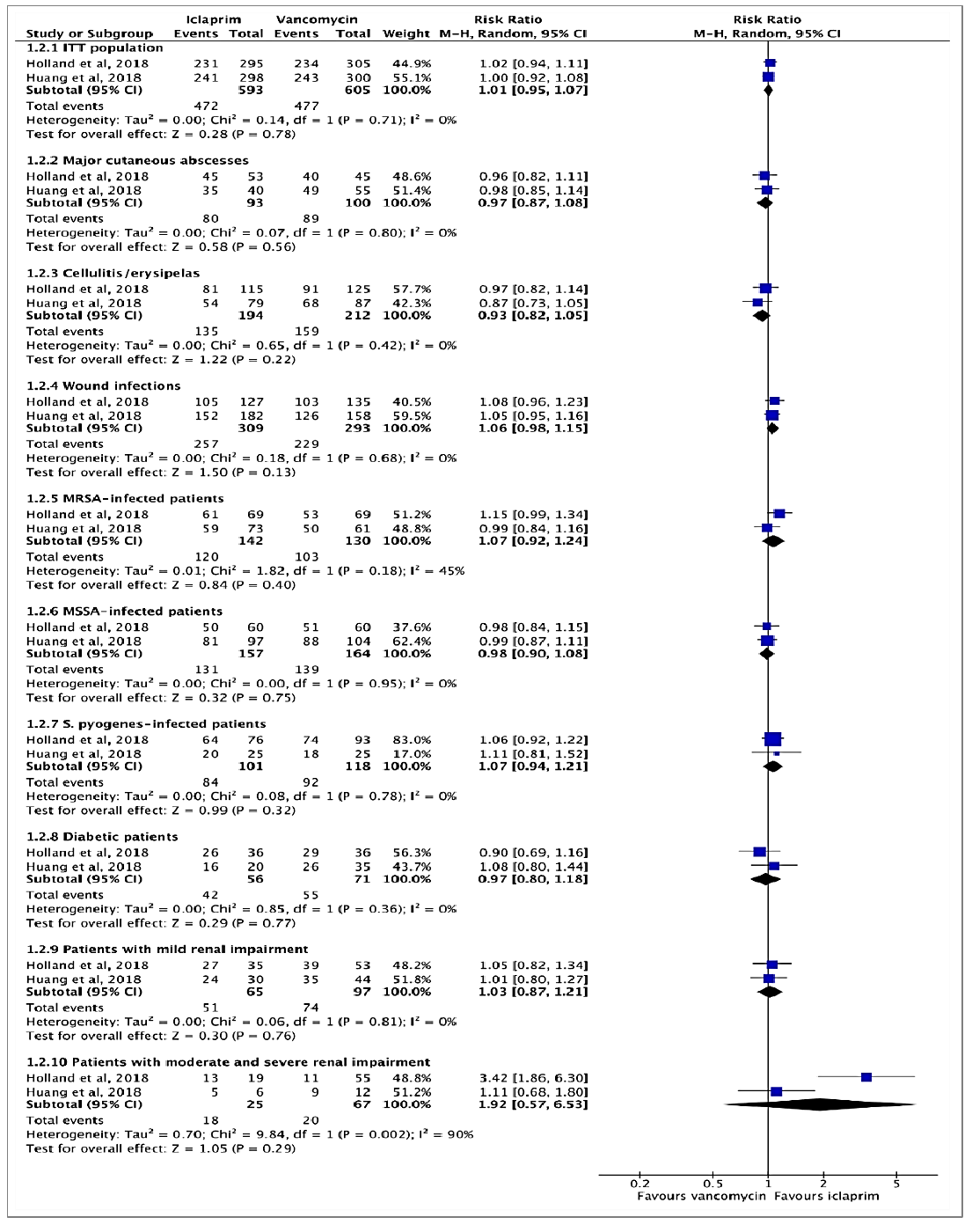
临床疗效 对3次注册试验的汇总分析表明,在接受伊氏剂和香霉素的患者中,TOC的临床治愈率为81.0%(506/625)和82.3%(527/635)。 总体而言,Iclaprium和vancomycin的临床治愈率相似(RR,0.97;95% CI,0.92-1.02,I2=0%,图3)。 在每次删除一项单独研究之后的敏感性分析都揭示了同样的发现. 只有第二阶段的审判 (20, 21) 在ETP上报告了ECR的调查结果. 在ITT人群中,iclaprium和vancomycin组群的ECR和ETP没有区别(80%对78.8%;RR,1.01;95%CI,0.95-1.07,I2=0%,图4)。 在分组分析中,Iclaprium和vancomycin在三种类型的ABSSSI中表现出类似的ECR:主要皮下血栓(RR, 0.97;95%CI, 0.87-1.08, I2=0%),细胞内炎/红血球(RR, 0.93;95%CI, 0.82-1.05, I2=0%)和伤口感染(RR, 1.06;95%CI, 0.98-1.15, I2=0%)。 Iclaprim和vancomycin对3种病原体也具有类似效力:MRSA(RR,1.07;95%CI,0.92-1.24,I2=45%)、MSA(RR,0.98;95%CI,0.90-1.08,I2=0%)和链球菌寄生虫感染(RR,1.07;95%CI,0.94-1.21,I2=0%)。 2种药物在糖尿病患者(RR, 0.97;95%CI, 0.80-1.08, I2=0%)和肾功能障碍患者(Midd学位:RR, 1.03;95%CI, 0.87-1.21, I2=0%;中度和重度:RR, 1.92;95%CI, 0.57-6.53, I2=90%,图4)中再次显示出类似的效果.
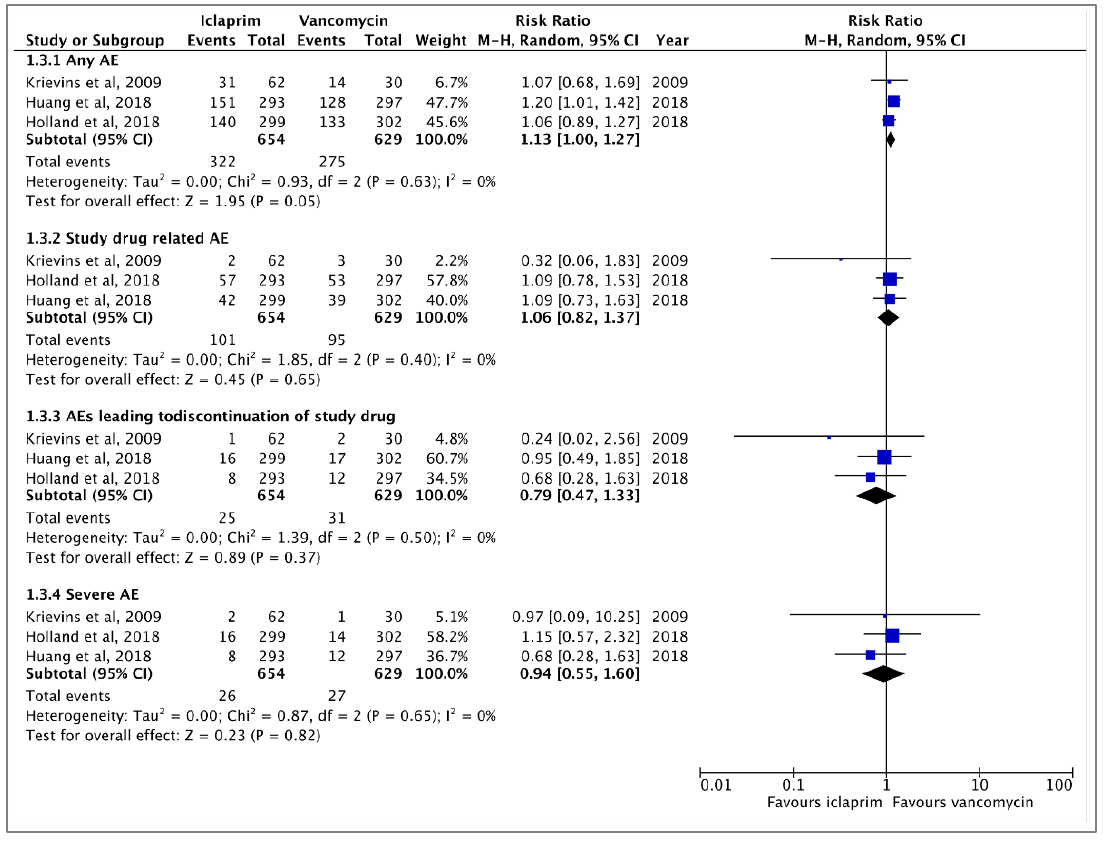
不利事件 在AE风险的集合分析中,Iclaprim和vancomycin与任何AE风险(RR, 1.13;95% CI, 1-1.27, I2=0%),与毒品有关的AE风险(RR, 1.06;95% CI, 0.82-1.37, I2=0%),因AE而停止学习药物(RR, 0.79;95% CI, 0.47-1.33, I2=0%)和严重AE风险(RR, 0.94;95% CI, 0.55-1.60, I2=0%)(图5)。 虽然乙酰丙胺与肝脏毒性的风险比香肠霉素低,但在两个链霉素的集合分析中,这种差异没有达到差异(0%对0.3%;RR,0.17;95%CI,0.17-1.40,I2=0) (20, 21)最后,有2例死亡病例报告为所有原因的死亡病例;未报告患儿患儿患儿患儿患儿宫颈炎的死亡病例,但3例死亡病例(0.5%)为患儿患儿患儿。
讨论情况
这一元分析共录入了3个RCTs19-21,涉及1 260名ABSSSI患者,其中分别有625名和635名患者接受伊拉皮素和香霉素. 总之,我们的调查结果表明,在对ABSSI的治疗中,Iclaprim对vancomycin是非致命的,这些调查结果有以下证据佐证。 首先,Iclaprim的TOC的临床治愈率为81%,与vancomycin(82.3%)相当。 在灵敏度分析中,Iclaprim对vancomycin的这种非强性保持不变. 在早期反应方面,青霉素对香霉素的不孕性在各种人群中仍然一致,包括不同类型的ABSSI(主要皮下脓肿、细胞炎/红血球炎和伤口感染)、不同的病原体(MRSA、MSSA和S. Pygenes)以及不同的基本共性(糖尿病和肾脏损伤)。 这些调查结果与以前的研究一致,是对两个阶段的集合分析。 (24, 25)黄等人的研究结论 (2, 6) 与静脉注射毒品的ABSSSI患者相比,Iclaprim早期临床反应率较高(85.8%;95%CI,81.5%-89.4%),而vancomycin(79.8%;95%CI,74.8%-84.2%)。 然而,我们的调查结果是基于3个有更多病人和更多分组分析的RCT。 所有结果在总体分析中和在每一个分组分析中都保持一致,因此我们的调查结果可以进一步证实脑膜的临床疗效. 简而言之,在治疗ABSSI时,丙氨酸的临床疗效与根据这一元分析的vancomycin是无关的。
第二,临床医生在开新抗生素治疗急性细菌感染时应考虑安全问题。 在AE风险的集合分析中,Iclaprium和vancomycin在任何AE,严重事件,因AE而停止研究药物,以及死亡率方面都有类似的风险. 此外,在两次第三阶段试验中,接受丙烯酸盐的病人中,没有一人具有与药物有关的肾上腺毒性,但接受香血素的病人中有0.3%(5/599)具有肾毒性。 (20, 21)总的来说,我们的调查结果表明,Iclaprim的安全性也与vancomycin相似。
这一元分析有一些局限性,应当加以解决。 首先,只招收了3名留职医生;因此,包括的病人人数有限。 第二,只有1名RCT19报告了微生物结果,在技选委员会访问时,克阳性病原体的微生物根除率为26/29名患者(90%),其脊髓灰质为0.8毫克/千克,其脊髓灰质为24/30(80%),其脊髓灰质为1.6毫克/千克,其脊髓灰质为18/25(72%)。 在3个治疗组中,S.Aureus的微生物消除率分别为12/15个病人(80%)、13/18个病人(72%)和10/17个病人(59%)。 甚至有5名患有MRSA的病人——包括0.8毫克/千克-螺旋桨组的4名病人和1名含香霉素组的病人——在临床上和微生物上都得到治愈。 然而,还需要进行更多的大规模研究来调查这些问题。
结论
这一元分析表明,在治疗ABSSI时,石膏与香霉素相比,具有非烈性疗效。 此外,Iclaprim一般被作为vancomycin得到很好的容忍,肾毒性的发生率更低.
声明
- 作者贡献(CRediT)
- 所有作者对全部 14 项 CRediT 角色贡献均等(Conceptualization, Data curation, Formal analysis, Funding acquisition, Investigation, Methodology, Project administration, Resources, Software, Supervision, Validation, Visualization, Writing – original draft, Writing – review & editing)。
- 资助
-
Funding information was not reported in the published version of this article.
- 利益冲突
- All authors declare there is no conflict of interest
- 伦理批准
- Ulutas Med J 2022;8(3):100-109 Figure 2. The risk of bias in each domain This study was exempt from ethics approval of Chi Mei Medical center as the study authors just collected and synthesized data from previous clinical trials in which informed consent has already been obtained by the trial investigators.
- 数据可用性
- A data availability statement was not reported in the published version of this article.
参考文献 (26)
26 条参考文献中有 25 条已链接 DOI。
- Soriano A, Stefani S, Pletz MW, Menichetti F. Antimicrobial stewardship in patients with acute bacterial skin and skin structures infections: an international Delphi consensus. J Glob Antimicrob Resist. 2020;22:296-301. DOI Crossref PubMed Google Scholar
- Moran GJ, Abrahamian FM, Lovecchio F, Talan DA. Acute bacterial skin infections: developments since the 2005 Infectious Diseases Society of America (IDSA) guidelines. J Emerg Med. 2013;44(6):e397-412. DOI Crossref PubMed Google Scholar
- Garau J, Ostermann H, Medina J, Avila M, McBride K, Blasi F. Current management of patients hospitalized with complicated skin and soft tissue infections across Europe (2010-2011): assessment of clinical practice patterns and real-life effectiveness of antibiotics from the REACH study. Clin Microbiol Infect. 2013;19(9):E377-85. DOI Crossref PubMed Google Scholar
- Falcone M, Concia E, Giusti M, Mazzone A, Santini C, Stefani S, et al. Acute bacterial skin and skin structure infections in internal medicine wards: old and new drugs. Intern Emerg Med. 2016;11(5):637-48. DOI Crossref PubMed Google Scholar
- Roshdy D, Jaffa R, Pillinger KE, Guffey J, Rozario N, Davidson L, et al. Effect of a multifaceted stewardship intervention on antibiotic prescribing and outcomes for acute bacterial skin and skin structure infections. Ther Adv Infect Dis. 2018;5(6):103-9. DOI Crossref PubMed Google Scholar
- Jenkins TC, Sabel AL, Sarcone EE, Price CS, Mehler PS, Burman WJ. Skin and soft-tissue infections requiring hospitalization at an academic medical center: opportunities for antimicrobial stewardship. Clin Infect Dis. 2010;51(8):895-903. DOI Crossref PubMed Google Scholar
- Bassetti M, Carnelutti A, Righi E. The role of methicillin-resistant Staphylococcus aureus in skin and soft tissue infections. Curr Opin Infect Dis. 2017;30(2):150-7. DOI Crossref PubMed Google Scholar
- Bassetti M, Baguneid M, Bouza E, Dryden M, Nathwani D, Wilcox M. European perspective and update on the management of complicated skin and soft tissue infections due to methicillin-resistant Staphylococcus aureus after more than 10 years of experience with linezolid. Clin Microbiol Infect. 2014;20 Suppl 4:3-18. DOI Crossref PubMed Google Scholar
- Stevens DL, Bisno AL, Chambers HF, Dellinger EP, Goldstein EJ, Gorbach SL, et al. Practice guidelines for the diagnosis and management of skin and soft tissue infections: 2014 update by the Infectious Diseases Society of America. Clin Infect Dis. 2014;59(2):e10-52. DOI Crossref PubMed Google Scholar
- Tirupathi R, Areti S, Salim SA, Palabindala V, Jonnalagadda N. Acute bacterial skin and soft tissue infections: new drugs in ID armamentarium. J Community Hosp Intern Med Perspect. 2019;9(4):310-3. DOI Crossref PubMed Google Scholar
- Lan SH, Lin WT, Chang SP, Lu LC, Chao CM, Lai CC, et al. Tedizolid Versus Linezolid for the Treatment of Acute Bacterial Skin and Skin Structure Infection: A Systematic Review and Meta-Analysis. Antibiotics (Basel). 2019;8(3). DOI Crossref PubMed Google Scholar
- Lan SH, Chang SP, Lai CC, Lu LC, Chao CM. The efficacy and safety of omadacycline in treatment of acute bacterial infection: A systemic review and meta-analysis of randomized controlled trials. Medicine (Baltimore). 2019;98(51):e18426. DOI Crossref PubMed Google Scholar
- Lan SH, Lai CC, Lu LC, Chang SP, Huang HT. Efficacy and safety of delafloxacin in the treatment of acute bacterial skin and skin structure infections: a systematic review and meta-analysis of randomized controlled trials. Infect Drug Resist. 2019;12:1415-23. DOI Crossref PubMed Google Scholar
- Lan SH, Chang SP, Lai CC, Lu LC, Chao CM. Ceftaroline Efficacy and Safety in Treatment of Complicated Skin and Soft Tissue Infection: A Systemic Review and Meta-Analysis of Randomized Controlled Trials. J Clin Med. 2019;8(6). DOI Crossref PubMed Google Scholar
- Hawser S, Lociuro S, Islam K. Dihydrofolate reductase inhibitors as antibacterial agents. Biochem Pharmacol. 2006;71(7):941-8. DOI Crossref PubMed Google Scholar
- Peppard WJ, Schuenke CD. Iclaprim, a diaminopyrimidine dihydrofolate reductase inhibitor for the potential treatment of antibiotic-resistant staphylococcal infections. Curr Opin Investig Drugs. 2008;9(2):210-25. PubMed Google Scholar
- Sader HS, Fritsche TR, Jones RN. Potency and bactericidal activity of iclaprim against recent clinical gram-positive isolates. Antimicrob Agents Chemother. 2009;53(5):2171-5. DOI Crossref PubMed Google Scholar
- Schneider P, Hawser S, Islam K. Iclaprim, a novel diaminopyrimidine with potent activity on trimethoprim sensitive and resistant bacteria. Bioorg Med Chem Lett. 2003;13(23):4217-21. DOI Crossref PubMed Google Scholar
- Krievins D, Brandt R, Hawser S, Hadvary P, Islam K. Multicenter, randomized study of the efficacy and safety of intravenous iclaprim in complicated skin and skin structure infections. Antimicrob Agents Chemother. 2009;53(7):2834-40. DOI Crossref PubMed Google Scholar
- Holland TL, O'Riordan W, McManus A, Shin E, Borghei A, File TM, Jr., et al. A phase 3, randomized, double-blind, multicenter study To evaluate the safety and efficacy of intravenous iclaprim versus vancomycin for treatment of acute bacterial skin and skin structure infections suspected or confirmed to be due to Gram-positive pathogens (REVIVE-2 Study). Antimicrob Agents Chemother. 2018;62(5):e02580-17. DOI Crossref PubMed Google Scholar
- Huang DB, O'Riordan W, Overcash JS, Heller B, Amin F, File TM, et al. A Phase 3, randomized, double-blind, multicenter study to evaluate the safety and efficacy of intravenous iclaprim vs vancomycin for the treatment of acute bacterial skin and skin structure infections suspected or confirmed to be due to Gram-positive pathogens: REVIVE-1. Clin Infect Dis. 2018;66(8):1222-9. DOI Crossref PubMed Google Scholar
- Huang DB, File TM, Jr., Torres A, Shorr AF, Wilcox MH, Hadvary P, et al. A phase II randomized, double-blind, multicenter study to evaluate efficacy and safety of intravenous iclaprim versus vancomycin for the treatment of Iclaprim Versus Vancomycin Shao-Huan Lan et al. nosocomial pneumonia suspected or confirmed to be due to Gram-positive pathogens. Clin Ther. 2017;39(8):1706-18. DOI Crossref PubMed Google Scholar
- Higgins JP, Altman DG, Gotzsche PC, Juni P, Moher D, Oxman AD, et al. The Cochrane Collaboration's tool for assessing risk of bias in randomised trials. Bmj. 2011;343:d5928. DOI Crossref PubMed Google Scholar
- Huang DB, Corey GR, Holland TL, Lodise T, O'Riordan W, Wilcox MH, et al. Pooled analysis of the phase 3 REVIVE trials: randomised, double-blind studies to evaluate the safety and efficacy of iclaprim versus vancomycin for treatment of acute bacterial skin and skin-structure infections. Int J Antimicrob Agents. 2018;52(2):233-40. DOI Crossref PubMed Google Scholar
- Noviello S, Corey GR, Holland TL, Lodise T, O'Riordan W, Wilcox MH, et al. A pooled analysis of patients with wound infections in the Phase 3 REVIVE trials: randomized, double-blind studies to evaluate the safety and efficacy of iclaprim versus vancomycin for treatment of acute bacterial skin and skin structure infections. J Med Microbiol. 2020;69(4):625-630. DOI Crossref PubMed Google Scholar
- Huang DB, Noviello S, Balser B, Scaramucci A, Corey GR. A pooled analysis of the safety and efficacy of iclaprim versus vancomycin for the treatment of acute bacterial skin and skin structure infections in patients with intravenous drug use: Phase 3 REVIVE Studies. Clin Ther. 2019;41(6):1090-6. DOI Crossref PubMed Google Scholar
阅读全文
在此打开 PDF
正在加载 PDF…
若 PDF 未在此显示,请使用上方的下载按钮。
如何引用本文
Lan SH, Chao CM, Chang SP, Lu LC, Hsu TL. Iclaprim Versus Vancomycin for the Treatment of Acute Bacterial Skin and Skin Structure Infection: A Systematic Review and Meta-analysis of Randomized Controlled Trials. Ulutas Med J. 2022;8(3):100-109. doi:10.5455/umj.20220613080211
Lan, S. H., Chao, C. M., Chang, S. P., Lu, L. C., & Hsu, T. L. (2022). Iclaprim Versus Vancomycin for the Treatment of Acute Bacterial Skin and Skin Structure Infection: A Systematic Review and Meta-analysis of Randomized Controlled Trials. The Ulutas Medical Journal, 8(3), 100–109. https://doi.org/10.5455/umj.20220613080211
Lan, S.H. et al. (2022) 'Iclaprim Versus Vancomycin for the Treatment of Acute Bacterial Skin and Skin Structure Infection: A Systematic Review and Meta-analysis of Randomized Controlled Trials', The Ulutas Medical Journal, 8(3), pp. 100–109. doi: 10.5455/umj.20220613080211.