The Ulutas Medical Journal · ISSN 2149-0430 (印刷版), 2149-388X (在线版) · https://www.ulutasmedicaljournal.com/?mno=38735
原创论著 · 开放获取
固体器官移植中的鼻塞尿素携带与其他外科病例和健康个人的比较
标题、摘要和全文为机器翻译。 英文原文
- Istanbul Turkey
- Department of Infectious Diseases and Clinical Microbiology, Istanbul Yeni Yüzyil University School of Medicine, Gaziosmanpasa Hospital, Istanbul, Turkey. ROR
- Department of Infectious Diseases and Clinical Microbiology, Ondokuz Mayis University School of Medicine, Samsun, Turkey. ROR
- 开放获取
- CC BY-NC 4.0
- ORCID
- 资助
- 伦理批准
- 数据可用性
摘要
背景:鼻腔S. aureus马车(NSAC)增加了伤口感染的风险,特别是在手术中. 在我们的研究中,我们的目标是将计划接受固体器官移植的病人的鼻塞尿素马车与申请其他手术的病人和申请工作的健康人进行比较。 材料与方法:1425名参与者的鼻吸菌培养包括433名固体器官移植患者和791名其他手术患者,他们于2016-2018年到201年进入我国三级护理医院就诊,健康个体均被纳入研究范围. 通过使用5%的羊血醋还原法和孵化法来培养鼻囊标本. 这些隔离是通过传统方法确定的,抗生素易感性测试是通过磁盘扩散方法进行的。 结果:在283种培养物(19.85%)中检测到S.aureus生长,其中8.48%是耐甲基西林的S.aureus(MRSA)。 固体器官移植接受者为20.78%,其他外科病人为19.6%,健康个人为15.9%。 在S. Aureus马车(p=0.315)方面各组之间没有统计上的重大差异. 在计划进行任何手术的所有病人中,国家安全局的比率是20.35%,接受手术的病人与申请工作的人在S.Aureus的载体上没有统计上的重大差别(p=0.131)。 在MRSA运输方面,这些组别之间没有统计上的重大差别(p=0.473)。 结论: 在我们的研究中,人们发现,在社区里,有计划进行手术的病人和健康的个人当中,甲基辛西林-可接受S.Aureus殖民化现象都很高。 接受外科手术的病人对于国家卫生健康委员会来说风险更大。 我们建议,对S. Aureus马车进行手术前的筛查和在马车在场的情况下实现非殖民化,可以减少计划进行手术的病人S. Aureus感染的发病率.
关键词
全文
全文为机器翻译;以英文原文为准。 英文原文
导言
Staphylococcus aureus是一种微生物,在社区和医院获得的感染中经常被隔离. S.aureus是软组织和呼吸系统的一种突发性感染因素,尤其是:(1–3)传染给病人既可能来自环境,也可能来自对自身身体的关注。 这些病原体在载体中的重点也是将病原体传染给易感者的源头。 承运人最重要的焦点是鼻部运输。 社区内的鼻塞车(NSAC)正在增加。 这一问题增加了在所有手术和入侵程序中,特别是在心血管外科、固体器官移植和矫形植入手术中手术后伤口感染、发病率和死亡率的风险。 为防止感染,应查明和治疗携带者 (1, 4–7)。 。 。
我们没有找到一项研究,在国家和国际文献中对不同群体的国家反补贴税比率进行比较。 正如我们所了解的那样,大多数研究是在健康的个人身上进行的。 我们认为,我们的研究将有助于有关这一主题的文献。 在我们的研究中,我们的目标是对计划用于固体器官移植的患者和计划用于其他手术的患者以及申请担任控制组工作的健康个体的NSAC和甲基西林抗药性进行比较.
材料和方法
患者
共有1425名参与者,包括433名固体器官移植患者和791名其他外科患者,在2016年1月1日至2018年12月31日期间被伊斯坦布尔耶尼·尤齐尔大学,医学院医院收治,201名健康人士申请工作,均被纳入研究范围. 患者分为三类:
• 支助 第1组:接受固体器官移植的病人 • 支助 第2组:其他外科病人(矫形手术和心血管手术) • 支助 第3组:申请工作的健康人
从鼻孔的后部取出鼻腔标本,上面有无菌的盐水浸润的棉片和来自所有病人和健康个体的鼻孔。 鼻鳞标本用5%的羊血醋培养,并在烤箱37°C孵化24小时. 孵化结束后,通过格拉姆污渍,催化酶和滑动凝血检测,确定了从殖民地产生β血解的殖民地,阳性检测为S. aureus. 根据临床和实验室标准研究所的标准,Kirby-Bauer磁盘扩散法使用氯氟锡磁盘(30微克)对甲基西林抗药性进行评估。 S.aureus标准菌株(ATCC 29213)被用作控制.
统计分析
这些数据使用SPSS24.0版本的软件(SPSS Inc., Chicago, IL, USA)进行了分析. 为了总结从研究中获得的数据,按绝对变量的数量和百分比提供了描述性统计数据。 Pearson的chi-quare测试被用来评价绝对变量之间的关系. p值小于0.05被认为具有统计意义。 然而,Bonferroni校正在所有多个比较中都被使用,以控制可能的I型错误.
道德认可
本研究由耶尼·尤齐尔大学医学院伦理委员会批准,编号为26.03.2018/014.
结果
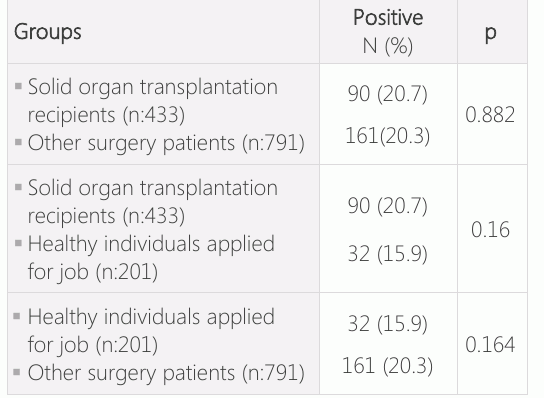
在1425名患者中,41.05%为女性,58.95%为男性。 女性的平均年龄为53.15±15.13岁,男性为53.6317.03岁。 在19.86%的样本中检测到了S. Aureus. 91.5%的隔离物容易感染甲基西林。 在计划进行固体器官移植的患者中,20.78%的患者检测到NSAC车厢,其他手术患者检测到20.36%,健康控制组检测到15.92%. 在计划进行任何手术的所有病人中,鼻腔S.aureus的马车率是20.5%。 在外科病人中,鼻塞尿素携带率高于健康的个体。 然而,在统计学上,这些类别之间没有显著差别(第0.131页)。 此外,在S. aureus马车(p=0.882,p=0.16,p=0.164)方面,三组车组之间没有统计上的重大差异(表-1).
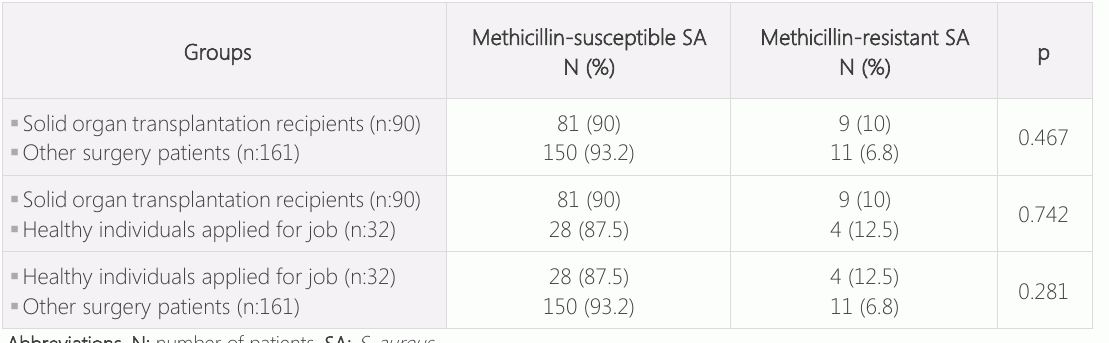
甲基西林抗药性(MRSA)被发现在S. aureus隔离物中为8.48%. 在MRSA运输(p=0.473,p=0.742,p=0.281)方面,三组之间没有统计上的重大差异(表-2).
讨论情况
已经证明鼻塞尿素马车(NSAC)在由鼻塞尿素引起的感染中起着关键作用. 检查这些病人对器官移植或其他手术更加重要 (1–4). 在我们的研究中,发现计划进行其他手术的病人(20.79%)和固体器官移植接受者(20.36%)的NSC比率高于控制(15.92%),但从统计学上看,这一差别很小。 增加拟纳入研究的患者数量,分析其他手术计划患者的分组,可能有助于理解原因或确认结果. 在国家和国际文献中,我们没有发现任何研究能够像我们的研究中那样比较不同群体之间的NSAC比率。 在国家文献中,关于国家安全委员会的研究大多是在健康的个人和医院工作人员中调查的。 在对保健人员进行的研究中,国家卫生健康委员会据报在8.7%至36.4%之间(平均20.4%),甲基西林抗药性在0至39.4%之间(平均11.4%)。 (8–17)在Kurutepe等人进行的研究中。 (18)在临床人员中,MRSA的马车比例为6.8%,临床前工人为1.2%。 在Ulug等人进行的一项研究中。 (19)在4.2%的外科病人中发现了NSAC,3.2%的这些菌株被定义为MRSA. 在同一名提交人进行的另一项研究中,在医院的手术室、新生儿和重症监护室工作的工作人员中,国家安全局的载体率为25.9%。 S.Aureus隔离物中共有11.1%是MRSA。 (20)此外,据报告,在土耳其进行血液透析的病人中,S.aureus的鼻道运输率为32.3%至67%,而S.aureus的鼻道运输率为9.4%至27.2%。(21–23) 在Weiser等人进行的研究中,国家航天局和MRSA的运输率相似(分别为19.86%和8.48%)。 (25). Price et al. (24) 据报告,在接受外科手术的病人中,国家安全局的比率很高,为30.2%。 伯特等人著. (26) 报告,在肝脏移植接受者中,国家安全分类率为36.8%,鼻部MRSA携带率为9.1%。 他们还报告说,鼻部MRSA马车在肝脏移植接受者中感染MRSA的风险很高。 (26)Abbasi et al. Abbasi et al. 互联网档案馆的存檔,存档日期2013-12-21. (27) 报告在重症监护单位中,全国儿童安全委员会的比率为14.6%,鼻部MRSA的乘车率为7.3%。 他们还说,长期住院、慢性病和接受手术对国家安全局和MRSA车来说风险最大。 (27). Sollid 等人著. (28) 报告对NSAC和MRSA运输进行了相当广泛的元分析。 在我们的研究中,NSAC和MRSA的车载率与其中一些研究相似。 这些研究表明,在诊所的外科手术部门中,报告的比率最高。 造成这种情况的原因是,MRSA的车厢在外科病人中较高,因此护理病人的工作人员的车厢较高。 此外,导管感染史被确定为鼻部MRSA车厢的独立风险因素。 在我们的研究中,在固体器官移植接受者(20.79%)和其他外科病人(20.36%)中,NSAC的比率相似. 然而,这些比率高于健康控制组(15.92%)。 然而,这三个组别之间没有统计上的重大差异。 此外,从MRSA的载体率来看,在固体器官移植中的比例要高一些,在其他外科病人中的比例是10%。 然而,各群体之间在统计学上没有显著差别。 在评估这些研究中的数据以及申请工作的健康个人的结果时,可以看出社会中健康个人的NSC比率较低。 在我们的研究中,我们确定的南澳大利亚州和南澳大利亚州的比率低于海外研究,后者报告的比率在20%-50%之间。(18)。 。 。
一项研究显示,NSAC会影响发病率,并可能在重点研究之后作为严重感染剂出现在体内,这项研究是对冯·艾夫等人的研究. (29)据报告,在S. Aureus车厢方面进行手术性筛查,并在有车厢的情况下进行非殖民化,以减少预定手术的病人发生术后感染的风险 (6–8)鼻部非殖民化常用的抗生素是穆皮罗霉素。 世界卫生组织强烈建议施用2%的穆皮罗霉素(Mupirocin).・氯己胺浴),在计划进行心肌外科和矫形外科手术的患者中,有鼻腔S. aureus马车在场. 在手术前5天,每天两次施用肠内穆皮罗辛奶油。 在48小时之后,应当通过控制文化确认根除。 氯己西丁是葡萄糖凝胶内膜管理的另一个替代品。 (1, 4)我国正努力在世界各国中开展健康旅游。 保健旅游业必须获得国际认证机构,特别是国际联合委员会的证书。 (30)为确保患者在所有护理标准中的安全,JCI还在预防感染的措施和程序清单中列入了NSAC的筛查。 (1, 4)我们的医院得到JCI的认可,对计划进行心血管手术和矫形植入手术的病人使用有效的NSAC载体筛查方案,特别是对固体器官移植候选人 (31, 32)。 。 。
结论
在关于国家航天局和MRSA运输的各种研究中,报告的比率不同。 然而,其中最重要的病例似乎是外科患者. 在我们的研究中,器官移植病人感染的风险较高. 总之,由于这些患者因免疫抑制治疗而感染的风险较高,因此这个患者群体中需要更加谨慎,这一点再次凸显出来. 社区内的S. Aureus殖民化在计划进行手术的病人和健康的个人中非常明显。 接受外科手术的患者在与NSAC有关的并发症中风险更大. 对S. Aureus车厢进行手术前检查,并在出现车厢时进行非殖民化,将减少术后感染的风险。 此外,我们认为,对参与治疗外科病人的保健工作者进行筛查和必要的治疗,将减少医院获得的S.Aureus传染和医院感染。
声明
- 作者贡献(CRediT)
- 所有作者对全部 14 项 CRediT 角色贡献均等(Conceptualization, Data curation, Formal analysis, Funding acquisition, Investigation, Methodology, Project administration, Resources, Software, Supervision, Validation, Visualization, Writing – original draft, Writing – review & editing)。
- 资助
-
Funding information was not reported in the published version of this article.
- 利益冲突
- The authors declare that they have no conflict of interest in the current study.
- 伦理批准
- Ethic Approval The present study was approved by Yeni Yüzyil University, Faculty of Medicine Hospital ethics committee with the number 26.03.2018/014. Results Of the 1425 patients, 41.05% were female and 58.95% were male.
- 数据可用性
- A data availability statement was not reported in the published version of this article.
参考文献 (32)
32 条参考文献中有 15 条已链接 DOI。
- Wertheim HF, Melles DC, Vos MC, van Leeuwen W, van Belkum A, et al. The role of nasal carriage in Staphylococcus aureus infections. Lancet Infect Dis 2005;5:751-762 DOI Crossref PubMed Google Scholar
- Ippolito G, Leone S, Lauria FN, Nicastri E, Wenzel RP. Methicillin-resistant Staphylococcus aureus: the superbug. Int J Infect Dis 2010;14:7-11 DOI Crossref PubMed Google Scholar
- Gemmell C, Edwards DI, Fraise AP, Gould FK, Ridgway GL, et al. Guidelines for the prophylaxis and treatment of methicillin- resistant Staphylococcus aureus (MRSA) infections in the UK. J Antimicrob Chemother 2006;57: 589-608 DOI Crossref PubMed Google Scholar
- Wardvogel FA. Staphylococcus aureus (including toxic shock syndrom). In: Mandell GL, Bennett JE, Dolin R, eds. Principles and practice of infectious diseases. Livingstone: USA; 2015. pp. 1757. PubMed Google Scholar
- Yano K, Minoda Y, Sakawa A, Kuwano Y, Kondo K, et al. Positive nasal culture of methicillin-resistant Staphylococcus aureus is a risk factor for surgical site infection in orthopedics. Acta Orthopaedica 2009;80:486- DOI Crossref PubMed Google Scholar
- Taylor MD, Napolitano LM. Methicillin-resistant Staphylococcus aureus infections in vascular surgery: increasing prevalence. Surg Infec 2004;5:180-187 DOI Crossref PubMed Google Scholar
- Olsen K, Sangvik M, Simonsen GS, Sollid JUE, Sundsfjord A, Thune I, et al. Prevalence and population structure of Staphylococcus aureus nasal carriage in healthcare workers in a general population. The Tromsø Staph and Skin Study. Epidemiol Infect 2013;141: 143-152 DOI Crossref PubMed Google Scholar
- Aykut Arca E, Karabiber N, Sen S. Investigation of Staphylococcus aureus in pre-operative nasal cultures. Türk Hij Den Biyol Derg 2007;64: 23-26 PubMed Google Scholar
- Aydin M, Yazici S. Investigation of Nasal Staphylococcus aureus carriage at hospital staff. Ankara Üniversitesi Tip Fakültesi Mecmuasi 2012;65:1 PubMed Google Scholar
- Yagmur G, Melek I. Investigation of nasal carriage and antibiotic susceptibility of Staphylococcus aureus in healthcare staff. Journal of Harran University Medical Faculty. 2015;12: 31-37 PubMed Google Scholar
- Kökoglu ÖF, Geyuk MF, Ayaz C, Ucmak H, Hosoglu S. Investigation of nasal carriage rates and antimicrobial susceptibility of Staphylococcus aureus in health-care workers and hemodialysis patients in dicle university hospital. Turk J Infect. 2003;17: 443-446 PubMed Google Scholar
- Naz H, Cevik FC, Aykin N. Nasal Staphylococcus aureus carriage among hospital staff in Eskişehir Yunus Emre State Hospital. Ankem Derg 2006;20:141-144 PubMed Google Scholar
- Kurtoglu MG, Güzelant A, Kaya M, Kesli R, Baysal B. Staphylococcus aureus: nasal colonization, antimicrobial susceptibility and the effect of mupirosin in medical care workers Turk J Infect 2009;23:127-131 PubMed Google Scholar
- Bozkurt H, Bayram Y, Güdücüoglu H, Berktas M. Investigation of resistance rates to methicillin with nasal Staphylococcus aureus carrige at staff of Y.Y.Ü. Medical Faculty Research Hospital. Van Tip Derg 2007;14:52-56 PubMed Google Scholar
- Alim A, Artan OA, Atas M, Kalkan H, Madak S. Nasal carriage rate of Staphylococcus aureus in individuals participating in the routine carrier inspection process in Sivas. Flora 2012;17:202-205 PubMed Google Scholar
- Marım F, Taban Ö, Ergin C. Investigation of nasal Staphylococcus aureus carriage in Pamukkale University Health, Research and Training Center. Pam Tip Derg 2009;2: 20-23 PubMed Google Scholar
- Gündüz T, Akgül S. Nasal Staphylococcus aureus carriage in hospital staff. Türk Mikrobiyol Cem Derg 2004;34:220- PubMed Google Scholar
- Kurutepe S, Gaz H, Sürücüoglu S, Aktas E, Özbakkaloglu B. Nasal carriage rates of methicillin-resistant Staphylo Nasal S.aureus Carriage in Solid Organ Transplant Bayirli-Turan et al. coccus aureus in clinical and pre-clinical hospital staff. Türk Mikrobiyol Cem Derg 2005;35:178-182 PubMed Google Scholar
- Ulug M, Ayaz C, Celen MK. The evaluation of Staphylo cocci strains isolated from nasal and bone cultures in patients with chronic osteomyelitis. Dicle Med J 2012;39: 339-343 DOI Crossref PubMed Google Scholar
- Ulug M.Investigation of Nasal Staphylococcus aureus Carriage in Intensive Care Unit and Operating Room Staff. Med Bull Haseki The Medical Bulletin of Haseki 2012; 50: 48-52 DOI Crossref PubMed Google Scholar
- Çelik G, Gülcan A. Hemodiyaliz tedavisi alan hastalarda nazal Staphylococcus aureus taşıyıcılığı ve risk faktörlerinin belirlenmesi. Türk Mikrobiyoloji Cem Derg 2010;40: 79-86 PubMed Google Scholar
- Çifci A, Biberoğlu S, Tosun İ, Cesur S, Gençtürk Z, İnal S, Ergen E. The rate and risk factors of nasal Staphylococcus aureus carriage in hemodialysis patients. Turk J Clin Lab 2016:7(4): 94-98 PubMed Google Scholar
- Kurutepe S, Ecemiş T, Sürücüoğlu S, Kürşat S, özbakkaloğlu B. Hemodiyaliz hastalarında Staphylococcus aureus burun taşıyıcılığı ve suşların antibiyotik direnci. Ankem Derg 2005;19:88-91 PubMed Google Scholar
- Weiser MC, Moucha CS. The current state of screening and decolonization for the prevention of Staphylococcus aureus surgical site infection after total hip and knee arthroplasty. J Bone Joint Surg Am 2015;97:1449-1458 DOI Crossref PubMed Google Scholar
- Price CS, Williams A, Philips G, Dayton M, Smith W, et al. Staphylococcus aureus nasal colonization in preoperative orthopaedic outpatients. Clin Orthop Relat Res 2008;466: 2842-2847 DOI Crossref PubMed Google Scholar
- Bert F, Galdbart JO, Zarrouk V, Me´e JL, Durand F, Mentre´F, et al. Association between Nasal Carriage of Staphylococcus aureus and Infection in Liver Transplant Recipients. Clinical Infectious Diseases 2000;31:1295– 9 DOI Crossref PubMed Google Scholar
- Abbasi S, Rostami S, Khorvash F, Shokri D, Khomarbaghi N and Ebrahimi N. Colonization With Methicillin-Resistant Staphylococcus aureus Upon Intensive Care Unit Admission: Incidence and Risk Factors,Avicenna J Clin Microb Infec. 2016 August; 3(3):e38217 PubMed Google Scholar
- Sollid JUE,. Furberg AS, Hanssen AM, Johannessen M. Staphylococcus aureus: Determinants of human carriage. Infection, Genetics and Evolution 21;2014 531–541 DOI Crossref PubMed Google Scholar
- Von Eiff C, Becker K, Machka K, Stammer H, Peters G. Nasal carriage as a source of Staphylococcus aureus bacteremia. N Engl J Med 2001;344:11-16 DOI Crossref PubMed Google Scholar
- Web page [02/02/2019] http://www.sağlıkturizmi.org.tr/tr /saglik-turizmi/genel-bilgi.html PubMed Google Scholar
- Devkaran S, O’Farrell PN. The impact of hospital accreditation on clinical documentation compliance: a life cycle explanation using interrupted time series analysis. BM Open 2014;4:e005240. DOI Crossref PubMed Google Scholar
- Devkaran S, O’Farrell PN. The impact of hospital accreditation on quality measures: an interrupted time series analysis. BMC Health Serv Res 2015;15:137 DOI Crossref PubMed Google Scholar
阅读全文
在此打开 PDF
正在加载 PDF…
若 PDF 未在此显示,请使用上方的下载按钮。
如何引用本文
Turan DB, Ozgun O, Kuruoglu T, Serefhanoglu K. Comparison of Nasal S. aureus Carriage in Solid Organ Transplant Recipients with Other Surgical Cases and Healthy Individuals. Ulutas Med J. 2019;5(2):160-165. doi:10.5455/umj.20190325124138
Turan, D. B., Ozgun, O., Kuruoglu, T., & Serefhanoglu, K. (2019). Comparison of Nasal S. aureus Carriage in Solid Organ Transplant Recipients with Other Surgical Cases and Healthy Individuals. The Ulutas Medical Journal, 5(2), 160–165. https://doi.org/10.5455/umj.20190325124138
Turan, D.B. et al. (2019) 'Comparison of Nasal S. aureus Carriage in Solid Organ Transplant Recipients with Other Surgical Cases and Healthy Individuals', The Ulutas Medical Journal, 5(2), pp. 160–165. doi: 10.5455/umj.20190325124138.