The Ulutas Medical Journal · ISSN 2149-0430 (print), 2149-388X (online) · https://www.ulutasmedicaljournal.com/?mno=38735
Original Article · Open access
Comparison of Nasal S. aureus Carriage in Solid Organ Transplant Recipients with Other Surgical Cases and Healthy Individuals
- Istanbul Turkey
- Department of Infectious Diseases and Clinical Microbiology, Istanbul Yeni Yüzyil University School of Medicine, Gaziosmanpasa Hospital, Istanbul, Turkey. ROR
- Department of Infectious Diseases and Clinical Microbiology, Ondokuz Mayis University School of Medicine, Samsun, Turkey. ROR
Abstract
- Background
- Nasal S. aureus carriage (NSAC) increases the risk of wound infection, especially in surgery. In our study, we aimed to compare nasal S. aureus carriage in patients who were planned to undergo solid organ transplantation with patients applied for other surgery and healthy individuals who applied for job.
- Materials and Methods
- Nasal swab cultures of 1425 participants consisting of 433 solid organ transplant patients and 791 other surgery patients who admitted to our tertiary care hospital between 2016-2018 and 201 healthy individuals were included in the study. Nasal swab specimens were cultured by using 5% sheep blood agar reduction method and incubated. The isolates were identified by conventional methods and antibiotic susceptibility tests were performed by disk-diffusion method.
- Results
- S. aureus growth was detected in 283 (19.85%) of the cultures, and 8.48% of them were methicillin resistant S.aureus (MRSA). NSAC rate was 20.78% in solid organ transplant recipients, 19.6% in other surgical patients, and 15.9% in healthy individuals. There was no statistically significant difference between groups in terms of S. aureus carriage (p=0.315). NSAC rate was 20.35% in all patients who were planned for any surgery, and there was no statistically significant difference in the carriage of S. aureus between the patients who underwent surgery and those who applied for job (p=0.131). There was no statistically significant difference between these groups in terms of MRSA carriage (p=0.473).
- Conclusion
- In our study, methicillin-susceptible S. aureus colonization in the community was found to be high in both patients who were planned for surgery and in healthy individuals. Patients undergoing surgery are at greater risk for NSAC. We suggest that screening for S. aureus carriage preoperatively and decolonization in the presence of carriage may decrease the incidence of S. aureus infections in patients who are planned for surgery.
Keywords
Full text
Introduction
Staphylococcus aureus is a microorganism, which is frequently isolated in community and hospital-acquired infections. S.aureus is an emergent infectious factor in soft tissue and respiratory system especially(1–3). Transmission to patients can be caused from environmental as well as from a focus on their own body. These foci in the carriers are also the source of the transmission of the pathogen to susceptible persons. The most important focus in carriers is nasal carriage. Nasal S. aureus carriage (NSAC) is increasing in the community. This problem increases the risk of post-operative surgery wound infection, morbidity and mortality rates in all surgical and invasive procedures, especially in cardiovascular surgery, solid organ transplantation, and orthopedic implant surgery. In order to prevent infections, carriers should be identified and treated (1, 4–7).
We did not find a study in which NSAC rate was compared in different groups in the national and international literature. As we reached, studies have been mostly conducted in healthy individuals. We think that our study will contribute to the literature on this subject. In our study, we aimed to compare NSAC and methicillin resistance in the patients who were planned for solid organ transplantation and the patients who were planned for other surgery, and healthy individuals who applied for job as the control group.
Materials and Methods
Patients
A total of 1425 participants consisting of 433 solid organ transplant patients and 791 other surgery patients admitted to Istanbul Yeni Yüzyıl University, Faculty of Medicine Hospital between January 1, 2016 and December 31, 2018 and 201 healthy individuals who applied for job were included in the study. The patients were divided into three groups:
• Group 1: Patients who underwent solid organ transplantation • Group 2: Other surgery patients (orthopedics and cardiovascular surgery) • Group 3: Healthy individuals who applied for job
Methodology Nasal swab specimens were taken from the anterior part of the nostrils with a sterile saline-soaked cotton swab and both nostrils from the all patients and healthy individuals. Nasal swab specimens were cultured using 5% sheep blood agar, and incubated for 24 hours at 37 °C in the oven. At the end of incubation, colonies that produce beta hemolysis from the colonized colonies were identified using Gram staining, catalase and slide coagulase test, and positive ones were identified as S. aureus. Methicillin resistance was assessed using cefoxitin disk (30µg) by Kirby-Bauer disc diffusion method according to Clinical and Laboratory Standards Institute criteria. S.aureus standard strain (ATCC 29213) was used as the control.
Statistical Analysis
The data were analyzed using SPSS version 24.0 software (SPSS Inc., Chicago, IL, USA). To summarize the data obtained from the study, descriptive statistics were given as number and percentage for categorical variables. Pearson’s chi-square test was used to evaluate the relationship between categorical variables. A p value less than 0.05 was considered statistically significant. However, Bonferroni correction was used in all multiple comparisons to control possible Type I errors.
Ethic Approval
The present study was approved by Yeni Yüzyil University, Faculty of Medicine Hospital ethics committee with the number 26.03.2018/014.
Results
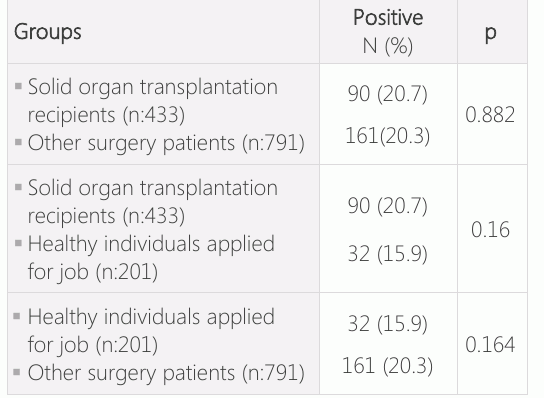
Of the 1425 patients, 41.05% were female and 58.95% were male. The mean age was 53.15± 15.13 years in females, and 53.63±17.03 years in males. S. aureus was detected in 19.86% of the samples. 91.5% of the isolates were susceptible to methicillin. NSAC carriage was detected in 20.78% of the patients who were planned for solid organ transplantation, 20.36% in the other surgery patients, and 15.92% in the healthy control group. Nasal S.aureus carriage rate was 20.5% in all patients planned for any surgery. In surgery patients nasal S. aureus carriage rate was higher than healthy individuals. However, there was no statistically significant difference between these groups (p=0.131). In addition, there was no statistically significant difference between three groups in terms of S. aureus carriage (p=0.882, p=0.16, p=0.164) (Table-1).
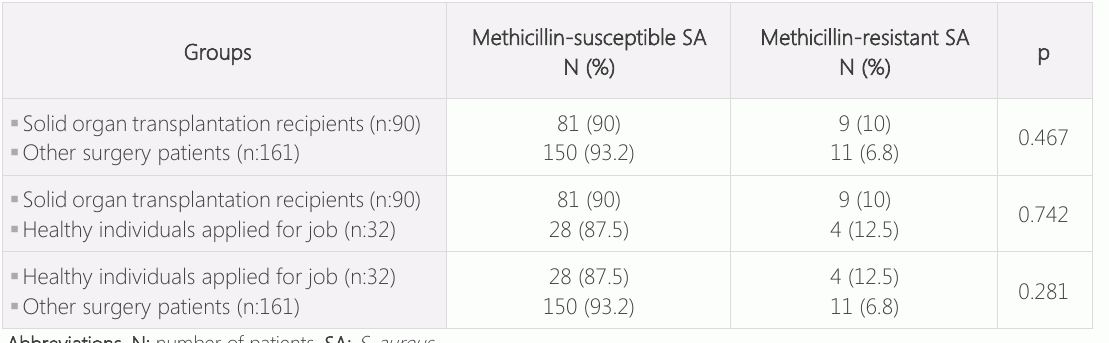
Methicillin resistance (MRSA) was found to be 8.48% in S. aureus isolates. There was no statistically significant difference between three groups in terms of MRSA carriage (p=0.473, p=0.742, p=0.281) (Table-2).
Discussion
Nasal S. aureus carriage (NSAC) has been shown to play a key role in infections caused by S. aureus. Screening these patients is even more important for organ transplantation or other surgery (1–4). In our study, NSAC rate was found to be higher in the patients who planned other surgery (20.79%) and in the solid organ transplant recipients (20.36%) compared to the control (15.92%), however, the difference was statistically insignificant. Increasing the number of patients to be included in the study and the analysis of subgroups in the other surgery-planned patients may help to understand the reason or to confirm the result. In the national or international literature, we did not find any studies comparing the NSAC rate between different groups as in our study. In the national literature, the studies on NSAC were mostly investigated in healthy individuals and hospital staff. In the studies conducted in healthcare staff in, NSAC was reported to be between 8.7-36.4% (mean 20.4%), and methicillin resistance was between 0-39.4% (mean 11.4%) (8–17). In the study conducted by Kurutepe et al. (18), MRSA carriage was found to be 6.8% in clinical staff, and 1.2% in preclinical workers. In a study conducted by Ulug et al. (19), they found NSAC in 4.2% of surgical patients, and 3.2% of these strains were defined as MRSA. In another study conducted by the same authors, NSAC carriage rate was 25.9% among the staff working in operating room, neonatal and intensive care units of our hospital. A total of 11.1% among all S. aureus isolates were MRSA (20). In addition the nasal carriage for S.aureus in the patients undergoing hemodialysis in Turkey was reported to be between 32.3-67%, and for nasal MRSA carriage was reported from 9.4to27.2%(21–23). In the study conducted by Weiser et al., the NSAC and MRSA carriage rates were similar (19.86% and 8.48%, respectively) (25). Price et al. (24) reported a high NSAC rate of 30.2% in patients who underwent surgical intervention. Bert et al. (26) reported NSAC rate as 36.8% in liver transplant recipients and as 9.1% for nasal MRSA carriage rate. They also reported that nasal MRSA carriage was associated with a very high risk of MRSA infection in liver transplant recipients (26). Abbasi et al. (27) reported NSAC rate as 14.6% in intensive care unit, and as 7.3% for the nasal MRSA carriage rate. They also raported that longer hospital stays, chronic diseases and undergoing surgery had the highest risk th for NSAC and MRSA carriage (27). Sollid et al. (28) reported a quite extensive meta-analysis about NSAC and MRSA carriage. In our study NSAC and MRSA carriage rates were similar to some of these studies. These studies showed that the highest rate was reported in the surgical departments among the clinics. This situation can be explained by the fact that MRSA carriage is higher in surgical patients and consequently the carriage of the staff who care the patient is higher. Also, history of catheter infection was determined as an independent risk factor for the nasal MRSA carriage. In our study, the NSAC rate was similar in the solid organ transplant recipients (20.79%) and other surgical patients (20.36%). However, these rates are higher than the healthy control group (15.92%). However, there was no statistically significant difference among these three groups. In addition, a bit a higher rate was found in terms of MRSA carriage rate as 10% in solid organ transplantation and as 6.8% in other surgical patients. Nevertheless, there was no statistically significant difference between groups. When the data in these studies are evaluated together with the results of the healthy individuals who apply for job, it shows that NSAC rate is low in healthy individuals in the society. In our study, the rates we determined for NSAC and MRSA were lower than that of overseas studies, which reported a higher rates between 20-50%(18).
One of the studies indicating that NSAC affects morbidity and may present as a serious infectious agent in the body following a focus is the study of von Eiff et al. (29). Preoperative screening in terms of S. aureus carriage and performing decolonization in case of presence of carriage has been reported to decrease the risk of postoperative infections in patients scheduled for surgery (6–8). The commonly used antibiotic for nasal decolonization is mupirocin. The World Health Organization strongly recommends the application of 2% mupirocin (±chlorhexidine bath) in the presence of nasal S. aureus carriage in patients planned for cardiothoracic and orthopedic surgery. Intranasal mupirocin cream was applied twice a day for five days before the surgery. Eradication should be confirmed by a control culture after 48 hours. Chlorhexidine is another alternative to intranasal administration of gluconate gel (1, 4). Our country is trying to take place among the countries of the world in terms of health tourism. It is a requirement for health tourism to obtain a certificate from international accreditation bodies, especially the Joint Commission International (JCI) (30). To ensure patient safety in all care standards, JCI also includes NSAC screening in the list of measures and procedures to prevent infections (1, 4). Our hospital is accredited by JCI, and uses an effective NSAC carrier screening program for patients planned for cardiovascular surgery and orthopedic implant surgery, especially for solid organ transplant candidates (31, 32).
Conclusion
Different rates have been reported in various studies for NSAC and MRSA carriage. However, the most important of these cases seems to be the surgery patients. In our study, organ transplant patients had the higher risk in terms of infection. In conclusion, since the higher risk for infection in these patients due to the immunosuppressive treatment, the need to be more careful in this patient group has once again come to the fore. S. aureus colonization in the community is seen intensively in patients who are planned for surgery and in healthy individuals. Patients undergoing surgery are at greater risk for complications associated with NSAC. Preoperative screening for S. aureus carriage and in decolonization in case of presence of carriage, will reduce the risk of postoperative infections In addition, we believe that screening and necessary treatment for NSAC for health workers who are involved in the treatment of surgical patients will reduce the hospital-acquired S. aureus transmission and hospital infections.
Declarations
- Author contributions (CRediT)
- All authors contributed equally to all 14 CRediT roles (Conceptualization, Data curation, Formal analysis, Funding acquisition, Investigation, Methodology, Project administration, Resources, Software, Supervision, Validation, Visualization, Writing – original draft, Writing – review & editing).
- Funding
-
Funding information was not reported in the published version of this article.
- Conflicts of interest
- The authors declare that they have no conflict of interest in the current study.
- Ethics approval
- Ethic Approval The present study was approved by Yeni Yüzyil University, Faculty of Medicine Hospital ethics committee with the number 26.03.2018/014. Results Of the 1425 patients, 41.05% were female and 58.95% were male.
- Data availability
- A data availability statement was not reported in the published version of this article.
References (32)
15 of 32 references are linked to their DOI.
- Wertheim HF, Melles DC, Vos MC, van Leeuwen W, van Belkum A, et al. The role of nasal carriage in Staphylococcus aureus infections. Lancet Infect Dis 2005;5:751-762 DOI Crossref PubMed Google Scholar
- Ippolito G, Leone S, Lauria FN, Nicastri E, Wenzel RP. Methicillin-resistant Staphylococcus aureus: the superbug. Int J Infect Dis 2010;14:7-11 DOI Crossref PubMed Google Scholar
- Gemmell C, Edwards DI, Fraise AP, Gould FK, Ridgway GL, et al. Guidelines for the prophylaxis and treatment of methicillin- resistant Staphylococcus aureus (MRSA) infections in the UK. J Antimicrob Chemother 2006;57: 589-608 DOI Crossref PubMed Google Scholar
- Wardvogel FA. Staphylococcus aureus (including toxic shock syndrom). In: Mandell GL, Bennett JE, Dolin R, eds. Principles and practice of infectious diseases. Livingstone: USA; 2015. pp. 1757. PubMed Google Scholar
- Yano K, Minoda Y, Sakawa A, Kuwano Y, Kondo K, et al. Positive nasal culture of methicillin-resistant Staphylococcus aureus is a risk factor for surgical site infection in orthopedics. Acta Orthopaedica 2009;80:486- DOI Crossref PubMed Google Scholar
- Taylor MD, Napolitano LM. Methicillin-resistant Staphylococcus aureus infections in vascular surgery: increasing prevalence. Surg Infec 2004;5:180-187 DOI Crossref PubMed Google Scholar
- Olsen K, Sangvik M, Simonsen GS, Sollid JUE, Sundsfjord A, Thune I, et al. Prevalence and population structure of Staphylococcus aureus nasal carriage in healthcare workers in a general population. The Tromsø Staph and Skin Study. Epidemiol Infect 2013;141: 143-152 DOI Crossref PubMed Google Scholar
- Aykut Arca E, Karabiber N, Sen S. Investigation of Staphylococcus aureus in pre-operative nasal cultures. Türk Hij Den Biyol Derg 2007;64: 23-26 PubMed Google Scholar
- Aydin M, Yazici S. Investigation of Nasal Staphylococcus aureus carriage at hospital staff. Ankara Üniversitesi Tip Fakültesi Mecmuasi 2012;65:1 PubMed Google Scholar
- Yagmur G, Melek I. Investigation of nasal carriage and antibiotic susceptibility of Staphylococcus aureus in healthcare staff. Journal of Harran University Medical Faculty. 2015;12: 31-37 PubMed Google Scholar
- Kökoglu ÖF, Geyuk MF, Ayaz C, Ucmak H, Hosoglu S. Investigation of nasal carriage rates and antimicrobial susceptibility of Staphylococcus aureus in health-care workers and hemodialysis patients in dicle university hospital. Turk J Infect. 2003;17: 443-446 PubMed Google Scholar
- Naz H, Cevik FC, Aykin N. Nasal Staphylococcus aureus carriage among hospital staff in Eskişehir Yunus Emre State Hospital. Ankem Derg 2006;20:141-144 PubMed Google Scholar
- Kurtoglu MG, Güzelant A, Kaya M, Kesli R, Baysal B. Staphylococcus aureus: nasal colonization, antimicrobial susceptibility and the effect of mupirosin in medical care workers Turk J Infect 2009;23:127-131 PubMed Google Scholar
- Bozkurt H, Bayram Y, Güdücüoglu H, Berktas M. Investigation of resistance rates to methicillin with nasal Staphylococcus aureus carrige at staff of Y.Y.Ü. Medical Faculty Research Hospital. Van Tip Derg 2007;14:52-56 PubMed Google Scholar
- Alim A, Artan OA, Atas M, Kalkan H, Madak S. Nasal carriage rate of Staphylococcus aureus in individuals participating in the routine carrier inspection process in Sivas. Flora 2012;17:202-205 PubMed Google Scholar
- Marım F, Taban Ö, Ergin C. Investigation of nasal Staphylococcus aureus carriage in Pamukkale University Health, Research and Training Center. Pam Tip Derg 2009;2: 20-23 PubMed Google Scholar
- Gündüz T, Akgül S. Nasal Staphylococcus aureus carriage in hospital staff. Türk Mikrobiyol Cem Derg 2004;34:220- PubMed Google Scholar
- Kurutepe S, Gaz H, Sürücüoglu S, Aktas E, Özbakkaloglu B. Nasal carriage rates of methicillin-resistant Staphylo Nasal S.aureus Carriage in Solid Organ Transplant Bayirli-Turan et al. coccus aureus in clinical and pre-clinical hospital staff. Türk Mikrobiyol Cem Derg 2005;35:178-182 PubMed Google Scholar
- Ulug M, Ayaz C, Celen MK. The evaluation of Staphylo cocci strains isolated from nasal and bone cultures in patients with chronic osteomyelitis. Dicle Med J 2012;39: 339-343 DOI Crossref PubMed Google Scholar
- Ulug M.Investigation of Nasal Staphylococcus aureus Carriage in Intensive Care Unit and Operating Room Staff. Med Bull Haseki The Medical Bulletin of Haseki 2012; 50: 48-52 DOI Crossref PubMed Google Scholar
- Çelik G, Gülcan A. Hemodiyaliz tedavisi alan hastalarda nazal Staphylococcus aureus taşıyıcılığı ve risk faktörlerinin belirlenmesi. Türk Mikrobiyoloji Cem Derg 2010;40: 79-86 PubMed Google Scholar
- Çifci A, Biberoğlu S, Tosun İ, Cesur S, Gençtürk Z, İnal S, Ergen E. The rate and risk factors of nasal Staphylococcus aureus carriage in hemodialysis patients. Turk J Clin Lab 2016:7(4): 94-98 PubMed Google Scholar
- Kurutepe S, Ecemiş T, Sürücüoğlu S, Kürşat S, özbakkaloğlu B. Hemodiyaliz hastalarında Staphylococcus aureus burun taşıyıcılığı ve suşların antibiyotik direnci. Ankem Derg 2005;19:88-91 PubMed Google Scholar
- Weiser MC, Moucha CS. The current state of screening and decolonization for the prevention of Staphylococcus aureus surgical site infection after total hip and knee arthroplasty. J Bone Joint Surg Am 2015;97:1449-1458 DOI Crossref PubMed Google Scholar
- Price CS, Williams A, Philips G, Dayton M, Smith W, et al. Staphylococcus aureus nasal colonization in preoperative orthopaedic outpatients. Clin Orthop Relat Res 2008;466: 2842-2847 DOI Crossref PubMed Google Scholar
- Bert F, Galdbart JO, Zarrouk V, Me´e JL, Durand F, Mentre´F, et al. Association between Nasal Carriage of Staphylococcus aureus and Infection in Liver Transplant Recipients. Clinical Infectious Diseases 2000;31:1295– 9 DOI Crossref PubMed Google Scholar
- Abbasi S, Rostami S, Khorvash F, Shokri D, Khomarbaghi N and Ebrahimi N. Colonization With Methicillin-Resistant Staphylococcus aureus Upon Intensive Care Unit Admission: Incidence and Risk Factors,Avicenna J Clin Microb Infec. 2016 August; 3(3):e38217 PubMed Google Scholar
- Sollid JUE,. Furberg AS, Hanssen AM, Johannessen M. Staphylococcus aureus: Determinants of human carriage. Infection, Genetics and Evolution 21;2014 531–541 DOI Crossref PubMed Google Scholar
- Von Eiff C, Becker K, Machka K, Stammer H, Peters G. Nasal carriage as a source of Staphylococcus aureus bacteremia. N Engl J Med 2001;344:11-16 DOI Crossref PubMed Google Scholar
- Web page [02/02/2019] http://www.sağlıkturizmi.org.tr/tr /saglik-turizmi/genel-bilgi.html PubMed Google Scholar
- Devkaran S, O’Farrell PN. The impact of hospital accreditation on clinical documentation compliance: a life cycle explanation using interrupted time series analysis. BM Open 2014;4:e005240. DOI Crossref PubMed Google Scholar
- Devkaran S, O’Farrell PN. The impact of hospital accreditation on quality measures: an interrupted time series analysis. BMC Health Serv Res 2015;15:137 DOI Crossref PubMed Google Scholar
Respond to this article
Comments on a published article are welcome as a Letter to the Editor.
Get an e-mail when new articles in your fields are published
Read the full text
Open the PDF here
Loading the PDF…
If the PDF does not show here, use the download button above.
How to cite this article
Turan DB, Ozgun O, Kuruoglu T, Serefhanoglu K. Comparison of Nasal S. aureus Carriage in Solid Organ Transplant Recipients with Other Surgical Cases and Healthy Individuals. Ulutas Med J. 2019;5(2):160-165. doi:10.5455/umj.20190325124138
Turan, D. B., Ozgun, O., Kuruoglu, T., & Serefhanoglu, K. (2019). Comparison of Nasal S. aureus Carriage in Solid Organ Transplant Recipients with Other Surgical Cases and Healthy Individuals. The Ulutas Medical Journal, 5(2), 160–165. https://doi.org/10.5455/umj.20190325124138
Turan, D.B. et al. (2019) 'Comparison of Nasal S. aureus Carriage in Solid Organ Transplant Recipients with Other Surgical Cases and Healthy Individuals', The Ulutas Medical Journal, 5(2), pp. 160–165. doi: 10.5455/umj.20190325124138.