The Ulutas Medical Journal · ISSN 2149-0430 (مطبوع), 2149-388X (إلكتروني) · https://www.ulutasmedicaljournal.com/?mno=82600
مقالة أصلية · وصول مفتوح
The Relationship of Non-dipper blood Pressure Pattern with the Fragmented QRS Morphology on ECG and the Role of Inflammatory Biomarkers in Polycystic Ovary Syndrome
ترجمة آلية للعنوان والملخص والنص الكامل. الأصل الإنجليزي
الملخص
مقدمة: This study aimed to investigate the relationship between the fragmented QRS (fQRS) morphology and hematological markers and non-dipper blood pressure patterns in patients with polycystic ovary syndrome (PCOS). Materials and Methods: 60-five patients with PCOS between the ages of and 18-40 years were included in the study. وقارنت المراقبة والمرضى من حيث النتائج المختبرية، والصدمات الكهربائية، ونتائج المذيبات. النتائج: In the PCOS, non-dipper patterns in systolic and diastolic blood pressure were more common, but only the non-dipper pattern showed significance in systolic blood pressure (p=0.007). In both groups, the non-dipper blood pressure was more frequent in those with fragmented QRS. Neutrophil (p=0.01), lymphocyte (p=0.002), neutrophil-lymphocyte ratio(p0.0001), monocyte-lymphocyte ratio(p=0.014), platelet lymphocyte ratios (p=0.001), erythrocyte distribution width (p=0.0001), and plate higherlet distribution width (p=0.001) الاستنتاج: وزادت مستويات علامات الالتهاب وتواتر أنماط ضغط الدم غير الجلدية في نظام PCOS. In these patients, the fQRS morphology may be used to distinguish those with non-dipping blood pressure patterns.
الكلمات المفتاحية
النص الكامل
ترجمة آلية للنص الكامل؛ النسخة المعتمدة هي الأصل الإنجليزي. الأصل الإنجليزي
مقدمة
متلازمة المبيضات المتعددة النسيج هي متلازمة سمية تتميز بمتلازمة الآمنوريا وأوليلومنورها، والنزيف غير النظامي، والهزلية، و/أو السمنة بنسبة 5 في المائة إلى 10 في المائة من النساء في فترة الإنجاب (1)زيادة خطر الإصابة بمرض القلب والأوعية الدموية بالإضافة إلى النوع 2 من الديموغرافيا، وسرطان الغدة الدرقية، والإجهاض التلقائي في مرضى PCOS (2)وزاد خطر الوفاة والزراعة القلبية 3.3 أضعاف في هؤلاء الأفراد، تليها أسباب القلب والأوعية الدموية (3).
وقد أجريت دراسات عديدة في السنوات الأخيرة بشأن العلاقة بين البرنامج والإصابة بمرض القلب والأوعية الدموية. A contributing factor to the elevated cardio vascular risk status in these patients may be the high frequency of non-dipper blood pressure patterns. The non-dipping blood pressure pattern was a prominent prognostic indicator for cardiovascular illness and mortality in hypertensive and non-hypertensive individuals (4, 5)كما أن زيادة التهاب هؤلاء المرضى قد تكون آلية أخرى لشرح الخطر المتزايد على القلب والأوعية الدموية.
It has been reported that fragmented QRS (fQRS) morphology can be used to predict non-dipper blood pressure patterns on electrocardiography (ECG). ولأفضل ما نعرفه، لم تحقق أي دراسة في الصلة بين نمط ضغط الدم غير الجلدي وأجهزة إعادة تحديد المواقع في المرضى المصابين بجهاز PCOS. وفي هذه الدراسة، استهدفنا دراسة العلاقة بين سرطان الثدي وعلامات الالتهاب الوراثي، التي هي مؤشرات خطر محتملة لأمراض القلب والأوعية الدموية في المرضى المصابين بمرض PCOS، ونمط ضغط الدم غير الجلدي.
المواد والأساليب
تصميم الدراسة
وحللت هذه الدراسة العلاقة بين مورفولوجيا الترددات وعلامات الالتهاب الوراثي، التي هي مؤشرات خطر محتملة لأمراض القلب والأوعية الدموية في المرضى المصابين بمرض PCOS، ونمط ضغط الدم غير الجلدي. وأُدرج في هذه الدراسة تسعون مريضاً قدموا طلبات إلى عيادة المرضى الخارجيين للأمراض وأمراض النساء. The patients were divided into two groups as PCOS and controls.
البيان الأخلاقي
وأُجريت الدراسة بعد الحصول على الموافقة من لجنة الأخلاقيات. تم الحصول على الموافقة من لجنة الأخلاقيات المحلية (التاريخ: 24/06/2020، الدورة: 2020/12، المقرر رقم 09). Following the Helsinki Declaration, voluntary consent forms of patients included in the study were obtained (06/03/2017- No:02).
معايير الإدماج/الاستبعاد
وأُدرجت في مجموعة المراقبة (n:65) المرضى الذين توصلوا إلى نتيجة إيجابية للتسلسل الهزلي، ومثول المبيضات البوليسيتي، وعدم انتظام الرجال. EG without sinusoidal rhythm, left ventricular systolic dysfunction, heart valve disease, left ventricular hypertrophy, atrial fibrillation, morbid obesity (BMI4040 kg/m2() التدخين واستخدام الكحول، وتاريخ المرض النظامي (الارتطام، والسكري، والفشل الكلوي، ومرض الأنسجة الموصلية، وخلل الغدة الدرقية، وما إلى ذلك)، واستبعدت من الدراسة المرضى الذين يعانون من اختلال في التوازن بين السوائل والكهرباء. وسُجلت بيانات ديموغرافية ومختبرية لجميع المرضى المشمولين بالدراسة.
التقييم القلبي
In the study and control groups, 12-lead ECGs were derived at 10 mm/mV amplitude and 25 mm/s. وقُيِّم عنصر إدارة السجلات والمحفوظات لجميع خيوط الإدارة. وعرّف جيش الرب للمقاومة المجزأ بأنه يقذف في موجتين متاخمين من طراز R أو S، حيث دام جيش الرب للمقاومة 120 مترا دون أي لبنة من فروع الحزم في مناطق إمدادات الدم إلى الشريان التاجي الرئيسي (6)ضغط الدم 24 ساعة تم قياسه للتحقيق في الإيقاع الحاد لضغط الدم اليومي للمرضى ولكي يُعتبر تسجيل هولتر صحيحا، فإن ظروف استخدامه لمدة 24 ساعة على الأقل، وقياس ضغط الدم كل 15 دقيقة خلال اليوم، وكل 30 دقيقة في الليل، ومعدل قياس خاطئ يقل عن 20 في المائة قد نص عليه. ومن سجلات ضغط دم هولتر، ووقت النهار، ووقت الليل، وضغوط الدم العنكبوتية على مدار الساعة، وضغوط الدم الشاذة، فضلاً عن اختلافات ضغط الدم على الدوام النهاري والشرس. الأفراد الذين يعانون من انخفاض في ضغط الدم بنسبة تزيد على 10 في المائة ليلاً تم قبولهم كحندق وأولئك الذين تقل نسبة ضغط الدم عن 10 في المائة (7)تم تخزين التسجيلات السطحية للمسح الرئوي في مكان راحة لتقييم وجود مورفيولوجيا الترددي للترددات وارتباطه بنمط ضغط الدم غير الجلدي. وطُلب إلى المرضى في كلتا المجموعتين القيام بزيارة في اليوم الثاني أو الثالث من فترة الدراسة.
الديمغرافية والتحليل الجهلي
(ب) عمر المرضى، وطولهم، ووزنهم، ومؤشر كتلة الجسم (BMI)، وسرعة الغلوكوز (FBG)، والكوليسترول الكلي، وتريغليسيرايد، وLDL، وHDL، وBUN، والكراتين، وAST، و ALT، وFSH، وLH، وحامض، وبوتاسيوم، وبروكتين، واسترادول، و TSH، والهيموغرام. وقُيِّمت البارامترات الفرعية للنيتروبل، واللمفوسيتي، واللونسيت، واللوحات، واسطة توزيع النيتروز، واسطة توزيع لوحات النيتروجين، وخلايا الدم الحمراء في الأشعة. وقد حُسبت نسبة اللمفوسيتي في نيوتروفيل (NLR)، ونسبة اللمفوسيتي الأحاديث (MLR)، ونسبة اللمفوسيتي في الصفائح. The relationship between hematological markers, 24-hour ambulatory blood pressure results, non-dipper blood pressure pattern, and the presence of fQRS morphology on ECG were investigated.
البيانات الإحصائية
وقدمت جميع التحليلات بتفاصيل في الجداول. وتُعرض تواتر ونسبة البيانات القاطعة والوساطة (التطهير) للبيانات المستمرة كقيم وصفية. من أجل المقارنات بين المجموعات، "إختبار (مان ويتني) إستخدم للمجموعتين، بينما "اختبار ميداني" استخدم لمقارنة المتغيرات القاطعة. واعتبرت النتائج ذات أهمية إحصائية عندما كانت القيمة المقومة أقل من 0.05 (p.0.05). وتم تحليل بيانات المرضى التي تم جمعها باستخدام الحزمة الإحصائية لعلوم اجتماعية من أجل ويندوز 23.0.
النتائج
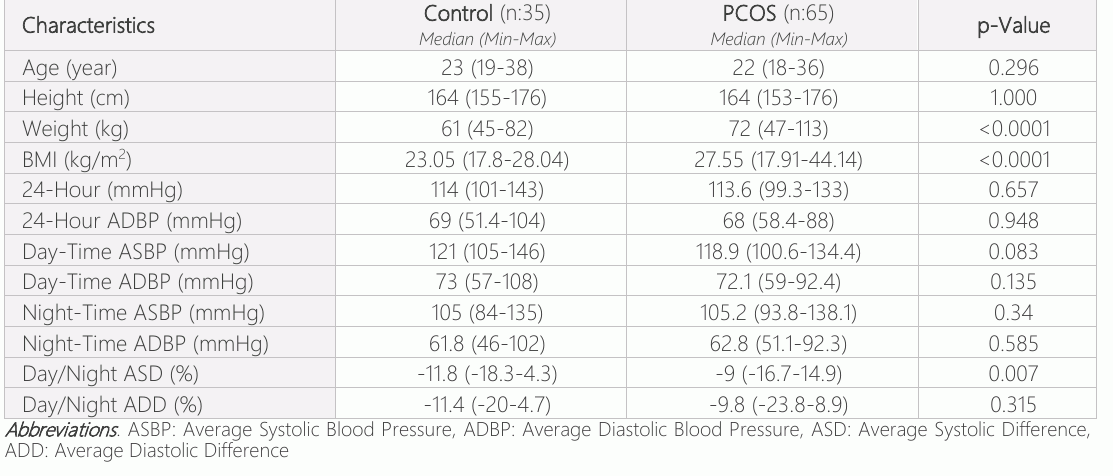
In demographic assessmnets, there were no differences in age and altitude between the two groups. A significant difference was found in weight and BMI in the PCOS (pline 0.0001 and p0.0001,respectively). ولم يلاحظ أي فرق كبير بين المجموعتين لمدة 24 ساعة يعني ضغط الدم الاستبدادي والدايستيكية ومرضية في النهار، وضغوط الدم العنكبوتية والشاذة. A significant difference was found in the PCOS group in terms of the mean daytime/nighttime systolic blood pressure difference. غير أنه عندما كانت كلتا الفئتين مقارنتين من حيث الفرق في ضغط الدم اليومي/الأسبوعي، رغم أن التغيير في المجموعة أقل من ذلك، فإنه لم يعتبر كبيرا.
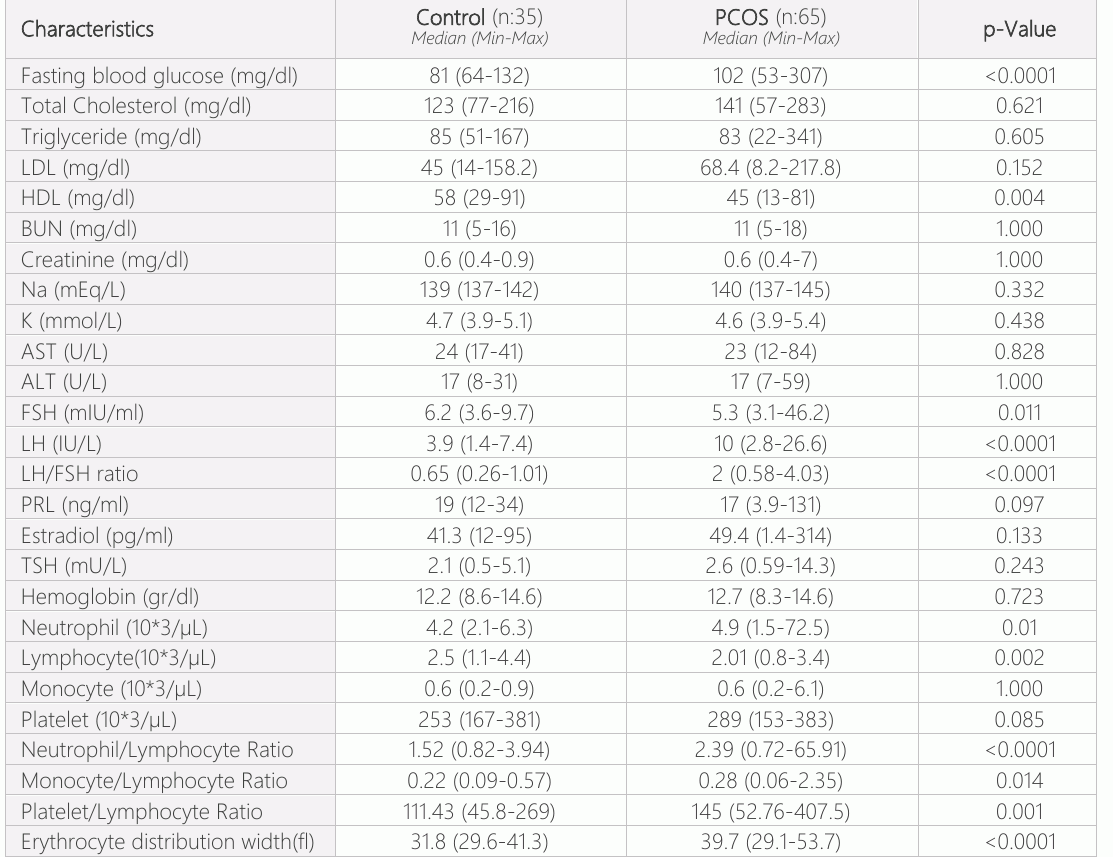
وعلى الرغم من وجود اختلافات كبيرة في الفلفل الخماسي الكلور والهيدز في كلتا الفئتين، لم يعثر على أي فرق من حيث مجموع الكولسترول، وتريغليسيرايد، وLDL، وBUN، والكراتينين، والبوتاسيوم، والصوديوم، وAST، وقيم ALT. In terms of LH/FSH, this ratio was observed to be increased in the PCOS group and was found to be significant. There were no differences in PRL, estradiol, TSH, and hemoglobin values.
In terms of hemogram, monocyte and platelet counts were not significantly different in both groups, while neutrophil and lymphocyte counts showed an increase in favor of PCOS, and this difference was considered significant. In terms of NLR, MLR, PLR, RDW-SD, and PDW values, these values were found to be increased in the PCOS group, and this was considered significant. ولم يعثر على أي فرق في أي من المجموعتين من حيث قيم RBC (الجدولان 1 و2). When patients with ECG fragmentation were evaluated in terms of the daytime/nighttime mean systolic blood pressure difference, although the difference in the PCOS group was less, this was not significant (p=0.765). When both groups without ECG fragmentation were compared, no significant difference was found in terms of daytime/nighttime systolic pressure difference (p=0,289). وكان لتشتت الأوعية الدموية نمط ضغط غير سطحي، وكان للمرضى الذين لا يعانون من التجزؤ نمط ضغط الدم في كلتا الفئتين. وبالإضافة إلى ذلك، فإن التغير في الفرق بين الفئتين مع تجزؤ النمو الاقتصادي الكلي والنهاري في ضغط الدم بين الفئتين كان أكبر من التغيير بين كلتا الفئتين دون تجزؤ الجماعة الأوروبية. When we evaluated the patients with and without ECG fragmentation in terms of daytime/nighttime systolic blood pressure difference in the control group and the PCOS group, it was observed that the change in the daytime/nighttime systolic blood pressure difference was less in patients with ECG fragmentation. When patients with and without ECG fragmentation were compared, in both groups, a difference was seen (p0.0001 and p0.0001, respectively) (Table 3).
When patients with ECG fragmentation were evaluated in terms of the daytime/nighttime mean diastolic blood pressure difference, although the difference in the control was less, this was not significant (p=0.222). وعندما قورنت كلتا الفئتين دون تجزؤ الجماعة الأوروبية، على الرغم من أن الفرق في ضغط الدم اليومي/الأسبوعي كان أقل في دائرة عمليات حفظ السلام، فإن الفرق لم يكن كبيرا (ع=888). وكان للمرضى الذين يعانون من تشظي الجهاز المركزي الأوروبي نمط ضغط دم غير رئوي، وكان للمرضى الذين لا يعانون من التشظي نمط ضغط دم في كلا الفئتين. When the difference in daytime/nighttime diastolic blood pressure was compared between those with and without ECG fragmentation, a significant difference was found in both groups (p0.0001 and p0.0001, respectively) (Table 4).
المناقشة
In clinical studies of ambulatory blood pressure, a circadian rhythm was observed, and it has been shown that blood pressure drops at night and is higher during the daytime. وهذه الحالة، التي هي جزء من الإيقاع الطبيعي للسيركادي، تُعرّف بأنها نمط النحاس النكهة. The absence of observation of this physiological process is called the non-dipper blood pressure pattern, a condition closely connected to the dangers of a cardiovascular event and end-organ damage (8)وقد أفيد بأن التصريف بالجهاز العصبي الدوار يؤدي دورا في تشكيل هذا النمط (9)- قد يؤدي تدهور وظائف الجهاز العصبي الذاتي، وهو السبب الرئيسي لأنماط ضغط الدم غير الجلدية، إلى وقوع أحداث ضارة من خلال زيادة مقاومة الأوعية الدموية المحيطة. It has been reported that this condition emerges more frequently in obese or over weight people than in the healthy population (10)معدل انتشار أمراض القلب والأوعية الدموية في الأشخاص الذين يعانون من أنماط غير رئوية هو ضعف معدل انتشار الأمراض في صحة الأشخاص الذين هم في سن مماثلة (11)وهو أيضاً شرط يرتبط بتعريف أسوأ لنمط ضغط الدم غير الجلدي مقارنة بنمط ضغط الدم (12).


In PCOS, the three key inflammatory markers are highly and significantly correlated with BMI, according to last reports. In addition, there were correlations with other cardiovascular risk markers, including HDL, triglycerides, diastolic pressure, as well as with insulin resistance, quantified by HOMA-IR. In the previous reports, untreated PCOS demonstrated significantly increased serum concentrations of hsCRP, IL-6, and increased numbers of leukocytes, granulocytes, and lymphocytes compared to a sample of healthy women which were, however, not matched by BMI. In a study, Kargılı et al. reported that the non-dipping blood pressure pattern was higher in PCOS patients than in the control group. وبالإضافة إلى ذلك، تم التأكيد على أن النمط غير الرحيم قد يكون السبب الوحيد لإنشاء أساس لأمراض القلب والأوعية الدموية (13)وتماشيا مع الأدبيات، لاحظنا النمط غير الرحيم في مجموعة PCOS، ولا سيما من حيث متوسط أوقات الدوام اليومي/الليلى والفروق في ضغط الدم بين المجموعات في دراستنا. ومع ذلك، وجدنا أن تواتر زيادة النمط غير الرحيم في المرضى المصابين بجهاز PCOS كان ذا أهمية إحصائية، مع وجود فرق فقط في ضغط الدم الاستوائي. واعتبر أن هذا الوضع قد يعزى إلى حجم الدراسة الصغير.
وقد يكون من المهم في الحد من مخاطر القلب والأوعية الدموية تفريق أولئك الذين يعانون من أنماط ضغط الدم غير الرطبة في المرضى المصابين بجهاز PCOS. لذلك، يجب أن يكون لدى هؤلاء المرضى علامات تشير إلى نمط ضغط الدم غير الجلدي. In a recent study, Eyüboğlu ' Akdeniz showed that fQRS may be predictive of non-dipper pressure patterns in prehypertensive patients. (14)ووكالة الأنباء الروسية هي نتيجة تحدث خلال العديد من أمراض القلب والأوعية الدموية. It has been shown that fQRS is also associated with increased blood pressure in patients with a non-dipper cardiac pattern, and a narrow fQRS complex seen on ECG indicates delayed ventricular conduction disturbance as well as myocardial damage and fibrosis (15, 16)ولذلك، قد يكون تحديد الدور المتوقع لنمط ضغط الدم غير الجلدي في مرضى مرضى فيروس نقص المناعة البشرية/متلازمة نقص المناعة المكتسب (الإيدز) مهماً للكشف المبكر عن المرضى الذين يعانون من مخاطر كبيرة في القلب والأوعية الدموية. وفي هذه الدراسة، وجدنا أن البيانات المتعلقة بضغط الدم غير الجلدي في كلتا المجموعتين. ووجدنا أيضا أن نمط ضغط الدم غير الجلدي كان أكثر تواترا في مجموعة PCOS من مجموعة التحكم. These results show that fQRS can be used in ECG to predict non-dipper blood pressure in patients with PCOS.
In studies in the literature, many different inflammatory markers have been observed to increase in patients with PCOS. Due to its relationship with obesity, insulin resistance has been identified in patients with PCOS, and increased levels of free fatty acids, TNF-A, and CRP have been detected (10)- لاحظت باتيل وآخرون، في دراسة أجريت، زيادات في جميع العلامات الإلتهاباتية وسماكة الوسيط في مرضى PCOS. (17)- أثبت سامي وآخرون أنه تم التحقيق في علامات تحريضية في 108 مرضى من طراز PCOS و 75 متطوعا صحيا، وتبين أن CRP, IL-6, و TNF-A زيادة كبيرة ومرتبطة مع BMI و HOMA-IR عند قياسها ضد مجموعة المراقبة (18)وفي هذه الدراسة، وفي حين لوحظت زيادة كبيرة من الناحية الإحصائية في الـ FBG و low HDL في كلتا المجموعتين، لم يعثر على أي فرق كبير من الناحية الإحصائية فيما يتعلق بمجموع الكولسترول، وتريغليسيرايد، وLDL، و BUN، والكراتين، والصوديوم، والبطاطس، و AST، و ALT. وفيما يتعلق بالصحة الإنجابية/الصحة المالية، لوحظ أن هذه النسبة قد زادت في مجموعة نظام مراقبة الأداء، وتبين أنها ذات أهمية إحصائية. There were no statistical differences in PRL, estradiol, TSH, and hemoglobin values. وفيما يتعلق بالمواصفات الفرعية للدمغ، أظهرت عدّات النيوتروبرفيل واللمفوسيتي زيادة في خدمة البرنامج، واعتبر هذا الفرق كبيرا من الناحية الإحصائية. وقد تبين أن قيم النوتروبل، واللمفوسيتي، والحركة الوطنية للتحرير، وحركة تحرير رواندا، والتجمع الكونغولي من أجل الديمقراطية، وقيم PDW، التي هي علامات تلتهاب دموية، أعلى بكثير في مجموعة PCOS. هذه المستويات المرتفعة من علامات الالتهاب الوراثي قد تفسر الارتفاع في التهديدات القلبية الوعائية للمرضى المصابين بمرض PCOS (19) - وفي دراستنا، أظهرنا أن نمط جيش الرب للمقاومة يرتبط ارتباطا وثيقا بنمط ضغط الدم الذي لا يرحم. وقد برهننا بشكل فريد في الأدبيات على أن نمط الترددات المحلية قد يؤدي دوراً تنبؤياً في التمييز بين أولئك الذين يعانون من أنماط ضغط الدم التي لا توصف في مرضى PCOS. In addition, consistent with the literature, the presence of increased inflammation in PCOS patients was shown through the hematological inflammation markers used in the study.
ونتيجة لذلك، فإن هيمنة نمط ضغط الدم غير الجلدي قد تكون آلية تسهم في ارتفاع مخاطر القلب والأوعية الدموية في هذه المجموعة. ويمكن أن يكون تصنيف مورفولوجيا الرباعي المغناطيسي المجزأة على الـ(ECG) البارامترات في التفريق بين مرضى PCOS مع زيادة مخاطر القلب والأوعية الدموية بسبب ضغط الدم غير الجلدي.
الإقرارات
- مساهمات المؤلفين (CRediT)
- ساهم جميع المؤلفين بالتساوي في جميع أدوار CRediT الأربعة عشر (Conceptualization, Data curation, Formal analysis, Funding acquisition, Investigation, Methodology, Project administration, Resources, Software, Supervision, Validation, Visualization, Writing – original draft, Writing – review & editing).
- التمويل
-
The author(s) received no financial support for the research, authorship, and/or publication of this article.
- تضارب المصالح
- The authors declare no conflict of interest.
- الموافقة الأخلاقية
- The study was administered after consent was obtained from the ethics committee. Approval from the local ethics committee was obtained (date: 24/06/2020, Session: 2020/12, Decision Number:09). Following the Helsinki Declaration, voluntary consent forms of patients included in the study were obtained (06/03/2017-No:02).
- إتاحة البيانات
- A data availability statement was not reported in the published version of this article.
المراجع (19)
19 من أصل 19 مرجعًا مرتبطة بمعرّف DOI.
- Sherwood A, Bower JK, Routledge FS, Blumenthal JA, McFetridge-Durdle JA, Newby LK, et al. Nighttime blood pressure dipping in postmenopausal women with coronary heart disease. Am J Hypertens. 2012 Oct;25(10):1077-82 DOI Crossref PubMed Google Scholar
- Cai A, Zhong Q, Liu C, Zhou D, Li X, Zhang Y, et al. Associations of systolic and diastolic blood pressure night-to-day ratios with atherosclerotic cardiovascular diseases. Hypertens Res. 2016 Dec;39(12):874-8 DOI Crossref PubMed Google Scholar
- Routledge FS, Hinderliter AL, McFetridge-Durdle J, Blumenthal JA, Paine NJ, Sherwood A. Endothelial function in postmenopausal women with nighttime systolic hypertension. Menopause. 2015 Aug;22(8):857-63 DOI Crossref PubMed Google Scholar
- Hansen TW, Li Y, Boggia J, Thijs L, Richart T, Staessen JA. Predictive role of the nighttime blood pressure. Hypertension. 2011;57(1):3-10 DOI Crossref PubMed Google Scholar
- de la Sierra A, Gorostidi M, Banegas JR, Segura J, de la Cruz JJ, Ruilope LM. Nocturnal hypertension or nondipping: which is better associated with the cardiovascular risk profile?. Am J Hypertens. 2014;27(5):680-7 DOI Crossref PubMed Google Scholar
- Stewart JM. Mechanisms of sympathetic regulation in orthostatic intolerance. J Appl Physiol (1985). 2012;113(10): 1659-68 DOI Crossref PubMed Google Scholar
- Cuspidi C, Giudici V, Negri F, Sala C. Nocturnal nondipping and left ventricular hypertrophy in hypertension: an updated review. Expert Rev Cardiovasc Ther. 2010;8(6):781-92 164 77 Polycystic Ovary Syndrome Erkayiran et al. DOI Crossref PubMed Google Scholar
- Passino C, Magagna A, Conforti F, Buralli S, Kozáková M, Palombo C, et al. Ventricular repolarization is prolonged in nondipper hypertensive patients: role of left ventricular hypertrophy and autonomic dysfunction. J Hypertens. 2003 Feb;21(2):445-51 DOI Crossref PubMed Google Scholar
- Salles GF, Reboldi G, Fagard RH, Cardoso CR, Pierdomenico SD, Verdecchia P, et al. ABC-H Investigators. Prognostic Effect of the Nocturnal Blood Pressure Fall in Hypertensive Patients: The Ambulatory Blood Pressure Collaboration in Patients With Hypertension (ABC-H) Meta-Analysis. Hyper tension. 2016 Apr;67(4):693-700 DOI Crossref PubMed Google Scholar
- Nakano S, Kitazawa M, Tsuda S, Himeno M, Makiishi H, Nakagawa A, et al. Insulin resistance is associated with reduced nocturnal falls of blood pressure in normotensive, nonobese type 2 diabetic subjects. Clin Exp Hypertens. 2002 Jan-Feb;24(1-2):65-73 DOI Crossref PubMed Google Scholar
- Sherwood A, Steffen PR, Blumenthal JA, Kuhn C, Hinderliter AL. Nighttime blood pressure dipping: the role of the sympathetic nervous system. Am J Hypertens. 2002;15(21): 111-8 DOI Crossref PubMed Google Scholar
- Das MK, Saha C, El Masry H, Peng J, Dandamudi G, Mahenthiran J, et al. Fragmented QRS on a 12 -lead ECG: a predictor of mortality and cardiac events in patients with coronary artery disease. Heart Rhythm. 2007;4(11):1385-92 DOI Crossref PubMed Google Scholar
- Kargili A, Karakurt F, Kasapoglu B, Derbent A, Koca C, Selcoki Y. Association of polycystic ovary syndrome and a non-dipping blood pressure pattern in young women. Clinics (Sao Paulo). 2010;65(5):475-9 DOI Crossref PubMed Google Scholar
- Eyuboglu M, Akdeniz B. Association Between Non-Dipping and Fragmented QRS Complexes in Prehypertensive Patients. Arq Bras Cardiol. 2019;112(1):59-64 DOI Crossref PubMed Google Scholar
- Romero-Corral A, Caples SM, Lopez-Jimenez F, Somers VK. Interactions between obesity and obstructive sleep apnea: implications for treatment. Chest. 2010;137(3):711-9 DOI Crossref PubMed Google Scholar
- Jain R, Singh R, Yamini S, Das MK. Fragmented ECG as a risk marker in cardiovascular diseases. Curr Cardiol Rev. 2014;10 (3):277-86 DOI Crossref PubMed Google Scholar
- Patel SS, Truong U, King M, Ferland A, Moreau KL, Dorosz J, et al. Obese adolescents with polycystic ovarian syndrome have elevated cardiovascular disease risk markers. Vasc Med. 2017 Apr;22(2):85-95 DOI Crossref PubMed Google Scholar
- Samy N, Hashim M, Sayed M, Said M. Clinical significance of inflammatory markers in polycystic ovary syndrome: their relationship to insulin resistance and body mass index. Dis Markers. 2009;26(4):163-70 DOI Crossref PubMed Google Scholar
- Polónia J, Amaral C, Bertoquini S, Martins L. Attenuation of heart rate recovery after exercise in hypertensive patients with blunting of the nighttime blood pressure fall. Int J Cardiol. 2006;106(2):238-43 DOI Crossref PubMed Google Scholar
اقرأ النص الكامل
افتح ملف PDF هنا
جارٍ تحميل ملف PDF…
إذا لم يظهر ملف PDF هنا، استخدم زر التنزيل أعلاه.
كيف تقتبس هذه المقالة
Erkayiran U, Aksu E, Arslanca T. The Relationship of Non-dipper Blood Pressure Pattern with the Fragmented QRS Morphology on ECG and the Role of Inflammatory Biomarkers in Polycystic Ovary Syndrome. Ulutas Med J. 2021;7(3):157-164. doi:10.5455/umj.20210520114119
Erkayiran, U., Aksu, E., & Arslanca, T. (2021). The Relationship of Non-dipper Blood Pressure Pattern with the Fragmented QRS Morphology on ECG and the Role of Inflammatory Biomarkers in Polycystic Ovary Syndrome. The Ulutas Medical Journal, 7(3), 157–164. https://doi.org/10.5455/umj.20210520114119
Erkayiran, U., Aksu, E. and Arslanca, T. (2021) 'The Relationship of Non-dipper Blood Pressure Pattern with the Fragmented QRS Morphology on ECG and the Role of Inflammatory Biomarkers in Polycystic Ovary Syndrome', The Ulutas Medical Journal, 7(3), pp. 157–164. doi: 10.5455/umj.20210520114119.