The Ulutas Medical Journal · ISSN 2149-0430 (印刷版), 2149-388X (在线版) · https://www.ulutasmedicaljournal.com/?mno=8738
原创论著 · 开放获取
宫颈癌筛查中的HPV在哪个点?
标题、摘要和全文为机器翻译。 英文原文
- Obstetrics and Gynecology, Amasya University Training and Research Hospital, Amasya, Turkey ROR
- 开放获取
- CC BY-NC 4.0
- ORCID
- 资助
- 伦理批准
- 数据可用性
摘要
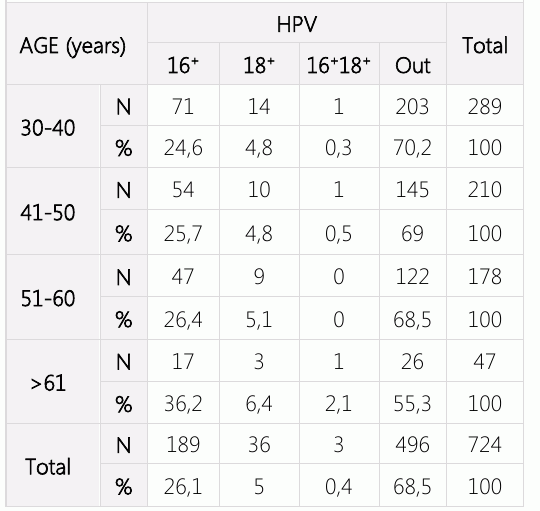
背景:子宫颈癌是继子宫颈癌和乳腺癌之后第三种最常看到的癌症类型. 妇女癌症死亡率居第四位。 这项研究的目的是调查HPV与宫颈前膜损伤和所见前膜损伤类型的关系。 材料和方法: 该研究于2014年8月至2017年12月在土耳其阿马萨亚省进行,共有24 446名30至65岁的女性,通过结合使用HPV和宫颈细胞学进行联合检测. 结果:HPV的发现率为26%,HPV18的发现率为16.5%,HPV以外的16-18的发现率为68.6%,HPV16-18的组合的发现率为0.4%。 724名HPV阳性患者的细胞学结果显示,24.3%正常,5.8%有ASC-US,8%有LGSIL,0.3%有HGSIL,0.3%有ASC-H,0.4%有AGC,45%有感染,15.9%有材料不足. 结论: 这项研究显示了我们主要遇到的细胞学发现。 HPV检查显示,HPV16-18以外的HPV类型占绝大多数,并存在大量伴生的细胞异常. 总之,其他类型的HPV导致宫颈前膜损伤,从而导致其与宫颈癌的联系的可能性很小.
关键词
全文
全文为机器翻译;以英文原文为准。 英文原文
导言
人类乳头瘤病毒(HPV)是一种性传染疾病,多见于20至30岁之间. 有超过100种报告亚型,HPV是一种双螺旋DNA病毒. 风险分为高风险和低风险两类。 从风险类别来看,6、11、40、42、43、44、54、61、72和81属于低风险类别,16、18、31、33、35、39、45、51、52、56、58、59和68属于高风险类别。 从子宫颈入侵前的损伤到癌症,都广泛存在。 它还与阴道、肛门、膀胱阴茎和喉咙的癌症密切相关。 (1–5)最常见的传播模式是性传播,其中90%在两年内出现倒退 (4, 5)持续的HPV感染涉及癌症发展的风险。 癌症发展的根本原因并不完全为人所知,但在那些已经或正在接受免疫抑制性疾病治疗的人、吸烟者和30岁以上的人中,转变为癌症更为普遍。 (3, 6, 7)HPV是一种筛查测试,在一些国家的宫颈癌筛查方案中取代了涂片检测 (8–12)在一些国家,这是除涂片试验外的另一种试验。 美国预防服务工作队(USPSTF)在2017年提出了4个不同的宫颈癌筛查方案. 这些选择是; 1. 每3年对21至29岁的妇女进行宫颈细胞检查。 只有每3年进行细胞学检查,或每5年对30至65岁的妇女进行高风险HPV检查,3岁。 21岁以下和65岁以上在前一次筛查中无病症者不进行筛查,4。 对无高等级子宫颈损伤史,子宫颈经切除术被切除的患者,不进行筛查.
前三种选择适用于有子宫颈的妇女,无论她们是否有性史或接种过疫苗。 这些选择都不推荐给患有高等级先天性损伤的妇女。 对于怀孕期间接触二乙基斯蒂尔贝酯醇的妇女或感染艾滋病毒的妇女,也不推荐这些选择。 主要的专业社会准则和现行实用准则建议每三年进行一次宫颈细胞检查 (2, 13, 14)30至65岁之间的宫颈细胞检查结合了HPV。 美国癌症协会、美国结膜检查和子宫颈病理学协会以及美国产科医生和妇科医生大会的建议,在过去几年中成为宫颈癌筛查的指南。 (2, 14, 15)他们认为,与其他专业组织一样,共同测试方案是一种可取的筛选方法。 (15, 16)根据他们的研究,对30岁以下的病人来说,共同测试似乎不是适当的测试,因为这一群体中HPV的持久性较低。 (1). 与HPV有关的癌症大多与子宫颈的结膜细胞癌有关,但其与腺炎者的联系也得到证明。 也有一些研究证明,HPV筛查是相对于矫形细胞筛查而言,在诊断胆炎者时更敏感的测试. (17–19)ASCCP和ACOG建议每5年对30至65岁的妇女进行联合检测。 (2, 3)。 。 。
材料和方法
这项研究是在2014年8月至2017年12月期间进行的,在阿马西亚省公共卫生检查方案的框架内,对24 446名30至65岁的妇女进行了结合HPV和宫颈细胞检查的联合测试检查。 在选择接受筛查的病人时,要注意包括那些没有主动性阴道感染,过去3天没有性关系,而且之前没有HPV检测的人. 验出HPV阳性的患者需接受宫颈细胞学评估,从HPV阴性的患者身上提取的宫颈细胞学材料则被置于这种评估之外. 统计分析使用SPSS 22.0版,简单频率分析.
结果
在2014年8月至2017年12月期间接受HPV筛查的总共24 446名患者中,有724人发现了HPV阳性,其中188人(26%)被列为HPV16+ 键,36(5%)作为HPV18,497(68.6%)作为HPV16-18以外的HPV,3(0.4%)作为HPV16+ 键 和HPV18+ 键宫颈细胞学结果显示,有45%(326)的感染,8%(58)的LGSIL(宫颈内膜肿瘤),5.8%(42)的ASC-US(非典型的、意义未定的结膜细胞),0.04%。(3) AGC(非典型腺细胞),0.03%(2) ASC-H(非典型的组状细胞不能排除HGSIL),0.03%(2) HGSIL(高等级的结膜内膜损伤),24.3%(176)正常细胞学发现,15.9%(117)材料不足。 从具体类型来看,我们看到9%的HPV16阳性有LGSIL,6.9%的ASC-US;5.6%的HPV18阳性有LGSIL,5.6%的ASC-US;其他HPV的7.9%有LGSIL,5.2%ASC-US。
讨论情况
根据涂片结果和临床要求,在各国单独或以联合检测的形式使用HPV筛查方法。 在我国土耳其,人体免疫机能丧失综合症筛查是在一般公共卫生筛查方案范围内进行的联合检测,目的是使我们的筛查方案标准化,并筛查人体免疫机能丧失综合症的普遍流行情况。 Martins等人已经确认,HPV 16和56是他们研究665名患者时最常见的类型. 他们发现HPV56最常与LSIL有关. 他们发现最常见的类型是高等级损伤中的HPV 16. 他们发现,HPV 18与低风险和异常涂片结果有关 (21)Otero等人发现,HPV 16、33和58类HGSIL的流行率有所增加,HPV51、53和66类HGSIL的流行率有所下降。 (22)Koliopoulos等人还得出结论认为,HPV检查比涂片测试更令人放心,并指出涂片测试的虚假负面性很高。 (23)。 。 。
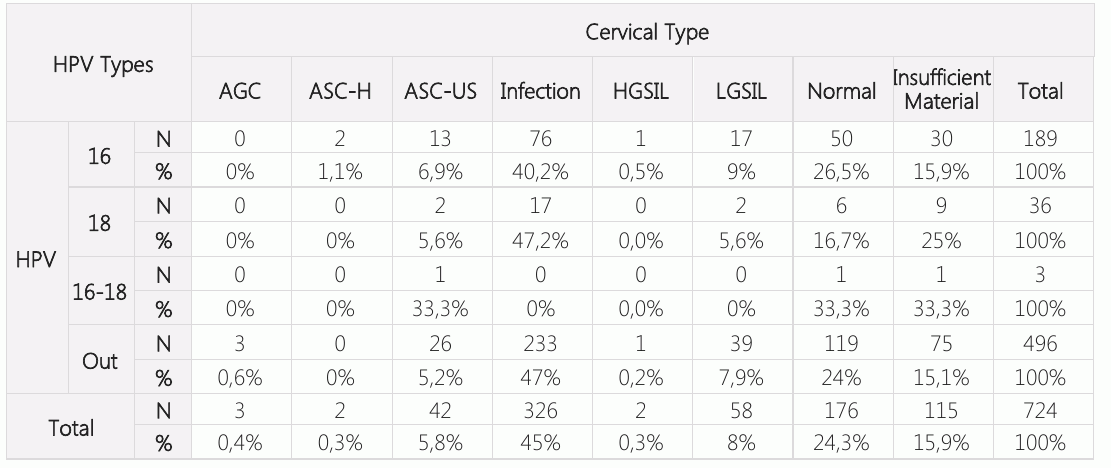
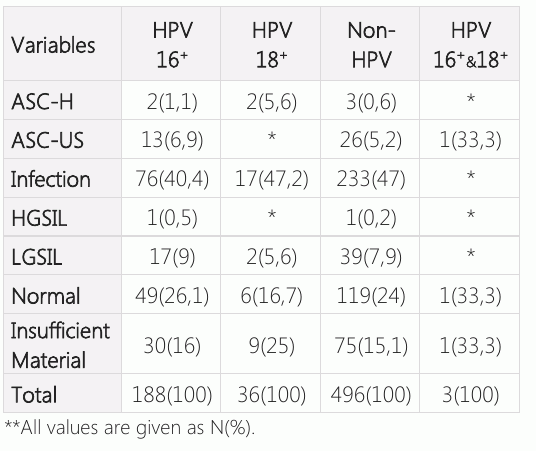
HPV检查很重要,因为HPV会导致宫颈癌,是第三常见的癌症类型,属于性传播疾病类别. 我们作为一个国家,应把HPV视为为检查宫颈癌而进行的单一检查,还是只在必要时才考虑HPV检查? 为了回答这些问题,我们组织了区域联合检测筛查方案,以确定土耳其HPV的流行程度,并使我国需要选择的宫颈癌筛查方法标准化,作为筛查方案。 我们的研究中提供的数据属于阿马西亚省,女性人口为165,494人。 我们的筛选结果表明,最常见的类型实际上由一组人组成,其中包括一些不太常见的不同类型的人,他们被归类在“其他类型”标题下。 我们发现,属于全世界最常见的高风险HPV类别的第16型HPV在所有其他HPV类型中被观测到的比例为26%。 这显然表明,地区妇女感染最多的是“其他类型”。
结论
在这项研究中,我们的目标是从24 446名被列入HPV筛查方案的妇女中发现所有724名被我们检测为HPV阳性的患者的子宫颈细胞学结果,这些患者的细胞学类型伴随这些结果,而HPV类型是最常见的。 鉴于这些结果,我们可以说,我们应该考虑我们地区最需要的哪些类型的HPV,我们种族对HPV的反应,以及它们在多大程度上转化为高等级的宫颈损伤。 将同一患者的光谱评估结果纳入我们的研究,将使我们能够提供更全面的信息,但是,由于妇女咨询保健机构,当她们发现自己是宫颈癌疑似患者时,发现她们呈HPV阳性,我们无法将她们的宫颈活检结果列入我们的研究范围。 因此,无法说有多少HPV阳性结果涉及宫颈癌。 然而,在过去的1.5年里,我们诊所有224名患者中只有3人出现子宫颈癌,其中2人患有急性癌,1人患有恶性细胞癌。
声明
- 作者贡献(CRediT)
- 所有作者对全部 14 项 CRediT 角色贡献均等(Conceptualization, Data curation, Formal analysis, Funding acquisition, Investigation, Methodology, Project administration, Resources, Software, Supervision, Validation, Visualization, Writing – original draft, Writing – review & editing)。
- 资助
-
Funding information was not reported in the published version of this article.
- 利益冲突
- The author declares that there is no conflict of interests regarding publication of this paper.
- 伦理批准
- Ethics approval details were not reported in the published version of this article.
- 数据可用性
- A data availability statement was not reported in the published version of this article.
参考文献 (23)
23 条参考文献中有 15 条已链接 DOI。
- Yıldırım, D (2013). The importance of hpvdna test in the screening of cervical cancer. Türk Jinekolojik Onkoloji Derneği. PubMed Google Scholar
- Saslow D, Solomon D, Lawson HW, et al. American Cancer Society, American Society for Colposcopy and Cervical Pathology, and American Society for Clinical Pathology screening guidelines for the prevention and early detection of cervical cancer. CA Cancer J Clin 2012;62:147. DOI Crossref PubMed Google Scholar
- ACOG Practice Bulletin Number 131: Screening for cervical cancer. ObstetGynecol. 2012 Nov;120(5):1222-38. DOI Crossref PubMed Google Scholar
- Schiffman M, Castle P. When to test women for human papilloma virus. BMJ. 2006 Jan 14; 332(7533): 61– 62 PubMed Google Scholar
- Newkirk G. Human Papilloma virus DNA Typing. In:John L. Pfenninger, Grant C. Fowler. Pfenninger and Fowler’s Procedures for Primary Care, 3rd Edition; 2010. Philadelphia. Saunders, p.963-65. PubMed Google Scholar
- Ho GY, Bierman R, Beardsley L, Chang CJ, Burk RD. Natural history of cervicovaginal papilloma virus infection in young women. N Engl J Med. 1998 Feb 12;338(7):423-8. DOI Crossref PubMed Google Scholar
- Xi LF, Koutsky LA, Castle PE, Edelstein ZR, Meyers C, Ho J, Schiffman M. Relationship between cigarette smoking and human papilloma virus types 16 and 18 DNA load. Cancer Epidemiol Biomarkers Prev. 2009 Dec;18(12):3490-6 DOI Crossref PubMed Google Scholar
- Weissenborn S. J.,Funke A. M., Hellmich M., Mallmann P., Fuchs P. G., Pfister H. J., U. Wieland. Oncogenic Human Papilloma virus DNA Loads in Human Immunodeficiency Virus-Positive Women with High-Grade Cervical Lesions Are Strongly Elevated. J Clin Microbiol. 2003 Jun;41(6):2763 –2767. DOI Crossref PubMed Google Scholar
- National Screening Unit. Updated Guidelines for Cervical Screening in New Zealand. 2016. https://www.nsu.govt.nz/ health-professionals/national-cervical-screening programme/cervical-screeningguidelines/ updated. Cited 14 September 2017. PubMed Google Scholar
- Australian Government Department of Health. Overview of the Renewal. 2017. http://www.cancerscreening.gov.au/ internet/screening/publishing.nsf/Content/overview-of-the-renewal. Cited 14 September 2017 PubMed Google Scholar
- Ministero della Salute. Piano Nazionale di Prevenzione 2014±2018. 2014. https://www.salute.gov.it/imgs/C_17_pub blicazioni_2285_allegato.pdf. Cited 14 September 2017 PubMed Google Scholar
- Rijksinstituutvoor Volksgezondheid en Milieu. Population screening will change (in Dutch). 2014. PubMed Google Scholar
- Hall, M. T.,Simms, K. T., Lew, J. B., Smith, M. A., Saville, M., &Canfell, K.(2018). Projected future impact of HPV vaccination and primary HPV screening on cervical cancer rates from 2017–2035: Example from Australia. Plo Sone, 13(2), e0185332. DOI Crossref PubMed Google Scholar
- Nayar, R.,Goulart, R. A., &Davey, D. D. (2018). Primary HPV cervical cancer screening in the United States: Are we ready? Journal of the American Society of Cytopathology, 7(1),50-55. DOI Crossref PubMed Google Scholar
- American College of Obstetricians and Gynecologists. Practice bulletin number 157. Cervical cancer screening and prevention. Obstet Gynecol.2016;127:185e187. DOI Crossref PubMed Google Scholar
- Huh WK, Ault K, Chelmow D, et al. Use of primaryhigh risk papilloma virus testing for cervical cancer screening: interim clinical guidance. Gynecol Oncol. 2015;136:178e182. DOI Crossref PubMed Google Scholar
- Draft Recommendation Statement. Cervical Cancer: Screening. Available at: https://www.uspreventiveservicestask force.org/Page/Document/draft-recommendation-state ment/cervical-cancer-screening.Accessed November17, 2017 PubMed Google Scholar
- Bray F, Carstensen B, Møller H, Zappa M, Zakelj MP, Lawrence G, Hakama M, Weiderpass E. Incidence trends of adenocarcinoma of the cervix in 13 European countries. Cancer Epidemiol Biomarkers Prev. 2005 Sep;14(9):2191-9. DOI Crossref PubMed Google Scholar
- Anttila A1, Kotaniemi-Talonen L, Leinonen M, Hakama M, Laurila P, Tarkkanen J, Malila N, Nieminen P. Rate of cervical cancer, severe intraepithelial neoplasia, and adenocarcinoma in situ in primary HPV DNA screening with cytology triage: randomised study within organised screening programme. BMJ. 2010 Apr 27;340:c1804. DOI Crossref PubMed Google Scholar
- Katki HA1, Kinney WK, Fetterman B, Lorey T, Poitras NE, Cheung L, Demuth F, Schiffman M, Wacholder S, Castle PE. Cervical cancer risk for women undergoing concurrent testing for human papilloma virus and cervical cytology: a population-based study in routine clinical practice. Lancet Oncol. 2011 Jul;12(7):663 -72. DOI Crossref PubMed Google Scholar
- Martins, T. R., de Oliveira, C. M., Rosa, L. R., de Campos Centrone, C., Rodrigues, C. L. R., Villa, L. L., & Levi, J. E. (2016). HPV genotype distribution in Brazilian women with and without cervical lesions: correlation to cytological data. Virology journal, 13(1),138. DOI Crossref PubMed Google Scholar
- OTERO‐MOTTA, A. P., Ordóñez, J. L., GONZÁLEZ‐CELADOR, R. A. F. A. E. L., Rivas, B., Garcia Macias, M. D. C., BullÓn, A., & Abad, M. D. M. (2011). Prevalence of human papillomavirus genotypes in cytologic abnormalities from unvaccinated women living in north‐western Spain. Apmis, 119(3), 204-215. DOI Crossref PubMed Google Scholar
- Koliopoulos, G., Nyaga, V. N., Santesso, N., Bryant, A., Martin‐ Hirsch, P. P., Mustafa, R. A.,... & Arbyn, M. (2017). Cytology versus HPV testing for cervical cancer screening in the general population. The Cochrane Library. DOI Crossref PubMed Google Scholar
阅读全文
在此打开 PDF
正在加载 PDF…
若 PDF 未在此显示,请使用上方的下载按钮。
如何引用本文
Karli P. At what Point is HPV in Cervical Cancer Screening?. Ulutas Med J. 2018;4(4):227-231. doi:10.5455/umj.20180916094458
Karli, P. (2018). At what Point is HPV in Cervical Cancer Screening?. The Ulutas Medical Journal, 4(4), 227–231. https://doi.org/10.5455/umj.20180916094458
Karli, P. (2018) 'At what Point is HPV in Cervical Cancer Screening?', The Ulutas Medical Journal, 4(4), pp. 227–231. doi: 10.5455/umj.20180916094458.