The Ulutas Medical Journal · ISSN 2149-0430 (印刷版), 2149-388X (在线版) · https://www.ulutasmedicaljournal.com/?mno=218539
短篇通讯 · 开放获取
HTLV1相关淋巴瘤的流行病学
标题、摘要和全文为机器翻译。 英文原文
- Hematology-Oncology/Internal medicine/Mashhad University of Medical Science/Mashhad/Iran ROR
- 开放获取
- CC BY-NC 4.0
- ORCID
- 资助
- 伦理批准
- 数据可用性
摘要
导言: 近年来,美国许多B细胞淋巴瘤的发病率开始下降,相比之下,T细胞淋巴瘤的发病率持续上升. T细胞淋巴瘤由多个亚型组成,其发病率和规律不同,可能反映其独特的病原. 淋巴恶性腺炎的发病率也因地理而异,亚型也有一些特殊的差别. 人类T细胞淋巴病毒I(HTLV-1)在日本和加勒比海,伊朗东北部流行,导致这些地区的ATL发病率上升,但在北美近郊T细胞淋巴瘤(PTCL)等非流行地区是最常见的T细胞淋巴瘤. 结论:通过多学科的流行病学研究方法,发现T细胞淋巴瘤风险因素的主要障碍可能最终可以克服.
关键词
全文
全文为机器翻译;以英文原文为准。 英文原文
导言
淋巴性恶性肿瘤是显著而多样的肿瘤群,因为它在世界不同地区的流行病学和病原学上有差异. 在亚洲各国,淋巴病的发病率总体较低。 淋巴瘤的病理学亚型在东部和西部国家有所不同,亚洲各国类似. 亚洲国家的T细胞淋巴瘤发病率较高,非霍奇金淋巴瘤和结节外疾病发病率较高。 (1)淋巴瘤发率的地理变化表明,遗传标记或多形态、免疫特征 -- -- 由于以前的慢性疾病或环境影响等潜在易感因素十分重要。 (2)慢性抗原刺激和免疫缺陷可能是受艾滋病毒感染个人NHL风险增加的原因。 其他细菌和病毒感染,特别是在东部地区比较常见的是:人类T细胞白血病/淋巴病毒1(HTLV-1)、Epstein-Barr病毒(EBV)、Helicobacter pylori感染和丙型肝炎感染;他们负责淋巴瘤的不同流行病学。(3)。 。 。
T 细胞淋巴瘤子类型
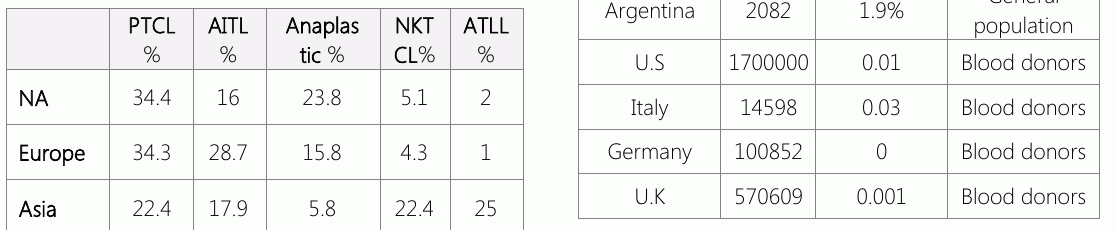
T细胞淋巴瘤亚型非常复杂,根据WHO分类. T细胞淋巴瘤有多种亚型,在世界不同地区都不同. 其中有些是极罕见的,每年在世界各地有少数病人出现。 国际研究中报告了1300名病人的主要T细胞NHL亚型,不同国家的22个站点(4)根据这项研究,T细胞淋巴瘤在欧洲最常见的亚型是Angioimmunoblastic T细胞淋巴瘤(ATL),在北美(NA)是Peripheral T细胞淋巴瘤(PTCL),在亚洲是自然杀手T细胞淋巴瘤(NKTCL)和成人T细胞淋巴瘤/白血病(ATLL). (4)这种变化可能反映亚洲国家遗传易感性或接触HTLV1等致病剂的情况。 表1显示不同区域NHL的主要 T 细胞子类型 (5)正如我们在本表中所看到的那样,ATLL和NK-T细胞淋巴瘤的发病率在亚洲更为常见,这可能与该地区HTLV-1和EBV感染的流行有关。 与淋巴瘤有关的HTLV1在日本西南部、加勒比盆地更频繁发生 (6)伊朗东北部(马什哈德) (7–9)。 。 。
人类T-Cell Lymphorotric病毒-1
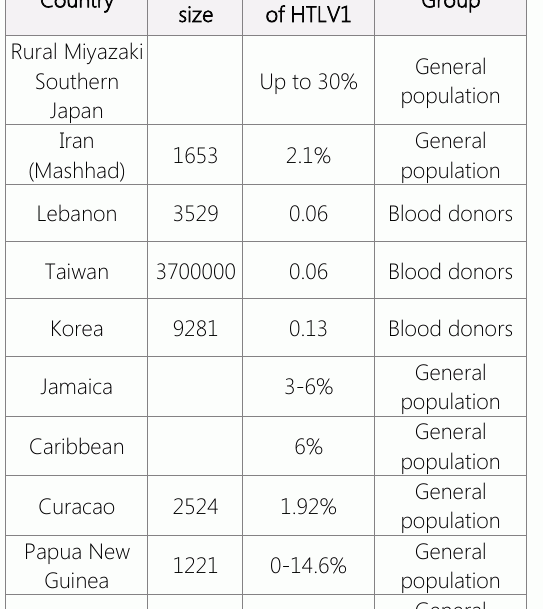
人类T-Cell Lymphorotrophic Virus-1(HTLV-1)是第一种被发现的人类逆转录病毒,估计将感染全球1000~2000万人. (10)HTLV1感染与成年T细胞白血病/淋巴瘤密切相关。(11)和HTLV1 相关 寡头性(12)HTLV1主要通过输血,母乳喂养,性传播和共用针头传播,垂直传播的结果是将病例集中在家庭或地理上离散的群体中. HTLV1感染流行于日本南部,加勒比海,美拉尼西亚岛,巴布亚新几内亚,中东,中部和南部,以及美洲南部非洲. 在这些地方病区,血清阳性反应率与伊朗东南部马什哈德的大约1%-3%不同。 (13) 在日本南部的宫崎农村达到30%。
欧洲各国HTLV-1的感染率非常低,第一次献血者HTLV-1的流行率低于0.4/10 000;欧洲唯一真正的HTLV-1流行地区是罗曼尼。 (14)在表2中,我们可以看到不同国家HTLV1的流行率。 HTLV-I血清反应率随着年龄的增长而增加,女性的血清反应率是女性的两倍。 (15)在牙买加,70岁以上的妇女占4%,70岁以上的男子占1%。 在日本的一些地区,80岁以上的人的HTLV-I血清阳性反应率为女性50%,男性30%。 这种性别差异往往发生在30岁之后,可能与在性活动年份中男性向女性更高效地传播病毒有关。 (16).HTLV1显示,在同一地理区域和感染过程中,患者之间的基因组变化不大。 事实证明,冲绳的配偶对夫妇和母亲/子女在病毒基因组直接测序时感染了高度保护的病毒。(17)在法国的研究(18) 扎伊尔(19)和所罗门群岛(20)根据PCR产品测序不准确,基因组变异性也很低。 因此,不同地理区域之间的菌株差异很小。 在母婴传染中,来自HTLV-1感染母亲的母乳喂养婴儿中,10%至25%会感染。 母乳喂养婴儿的感染风险比接受奶瓶喂养婴儿的感染风险高约四倍,母乳喂养时间更长(超过6个月),增加传染风险 (14) 在母乳中,Provars负荷是另一个重要的风险因素。 由于潜伏期很长,感染通常在开始时是无症状的,疾病一般在生命的后期显现;因此,静悄悄的传播发生. 由于没有疫苗和血库筛查的前景,而且并非所有地区都有产前护理设施,因此,在许多地区,如非洲、南美洲和中美洲、亚洲、加勒比区域和美拉尼西亚的一些地区,传播十分活跃。 (1)。 。 。
成人T-细胞淋巴瘤白血病
成人T细胞淋巴性白血病(ATL)是一种淋巴性恶性肿瘤,其急性生存期短,HTLV-1感染者的发病率不到5%. (21)在日本HTLV1载体中,ATL的累计发病率为男性约3-5%,女性为1-2%(平均2.5%)。 ATL发生在HTLV-1感染开始后至少20至30年,在男性中更为常见,尽管女性受HTLV1感染较多. ATL最初是在日本,后来是在南美洲和加勒比区域。 (22)在美国和欧洲,ATL被诊断为来自流行地区的移民. 与成年感染者相比,童年时期感染者可能具有更高的发展ATL的风险. 地方因素可能在疾病发病方面起一定作用,因为在巴西和牙买加,第四十年中ATL的发生占多数。(23)但是,在日本,生命的第五十年对ATL的发生来说是占主导地位的。
HTLV-1相关淋巴瘤包括1. 急性ATL,症状迅速发展,包括疲劳,皮肤皮疹和淋巴病,高血压也可能存在,会导致混乱,骨痛和严重的便秘,淋巴细胞出现在血液中,2. Smooldering ATL,其特征是小数量循环的无节点参与的白血病细胞,3. Lymphomatous ATL,在无麻黄参与的情况下呈现淋巴病,4 慢性ATL,其特点是皮肤损伤,麻黄,节点,以及无高血压,肠胃参与,骨骼,或中枢神经系统疾病的粘膜疾病. (4, 24)患有慢性或沉积型ATLL的患者,大约25%的患者可以发展为急性病。
例如,ATLL治疗策略因不同国家而异;AZT/IFN-α治疗在日本没有广泛深入,而且很少有外出治疗。 相比之下,AZT/IFN-α疗法一直是美国、英国、法国和巴西实际环境中的首选疗法。 (25)因此,治疗战略应当基于ATLL子分类和起始时的预测因素 (26)。 。 。
结论
T细胞淋巴瘤的流行病学可能因类型不同而不同的程度对于确定很重要,这些差异反映了病原学的差异,需要进一步研究. 今后对T细胞淋巴瘤的流行病学研究将通过分析其亚型、提高评估接触工具的可靠性和有效性来增强,以评估环境和个人的接触情况以及对T细胞淋巴瘤风险可能与一般人群不同的个人的易感亚种的评价,特别是在某些特定领域。
声明
- 作者贡献(CRediT)
- 所有作者对全部 14 项 CRediT 角色贡献均等(Conceptualization, Data curation, Formal analysis, Funding acquisition, Investigation, Methodology, Project administration, Resources, Software, Supervision, Validation, Visualization, Writing – original draft, Writing – review & editing)。
- 资助
-
Funding information was not reported in the published version of this article.
- 利益冲突
- The authors declare that there is no conflict of interests to publish this article.
- 伦理批准
- Ethics approval details were not reported in the published version of this article.
- 数据可用性
- A data availability statement was not reported in the published version of this article.
参考文献 (26)
26 条参考文献中有 25 条已链接 DOI。
- Mozaheb Z. Epidemiology of Lymphoid Malignancy in Asia: Intech; 2012. DOI Crossref PubMed Google Scholar
- Boffetta P. I. Epidemiology of adult non-Hodgkin lymphoma. Annals of oncology. 2011;22(suppl 4):iv27-iv31. DOI Crossref PubMed Google Scholar
- Engels EA. Infectious agents as causes of non-Hodgkin lymphoma. Cancer Epidemiology Biomarkers & Prevention. 2007;16(3):401-4. DOI Crossref PubMed Google Scholar
- Foss FM, Zinzani PL, Vose JM, Gascoyne RD, Rosen ST, Tobinai K. Peripheral T-cell lymphoma. Blood. 2011;117(25):6756-67. DOI Crossref PubMed Google Scholar
- Harris ME. International peripheral T-cell and natural killer/T-cell lymphoma study: pathology findings and clinical outcomes. J Clin Oncol. 2008;26:4124-30. DOI Crossref PubMed Google Scholar
- Tajima K. The 4th nation‐ wide study of adult T‐cell leukemia/lymphoma (ATL) in Japan: Estimates of risk of ATL and its geographical and clinical features. International Journal of Cancer. 1990;45(2):237-43. DOI Crossref PubMed Google Scholar
- Abbaszadegan MR, Gholamin M, Tabatabaee A, Farid R, Houshmand M, Abbaszadegan M. Prevalence of human T - lymphotropic virus type 1 among blood donors from Mashhad, Iran. Journal of clinical microbiology. 2003;41(6):2593-5. DOI Crossref PubMed Google Scholar
- Mozaheb Z, Aledavood A, Farzad F. Distributions of major sub-types of lymphoid malignancies among adults in Mashhad, Iran. Cancer Epidemiology. 2011;35(1):26-9. DOI Crossref PubMed Google Scholar
- Ohshima K, Suzumiya J, Kikuchi M. The World Health Organization classification of malignant lymphoma: Incidence and clinical prognosis in HTLV‐1‐endemic area of Fukuoka. Pathology international. 2002;52(1):1-12. DOI Crossref PubMed Google Scholar
- De Thé G, Bomford R. An HTLV-I vaccine: why, how, for whom? AIDS research and human retroviruses. 1993;9(5):381-6. DOI Crossref PubMed Google Scholar
- Hinuma Y, Nagata K, Hanaoka M, Nakai M, Matsumoto T, Kinoshita K-I, et al. Adult T-cell leukemia: antigen in an ATL cell line and detection of antibodies to the antigen in human sera. Proceedings of the National Academy of Sciences. 1981;78(10):6476-80. DOI Crossref PubMed Google Scholar
- Morgan OS, Mora C, Rodgers-Johnson P, Char G. HTLV-1 and polymyositis in Jamaica. The Lancet. 1989;334(8673):1184-7. DOI Crossref PubMed Google Scholar
- Tarhini M, Kchour G, Zanjani DS, Rafatpanah H, Otrock ZK, Bazarbachi A, et al. Declining tendency of human T-cell leukaemia virus type I carrier rates among blood donors in Mashhad, Iran. Pathology. 2009;41(5):498-9. DOI Crossref PubMed Google Scholar
- Gessain A, Cassar O. Epidemiological aspects and world distribution of HTLV-1 infection. Frontiers in microbiology. 2012;3:388. DOI Crossref PubMed Google Scholar
- Mueller N, Okayama A, Stuver S, Tachibana N. Findings from the Miyazaki cohort study. JAIDS Journal of Acquired Immune Deficiency Syndromes. 1996;13:S2-S7. DOI Crossref PubMed Google Scholar
- Yamaguchi K. Human T-lymphotropic virus type I in Japan. The Lancet. 1994;343(8891):213-6. HTLV1 Associated Lymphoma Zahra Mozaheb, et al. DOI Crossref PubMed Google Scholar
- Kakuda K, Ikematsu H, Chong WLY, Hayashi J, Kashiwagi S. Molecular epidemiology of human T lymphotropic virus type 1 transmission in Okinawa, Japan. The American journal of tropical medicine and hygiene. 2002;66(4):404-8. DOI Crossref PubMed Google Scholar
- Gessain A, Gallo RC, Franchini G. Low degree of human T-cell leukemia/lymphoma virus type I genetic drift in vivo as a means of monitoring viral transmission and movement of ancient human populations. Journal of virology. 1992;66(4):2288-95. DOI Crossref PubMed Google Scholar
- Liu L, Buchner E, Beitze D, Schmidt-Weber CB, Kaever V, Emmrich F, et al. Amelioration of rat experimental arthritides by treatment with the alkaloid sinomenine. International journal of immunopharmacology. 1996;18(10):529-43. DOI Crossref PubMed Google Scholar
- Nerurkar VR, Song K-J, Saitou N, Melland RR, Yanagihara R. Interfamilial and intrafamilial genomic diversity and molecular phylogeny of human T-cell lymphotropic virus type I from Papua New Guinea and the Solomon Islands. Virology. 1993;196(2): 506-13. DOI Crossref PubMed Google Scholar
- Shimoyama M. Diagnostic criteria and classification of clinical subtypes of adult T‐cell leukaemia‐lymphoma. British journal of haematology. 1991;79(3):428-37. DOI Crossref PubMed Google Scholar
- Uchiyama T, Yodoi J, Sagawa K, Takatsuki K, Uchino H. Adult T-cell leukemia: clinical and hematologic features of 16 cases. Blood. 1977;50(3):481-92. DOI Crossref PubMed Google Scholar
- Proietti FA, Carneiro-Proietti ABF, Catalan-Soares BC, Murphy EL. Global epidemiology of HTLV-I infection and associated diseases. Oncogene. 2005;24(39):6058-68. DOI Crossref PubMed Google Scholar
- Mozaheb Z. Rare Presentation of Anaplastic Large Cell Lymphoma and HTLV1 Positivity: A Case Report and Review. Jacobs Journal of Hematology. 2015;1(3):16. PubMed Google Scholar
- Gill PS, Harrington Jr W, Kaplan MH, Ribeiro RC, Bennett JM, Liebman HA, et al. Treatment of adult T-cell leukemia–lymphoma with a combination of interferon alfa and zidovudine. New England Journal of Medicine. 1995;332(26):1744-8. DOI Crossref PubMed Google Scholar
- Tsukasaki K, Hermine O, Bazarbachi A, Ratner L, Ramos JC, Harrington W, et al. Definition, prognostic factors, treatment, and response criteria of adult T-cell leukemia-lymphoma: a proposal from an international consensus meeting. Journal of Clinical Oncology. 2009;27(3):453-9. DOI Crossref PubMed Google Scholar
阅读全文
在此打开 PDF
正在加载 PDF…
若 PDF 未在此显示,请使用上方的下载按钮。
如何引用本文
Mozaheb Z. Epidemiology of HTLV1 Associated Lymphoma. Ulutas Med J. 2016;2(1):77-81. doi:10.5455/umj.20160216043925
Mozaheb, Z. (2016). Epidemiology of HTLV1 Associated Lymphoma. The Ulutas Medical Journal, 2(1), 77–81. https://doi.org/10.5455/umj.20160216043925
Mozaheb, Z. (2016) 'Epidemiology of HTLV1 Associated Lymphoma', The Ulutas Medical Journal, 2(1), pp. 77–81. doi: 10.5455/umj.20160216043925.