The Ulutas Medical Journal · ISSN 2149-0430 (print), 2149-388X (online) · https://www.ulutasmedicaljournal.com/?mno=218539
Short Communication · Open access
Epidemiology of HTLV1 Associated Lymphoma
- Hematology-Oncology/Internal medicine/Mashhad University of Medical Science/Mashhad/Iran ROR
Abstract
- Introduction
- In recent years, the incidence rates of many B-cell lymphomas have begun to decline in the United States, in contrast, incidence rates for T-cell lymphomas have continued to rise. T-cell lymphomas comprise multiple subtypes with different incidence rates and patterns that likely reflect their distinct etiologies. Incidence rates for lymphoid malignancies also vary by geography and there are some particular differences by subtypes. Human T-cell lymphotropic virus I (HTLV-1) which is endemic in Japan and the Caribbean, northeast of Iran, resulting in elevated rates of ATLs in these regions, but in non-endemic area such as North America Peripheral T cell lymphoma (PTCL) is the most common T cell lymphoma.
- Conclusion
- With multidisciplinary approaches to epidemiologic research, the major hurdles for uncovering T-cell lymphoma risk factors may finally be surmountable.
Keywords
Full text
Introduction
Lymphoid malignancies are remarkable and heterogeneous group of neoplasm because of its difference in epidemiology and etiology in different areas around the world. The overall incidence of lymphoid malignancy in Asian countries is relatively low. Histopathologic subtypes of lymphoma are different in eastern and western countries and similar among Asian countries. Asian countries have higher incidence of T-cell lymphomas, aggressive Non-Hodgkin Lymphoma, and extra-nodal disease (1). Geographic variation in lymphoma rate suggests the importance of potential susceptibility factors such as genetic markers or polymorphisms, immunologic characteris-tics because of prior chronic illnesses, or environmental effects (2). Chronic antigenic stimulation and immune deficiency may be responsible for the increased risk of NHL among HIV-infected individuals. Other bacterial and viral infections, which are relatively frequent especially in eastern area are human T-cell leukemia/lymphoma virus type1 (HTLV-1), Epstein–Barr virus (EBV), Helicobacter pylori infections and Hepatitis C Viruses (HCV) infection; they are responsible for different epidemiology of lymphoma(3).
T Cell Lymphoma Subtypes
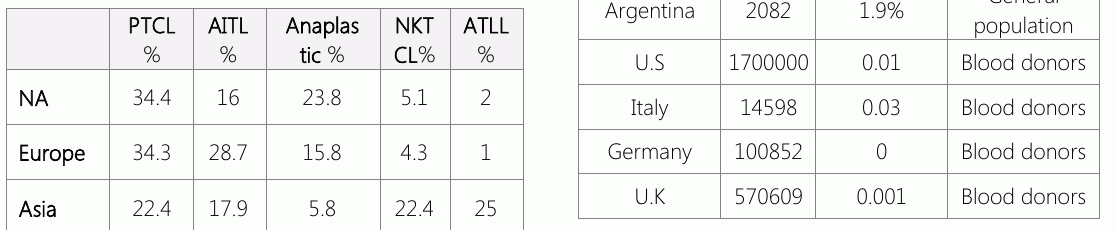
T cell lymphoma subtypes are very complicated, based on WHO classification. There are various subtypes of T cell lymphoma, which are different in various area of the world. Some of them are extremely rare, and occurring in a few patients per year throughout the world. Major T cell NHL subtypes were reported in the international study in 1300 patients, 22 sites in different countries(4). Based on this study the most common subtype of T cell lymphoma in Europe was Angioimmunoblastic T cell lymphoma (AITL ), in North American (NA) was Peripheral T cell lymphoma (PTCL), and in Asia was Natural Killer T cell lymphoma (NKTCL) and Adult T cell Lymphoma/Leukemia (ATLL) (4). This variation may reflect genetic susceptibility or exposure to pathogenic agents such as HTLV1 in Asian countries. Table 1 showed the major T cell subtype of NHL in different area (5). As we can see in this table incidence rate of ATLL and NK-T cell lymphomas are more common in Asia, which may relate to the endemic of HTLV-1 and EBV infections in the area. Lymphoma associated HTLV1 occurs more frequently in southwest Japan, the Caribbean basin (6), and northeast of Iran (Mashhad) (7–9).
Human T-Cell Lymphotrophic Virus-1
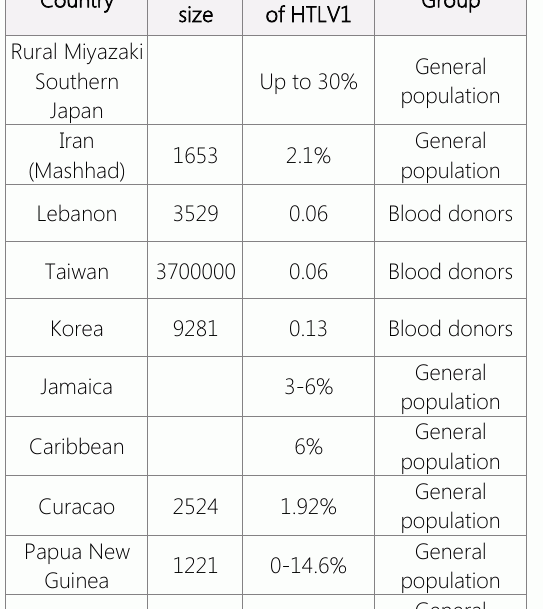
Human T-Cell Lymphotrophic Virus-1 (HTLV-1) is a first human retrovirus to be discovered, and estimated to infect 10-20 million people worldwide (10). HTLV1 Infection is strongly related to adult T-cell leukemia/Lymphoma (ATLL)(11)], and HTLV1 associated myelopathy(12). HTLV1 is primarily transmitted by blood transfusion, breast feeding, sexual transmission and sharing of needles, vertical transmission results in clustering cases in familial or geographically discrete groups. HTLV1 infection is endemic in southern Japan, the Caribbean, the Melanesian island, Papua New Guinea, the Middle East, central and South, and America southern Africa. In these endemic areas, seroprevalences range is different from about one (1-3%) percent in Mashhad in southeast Iran (13) to 30% in rural Miyazaki in southern Japan.
The level of HTLV-1 infection in European countries is very low as demonstrated by HTLV-1 prevalence in first-time blood donors of less than 0.4/10,000; the only true HTLV-1 endemic area in Europe is Romani (14). In table 2 we can see the prevalence rate of HTLV1 positivity in different countries. Population HTLV-I seroprevalence tends to increase with age and is twice as high in females (15). In Jamaica 4% of women over 70 and 1% of men over 70 were seropositive. In some area of Japan, HTLV-I seroprevalence in persons over 80 was 50% in females and 30% in males. This gender difference often emerges after 30 years of age and may be related to more efficient transmission of the virus from males to females in the years of sexual activity (16). HTLV1 shows little genomic variability between patients in the same geographic area and during the course of infection. Spouse pairs and mother/child from Okinawa have been shown to be infected with highly conserved viruses upon direct sequencing of viral genome(17). Studies in France(18) Zaire(19), and the Solomon Islands(20), have shown similarly low genomic variability based upon the less accurate sequencing of PCR products. Therefore, there is small strain variation between different geographic areas. In mother to child transmission, 10 to 25% of the breastfed children born from HTLV-1 infected mothers will become infected. Risk of infection is higher, about fourfold increase, in breast fed infants than in those who are bottle fed, and a longer duration of breast feeding (more than 6 month) increase transmission risk (14). Provirus load is the other important risk factor in breast milk. The infection is usually asymptomatic in the beginning and the disease typically manifests later in life, because of long latent period; therefore silent transmission occurs. Since there are no prospects of vaccines and screening of blood banks, and prenatal care settings are not available in all area, transmission is active in many areas such as some parts of Africa, South and Central America, Asia, the Caribbean region, and Melanesia (1).
Adult T-Cell Lymphoma Leukemia
Adult T-cell lymphoma leukemia (ATL) is a lymphoproliferative malignancy, with short survival in its acute form, and with an incidence of less than 5% in HTLV-1 infected people (21). The cumulative incidence of ATL among Japanese HTLV1 carrier is about 3-5% in male and 1-2% in female (average 2.5%). ATL occurs at least 20 to 30 years after onset of HTLV-1 infection, and is more common in men, although women are more infected with HTLV1. ATL was at first described in Japan and later in the South America and Caribbean region (22). In the United States and Europe, ATL was diagnosed in immigrants from the endemic regions. Individuals infected in childhood may be at a higher risk of developing ATL in comparison to people who infected in adult age. Local factors may play a role in disease pathogenesis, because the occurrence of ATL in the fourth decade predominates in Brazil and in Jamaica(23), but in Japan, the fifth decade of life is predominant for the occurrence of ATL.
HTLV-1-associated lymphomas include 1. Acute ATL, with symptoms that develop rapidly and include fatigue, skin rash and lymphadenopathy, hypercalcaemia may also be present which can cause confusion, bone pain and severe constipation, and lymphoma cells appear in the blood, 2. Smoldering ATL, which is characterized by small numbers of circulating leukemia cells without nodal involvement, 3. Lymphomatous ATL, which presents with lymphadenopathy without leukemic involvement, 4. Chronic ATL, which is characterized by skin lesions, leukemic, nodal, and visceral disease without hypercalcemia, gastrointestinal involvement, bone, or central nervous system disease (4, 24). Patients with the chronic or smoldering types of ATLL can progress to the acute form of disease in about 25% of cases.
The ATLL treatment strategies are vary between different countries for example; AZT/IFN-α therapy has not been extensively inves- tigated in Japan and very few experien-ces are available. By contrast, AZT/IFN-α therapy has been the treatment of choice in practical settings in the USA, England, France and Brazil (25). Therefore treatment strategies should be based on ATLL sub-classification and prognostic factors at onset (26).
Conclusion
The extent to which the epidemiology of T cell lymphoma may differ from one type to another is important to determine, these differences reflect differences in etiology, which needs further study. Future epidemiological research on T cell lymphoma will be enhanced by analyses of its sub-types, improved reliability and validity of exposure assessment tools to evaluate environmental and personal exposure and evaluation of susceptible subgroups of individuals whose risk of T cell lymphoma may differ from that of the general population, especially in some specific area.
Declarations
- Author contributions (CRediT)
- All authors contributed equally to all 14 CRediT roles (Conceptualization, Data curation, Formal analysis, Funding acquisition, Investigation, Methodology, Project administration, Resources, Software, Supervision, Validation, Visualization, Writing – original draft, Writing – review & editing).
- Funding
-
Funding information was not reported in the published version of this article.
- Conflicts of interest
- The authors declare that there is no conflict of interests to publish this article.
- Ethics approval
- Ethics approval details were not reported in the published version of this article.
- Data availability
- A data availability statement was not reported in the published version of this article.
References (26)
25 of 26 references are linked to their DOI.
- Mozaheb Z. Epidemiology of Lymphoid Malignancy in Asia: Intech; 2012. DOI Crossref PubMed Google Scholar
- Boffetta P. I. Epidemiology of adult non-Hodgkin lymphoma. Annals of oncology. 2011;22(suppl 4):iv27-iv31. DOI Crossref PubMed Google Scholar
- Engels EA. Infectious agents as causes of non-Hodgkin lymphoma. Cancer Epidemiology Biomarkers & Prevention. 2007;16(3):401-4. DOI Crossref PubMed Google Scholar
- Foss FM, Zinzani PL, Vose JM, Gascoyne RD, Rosen ST, Tobinai K. Peripheral T-cell lymphoma. Blood. 2011;117(25):6756-67. DOI Crossref PubMed Google Scholar
- Harris ME. International peripheral T-cell and natural killer/T-cell lymphoma study: pathology findings and clinical outcomes. J Clin Oncol. 2008;26:4124-30. DOI Crossref PubMed Google Scholar
- Tajima K. The 4th nation‐ wide study of adult T‐cell leukemia/lymphoma (ATL) in Japan: Estimates of risk of ATL and its geographical and clinical features. International Journal of Cancer. 1990;45(2):237-43. DOI Crossref PubMed Google Scholar
- Abbaszadegan MR, Gholamin M, Tabatabaee A, Farid R, Houshmand M, Abbaszadegan M. Prevalence of human T - lymphotropic virus type 1 among blood donors from Mashhad, Iran. Journal of clinical microbiology. 2003;41(6):2593-5. DOI Crossref PubMed Google Scholar
- Mozaheb Z, Aledavood A, Farzad F. Distributions of major sub-types of lymphoid malignancies among adults in Mashhad, Iran. Cancer Epidemiology. 2011;35(1):26-9. DOI Crossref PubMed Google Scholar
- Ohshima K, Suzumiya J, Kikuchi M. The World Health Organization classification of malignant lymphoma: Incidence and clinical prognosis in HTLV‐1‐endemic area of Fukuoka. Pathology international. 2002;52(1):1-12. DOI Crossref PubMed Google Scholar
- De Thé G, Bomford R. An HTLV-I vaccine: why, how, for whom? AIDS research and human retroviruses. 1993;9(5):381-6. DOI Crossref PubMed Google Scholar
- Hinuma Y, Nagata K, Hanaoka M, Nakai M, Matsumoto T, Kinoshita K-I, et al. Adult T-cell leukemia: antigen in an ATL cell line and detection of antibodies to the antigen in human sera. Proceedings of the National Academy of Sciences. 1981;78(10):6476-80. DOI Crossref PubMed Google Scholar
- Morgan OS, Mora C, Rodgers-Johnson P, Char G. HTLV-1 and polymyositis in Jamaica. The Lancet. 1989;334(8673):1184-7. DOI Crossref PubMed Google Scholar
- Tarhini M, Kchour G, Zanjani DS, Rafatpanah H, Otrock ZK, Bazarbachi A, et al. Declining tendency of human T-cell leukaemia virus type I carrier rates among blood donors in Mashhad, Iran. Pathology. 2009;41(5):498-9. DOI Crossref PubMed Google Scholar
- Gessain A, Cassar O. Epidemiological aspects and world distribution of HTLV-1 infection. Frontiers in microbiology. 2012;3:388. DOI Crossref PubMed Google Scholar
- Mueller N, Okayama A, Stuver S, Tachibana N. Findings from the Miyazaki cohort study. JAIDS Journal of Acquired Immune Deficiency Syndromes. 1996;13:S2-S7. DOI Crossref PubMed Google Scholar
- Yamaguchi K. Human T-lymphotropic virus type I in Japan. The Lancet. 1994;343(8891):213-6. HTLV1 Associated Lymphoma Zahra Mozaheb, et al. DOI Crossref PubMed Google Scholar
- Kakuda K, Ikematsu H, Chong WLY, Hayashi J, Kashiwagi S. Molecular epidemiology of human T lymphotropic virus type 1 transmission in Okinawa, Japan. The American journal of tropical medicine and hygiene. 2002;66(4):404-8. DOI Crossref PubMed Google Scholar
- Gessain A, Gallo RC, Franchini G. Low degree of human T-cell leukemia/lymphoma virus type I genetic drift in vivo as a means of monitoring viral transmission and movement of ancient human populations. Journal of virology. 1992;66(4):2288-95. DOI Crossref PubMed Google Scholar
- Liu L, Buchner E, Beitze D, Schmidt-Weber CB, Kaever V, Emmrich F, et al. Amelioration of rat experimental arthritides by treatment with the alkaloid sinomenine. International journal of immunopharmacology. 1996;18(10):529-43. DOI Crossref PubMed Google Scholar
- Nerurkar VR, Song K-J, Saitou N, Melland RR, Yanagihara R. Interfamilial and intrafamilial genomic diversity and molecular phylogeny of human T-cell lymphotropic virus type I from Papua New Guinea and the Solomon Islands. Virology. 1993;196(2): 506-13. DOI Crossref PubMed Google Scholar
- Shimoyama M. Diagnostic criteria and classification of clinical subtypes of adult T‐cell leukaemia‐lymphoma. British journal of haematology. 1991;79(3):428-37. DOI Crossref PubMed Google Scholar
- Uchiyama T, Yodoi J, Sagawa K, Takatsuki K, Uchino H. Adult T-cell leukemia: clinical and hematologic features of 16 cases. Blood. 1977;50(3):481-92. DOI Crossref PubMed Google Scholar
- Proietti FA, Carneiro-Proietti ABF, Catalan-Soares BC, Murphy EL. Global epidemiology of HTLV-I infection and associated diseases. Oncogene. 2005;24(39):6058-68. DOI Crossref PubMed Google Scholar
- Mozaheb Z. Rare Presentation of Anaplastic Large Cell Lymphoma and HTLV1 Positivity: A Case Report and Review. Jacobs Journal of Hematology. 2015;1(3):16. PubMed Google Scholar
- Gill PS, Harrington Jr W, Kaplan MH, Ribeiro RC, Bennett JM, Liebman HA, et al. Treatment of adult T-cell leukemia–lymphoma with a combination of interferon alfa and zidovudine. New England Journal of Medicine. 1995;332(26):1744-8. DOI Crossref PubMed Google Scholar
- Tsukasaki K, Hermine O, Bazarbachi A, Ratner L, Ramos JC, Harrington W, et al. Definition, prognostic factors, treatment, and response criteria of adult T-cell leukemia-lymphoma: a proposal from an international consensus meeting. Journal of Clinical Oncology. 2009;27(3):453-9. DOI Crossref PubMed Google Scholar
Read the full text
Open the PDF here
Loading the PDF…
If the PDF does not show here, use the download button above.
How to cite this article
Mozaheb Z. Epidemiology of HTLV1 Associated Lymphoma. Ulutas Med J. 2016;2(1):77-81. doi:10.5455/umj.20160216043925
Mozaheb, Z. (2016). Epidemiology of HTLV1 Associated Lymphoma. The Ulutas Medical Journal, 2(1), 77–81. https://doi.org/10.5455/umj.20160216043925
Mozaheb, Z. (2016) 'Epidemiology of HTLV1 Associated Lymphoma', The Ulutas Medical Journal, 2(1), pp. 77–81. doi: 10.5455/umj.20160216043925.