The Ulutas Medical Journal · ISSN 2149-0430 (印刷版), 2149-388X (在线版) · https://www.ulutasmedicaljournal.com/?mno=165447
原创论著 · 开放获取
对不育男性抗氧化剂-氧化剂水平的调查:前景跨部门研究
标题、摘要和全文为机器翻译。 英文原文
- Department of Urology, Hatem Private Hospital, Gaziantep, Turkey
- 开放获取
- CC BY-NC 4.0
- ORCID
- 资助
- 伦理批准
- 数据可用性
摘要
导言: 不孕症的上升,特别是其许多原因仍然令人困惑,因此必须采取先进的调查措施。 本研究探讨了不育男性患者中各种生化,荷尔蒙,血液,氧化应力参数及其精子参数之间的关联. 材料和方法:2023年1月至7月,对我国门诊部不育男性患者的血液样本进行了上述参数检查。 患者根据其精子参数分为四组:第一组(自然),第2组(Asthenospermia),第3组(Oligospermia),第4组(Azoospermia). 结果:不孕期、FSH、LH、prolactin和睾丸体积(左右)在各组之间差别很大(p<0.01)。 在单细胞、异骨化、TAS、TOS、OSI、CRP和ESR等水平(p<0.01)中也发现了重大差异。 具体来说,偶氮化物与增加的单体、TOS、OSI、CRP和ERSR水平(p=0.012、r:0.141至p<0.001、r:0.551)正相关。 物流回归将TAS、TOS、OSI和ESR确定为重要的区别风险因素。 根据ROC的分析,这些因素是Azoospermia的临界预测器. 结论:超高的TOS和OSI,加上TAS水平的下降,与单细胞,CRP,ESR在Azoospermia有联系. 因此,TAS、TOS、OSI和ESR可以成为不孕症的关键诊断工具,对常规血液样本的评估可以简化对不孕症的诊断和治疗反应评估。
关键词
全文
全文为机器翻译;以英文原文为准。 英文原文
导言
不孕症仍然是一个全球性的医疗挑战,通常被描述为在正常无保护的性交一年后无法进行临床妊娠 (1)在全球范围,它影响到约四分之一的夫妇,其病原谱包括女性、男性、两性或往往模糊的原因。 (2, 3)值得注意的是,男性不孕症几乎占所有此类病例的一半。 (4)令人不安的是,在所有受到影响的夫妇中,几乎有一半是男性因素导致不孕症,这种情况十分普遍。 不孕症的病理框架很复杂,包括激素障碍、遗传倾向、解剖异常、社会心理决定因素和与年龄有关的下降。 (5)此外,原生病理学往往强调受到生活方式、饮食、环境污染物、药物和其他毒素的有害影响的有害因素。 (6)令人不安的是,由于睾丸活性氧(ROS)的有害影响,破坏氧化剂-抗氧化剂平衡而导致的氧化应力失衡危及精子的产生。 (6)这又表现在偏执不孕和精液参数受损 (7)高强度的ROS和日益增加的氧化应力造成细胞、组织和器官损伤。 因此,含有可氧化不饱和脂肪酸和低量ROS中和酶的静膜特别脆弱。 (8)。 。 。
保持氧化剂-抗氧化剂平衡可产生坚固的、有弹性的、结构良好的精子,有可能减轻不孕症。 (9, 10). 静脉血浆室 多种酶和非酶抗氧化剂,从超氧化物消解酶和催化酶到维生素E,提供保护,防止ROS,并支持辅助生殖战略 (11)鉴于不育率居高不下,诊断、管理和跟踪大量不育夫妇的基因不明,需要创新标记。 鉴于不孕症的发病率不断上升,迫切需要为不明原因的病例提供创造性的诊断和治疗标记。 (12–14)研究的重点是生化、荷尔蒙、血液和氧化应激参数,这些男性患者因不育而申请到我们的诊所,并评估这些值与患者精子参数之间的关系。
材料和方法
研究设计
该研究被设计为远景,跨部门,单中心研究. 尽管在一年多的时间里没有保护措施的性交,但不能生育的男子也被纳入研究范围。
道德声明
本研究规程经大学院临床研究伦理委员会批准(批复:27.01.2023-52850). 为这项未来研究获得了患者的书面知情同意。 2023年1月至7月向泌尿科门诊提出申请的不育男性患者被纳入研究范围. 评估了年龄、不孕期、检查结果、睾丸体积、体积指数、额外疾病、以前的药物、以前的治疗方法、吸烟、职业和各种激素失调,特别是甲状腺和垂体等器官。 研究中包括的病人被认为是初级(从未生过孩子)和二级(以前生过孩子,一年以上没有孩子)不孕症.
过程和病人分组
我们首先根据具体标准确定并排除了潜在的参与者:那些接受过手术或医疗不孕症治疗的人、那些被诊断患有阴道或低位病的人、吸烟者和次级不孕病人。 经过体格检查,参与者接受了血色多普勒超声波检查,以评估血流到两个睾丸的情况。 在规定72小时的性禁欲期之后,进行了精液分析。 这一分析仔细研究了几个参数:精液体积,精液计数,运动力,前期精液率和计数,符合克鲁格标准的形态学,以及精液中的白细胞计数.
同时,对所有参与者的血液样本进行了各种测试。 这些指数旨在测量激素水平——包括总睾丸酮、LH、FSH、燕尾醇、蛋白素和TSH——炎症因素、外观和CRP。 在病人的标准门诊评估中,确定和分类了TOS、TAS和OSI的数值。 根据这些评价的全面数据,我们把参与者分为四个不同的组: 第一组(自然精子参数): 这些患者展示了标准的精子测量:精液体积超过1.5cc,精子数超过1500万/毫升,精子运动总密度超过40%,前向运动力超过32%,克鲁格形态大于14%,白细胞低于100万。 第2组(雅典斯珀米亚): 这一组由40%以下的精子运动组成,但平均精子数超过1 500万/毫升。 第3组(Oligospermia):精子数低于1 500万/毫升。 第4组(Azoospermia):精子缺乏存活精子细胞的病人。 我们开始比较分析,评估年龄,体质指数,激素水平,精子参数,TAS,TOS,OSI,以及诸如白细胞,中子素,血小板,CRP和沉积等炎症标记. OSI值、精子参数和其他重要变量(如激素水平和炎症因素)之间的关联得到了认真的确定。
氧化状态(TOS)合计
血清TOS级别是用Erel开发的商用Rel Assay包研究的. 为了测量TOS,采用了一种基于样品中含有的氧化物分子氧化到有色离子到发酵离子的色度测定方法,如试验工作原理所述. 结果为μmol H2个欧2个页:1 (19)。 。 。
抗氧化剂总量(TAS)
Serum TAS级用Erel开发的商用Rel Assay包进行了研究. 由Erel开发,这种方法是自动的,并测量人体对强自由基的全部抗氧化能力. 样品的TOS测量方法是基于所有抗氧化分子降低有色ABTS* 致生基,以及按抗氧化分子总浓度的比例将有色基脱色. (20). Trolox是维他命E的一种水溶类比,用作钙化剂. 结果以mmol Trolox等效/L表示。
氧化压力指数(OSI)
标本的氧化应激指数为标本总氧化物状态占标本总抗氧化物水平的百分比. (21)。在计算前,TAS测试单元中的mmol值会像TOS测试一样转换成微摩尔。
统计分析
利用GraphPad Prism 9.0(GraphPad Software、San Diego、CA、美国)方案分析了统计计量。 在评估研究数据时,计算出描述性统计方法(中间法、分法)。 Shapiro-Wilk测试确定了数据的分布. 单向ANOVA测试被用于正常分布,Kruskal Wallis用于非正常分布. 为了进行关联性分析,采用了非变量和多变量回归分析。 皮尔逊关联被用于正常分布,斯皮尔曼关系被用于非正常分布. 这些结果被认为具有重大意义,置信间隔为95%,p<0.05。
结果
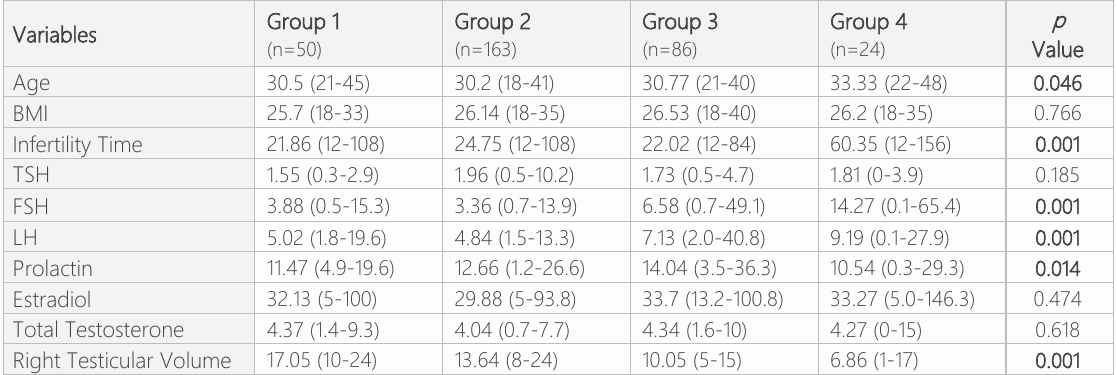
各组的生化炎症和激素参数的比较见表1。 各群体在年龄,不孕期,FSH,LH,prolactin,右睾丸体积和左睾丸体积上存在差异(p<0.05). 关于其他参数,各组之间没有统计上的重大差异(表1)。
表2列出了各组的血液、炎症和氧化应激参数的比较。 单细胞、肾上腺素、TAS、TOS、OSI、CRP和ESR(p<0.05)(图1)存在差异。 在其他参数中,各组没有区别(表2)。 在生物化学参数和激素参数方面对各组之间的参数进行了关联(表3)。 血吸虫病和不育时间的发展、FSH和LH(分别为p=0.016、r:0.134、p<0.001、r:0.368和p<0.001、r:0.278)之间有着显著的正相关关系。 异骨化症的发育与年龄,精子体积,以及亲乳素参数之间没有关系. 对各组之间炎症和氧化应激的重要参数进行了相关分析(表4)。 偶氮化物和单烯化物、TOS、OSI、CRP和ESR(分别为p=0.012、r:0.141、p=0.028、r:0.122、p<0.001、r:0.551、p=0.022、r:0.128、p<0.001、r:0.339)的发展之间有正相关关系。 然而,Azoospermia级和TAS级(第<0.001页,r:-0.443)的发育存在负相关关系. 血吸虫病和血吸虫病的发育之间没有关系(表4)。 采用与Azoospermia相关的变量作为依赖变量进行阶梯线性回归。 它显示与TAS的反相关性,但与TOS、OSI和ESR的正相关性(表5)。
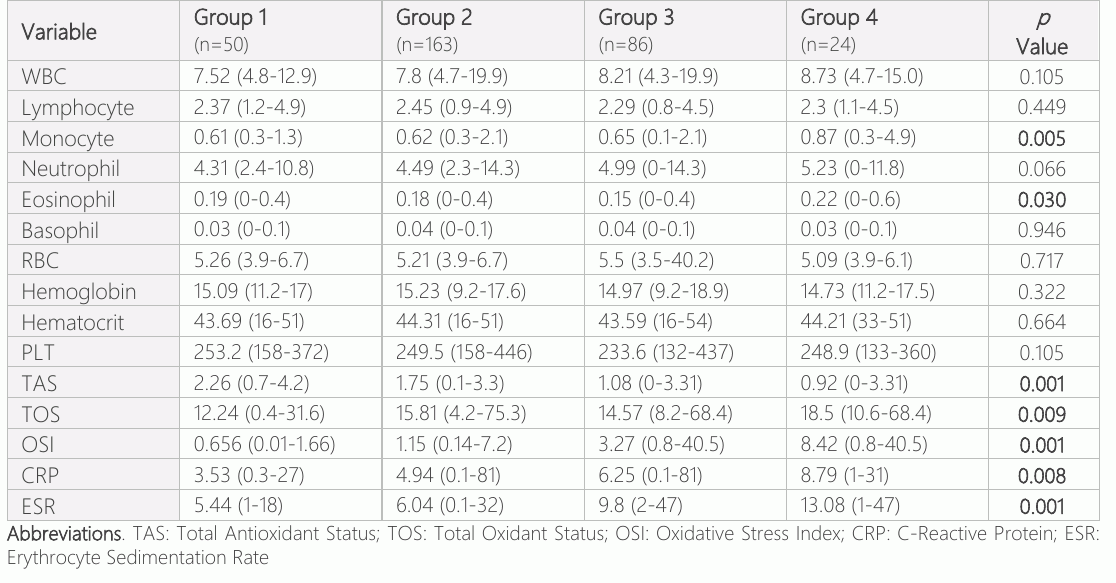

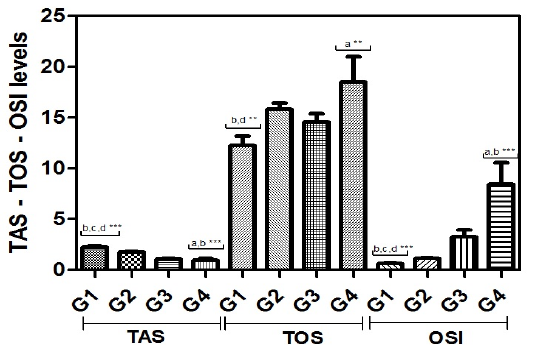
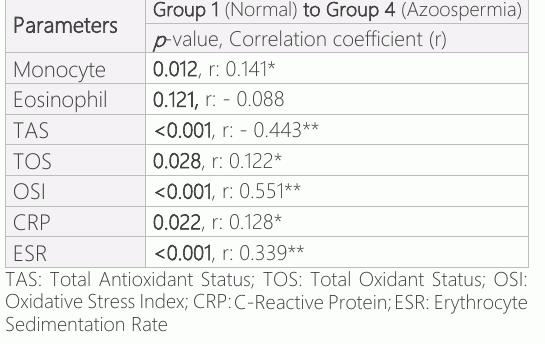
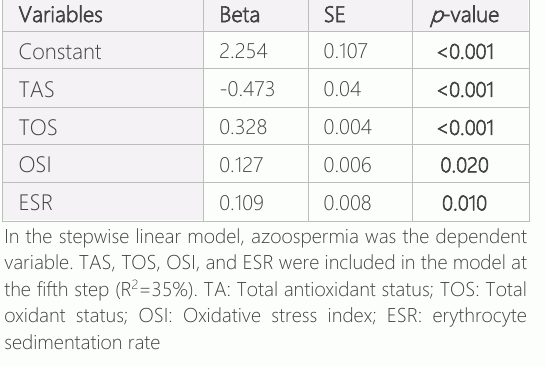
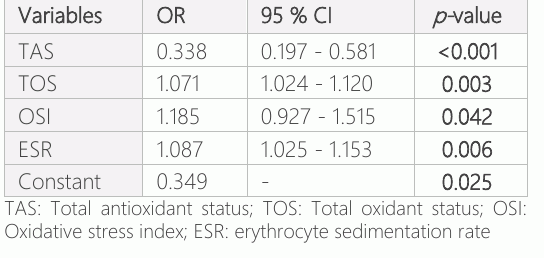
表6对用于区分异骨灰肿症和正常性的因素进行了逻辑回归分析。 与物流回归分析差异有关的风险因素包括TAS、TOS、OSI和ESR。
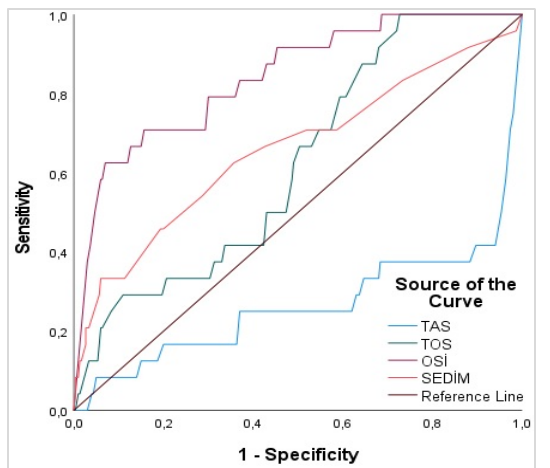
根据对Azoospermia病人的ROC分析结果,TAS的敏感度为33.3%,特异性为35.3%(p=00001;AUC:0.266;95%CI:0.130-0.402);TOS的敏感度为66.7%(p=0,044;AUC:0.624;95%CI:0.520-0.727);OSI的敏感度为70.8%,特异性为84.3%(p=00001;AUC:0.842;95%CI:0.759-0.924);ESR的敏感度为62.5%,特异性为64.3%(p=010;AUC:0.659;95%CI:0.528-0.790)。 这些值的临界点分别为1.11、12.35、1.92和7.5。 因此,根据ROC对Azoospermia的分析,TAS,TOS,OSI,和ESR是显著的预测因素(图2).
讨论情况
我们的研究审查了生化、激素、血液和氧化应激标记及其对男性不孕的影响。 我们确定了TAS、TOS、OSI和ESR在确定精子特征方面的重要作用。 抗氧化剂和自由基之间的不平衡导致的氧化应激,似乎对影响精子质量至关重要。 尽管现有文献中发现了各种不同的发现,但是在男性不孕症诊断和治疗效果中氧化应激参数的重要性是显而易见的. 这强调需要进行全面研究,以更好地理解这种关系。 由于体内抗氧化剂和自由氧基的不平衡而出现的氧化性应激,损害精子,并可能造成不孕症. (22)在原始血浆中,不成熟的白细胞(中微营养素和巨噬素)和受损的精子是自由氧基的主要内源。 (23, 24). 肾上腺血浆具有很强的抗氧化能力,可以保护精子,防止自由氧基引起的损害 (25, 26). 这个保护系统包含抗氧化剂分子,可以阻止自由氧基的链式反应,收集或中和氧化剂基. 关于自由氧基和抗氧化能力的不同数据在贫瘠男子的原始血浆中得到了报道. 夏尔马等人. (22) Saleh等人则报告说,在无精打采的男子中,TAS和TOS含量较低。 (27) TAS和TOS在不育的雄性原生血浆中没有发现任何变化. Shiva等人发现,Azoospermia病人的氧化能力低,抗氧化能力高 (28) 根据我们的研究结论,氧化性应激指数和总氧化能力相当高,抗氧化剂的总抗氧能力相对较低。 考虑到目前人们知道,骨干血浆中氧化应力的主要来源是白细胞和不成熟、有缺陷的精子细胞,预计我们的一群无血小细胞、低TOS值和精液中的OSI的动物杂交体。 然而,我们发现,Azoospermia群体中TOS和OSI的高值是由于血单细胞,CRP和ESR. 许多情况,如系统感染、抑郁症和应激,导致血液中的氧化平衡变化。 (3, 21, 29, 30)许多这些临床条件也是导致男性不孕的病因之一。 从这个角度看,我们可以说,在血清中引起氧化应激症状的病理可能间接影响骨质血浆以及精子的产生和功能. 反之的例子随时可见。 许多研究表明,通过纠正系统抗氧化剂平衡的治疗,精子的产生和/或功能可以得到改善。 (31, 32)因此,我们的研究中,精液中TAS含量高的原因之一可以用成熟精子细胞对抗氧化能力的贡献来解释。 在审查精液参数TAS和TOS之间关系的研究中也报告了不同的结果. 虽然一些作者找不到不育男性的精液参数与TAS的关联,TOS (33, 34),其他报告的关系 (5, 8) 。在我们的研究中,虽然精子参数与TOS和OSI在对角体组中存在正相关,但精子参数与TAS之间却存在负相关. 在我们的研究中,OSI高程与精液体积,精子计数,以及非az体组形态的负相关关系,支持文献中氧化应力对精子发育有负面影响的信息. (8, 35, 36)。 。 。
这项研究受到若干限制。 首先,它是一个单一中心的研究,它必然会限制我们调查结果的概括性。 第二,缺乏长期后续数据,限制了我们对所审查指数的持续诊断效力的洞察。 此外,没有广泛探讨系统性氧化平衡障碍,如抑郁情绪引起的失调对精子参数的影响。 鉴于关于氧化性应力及其与精子计数的关系的文献中的各种发现,我们的研究结论将得益于在更大,多中心研究中的验证.
结论
血清血浆和血液中Azoospermia显示出明显的氧化性应激模式,与寡骨permic和规范血压对应物相比。 我们的同位素组群中TOS和OSI水平升高,其特点是具有原始样本,没有精子细胞和/或血小球,这表明精液中氧化应力的主要促成因素可能是单细胞,还有CRP和ESR标记。 我们的调查结果强调了TAS、TOS、OSI和ESR测量在诊断不孕症方面的关键作用。 这项研究表明,TAS、TOS和OSI指标在评估抗氧化剂在解决男性不孕症方面的疗效方面具有潜在作用,主要是在与精子图同时使用时。 此外,对诱发氧化性压力的各种条件对精液质量的影响需要进行更深入的探索。 显然迫切需要进行更广泛和更有条理的调查。 值得注意的是,通常在Azoospermia和重度寡头动物吸食病人中观察到的抑郁症对精子参数的潜在影响,通过系统性氧化性不平衡,为今后的调查提供了令人感兴趣的途径。
声明
- 作者贡献(CRediT)
- 所有作者对全部 14 项 CRediT 角色贡献均等(Conceptualization, Data curation, Formal analysis, Funding acquisition, Investigation, Methodology, Project administration, Resources, Software, Supervision, Validation, Visualization, Writing – original draft, Writing – review & editing)。
- 资助
-
Funding information was not reported in the published version of this article.
- 利益冲突
- The authors declare no conflict of interest.
- 伦理批准
- This study protocol was approved by the clinical research ethics committee of the institution of the University (Approval:27.01.2023- 52850). Written informed consent was obtained from patients for this prospective study.
- 数据可用性
- The data that was used and analysed during this research are available from the corresponding author on reasonable request.
参考文献 (36)
36 条参考文献中有 33 条已链接 DOI。
- Vayena E, Rowe PJ, Griffin PD. Current practices and controversies in assisted reproduction: report of a meeting on medical, ethical and social aspects of assisted reproduction, held at WHO Headquarters in Geneva, Switzerland: World Health Organization; 2002. PubMed Google Scholar
- Dong L, Zhang X, Yang F, Li J, Yu X, Li Y. Effect of oral alpha-lipoic acid (ALA) on the treatment of male infertility: A protocol for systematic review and meta-analysis. Medicine (Baltimore). 2019;98(51):e18453. DOI Crossref PubMed Google Scholar
- Dokuyucu R, Karateke A, Gokce H, Kurt RK, Ozcan O, Ozturk S, et al. Antioxidant effect of erdosteine and lipoic acid in ovarian ischemia-reperfusion injury. Eur J Obstet Gynecol Reprod Biol. 2014;183:23-7. DOI Crossref PubMed Google Scholar
- Gabrielsen JS, Tanrikut C. Chronic exposures and male fertility: the impacts of environment, diet, and drug use on spermatogenesis. Andrology. 2016;4(4):648-61. DOI Crossref PubMed Google Scholar
- Maurya S, Kesari KK, Roychoudhury S, Kolleboyina J, Jha NK, Jha SK, et al. Metabolic Dysregulation and Sperm Motility in Male Infertility. Adv Exp Med Biol. 2022;1358:257-73. DOI Crossref PubMed Google Scholar
- Saad AB, Rjeibi I, Brahmi N, Elaloui E, Zouari N. Nicotine-induced oxidative stress, testis injury, AChE inhibition and brain damage alleviated by Mentha spicata. Inflammopharmacology. 2020;28(4):939-48. DOI Crossref PubMed Google Scholar
- Aitken RJ, De Iuliis GN, Finnie JM, Hedges A, McLachlan RI. Analysis of the relationships between oxidative stress, DNA damage and sperm vitality in a patient population: development of diagnostic criteria. Hum Reprod. 2010;25(10):2415-26. DOI Crossref PubMed Google Scholar
- Moustafa MH, Sharma RK, Thornton J, Mascha E, Abdel-Hafez MA, Thomas AJ, Jr., et al. Relationship between ROS production, apoptosis and DNA denaturation in spermatozoa from patients examined for infertility. Hum Reprod. 2004;19(1):129-38. 172 77 Antioxidant-Oxidant Levels in Infertile Men Mehmet Taşkıran DOI Crossref PubMed Google Scholar
- Hussain T, Kandeel M, Metwally E, Murtaza G, Kalhoro DH, Yin Y, et al. Unraveling the harmful effect of oxidative stress on male fertility: A mechanistic insight. Front Endocrinol (Lausanne). 2023;14:1070692. DOI Crossref PubMed Google Scholar
- Becatti M, Cito G, Argento FR, Fini E, Bettiol A, Borghi S, et al. Blood Leukocyte ROS Production Reflects Seminal Fluid Oxidative Stress and Spermatozoa Dysfunction in Idiopathic Infertile Men. Antioxidants (Basel). 2023;12(2). DOI Crossref PubMed Google Scholar
- Dutta S, Majzoub A, Agarwal A. Oxidative stress and sperm function: A systematic review on evaluation and management. Arab J Urol. 2019;17(2):87 -97. DOI Crossref PubMed Google Scholar
- Walczak-Jedrzejowska R, Wolski JK, Slowikowska-Hilczer J. The role of oxidative stress and antioxidants in male fertility. Cent European J Urol. 2013;66(1):60-7. DOI Crossref PubMed Google Scholar
- Aprioku JS. Pharmacology of free radicals and the impact of reactive oxygen species on the testis. J Reprod Infertil. 2013;14(4):158-72. DOI Crossref PubMed Google Scholar
- Sanocka-Maciejewska D, Ciupinska M, Kurpisz M. Bacterial infection and semen quality. J Reprod Immunol. 2005;67(1-2):51-6. DOI Crossref PubMed Google Scholar
- Aydogdu I, Karaca E, Coban G, Cay A, Guler EM, Kocyigit A, et al. An investigation of the effects of amniotic fluid on experimental ischemia/reperfusion damage in rat testes. J Pediatr Urol. 2021;17(6):761 e1- e6. DOI Crossref PubMed Google Scholar
- Erdemli Z, Erdemli ME, Turkoz Y, Gul M, Yigitcan B, Gozukara Bag H. The effects of acrylamide and Vitamin E administration during pregnancy on adult rats testis. Andrologia. 2019;51(7):e13292. DOI Crossref PubMed Google Scholar
- Isbilen E, Kulaksizoglu S, Kirmizioglu M, Karuserci Komurcu O, Tabur S. Role of prolidase activity and oxidative stress biomarkers in unexplained infertility. Int J Gynaecol Obstet. 2022;156(3):430-5. DOI Crossref PubMed Google Scholar
- Kati B, Gonel A, Ordek E, Pelit ES, Ciftci H. Do inflammatory markers such as NLRP3 and IL1-beta have an effect on the prediction of testicular sperm extraction success in infertile men? Andrologia. 2022;54(11):e14572. PubMed Google Scholar
- Erel O. A new automated colorimetric method for measuring total oxidant status. Clin Biochem. 2005;38(12):1103-11. DOI Crossref PubMed Google Scholar
- Erel O. A novel automated direct measurement method for total antioxidant capacity using a new generation, more stable ABTS radical cation. Clin Biochem. 2004;37(4):277-85. DOI Crossref PubMed Google Scholar
- Dokuyucu R, Cevik C, Ozler GS, Ozgur T, Arli C, Sefil F, et al. Determination of oxidative stress and effect of erdosteine on rhinitis medicamentosa in a rat model. Eur J Pharmacol. 2014;742:153-7. DOI Crossref PubMed Google Scholar
- Sharma RK, Pasqualotto FF, Nelson DR, Thomas AJ, Jr., Agarwal A. The reactive oxygen species-total antioxidant capacity score is a new measure of oxidative stress to predict male infertility. Hum Reprod. 1999;14(11):2801-7. DOI Crossref PubMed Google Scholar
- Barati E, Nikzad H, Karimian M. Oxidative stress and male infertility: current knowledge of pathophysiology and role of antioxidant therapy in disease management. Cell Mol Life Sci. 2020;77(1):93-113. DOI Crossref PubMed Google Scholar
- Agarwal A, Rana M, Qiu E, AlBunni H, Bui AD, Henkel R. Role of oxidative stress, infection and inflammation in male infertility. Andrologia. 2018;50(11):e13126. DOI Crossref PubMed Google Scholar
- Bisht S, Faiq M, Tolahunase M, Dada R. Oxidative stress and male infertility. Nat Rev Urol. 2017;14(8):470-85. DOI Crossref PubMed Google Scholar
- Sengupta P, Roychoudhury S, Nath M, Dutta S. Oxidative Stress and Idiopathic Male Infertility. Adv Exp Med Biol. 2022;1358:181-204. DOI Crossref PubMed Google Scholar
- Saleh RA, Agarwal A, Nada EA, El-Tonsy MH, Sharma RK, Meyer A, et al. Negative effects of increased sperm DNA damage in relation to seminal oxidative stress in men with idiopathic and male factor infertility. Fertil Steril. 2003;79 Suppl 3:1597-605. DOI Crossref PubMed Google Scholar
- Shiva M, Gautam AK, Verma Y, Shivgotra V, Doshi H, Kumar S. Association between sperm quality, oxidative stress, and seminal antioxidant activity. Clin Biochem. 2011;44(4):319-24. DOI Crossref PubMed Google Scholar
- Higashi Y, Hoshijima M, Yawata T, Nobumoto A, Tsuda M, Shimizu T, et al. Suppression of oxidative stress and 5-lipoxygenase activation by edaravone improves depressive-like behavior after concussion. J Neurotrauma. 2014;31(20):1689-99. DOI Crossref PubMed Google Scholar
- Dokuyucu R, Gozukara KH, Ozcan O, Sefil NK, Nacar A, Dokuyucu A, et al. The effect of Bongardia Chrysogonum on prostate tissue in a rat model of STZ-induced diabetes. Springerplus. 2016;5(1):1322. DOI Crossref PubMed Google Scholar
- Eroglu M, Sahin S, Durukan B, Ozakpinar OB, Erdinc N, Turkgeldi L, et al. Blood serum and seminal plasma selenium, total antioxidant capacity and coenzyme q10 levels in relation to semen parameters in men with idiopathic infertility. Biol Trace Elem Res. 2014;159(1-3):46-51. DOI Crossref PubMed Google Scholar
- Kobori Y, Ota S, Sato R, Yagi H, Soh S, Arai G, et al. Antioxidant cosupplementation therapy with vitamin C, vitamin E, and coenzyme Q10 in patients with oligoasthenozoospermia. Arch Ital Urol Androl. 2014;86(1):1-4. DOI Crossref PubMed Google Scholar
- Verit FF, Verit A, Ciftci H, Erel O, Celik H. Paraoxonase-1 activity in subfertile men and relationship to sperm parameters. J Androl. 2009;30(2):183-9. DOI Crossref PubMed Google Scholar
- Pasqualotto FF, Sharma RK, Nelson DR, Thomas AJ, Agarwal A. Relationship between oxidative stress, semen characteristics, and clinical diagnosis in men undergoing infertility investigation. Fertil Steril. 2000;73(3):459-64. DOI Crossref PubMed Google Scholar
- Mancini A, Festa R, Silvestrini A, Nicolotti N, Di Donna V, La Torre G, et al. Hormonal regulation of total antioxidant capacity in seminal plasma. J Androl. 2009;30(5):534-40. DOI Crossref PubMed Google Scholar
- Kothari S, Thompson A, Agarwal A, du Plessis SS. Free radicals: their beneficial and detrimental effects on sperm function. Indian J Exp Biol. 2010;48(5):425-35. PubMed Google Scholar
阅读全文
在此打开 PDF
正在加载 PDF…
若 PDF 未在此显示,请使用上方的下载按钮。
如何引用本文
Taskiran M. Investigation of Antioxidant-Oxidant Levels in Infertile Men: A Prospective Cross-Sectional Study. Ulutas Med J. 2023;9(3):165-172. doi:10.5455/umj.20230815053224
Taskiran, M. (2023). Investigation of Antioxidant-Oxidant Levels in Infertile Men: A Prospective Cross-Sectional Study. The Ulutas Medical Journal, 9(3), 165–172. https://doi.org/10.5455/umj.20230815053224
Taskiran, M. (2023) 'Investigation of Antioxidant-Oxidant Levels in Infertile Men: A Prospective Cross-Sectional Study', The Ulutas Medical Journal, 9(3), pp. 165–172. doi: 10.5455/umj.20230815053224.