The Ulutas Medical Journal · ISSN 2149-0430 (مطبوع), 2149-388X (إلكتروني) · https://www.ulutasmedicaljournal.com/?mno=127864
مقالة أصلية · وصول مفتوح
Survey Analysis of Anxiety in Gynecological Cancerients in the SARSCoV‐2 Pandemic
ترجمة آلية للعنوان والملخص والنص الكامل. الأصل الإنجليزي
- Department of Gynecologic Oncology, Ankara City Hospital, University of Health Sciences, Ankara, Turkey ROR
- Department of Perinatology, Etlik Zübeyde Hanım Woman's Health Care Training and Research Hospital, Ankara, Turkey ROR
- Department of Psychiatry, Ankara Oncology Education and Research Hospital, Ankara, Turkey ROR
- Department of Gynecologic Oncology, Ankara Oncology Education and Research Hospital, Ankara, Turkey ROR
الملخص
مقدمة: The study aimed to evaluate the relationship between anxiety and SARS-CoV-2-related anxiety in births and gynecology patients who received systemic anticancer treatment and did not receive any treatment through questionnaires measuring stress. المواد والأساليب: وقد أجريت هذه الدراسة الاستقصائية غير الشاملة للمراقبة في الفترة بين شباط/فبراير 2017 وحزيران/يونيه 2021. البيانات الديمغرافية والعيادية مثل العمر ونوع الجنس ونوع السرطان ونوع العلاج تم جمعها من تاريخ المريض الطبي وطُلب إلى المرضى المشاركة في استبيانات " STAI-1 " و2 " Covid-19 Stress " و " Thermometer " (DT) لقياس خوفهم/قلقهم بشأن رونافيروس SARS-CoV-2. وسُجلت العلاج الكيميائي والعلاج الإشعاعي وجرى تحليلهما لكل مريض. النتائج: أثر السرطان تأثيراً كبيراً على المعيار STAI-1، وSTAI-2 C19S، وDT scores. وكان عدد المرضى المصابين بالسرطان أعلى بـ 1.39 ضعفا (95 في المائة من المصابين بالسرطان: 1.32-1.47). Similarly, patients with cancer had 1.37 times (95%CI: 1.3-1.45) higher STAI-2 scores than patients without cancer (p0.001). In the analysis for C19S score, cancer had 1.41 times (95%CI: 1.32-1.52) higher C19S than patients without cancer (p0.001). وبالنسبة لسجلات الـ دي تي، بلغت هذه النسبة 1.65 مرة (95 في المائة: 1.5-1.8) (p0.001). ولم يؤثر التعليم الجامعي، والمرض المزمن، والمخدرات النفسية، والعمر على التعليم العالي - 1، والمرحلة الثانية من التعليم العالي، ورقم C19S، وDT (p>0.05). الاستنتاج: تعرض مرضى السرطان لتحدٍ قوي في معالجة أعراض الصحة العقلية أثناء انتشار الوباء. وفقاً لدراستنا، مرضى السرطان تأثروا بهذه الحالة من أجل القلق لذا يجب على العيادات أن تبقى حذرة من تعقيدات المزاج
الكلمات المفتاحية
النص الكامل
ترجمة آلية للنص الكامل؛ النسخة المعتمدة هي الأصل الإنجليزي. الأصل الإنجليزي
مقدمة
The coronavirus disease caused by the SARS- CoV-2 Virus, announced in early 2020, killed 600,000 people in one year (1)The coronavirus not only resulted in a high mortality disease, but it caused social functioning changed and view of health in all areas of life entirely (2, 3)- ومع تقدم العملية، أدى تزايد معدلات الاعتلال والوفيات بين قوسين - 19، المرتبطة بالعديد من الأمراض، إلى إحداث تغييرات في فهم الطب (4, 5)نفذت اللجنة العلمية المنشأة في بلدنا بعض الممارسات الوقائية المشتركة 19 (6, 7)ومن بين هذه العوامل: ارتداء الأقنعة باستمرار، وفرض قيود على التفكك الاجتماعي، وعدم عقد اجتماعات مزدحمة، والحد من عدد المخازن، والإغلاق المؤقت للمطاعم (8, 9)- في المستشفيات، استُحدثت أنظمة من قبيل تقييد الزائرين، وخفض الجراحة الانتخابية، وإزالة العلاج النظامي، وتغيير نظام العلاج الكيميائي، وتوسيع الفترات الفاصلة بين الدورة والتنفيذ (10)وعلى الرغم من أن هذه التدابير أثبتت جد جدواها وقللت من عدد الأشخاص المصابين، مع معدل الوفيات بين قوسين - 19، اضطر العديد من المرضى المصابين بالسرطان إلى تغيير الأماكن التي يتلقون فيها علاجاً منهجياً، مما أدى إلى تفاوت في نسبة القلق (11)وفقاً للدراسات الأخيرة، تبين أن الوباء يسبب تغيرات عقلية مختلفة مثل الإجهاد الحاد بعد الصدمة، والاكتئاب، والإحباط، والخوف، والقلق الذي يقلل من نوعية حياة المرضى ويؤثر سلباً على الامتثال للعلاج الطبي (12)- خاصة المرضى في عيادات التوليد، التي تتألف من مرضى من الإناث، تأثروا تأثرا كبيرا بالعملية (13) كما تأثر مرضى السرطان المتابعون في هذه المجموعة من المرضى بالأثر المدمر لعملية كوفيد-19 (14).
The study evaluates the relationship between anxiety and SARS-CoV-2-related anxiety in births ' gynecology patients who received systemic anticancer treatment and did not receive any treatment through questionnaires measuring stress through different methods.
المواد والأساليب
البيان الأخلاقي
وقد أجريت هذه الدراسة الاستقصائية غير الشاملة للمراقبة بين شباط/فبراير 2017 وحزيران/يونيه 2021. وأقرت اللجنة المحلية للأخلاقيات هذه الدراسة (التاريخ: 27/01/2021 - الهوية: 2021-01/908). وقد أجريت هذه الدراسة وفقا لإعلان هلسنكي.
تصميم الدراسة
وقد وقع جميع المرضى موافقة خطية على العلاج وتحليل البيانات. ولم يتغير العلاج بتصميم هذه الدراسة. واختير المرضى المؤهلون في عيادة التوليد من البالغين 18 سنة من العمر وكبار السن مع تأكيد مرض الأورام الخبيث الذي حصل على العلاج الأورامي النظامي وعلى دورة علاج واحدة على الأقل خلال الدراسة. أما المرضى الذين لم يتمكنوا من إكمال الاستبيانات بمفردهم والذين يعانون من تشخيص غير واضح لاضطرابات نفسية فقد استبعدوا من الدراسة. البيانات الديمغرافية والعيادية مثل العمر ونوع الجنس ونوع السرطان ونوع العلاج تم جمعها من تاريخ المرضى الطبي وطُلب إلى المرضى المشاركة في الاستبيانات المتعلقة بمؤشرات السلامة - 1، و2، وC19S، وDT، لقياس خوفهم/قلقهم بشأن فيروس الكارونا SARS-CoV-2. وسُجلت العلاج الكيميائي والعلاج الإشعاعي وجرى تحليلهما لكل منهما.
C19S scale
In the questionnaire study of Covid-19 Stress (C19S), we used the scale designed by Ahorsu et al. (15) " FCS " والنسخة التركية من الجدول الذي تكيفه باكيوغلو وآخرون. (16)وفي هذا الشكل، الذي تعني فيه الدرجات العالية من الجدول وجود مستوى عال من الخوف من كوفيد-19، كان النظام على النحو التالي: وهناك سبعة بيانات تتعلق بالخوف من كوفيد - 19، وتتراوح النطاق بين 7 و 35.
STAI scale
لقد قيّمنا الخوف أو القلق مع النتيجة التي طورتها شركة Spielberger ومكيفة مع السكان الأتراك (17)(ب) تطبيق " STAI " (STAI-1 و STAI-2) اختبار ذاتي يقيّم مستويات القلق في الصفة ويتكون من 20 بنداً. ويزداد عدد الإصابات من كل مقياس مع شدة أعراض القلق.
موازم الحرارة
The Distress Thermometer (DT) is a single item, 11-point visual analogue scale, with respondents indicating how distressed they have felt over the past week (18)The scale is the most frequently used climate scale in cancer and palliative settings, and the most frequently used reference measure in cancer populations.
التحليل الإحصائي
ويتطلب حساب تحليل الطاقة هذا حجما إجماليا من العينات يبلغ 255 على الأقل. وقُدِّر حجم العينة على أساس انتشار افتراضي للخوف مع 80 في المائة من قوة الاختبار مع وجود هامش خطأ بنسبة 5 في المائة يُتغاضى عنه بنسبة 95 في المائة من الثقة. وأجري تحليل إحصائي باستخدام المادة 22 من النظام الإحصائي للعلوم الاجتماعية. وتم تحليل البيانات الديمغرافية والعيادية باستخدام الوصف. وتم التحقيق في العلاقة بين الخصائص الديمغرافية/العيادة والضيق بالارتباطات، والاختبارات المستقلة، وتحليل الفرق.
النتائج
البيانات الديمغرافية
وشارك في هذه الدراسة ما مجموعه 302 مريضا. The mean age of the patients was 49.1512 years, and the age range was between 19-83. وتم تشخيص السرطان في 179 مريضا (59.3 في المائة)، في حين لم يكن هناك أي سرطان لدى 123 مريضا (40.7 في المائة). The 179 cancer patients were listed as follows according to the affected regions: 36 (20.1%) endometrium, 85 (47.5%) breast, 33 (18.4%) ovary, 23 (12.8%) cervix, and 2 (1.2%) uterus. وكان أربعة وستون مريضا (21.2 في المائة) مصابين بتشخيص (كوفيد-19). توفي عشرون مريضا (6.6) من كوفيد-19. وكان واحد وعشرون مريضا (7 في المائة) يتلقون علاجا نفسيا.
علاقة الكشافة بمرضى السرطان
وأثر السرطان تأثيراً كبيراً على المعيار STAI-1، وSTAI-2 C19S، وDT scores. وكان عدد المرضى المصابين بالسرطان أعلى بـ 1.39 ضعفا (95 في المائة من المصابين بالسرطان:1.32-1.47). Similarly, patients with cancer had 1.37 times (95%CI: 1.3- 1.45) higher STAI-2 scores than patients without cancer (p0.001). In the analysis for C19S score, cancer had 1.41 times (95%CI: 1.32-1.52) higher C19S than patients without cancer (p0.001). وبالنسبة لسجلات الـ دي تي، بلغت هذه النسبة 1.65 مرة (95 في المائة: 1.5-1.8) (p0.001). ولم يؤثر التعليم الجامعي، والمرض المزمن، والمخدرات النفسية، والعمر على التعليم العالي - 1، والمرحلة الثانية من التعليم العالي، ورقم C19S، وDT (p>0.05).
علاقة الكشافة بمعاملة السرطان
The STAI-1 scores of the patients who received CT were 1.16 times [95% CI: 1.03-1.32] than the STAI-1 scores of the patients who had cancer but did not receive additional tx(p0.001). STAI- 1 scores of the patients who received RT were 1.13 times the STAI-1 scores of the patients who had cancer but did not receive additional tx [95 %CI: 1.01-1.27] is higher (plate0.001). The STAI-1 scores of patients who received CT+RT were 1.18 times [95% CI: 1.05-1.33] more elevated than the STAI-1 scores of patients who had cancer and did not receive additional tx (p0.001). The STAI-2 tens of patients with cancer who received CT+RT treatment were 1.14 times [95% CI: 1.02-1.28] higher than patients with cancer who did not receive treatment (p0.001). RT (p=0.06) and CT (p=0.09) had no effects on STAI-2 scores.
The C19S of cancer patients who received CT, RT, and CT+RT were higher than those who did not receive treatments (p0.001). The C19S of the patients who received KT were 1.22 times [95% CI: 1.05-1.41] than the C19S of the patients who had cancer but did not receive additional tx (p0.001). 1.29 times [95%CI: 1.13-1.48], and C19S of patients who received LT+RT were 1.26 times [95% CI: 1.10-1.45] higher than the C19S of patients who had cancer but did not receive additional tx (p0.001).
Only RT(p=0.001) and CT+RT(p0.001) among additional tx types for cancer patients had significant effects on DT scores. The DT scores for those who received CT, RT, and CT+RT were higher than those who had cancer and did not receive these treatments. The DT scores who received RT were 1.33 times (95%CI: 1.13-1.58) than the DT scores who had cancer but did not receive additional tx (p0.001), and the DT scores of the patients who received CT+RT were 1.38 times the DT scores of the patients who had cancer but did not receive additional tx (95%: 1.16-1.64) is higher (p0.001).
نتائج المرضى المصابين بالسرطان وبدونه
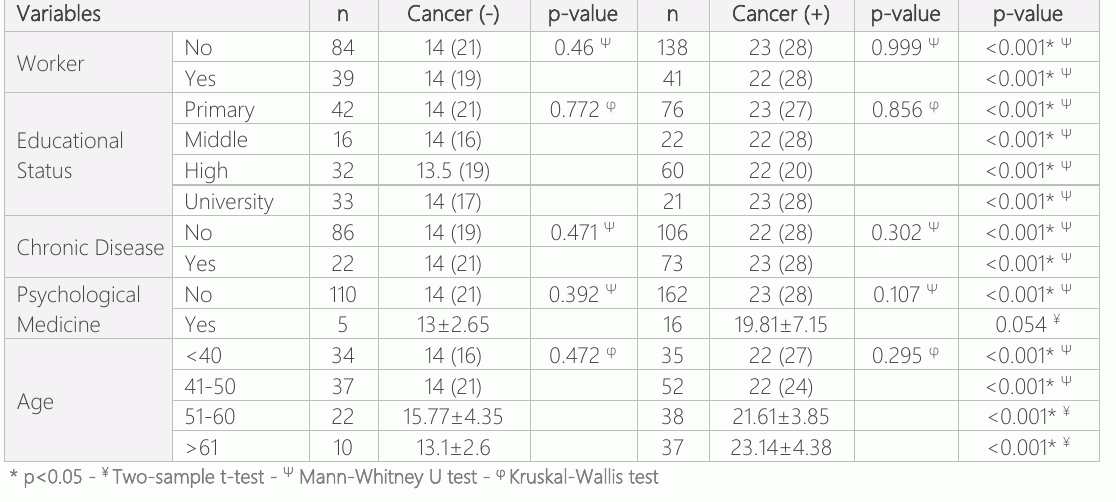
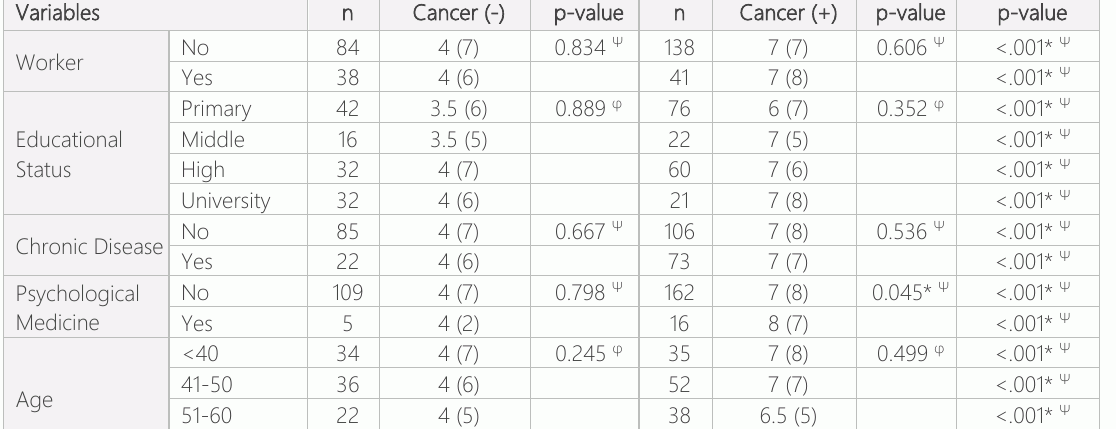
وبالنسبة لسجلات C19S وDT، في التحليل الذي أجري بشأن المرضى المصابين بالسرطان أو بدونه؛ ولم يكن هناك فرق من حيث العمل والعاطلين عن العمل، والأمراض المزمنة وغير المستعملة، ومستعملي المخدرات النفسيين وغير المستخدمين، والفئات العمرية، والوضع التعليمي (p of0.05). وكما هو موضح في الجدول 1، وجد التحليل المقارن أهمية في العديد من المعايير. A significant difference was found between the DT scores of patients using and not using psychological drugs (p=0.045). سجل الـ دي تي من استخدموا المخدرات النفسية
مقارنة كبيرة للمرضى المصابين بالسرطان
وكان السرطان أعلى من معدل الإصابة بالسرطان لدى من لم يكن لديهم سرطان (الجدول 2). There was no difference between the patient groups with breast, cervix, endometrial and ovarian cancer in terms of STAI-1 (p=0.815), STAI-2 (p=0.462), C19S (p=0.265) and DT (p=0.718) scores. In terms of STAI-1 (p=0.03) and STAI-2 score (p=0.021), a difference was found between the patient groups whose time value was 2021, 2020, 2019, 2018, and before 2017 - the STAI-1 who were between 2021 and 2017 and before differed from each other (p=0.021). ومرة أخرى، كانت النتيجة 1 للمرضى في عام 2020 والنتيجة في عام 2017 والأخرى مختلفة عن بعضها البعض (p=0.003). The STAI-2 scores of 2021 patients and the scores of 2017 and before differed from each other (p=0.012). The 2020 STAI-2 score and the score of the patients in and before 2017 differed from each other (p=0.002). The groups that differed in the C19S and DT scores were: patients with 2021 and 2017 and earlier, and patients with 2020 and before 2017, the C19S score (p0.001).
المناقشة
وقد درس الاستبيان الذي نصفه هنا، في مجموعة من المشاركين ذوي الصحة والسرطان الذين تلقوا العلاج المضاد للسرطان لمختلف أنواع السرطان في عيادات أمراض النساء، مسار القلق وأعراض الخوف ونوعية الحياة مقارنة بالعلاجات التي يتلقونها خلال وباء SARS-CoV-2. وتمشياً مع افتراضنا، وجدنا دليلاً على حدوث زيادة كبيرة في أعراض الصحة العقلية وزيادة كبيرة سريرياً في قيم القلق في السرطان وفئات المرضى الصحية. ولذلك، تأثر مرضى السرطان من حيث الصحة العقلية وقيم القلق أثناء انتشار الوباء.
According to the results of some individual studies, a high prevalence of depressive symptoms,anxiety and stress were encountered during the epidemic (19)غير أن تحليلات التحليلات الفوقية للأيوب وآخرون ويو وآخرون أظهرت قلقا أقل في المرضى الذين صادفوا مع كوفيد-19 (20, 21)The meta-analysis of Robinson et al. found an increase in mental health symptoms shortly after the epidemic, which then decreased (22)فوفقاً لما ذكره بينكمان وآخرون، قد يحتاج أثر الأحداث المتصلة باتفاقية فيينا الدولية - 19 على الصحة العقلية إلى وقت (23)وتطورت دراستنا مع ثلاثة استبيانات، وزاد القلق، بالاتفاق مع غالبية المؤلفات، في جميع الذين كان لديهم كوفيد-19. وخلال عملية الأوبئة، أثّرت العوامل الجنسانية والعمرية على السلوكيات والأفضليات المتصلة بالصحة للأفراد. In the study of Yildirim et al. (24)و (موشيا) و (إل) (25) وأفادت التقارير عن ارتفاع معدلات الاكتئاب والقلق لدى النساء المرضيات. وبطبيعة الحال، كان معظم سكان هذه الدراسة من الإناث، وقد يكون الفرق مرتبطا بحقيقة أن المرأة محرومة من حيث الحرية الاجتماعية أو تتحمل عبئا ثقيلا من حيث المسؤوليات المنزلية. In the study conducted in numerical equality, Özdin et al. found the anxiety about the epidemic to be higher in women (26)وعلاوة على ذلك، يفضل المرضى المسنون تأجيل تعييناتهم لفترة من الوقت والبقاء في المنزل. أظهر زو وآخرون أن القلق والاضطرابات العقلية أكثر حدة في المناطق التي توجد فيها ممارسات الحجر الصحي (27) شارك 302 مريضا في الدراسة الاستقصائية التي أجريناها، مع طائفة واسعة من الأعمار. 21.2% of the patients had a diagnosis of Covid-19, while 6.6% died from Covid-19. واحد وعشرون من المرضى كانوا يتلقون العلاج النفسي وذكرت شركة ميرز وآخرون أن الخصائص الاجتماعية الديمغرافية لمرضى السرطان، مثل التعليم والعمر، تؤثر على مستويات قلقهم أكثر من الخصائص المتصلة بالأمراض، وذكرت أن مستوى التعليم المنخفض يرتبط بمستويات عالية من القلق من مرضى السرطان أثناء انتشار الوباء (28)ولكن، وفقا لنتائجنا، فإن التعليم، والأمراض المزمنة، والعقاقير النفسية، والعمر لم يؤثر على درجات القلق.
وأظهرت الدراسة التي أجراها هاسيموسالار وآخرون أنه ليس فقط جنس الإناث بل أيضاً حاملة مرض مزمن هي عوامل خطر القلق أثناء انتشار الوباء(29)عمليات العلاج، التي تتسم بأهمية خاصة بالنسبة لمرضى السرطان، تتأثر سلبا من آثارها على القلق (30, 31)وعلى الرغم من أن حالات عدم التيقن، مثل القيود المتغيرة التي تفرضها الاتفاقية الدولية لحماية جميع الأشخاص من الاختفاء القسري - 19، تتسبب في القلق والخوف من مرضى السرطان، فإن الدراسات المتعلقة بآثارها النفسية على هؤلاء المرضى محدودة. Baffert et al. investigated COVID-related anxiety in cancer patients and found a reduction in anxiety levels after quarantine (32)- أفادت دراسة أجراها سيغورسكي وآخرون، في دراسته لـ 306 مرضى مصابين بسرطان الثدي، بأن النساء دون سن 65، وأن الإصابة بسرطان الثدي ترتبط بأعلى مستويات القلق. وأفادت أيضاً بأن القلق المتصل بالسرطان كان أعلى من القلق المتصل بالسرطان في إطار الاتفاقية الدولية لحماية جميع الأشخاص من الاختفاء القسري. (33)- وفي دراستنا، تم تشخيص السرطان في 59.3 في المائة حسب المناطق المتضررة: 20.1 في المائة من الرضاعة الطبيعية، و 47.5 في المائة من الثدي، و 18.4 في المائة من المبيض، و 12.8 في المائة من عنق الرحم، و 1.2 في المائة من الرحم. وأثر السرطان تأثيرا كبيرا على المعيار STAI-1، و STAI-2 C19S، و DT. وكان لدى المرضى المصابين بالسرطان 1.39 ضعفاً أعلى من عدد المصابين بالسرطان. وبالمثل، كان لدى المرضى المصابين بالسرطان 1.37 مرة أكثر من المرضى الذين يعانون من السرطان. In the analysis for C19S score, cancer had 1.41 times higher C19S than patients without cancer. وبالنسبة لسجلات الـ دي تي، كانت هذه النسبة 1.65 مرة.
The STAI-1 scores of the patients who received CT were 1.16 times than the STAI-1 scores of the patients who had cancer but did not receive additional tx. وكانت عشرات المرضى الذين تلقوا العلاج من الالتهاب الرئوي 1.13 مرة من عدد المرضى الذين أصيبوا بالسرطان ولكنهم لم يتلقوا توكس إضافية أعلى (p0.001). The STAI-1 scores of patients who received CT+RT were 1.18 times more elevated than the STAI-1 scores of patients who had cancer and did not receive additional tx. The STAI-2 tens of patients with cancer who received CT+RT treatment were 1.14 times higher than patients with cancer who did not receive treatment. RT and CT had no effects on STAI-2 scores. The C19S of cancer patients who received CT, RT, and CT+RT were higher than those who did not receive treatments. The C19S of the patients who received CT were 1.22 times than the C19S of the patients who had cancer but did not receive additional tx. C19S of patients who received LT+RT were 1.26 times higher than the C19S of patients who had cancer but did not receive additional tx.
ويتمثل الجانب الأقوى من هذه الدراسة في أنها دراسة استقصائية فريدة ومفصلة لتحليل أثر كوفيد - 19 مع تغير القلق. وكان لديها عدة قيود، لا سيما بسبب إجراء بحوث خلال الوباء. وأهم تقييد هو أن الدراسة لم تجر إلا في مستشفى واحد ولم تشمل أي رقابة. ولم يسمح لنا بإجراء تحقيق في التغييرات التي طرأت على الفترة السابقة للبيان، حيث لم يتضمن بيانات خط الأساس قبل انعقاد الدورة التاسعة للجنة. وعلى الرغم من أننا أضفنا المجموعات التي لم تكن مقسمة إلى 19، فإن بعض المرضى أصيبوا بالمرض دون أن يتم تشخيصهم بالقسم 19، ولا يمكننا التأكد من هذه المسألة. وثانياً، قد يختلف المستشفى الذي أجريت فيه الدراسة عن معدلات الوفيات في مركز فيينا الدولي - 19 في جميع أنحاء العالم. وأخيرا، أجرينا الاستقصاءات في فترات زمنية محددة سلفا ويمكن أن تتأثر القرارات بعوامل الحالة.
خاتمة
ويواجه مرضى السرطان تحدياً كبيراً في رعاية أعراض الصحة العقلية أثناء انتشار الوباء. ووفقاً لدراستنا، تأثر مرضى السرطان بهذه الحالة من أجل القلق، ولذلك ينبغي أن يظل العيادات متيقظين لمضاعفات المزاج.
الإقرارات
- مساهمات المؤلفين (CRediT)
- ساهم جميع المؤلفين بالتساوي في جميع أدوار CRediT الأربعة عشر (Conceptualization, Data curation, Formal analysis, Funding acquisition, Investigation, Methodology, Project administration, Resources, Software, Supervision, Validation, Visualization, Writing – original draft, Writing – review & editing).
- التمويل
-
Funding information was not reported in the published version of this article.
- تضارب المصالح
- Conflict of I nterest The author declares no conflict of interest.
- الموافقة الأخلاقية
- The study was approved by the local ethics committee (date: 27/01/2021 - ID: 2021-01/908). This study was carried out in accordance with the Declaration of Helsinki. Study Design All patients have signed a written consent for treatment and data analysis.
- إتاحة البيانات
- A data availability statement was not reported in the published version of this article.
المراجع (33)
31 من أصل 33 مرجعًا مرتبطة بمعرّف DOI.
- Ghaznavi H, Shirvaliloo M, Sargazi S, Mohammad ghasemipour Z, Shams Z, Hesari Z, et al. SARS-CoV-2 and influenza viruses: Strategies to cope with coinfection and bioinformatics perspective. Cell Biol Int. 2022;46(7):1009-20 DOI Crossref PubMed Google Scholar
- Kucukyildiz K, Yilmaz-Oral D, Turkcan D, Oztekin CV, Gur S. Impact of COVID-19 on male urogenital health: Success of vaccines. Drug Discov Today. 2022;27(10):103327 DOI Crossref PubMed Google Scholar
- Rizvi AA, Kathuria A, Al Mahmeed W, Al-Rasadi K, Al- Alawi K, Banach M, et al. Post-COVID syndrome, inflammation, and diabetes. J Diabetes Complications. 2022;36(11):108336 DOI Crossref PubMed Google Scholar
- Sirin S, Nigdelioglu Dolanbay S, Aslim B. The relationship of early- and late-onset Alzheimer's disease genes with COVID-19. J Neural Transm (Vienna). 2022;129(7):847-59 133 77 Anxiety in Cancer During the SARS‑CoV‑2 Zehra Ozturk Basarir et al. DOI Crossref PubMed Google Scholar
- van Mulukom V, Pummerer LJ, Alper S, Bai H, Čavojová V, Farias J, et al. Antecedents and consequences of COVID-19 conspiracy beliefs: A systematic review. Soc Sci Med. 2022;301:114912 DOI Crossref PubMed Google Scholar
- Laçinel Gürlevik S, Günbey C, Ozsurekci Y, Oygar PD, Kesici S, Gocmen R, et al. Neurologic manifestations in children with COVID-19 from a tertiary center in Turkey and literature review. Eur J Paediatr Neurol. 2022;37:139-54 DOI Crossref PubMed Google Scholar
- Rahman MM, Marzo RR, Chowdhury S, Qalati SA, Hasan MN, Paul GK, et al. Knowledge, Attitude and Practices Toward Coronavirus Disease (COVID- 19) in Southeast and South Asia: A Mixed Study Design Approach. Front Public Health. 2022;10:875727 DOI Crossref PubMed Google Scholar
- Bargon CA, Batenburg MCT, van Stam LE, Mink van der Molen DR, van Dam IE, van der Leij F, et al. Impact of the COVID-19 Pandemic on Patient-Reported Outcomes of Breast Cancer Patients and Survivors. JNCI Cancer Spectr. 2021;5(1):104 DOI Crossref PubMed Google Scholar
- Grajek M, Krupa -Kotara K, Rozmiarek M, Sobczyk K, Działach E, Górski M, et al. The Level of COVID-19 Anxiety among Oncology Patients in Poland. Int J Environ Res Public Health. 2022;19(18):54 -59 DOI Crossref PubMed Google Scholar
- Yasin AI, Topcu A, Shbair AT, Isleyen ZS, Ozturk A, Besiroglu M, et al. Anxiety levels of breast cancer patients in Turkey during the COVID-19 pandemic. Future Oncol. 2021;17(25):3373-81 DOI Crossref PubMed Google Scholar
- Yildirim OA, Poyraz K, Erdur E. Depression and anxiety in cancer patients before and during the SARS-CoV-2 pandemic: association with treatment delays. Qual Life Res. 2021;30(7):1903-12 DOI Crossref PubMed Google Scholar
- De Jaeghere EA, Kanervo H, Colman R, Schrauwen W, West P, Vandemaele N, et al. Mental Health and Quality of Life among Patients with Cancer during the SARS-CoV-2 Pandemic: Results from the Longitudinal ONCOVID Survey Study. Cancers (Basel). 2022;14(4):89-110 DOI Crossref PubMed Google Scholar
- Manchanda R, Oxley S, Ghaem-Maghami S, Sundar S. COVID-19 and the impact on gynecologic cancer care. Int J Gynaecol Obstet. 2021;155 Suppl 1(Suppl 1):94-101 DOI Crossref PubMed Google Scholar
- Derksen JWG, May AM, van de Poll-Franse LV, de Rooij BH, Hafkenscheid DA, Verkooijen HM, et al. Colorectal Cancer Care and Patients' Perceptions Before and During COVID-19: Implications for Subsequent SARS-CoV-2 Infection Waves. JNCI Cancer Spectr. 2021;5(4):047 DOI Crossref PubMed Google Scholar
- Ahorsu DK, Lin CY, Imani V, Saffari M, Griffiths MD, Pakpour AH. The Fear of COVID-19 Scale: Development and Initial Validation. International journal of mental health and addiction. 2022;20(3):1537-45 PubMed Google Scholar
- Bakioğlu F, Korkmaz O, Ercan H. Fear of COVID-19 and Positivity: Mediating Role of Intolerance of Uncertainty, Depression, Anxiety, and Stress. International journal of mental health and addiction. 2021;19(6):2369-82 DOI Crossref PubMed Google Scholar
- Spielberger C, Gorsuch R, Lushene R, Vagg P, Jacobs GJPAS. Manual for the State-Trait Anxiety Inventory; Palo Alto, CA, Ed. 1983 PubMed Google Scholar
- Kozlov E, Eghan C, Moran S, Herr K, Reid MC. Palliative Care Providers' Practices Surrounding Psychological Distress Screening and Treatment: A National Survey. Am J Hosp Palliat Care. 2018;35(7):938-44 DOI Crossref PubMed Google Scholar
- Momenimovahed Z, Salehiniya H, Hadavandsiri F, Allahqoli L, Günther V, Alkatout I. Psychological Distress Among Cancer Patients During COVID-19 Pandemic in the World: A Systematic Review. Front Psychol. 2021;12:682154 DOI Crossref PubMed Google Scholar
- Ayubi E, Bashirian S, Khazaei S. Depression and Anxiety Among Patients with Cancer During COVID-19 Pandemic: A Systematic Review and Meta-analysis. J Gastrointest Cancer. 2021;52(2):499-507 DOI Crossref PubMed Google Scholar
- Yu H, Zhou Z, Mo Q, Zhou X, Liu Y, Feng S. Prevalence of Anxiety and Depression Among Cancer Patients During the COVID-19 Pandemic: a Systematic Review and Meta-analysis. Research Square Platform LLC; 2020 DOI Crossref PubMed Google Scholar
- Robinson E, Sutin AR, Daly M, Jones A. A systematic review and meta-analysis of longitudinal cohort studies comparing mental health before versus during the COVID-19 pandemic in 2020. J Affect Disord. 2022;296:567-76 DOI Crossref PubMed Google Scholar
- Pinkham AE, Ackerman RA, Depp CA, Harvey PD, Moore RC. A Longitudinal Investigation of the Effects of the COVID-19 Pandemic on the Mental Health of Individuals with Pre-existing Severe Mental Illnesses. Psychiatry Res. 2020;294:113493 DOI Crossref PubMed Google Scholar
- Yildirim OA, Poyraz K, Erdur E. Depression and anxiety in cancer patients before and during the SARS-CoV-2 pandemic: association with treatment delays. Quality of life research: an international journal of quality of life aspects of treatment, care and rehabilitation. 2021;30(7):1903-12 DOI Crossref PubMed Google Scholar
- Moccia L, Janiri D, Pepe M, Dattoli L, Molinaro M, De Martin V, et al. Affective temperament, attachment style, and the psychological impact of the COVID-19 outbreak: an early report on the Italian general population. Brain Behav Immun. 2020;87:75-9 DOI Crossref PubMed Google Scholar
- Özdin S, Bayrak Özdin Ş. Levels and predictors of anxiety, depression and health anxiety during COVID-19 pandemic in Turkish society: The importance of gender. Int J Soc Psychiatry. 2020;66(5):504-11 DOI Crossref PubMed Google Scholar
- Zhao H, He X, Fan G, Li L, Huang Q, Qiu Q, et al. COVID-19 infection outbreak increases anxiety level of general public in China: involved mechanisms and influencing factors. J Affect Disord. 2020;276:446-52 DOI Crossref PubMed Google Scholar
- Merz V, Ferro A, Piras EM, Zanutto A, Caffo O, Messina C. Electronic Medical Record-Assisted Telephone Follow-Up of Breast Cancer Survivors During the COVID-19 Pandemic: A Single Institution Experience. JCO Oncol Pract. 2021;17(1):44- DOI Crossref PubMed Google Scholar
- Hacimusalar Y, Kahve AC, Yasar AB, Aydin MS. Anxiety and hopelessness levels in COVID-19 pandemic: A comparative study of healthcare professionals and other community sample in Turkey. J Psychiatr Res. 2020;129:181-8 DOI Crossref PubMed Google Scholar
- Greer JA, Pirl WF, Park ER, Lynch TJ, Temel JS. Behavioral and psychological predictors of chemotherapy adherence in patients with advanced non-small cell lung cancer. J Psychosom Res. 2008;65(6):549-52 134 77 Anxiety in Cancer During the SARS‑CoV‑2 Zehra Ozturk Basarir et al. DOI Crossref PubMed Google Scholar
- Karacin C, Bilgetekin I, F BB, Oksuzoglu OB. How does COVID-19 fear and anxiety affect chemotherapy adherence in patients with cancer. Future Oncol. 2020;16(29):2283-93 DOI Crossref PubMed Google Scholar
- Baffert KA, Darbas T, Lebrun-Ly V, Pestre-Munier J, Peyramaure C, Descours C, et al. Quality of Life of Patients With Cancer During the COVID-19 Pandemic. In Vivo. 2021;35 (1):663-70 DOI Crossref PubMed Google Scholar
- Sigorski D, Sobczuk P, Osmola M, Kuć K, Walerzak A, Wilk M, et al. Impact of COVID-19 on anxiety levels among patients with cancer actively treated with systemic therapy. ESMO Open. 2020;5(5):e000970 DOI Crossref PubMed Google Scholar
اقرأ النص الكامل
افتح ملف PDF هنا
جارٍ تحميل ملف PDF…
إذا لم يظهر ملف PDF هنا، استخدم زر التنزيل أعلاه.
كيف تقتبس هذه المقالة
Basarir ZO, Arslanca SB, Hamurcu HD, Atalay F. Survey Analysis of Anxiety in Gynecological Cancer Patients in the SARS‑CoV‑2 Pandemic. Ulutas Med J. 2022;8(4):127-134. doi:10.5455/umj.20221106083739
Basarir, Z. O., Arslanca, S. B., Hamurcu, H. D., & Atalay, F. (2022). Survey Analysis of Anxiety in Gynecological Cancer Patients in the SARS‑CoV‑2 Pandemic. The Ulutas Medical Journal, 8(4), 127–134. https://doi.org/10.5455/umj.20221106083739
Basarir, Z.O. et al. (2022) 'Survey Analysis of Anxiety in Gynecological Cancer Patients in the SARS‑CoV‑2 Pandemic', The Ulutas Medical Journal, 8(4), pp. 127–134. doi: 10.5455/umj.20221106083739.