The Ulutas Medical Journal · ISSN 2149-0430 (印刷版), 2149-388X (在线版) · https://www.ulutasmedicaljournal.com/?mno=93076
原创论著 · 开放获取
评估内科强化护理单位中中针病人的临床特征和结果:单一中心研究
标题、摘要和全文为机器翻译。 英文原文
- Cigli Regional Training Hospital, Anesthesia Intensive Care Unit,,Izmir, Turkey ROR
- 开放获取
- CC BY-NC 4.0
- ORCID
- 资助
- 伦理批准
- 数据可用性
摘要
导言:中风是可预防和可治疗的疾病之一。 发达国家试图采取措施减少导致中风的风险因素,并部分减少了这些因素。 由于发展中国家的基础设施和机会有限,在减少中风方面可能存在问题。 虽然在发达国家,中风病人一般在神经特别护理单位接受治疗,但在发展中国家却很有限。 我们的目标是评估医疗特别护理单位对中风病人的后续和治疗过程。 材料和方法: 在这项研究中,数据来自医院医疗特别护理单位的中风病人的医疗记录。 对风险因素和病人死亡率进行了评估。 该研究于2018年1月至6月进行. 结果: 参加我们研究的病人的平均年龄为79±7.9岁。 这两个群体在年龄方面都相似。 缺血性中风的年龄为80.4±7.7岁,而出血性中风的年龄为80.8±8.4岁,p值为0.47. 我们发现,在重症监护单位停留的中位时间是16.5天的中风和2至30天的间距。 在所有中风中,重症护理死亡率为24(35.3%),而在中风中,这一比率为16(%23.5),在出血中风中,这一比率为8(%11.8)。 结论: 不切实际的中风率接近发达国家和发展中国家。 然而,我们发现这一比率在出血性中风时较低。 在我国,需要医疗特别护理单位进行更大和多中心的研究.
关键词
全文
全文为机器翻译;以英文原文为准。 英文原文
导言
中风是造成死亡的疾病中第二多的,也是世界上第三多的发病率。 也属于社会成本高昂的疾病 (1)在对Akkoc等人的研究中,发现神经病患者在重症监护单位患者中排名第一,比例为17%。 (2)Feigin等人在研究中风时发现,发达国家的比例分别低于发展中国家(67%和82%)。 在发达国家发现22%的出血,在发展中国家发现11%的出血,在发达国家发现7%的出血,在发展中国家发现3% (3)20. 在发达国家中,亚空腔出血大约是发展中国家的两倍。 发展中国家的突出风险因素可能不同于发达国家 (4)。 。 。
在土耳其进行的一项单中心研究中,发现出血性中风占11.1%,风险因素为高血压(23.1%)、糖尿病(12.1%)、吸烟(31.9%)。 (5)在爱琴海地区的一项较大研究中,高血压63%和高胆固醇症37%是最常见的风险因素。 (6)在发达国家,已经表明,随着生活方式的改变,中风风险因素可以减少。 关于发展中国家中风的流行病学数据有限 (7)指南建议在神经综合护理单位跟踪中风病人 (8)由于土耳其神经病特别护理室的号码不足,可以将中风病人送入医疗特别护理室。 此外,土耳其的中风病人监测和治疗程序数据在服务条件和特别护理单位条件方面都很有限。 (9)确定高死亡率和高发病率的中风病人的地位,即使是在发达国家,在特别护理单位,可有助于为他们获得治疗创造必要的环境。
因此,在我们的研究中,我们的目标是评估中风特征、病人的人口特征和医疗特别护理单位的临床结果。
材料和方法
这项研究是在获得大学伦理委员会道德认可(152/2017)之后,于2018年1月1日至2018年6月30日在MCU进行的。 在这个位于培训和研究医院的MICU中,有12个特别护理床位能力、特别护理专家和内科研究助理工作。 在这项研究中,我们评估了患有中风诊断的病人在MCU呆了一个月。 我们把病人分为两组 分别是中风和出血中风 我们评估了病因、病情、人口特征、机械通风需求、住院和病人死亡率。
统计分析
描述性统计数据作为绝对变量的计数和百分比列报。 进行了Chi-square测试以确定这些变量之间的关系。 统计意义水平被视为5%,所有统计计算都采用SPSS(v13)统计方案。
结果
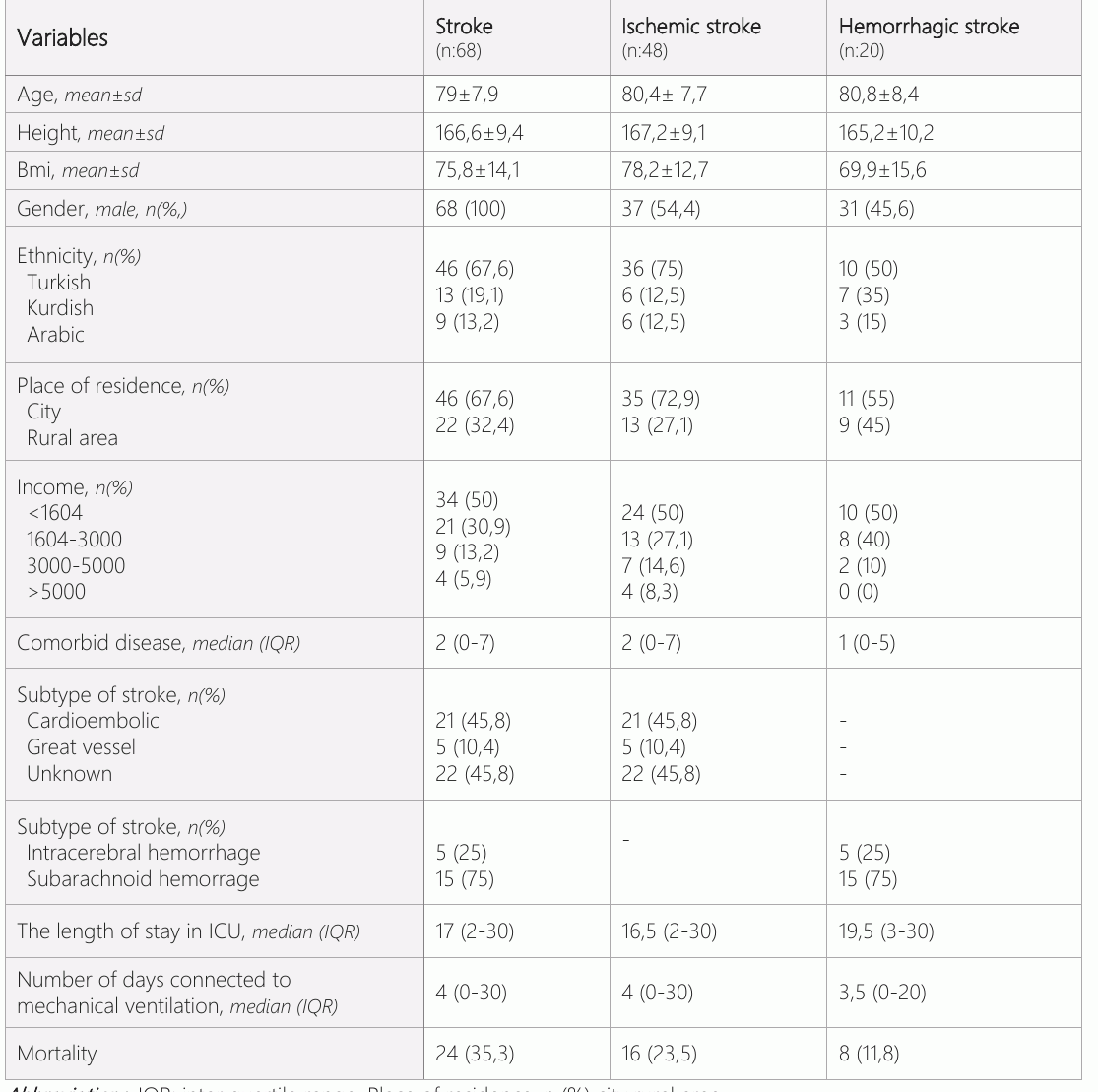
我们研究的68名病人中,48名(69.6%)为中风,20名(29.4%)为出血性中风。 中风病人的平均年龄为79±7.9岁,两者的年龄都相似。 中风中风的平均年龄为±sd(标准偏差)80.4±7.7,出血中风为80.8±8.4(p=0.47)。 参加我们研究的37名病人是男性,体积指数为78.2±12.7的中风,69.9±15.6的中风。 患者中最常见的同位素是高血压[41(60%)]. 慢性病的中位数为2。 大部分患者46人(67%)是有城市居住历史的患者(表1)。 我们发现机械通风所需的病人总数为50(73.5%)。 其中34人(68%)为中风,16人(32%)为出血性中风。 我们发现,重症监护的中位时间为16.5天,异化病人的间距为2至30天。
重症监护室的住院时间为19.5天,在出血性中风中,智商为5-30天。
讨论情况
我们从这项在土耳其进行的单中心研究中获得了关于因中风诊断留在MCU的病人的数据。 我们发现中风患者的中风分泌率是69.6%,出血中风的比例是29.4%。 我们发现,在接受中风诊断的病人中,机械通风需求的比例为73.6%。 在需要机械通风支持的病人中,32%是中风出血病人,62%是中风发作病人。 我们发现缺血性中风病人的死亡率为23.5%,出血病人的死亡率为11.8%。 在土耳其爱琴地区进行的一项研究发现,患者的平均年龄为62.3±12岁,这些结果低于我们的研究 (6)这可能是由于老年病人在重症监护室逗留的时间较长。 在与22个国家进行的中外合作研究中,发现发达国家与欠发达国家的年龄差异,所有国家的平均年龄分别为62.2岁,西欧,北美,奥地利66.7岁,东欧和中欧及中东63.9岁,南美65.8岁,中国61.9岁,南美59.6岁,东南亚56.6岁,非洲58.7岁. 在欠发达国家,与发达国家相比,年龄相当低 (10)在我们的研究中,我们发现高血压是最常见的风险因素。
根据在不发达和发展中国家进行的Meta分析,高血压是中风最常见的风险因素。 高血压中值为36% (11)在欧洲的一项大规模研究中,中风中值在芬兰为79%,克罗地亚为76.5%,意大利为65.4%,荷兰为77.2%,瑞典为70.3%。 (12)。这些值高于我们发现的值。 在我们的研究中,我们发现73.5%的病人与机械通风机相连. 在Erzurum、Arslan等人进行的一项研究中。 (9) 发现接受机械通风支持的患者比例为62.1%。 患者接受机械通风支持的比率在我们患者中比他们高. 与此相反,阿尔斯兰等人的死亡率. (9) 学习比我们的研究要高 在黎巴嫩进行的一项研究显示,一个月的死亡率为14.1%。 在发展中国家蒙古进行的一项研究发现,死亡率为25%。 (13)这些比率接近我们研究的价值。 在Avan等人进行的一项研究中。 (14) 评估了国际上中风的发生频率及其死亡率,发现中等收入发展中国家的中风比率上升,高收入国家的中风比率下降。 他们发现这两个组国家的死亡率逐渐下降。 据世界银行称,土耳其处于中层发展中国家之间。 (15)在高收入国家,在特别护理单位中发现缺血性中风的死亡率为21%。 (16)。这个比率接近我们发现的比率。 在西班牙进行的一项研究显示,严重出血性中风死亡率较高,为46.7%。 (17)。这个比例高于我们发现的比例。 在非洲,月死亡率为33%。 中风出血比例较低,发现为18% (18)。这些比率接近我们发现的异性中风比率,并且高于出血中风比率。 在发达国家,中风和中风出血死亡率随着风险因素的减少,以及使用增加的新技术而下降更多。 在中低级别发展中国家,中风的死亡率没有上升,但中风出血死亡率上升。 (19)我们的研究是在MCU进行的一项研究。 神经特别护理单位的基础设施不同于MICU (20)这项研究可能提供关于由于缺乏神经病特别护理单位而收治的病人的资料。 然而,在有限的时间内,这一单中心研究的结果需要用更大的研究来支持.
我们研究的局限性,是单中心研究。 因此,区域差异所产生的风险因素可能存在差异。 案件数量可能更多。 关于这个问题的大规模多中心研究将是非常宝贵的。
结论
我们发现中风病人的死亡率接近发达国家的中风病人,低于发展中国家。 但我们发现的出血性中风死亡率低于发达国家和发展中国家。 为了概括本研究的结果,需要支持更大规模的研究.
声明
- 作者贡献(CRediT)
- 所有作者对全部 14 项 CRediT 角色贡献均等(Conceptualization, Data curation, Formal analysis, Funding acquisition, Investigation, Methodology, Project administration, Resources, Software, Supervision, Validation, Visualization, Writing – original draft, Writing – review & editing)。
- 资助
-
Funding information was not reported in the published version of this article.
- 利益冲突
- The author declares that he has no competing interests.
- 伦理批准
- This study was conducted between 01.01.2018 and 30.06.2018 in MICU after obtaining ethical approval from the university ethical committee (152/2017).
- 数据可用性
- A data availability statement was not reported in the published version of this article.
参考文献 (20)
20 条参考文献中有 16 条已链接 DOI。
- Johnson W, Onuma O, Owolabi M, Sachdev S. Stroke: A global response is needed. Vol. 94, Bulletin of the World Health Organization. World Health Organization; 2016. p. 634A-635A DOI Crossref PubMed Google Scholar
- Akkoc I, Alpay N, Toptaş M, İşitemiz İ, Sunul H, Cebeci E, et al. Yoğun bakım hastalarının sağkalımında bazal verilerin etkisi. Haseki Tip Bul. 2017 PubMed Google Scholar
- Feigin VL, Lawes CMM, Bennett DA, Barker-Collo SL, Parag V. Worldwide stroke incidence and early case fatality reported in 56 population-based studies: a systematic review. Lancet Neurol 17;8(4):355–69 DOI Crossref PubMed Google Scholar
- Kuklina EV, Tong X, George MG, Bansil P. Epidemiology and prevention of stroke: A worldwide perspective. Vol. 12, Expert Review of Neurotherapeutics. NIH Public Access;2012;p199–208 DOI Crossref PubMed Google Scholar
- Türk Börü Ü, Kulualp AŞ, Tarhan ÖF, Bölük C, Duman A, Zeytin Demiral G, et al. Stroke prevalence among the Turkish population in a rural area of Istanbul: A community-based study. SAGE Open Med. 2018 Jan;6:205031211879756 DOI Crossref PubMed Google Scholar
- Kumral E, Özkaya B, Sagduyu A, Şirin H, Vardarli E, Pehliva M. The Ege Stroke Registry: A hospital-based study in the Aegean Region, Izmir, Turkey. Cerebrovasc Dis;8(5):278– 88 DOI Crossref PubMed Google Scholar
- Feigin VL, Krishnamurthi R. Topical Review Stroke Prevention in the Developing World. 2011 [cited 2020 Mar 8]; Available from: http://stroke.ahajournals.org DOI Crossref PubMed Google Scholar
- Program requirements for fellowship training in neurological intensive care: United Council for Neurologic Subspecialties Guidelines - Johns Hopkins University [Internet]. [cited 2020 Mar 7]. Available from: https://jhu.pure.elsevier.com/en/publi cations/program-requirements-for-fellowship-training-in-neu rological-inte PubMed Google Scholar
- Kemal M, Tıp Ü, Arslan Z, Özmen Ö, Çömez. Factors Affecting Mortality of the Patients with Ischemic Stroke in Reanimation Intensive Care Unit. Derg. 2016;7(26):23–31 PubMed Google Scholar
- O’Donnell MJ, Denis X, Liu L, Zhang H, Chin SL, Rao-Melacini P, et al. Risk factors for ischaemic and intracerebral haemorrhagic stroke in 22 countries (the INTERSTROKE study): A case-control study. Lancet. 2010 Jul 10;376(9735):112–23 DOI Crossref PubMed Google Scholar
- Ezejimofor MC, Chen YF, Kandala NB, Ezejimofor BC, Ezeabasili AC, Stranges S, et al. Stroke survivors in low- and middle-income countries: A meta-analysis of prevalence and secular trends [Internet]. Vol. 364, Journal of the Neurological Sciences. Elsevier B.V.; 2016 [cited 2020 Feb 26]. p. 68–76. Available from: https://linkinghub.elsevier.com/retrieve/pii/S00 22510X16301484 DOI Crossref PubMed Google Scholar
- Malmivaara A, Meretoja A, Peltola M, Numerato D, Heijink R, Engelfriet P, et al. Comparing ischaemic stroke in six European countries. The EuroHOPE register study. Eur J Neurol [Internet]. 2015 Feb 1 [cited 2020 Feb 26];22(2):284-e26. Available from: http://doi.wiley.com/10.1111/ene.12560 DOI Crossref PubMed Google Scholar
- Mendsaikhan N, Begzjav T, Lundeg G, Dunser M. The epidemiology and outcome of critical illness in Mongolia: A multicenter, prospective, observational cohort study. Int J Crit Illn Inj Sci [Internet]. 2016 Jul 1 [cited 2020 Feb 27];6(3):103 DOI Crossref PubMed Google Scholar
- Avan A, Digaleh H, Di Napoli M, Stranges S, Behrouz R, Shojaeianbabaei G, et al. Socioeconomic status and stroke incidence, prevalence, mortality, and worldwide burden: An ecological analysis from the Global Burden of Disease Study 2017. BMC Med [Internet]. 2019 Oct 24 [cited 2020 Feb 28];17(1):191. Available from: https://bmcmedicine.biomedcen tral.com/articles/10.1186/s12916-019-1397-3 DOI Crossref PubMed Google Scholar
- Turkey Overview [Internet]. [cited 2020 Feb 28]. Available from: https://www.worldbank.org/en/country/turkey/overview PubMed Google Scholar
- Golestanian E, Liou J-I, Smith MA. Long-Term Survival in Older Critically Ill Patients with Acute Ischemic Stroke. Crit Care Med. 2009;37(12):3107–13 DOI Crossref PubMed Google Scholar
- Ferrete-Araujo AM, Egea-Guerrero JJ, Vilches-Arenas Á, Godoy DA, Murillo-Cabezas F. Predictors of mortality and poor functional outcome in severe spontaneous intracerebral hemorrhage: A prospective observational study. Med Intensiva (English Ed. 2015 Oct 1;39(7):422–32 DOI Crossref PubMed Google Scholar
- Nkoke C, Lekoubou A, Balti E, Kengne AP. Stroke mortality and its determinants in a resource-limited setting: A prospective cohort study in Yaounde, Cameroon. J Neurol Sci [Internet]. 2015 Nov 15 [cited 2020 Mar 2];358(1–2):113–7. Available from: https://linkinghub.elsevier.com/retrieve/pii/S0022510X1500529 DOI Crossref PubMed Google Scholar
- Krishnamurthi R V., Feigin VL, Forouzanfar MH, Mensah GA, Connor M, Bennett DA, et al. Global and regional burden of first-ever ischaemic and haemorrhagic stroke during 1990-2010: Findings from the Global Burden of Disease Study 2010. Lancet Glob Heal. 2013 DOI Crossref PubMed Google Scholar
- Oddo M, Bracard S, Cariou A, Chanques G, Citerio G, Clerckx B, et al. Update in Neurocritical Care: a summary of the 2018 Paris international conference of the French Society of Intensive Care.Vol9, Annals of Intensive Care. Springer Verlag;2019.p1–13 DOI Crossref PubMed Google Scholar
阅读全文
在此打开 PDF
正在加载 PDF…
若 PDF 未在此显示,请使用上方的下载按钮。
如何引用本文
Bahar I. Evaluation of Clinical Features and Outcomes of Stroke Patients in the Internal Medicine Intensive Care Unit: A Single-Center Study. Ulutas Med J. 2020;6(1):38-43. doi:10.5455/umj.20200317040455
Bahar, I. (2020). Evaluation of Clinical Features and Outcomes of Stroke Patients in the Internal Medicine Intensive Care Unit: A Single-Center Study. The Ulutas Medical Journal, 6(1), 38–43. https://doi.org/10.5455/umj.20200317040455
Bahar, I. (2020) 'Evaluation of Clinical Features and Outcomes of Stroke Patients in the Internal Medicine Intensive Care Unit: A Single-Center Study', The Ulutas Medical Journal, 6(1), pp. 38–43. doi: 10.5455/umj.20200317040455.