The Ulutas Medical Journal · ISSN 2149-0430 (印刷版), 2149-388X (在线版) · https://www.ulutasmedicaljournal.com/?mno=86786
原创论著 · 开放获取
甲状腺素功能测试 抗肿瘤神经病因子治疗
标题、摘要和全文为机器翻译。 英文原文
- Medical Faculty of Adnan Menderes University, Department of Physical Medicine and Rehabilitation, Division of Rheumatology, Aydın, Turkey ROR
- 开放获取
- CC BY-NC 4.0
- ORCID
- 资助
- 伦理批准
- 数据可用性
摘要
导言:肾上腺炎(AS)是一种慢性炎症.甲状腺功能障碍在炎症患者中更为常见.在这项研究中,我们的目的是评估肾上腺炎患者的甲状腺功能和甲状腺自体抗体,以确定抗肿瘤坏死因子治疗对AS患者的影响以及甲状腺功能和自体抗体水平、炎症标记和肾上腺自体抗体患者的疾病活动之间的关系.材料和方法:包括74名根据1984年修改的纽约标准和国际pondylarthritis国际学会分类标准确诊的自旋性炎患者.其中41人接受抗肿瘤坏死因子治疗,33人接受非类固醇抗炎药物治疗.我们记录了患者的年龄,性别,红细胞沉积率,C反应蛋白值,血液计数,生化分析,甲状腺功能测试,自体抗体水平,Bath Ankylosing Spondylitis疾病活动指数.结果:与接受非类固醇抗炎药物的患者相比,接受抗肿瘤坏死因子的肾上腺素过氧化物平均水平较高(p=0.009)。 在胸腺刺激激素和C反应蛋白(r=-0,264,p=0,023)之间发现了负相关. 发现自由胸腺素与C反应蛋白(r=0,436,p=0,009),抗甲状腺过氧化物阳性与红细胞沉积率(r=0,384,p=0,001),抗甲状腺球蛋白阳性与红细胞沉积率和C反应蛋白(r=0,329,r=0,265,p=0,004,p=0,022)之间有正相关.结论: 与接受非类固醇抗炎药物的病人相比,接受抗TNF α的病人甲状腺障碍的频率较低.我们可以认为,抗TNFα治疗可以减少自体免疫性甲状腺疾病,并对甲状腺功能产生积极影响.
关键词
全文
全文为机器翻译;以英文原文为准。 英文原文
导言
肾上腺炎(AS)是一种慢性、系统性、自体免疫性、炎症,典型地影响圣体关节和脊柱。 (1)AS的诊断依据是经过修改的纽约标准以及国际单体肺炎协会(ASAS)的分类标准 (2, 3)系统性狼疮(SLE) (4)阴道炎 (5)间性肺病 (6)、沙虫病 (7),多次硬化 (8) 和自动免疫性肝脏疾病 (9) 据报道,这种疾病与AS同时发生。 整个基因组协会的研究对此作了解释。 在这些研究中,已经为这些自动免疫障碍确定了许多风险地点。 (10)在风湿病患者中,甲状腺功能障碍也很常见。 (11)这些疾病是风湿性关节炎(RA) (12)单曲 (13)Sjogren综合症(SS) (14) 自动交换 (15)Lazúrová等人著 (12) 定义了亚美尼亚共和国患者中自体免疫甲状腺疾病和抗甲状腺自体抗体的流行程度。 他们回顾了遗传学在协会和RA协会中的作用。 Appenzeller 等人著. (13) 报告甲状腺功能障碍与SLE之间的关系。 孙等. (14) 进行了系统审查,以证明党卫军患者的甲状腺疾病风险。 他们建议对党卫军患者进行甲状腺疾病筛查. 兰格等人. (15) 调查甲状腺免疫 由于他们的研究,抗甲状腺素抗体在AS的流行程度明显较高. 在我们的研究中,我们的目的是评估甲状腺功能测试(TFTs)和自体抗体,以确定抗肿瘤坏死因子治疗对AS患者的影响,以及甲状腺功能与自体抗体水平、炎症标记和AS患者疾病活动之间的关系。 据提交人所知,这是对ATFT和自体抗体患者的疾病活动进行评估的第一项研究。
材料和方法
道德声明
本研究经道德操守委员会批准,于2016年7月至2016年12月进行. 所有与会者都签署了知情同意表(核准日期:2017-1046). 74 AS根据1984年mNY和ASAS分类标准确诊。 (2, 3)MNY标准如下:至少有一项临床标准(背部发炎疼痛、腰椎运动受限、胸腔扩张受限)加上放射标准(放射性圣体炎;二级双边或三级至四级单边圣体炎) (2)根据ASAS标准,AS诊断是可能的,其方法是使用在磁共振成像(MRI)中具有活性血栓炎迹象的 " 成像 " 臂和至少一种其他自旋性血栓炎(SpA)特征,或者使用 " 临床 " 臂,在 " 临床 " 臂 " 中,人类白细胞抗原-B27(HLA-B27)的存在是强制性的,具有额外的两个或两个以上的SpA特征。 (3)41名AS患者正在接受抗TNF治疗,其中33人正在接受非类固醇抗炎药物。 Braun等人指出,使用抗TNF疗法治疗的条件应当是诊断AS(通常根据mNY标准)、活性疾病(BASDAI > 4和专家意见)至少4周、国家疾病分类系统至少3个月试验失败、动脉内类固醇(如果注明的话)和磺胺(如果主要外围关节炎)失败。 (16)所有参与者都有关于甲状腺激素和自体抗体水平的数据。
纳入标准是18岁以上的病人,根据《纽约修正标准》诊断为AS。 排除标准是: (1) 怀孕、哺乳; (2) 前甲状腺疾病;(3)出现补充性共同疾病(糖尿病、哮喘、慢性阻塞性肺病或肝肾血管心脏病等); (4) 使用可能导致甲状腺疾病的药物。 所有患者的年龄,性别,红细胞沉积率(ESR)和C反应蛋白(CRP)值,TFT(甲状腺刺激激素(TSH),胸腺素(FT))3个(FT),百草枯页:1),汽车抗体(抗甲状腺过氧化物(抗TPO),抗甲状腺球蛋白(抗TG)和BASDAI分数都有记录.
根据BASDAI的得分,对苯丙胺病活动进行了定义。 基于这一分数,BASDAI<4.0被定义为低疾病活动,BASDAI>4.0被定义为高疾病活动. 包括6项质疑患者疲劳,颈部严重,背部和臀部疼痛,侧缘关节疼痛严重,压力和发作时柔和,以及晨昏僵硬的严重程度. (17)BASDAI的分数和实验室特征记录在 3编号 治疗月.
乙酰乙酰乙酰乙酰乙酰乙酰乙酰乙酰乙酰乙酰乙酰乙酰乙酰乙酰乙酰乙酰乙酰乙酰乙酰乙酰乙酰乙酰乙酰乙酰乙酰乙酰乙酰乙酰乙酰乙酰乙酰乙酰乙酰乙酰乙酰乙酰乙酰乙酰乙酰乙酰乙酰乙酰乙酰乙酰乙酰乙酰乙酰乙酰乙酰乙酰乙酰乙酰乙酰乙酰乙酰乙酰乙酰乙酰乙酰乙酰乙酰乙酰乙酰乙酰乙酰乙酰乙酰乙酰乙酰乙酰乙酰乙酰乙酰乙酰乙酰乙酰乙酰乙酰乙酰乙酰乙酰乙酰乙酰乙酰乙酰乙酰乙酰乙酰乙酰乙酰乙酰乙酰乙酰乙酰乙酰乙酰乙酰乙酰乙酰乙酰乙酰乙酰乙酰乙酰乙酰乙酰乙酰乙酰乙酰乙酰乙酰乙酰乙酰乙酰乙酰乙酰乙酰乙酰乙酰乙酰乙酰乙酰乙酰乙酰乙酰乙酰乙酰乙 (18, 19)TSH的正常范围被定义为0.35-4.94 uU/ml, FT3个' 正常范围为1.71-3.71皮克/毫升,FT页:1' 正常范围被分别定义为0.70-1.48纳克/升。 (20)我们把甲状腺状态定义为:Euthyroid:TSH,FT3个 和 FT 组合页:1 正常范围之间的水平,甲状腺:TSH水平超过4.94uU/ml和FT页:1 水平低于0.70纳克/日,超甲状腺:TSH水平低于0.35 uU/ml和FT页:1 1.48纳克/升以上 (21)亚临床超甲状腺病被定义为TSH水平低于0.35 uU/ml,带有FT3个 和 FT 组合页:1 在正常范围之间的水平。 亚临床甲状腺素被定义为TSH水平超过4.94uU/ml,带有FT.3个 和 FT 组合页:1 正常范围之间的水平 (21)甲状腺自动免疫疾病被定义为抗TPO水平超过5.61IU/ml,抗TG水平超过4.11IU/ml (21)。 。 。
统计分析
利用社会科学统计一揽子计划v19对数据进行了分析。 通常分布式变量通过独立的T测试进行测试,非正常分布式变量通过Mann-Whitney U测试进行测试. 描述为平均±标准差(SD)和中值(25-75%百分位数)。 p<0.05被认为具有统计意义。
结果
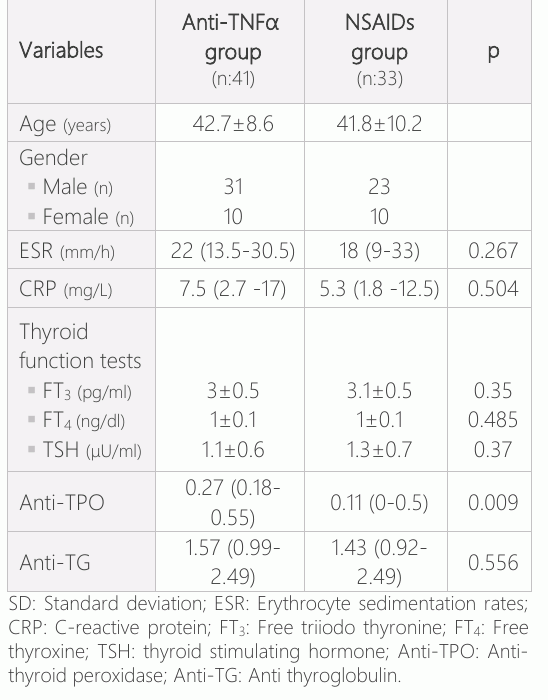
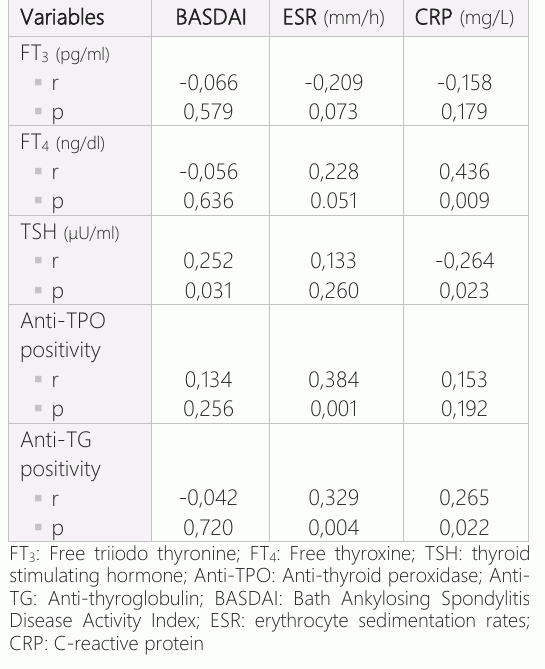
AS患者的平均年龄为42.7±8.6岁. 有31名男性,10名女性获得反TNF α。 平均年龄为41.8±10.2岁。 国家残疾调查中有23名男性,10名女性。 在人口特征(年龄和性别)、ESR、CRP、完整血数(CBC)、生化分析、TFTs和抗TG水平(p>0.05)方面,各群体之间没有统计上的重大差异。 在接受反TNF α的AS患者中,反TPO的平均水平与NSAIDs组(p=0.009)相比相当高。 患者的人口和实验室特征见表1。 在TSH和CRP(r=-0,264,p=0,023)之间发现了负相关关系. FT4与CRP(r=0,436,p=0,009),反TPO正性与ESR(r=0,384;p=0,001),反TG正性与ESR和CRP(r=0,329;r=0,265;p=0,004;p=0,022)之间有正相关关系(表2)。
讨论情况
在抗TNF α治疗中观察到的甲状腺障碍可能是巧合或自相矛盾的事件,同时也可能是免疫致病的标志. (22)抗TNF α治疗对甲状腺功能的影响尚不为人所知。
Lange等人的研究包括22名AS患者和22名控制人员。 (10)他们调查了FT3个电源页:1总三碘多丁基ine(TT)3个)水平,以及抗甲状腺抗体. 由于他们的研究,抗甲状腺素抗体在AS患者中的流行程度明显较高. Peluso等人著. (23) 对TFT和抗甲状腺素的抗体进行了357个spondyritis SpA和318个控制. 他们宣布甲状腺自动免疫在SPA中显著提高. Acay 等 (英语). (24) 评估TFTs,122控制中的抗甲状腺素抗体,以及定义明确的201名患者(包括AS). FT 电话页:1,TSH,以及抗甲状腺素抗体在定义明确的患者中较高. 3名患者中发现了亚临床性甲状腺障碍. Emmungil等人的研究 (25) 调查了80名AS患者、62名Sjögren综合症患者的TFTs水平和抗甲状腺素抗体阳性,以及80名健康控制。 在AS患者中,至少一种甲状腺抗体的阳性明显增加(p=0.017)。 塔尔汉等. (26) 研究TFT和抗甲状腺素抗体. 他们的研究对象包括44名接受抗TNFα的AS患者和64名接受其他药物的患者. 由于该研究,23名接受其他药物的病人的抗TPO水平较高(p<0.05)。 他们宣布,在接受抗TNF α的患者中,自体免疫甲状腺疾病较低. 在人类甲状腺组织中发现了肿瘤坏死因子α(TNF α)和TNF α受体。 (27)这可以解释为什么在抗TNF α治疗中会出现自体免疫性甲状腺障碍 (23) 在抗TNF α治疗过程中所见到的甲状腺障碍的频率可以用这种常见病理学来解释。
在我们的研究中,我们的目标是评估接受抗TNF α和NSAID的AS患者的TFTs和自体抗体. 因此,我们在接受抗TNF α的AS患者中发现了较高的抗TPO水平. 另外,我们发现TSH值和CRP值之间的负相关,而FT值之间的正相关.页:1 反TG、反TG、反ESR和CRP。 与NSAIDs群体相比,接受抗TNF α的AS患者甲状腺障碍的频率较低. 通过我们的研究,抗TNFα治疗可以减少自体免疫性甲状腺疾病,并对甲状腺功能产生积极影响. 我们可以认为,当AT病在接受抗TNFα的AS患者中发展时,这种治疗可以改善甲状腺疾病. ATPO和ATG 美洲热带木材组织 这项研究有一些局限性。 我们的调查结果一般能力有限,因为样本规模较小。 此外,我们没有关于基线和治疗后某一时间的反TPO和反TG值的数据。 需要用更大的样本进行进一步研究,并开展长期后续行动,以复制本研究的结论。
结论
根据我们的研究 我们可以考虑FT页:1,抗TPO和抗TG值可以在AS患者中用作煽动性标记. 然而,我们认为,需要进行更多的研究。
声明
- 作者贡献(CRediT)
- 所有作者对全部 14 项 CRediT 角色贡献均等(Conceptualization, Data curation, Formal analysis, Funding acquisition, Investigation, Methodology, Project administration, Resources, Software, Supervision, Validation, Visualization, Writing – original draft, Writing – review & editing)。
- 资助
-
Funding information was not reported in the published version of this article.
- 利益冲突
- The authors have declared no conflict of interest for the present article.
- 伦理批准
- This study was approved by the ethics committee and carried out from July 2016 to December 2016. All participants signed the informed consent form (Approval: 2017-1046).
- 数据可用性
- A data availability statement was not reported in the published version of this article.
参考文献 (27)
27 条参考文献中有 18 条已链接 DOI。
- Moreno M, Gratacós J, Torrente-Segarra V, Sanmarti R, Morlà R, Pontes C, Llop M, Juanola X; REMINEA study Group. Withdrawal of infliximab therapy in ankylosing spondylitis in persistent clinical remission results from the REMINEA study.Arthritis Res Ther. 2019;2:88 DOI Crossref PubMed Google Scholar
- Van der Linden S, Valkenburg HA, Cats A.Evaluation of diagnostic criteria for ankylosing spondylitis.A proposal for modification of the New York criteria.Arthritis Rheum. 1984; 27: 361-8 DOI Crossref PubMed Google Scholar
- Rudwaleit M, van der Heijde D, Landewe R, Listing J, Akkoc N, Brandt J, et al.The development of Assessment of Spondylo Arthritis international Society classification criteria for axial spondyloarthritis (part II): validation and final selection. Ann Rheum Dis.2009;68:777-83 DOI Crossref PubMed Google Scholar
- Akbaryan M, Soltani Z.Overlap of Ankylosing Spondylitis and Systemic Lupus Erythematosus: A case report.International Journal of Medical Research & Health Sciences, 2016;4:100-3 PubMed Google Scholar
- Ye C, Li W.Cutaneous vasculitis in a patient with ankylosing spondylitis: A case report.Medicine (Baltimore).2019;98:e14121 DOI Crossref PubMed Google Scholar
- Ferdoutsis M, Bouros D, Meletis G, Patsourakis G, Siafakas NM. Diffuse interstitial lung disease as an early manifestation of ankylosing spondylitis. Respiration.1995;62:286-9 PubMed Google Scholar
- El Ouazzani FZ, Tahiri L, Akasbi N, Kadi N, Harzy T. Sarcoidosis and ankylosing spondylitis: a rare association. Pan Afr Med J.2011;8:23 PubMed Google Scholar
- Fominykh V, Shevtsova T, Arzumanian N, Brylev L. Coexistence of multiple sclerosis and ankylosing spondylitis: report of four cases from Russia and review of the literature. J Clin Neurosci.2017;44:230-3 DOI Crossref PubMed Google Scholar
- Katalin KE, István B, Enikő G, Julianna BA.Primary Biliary Cirrhosis and Ankylosing Spondylitis, A Rare Association. Internal Medicine.2018;6:43-9 PubMed Google Scholar
- Carbone M, Neuberger JM.Autoimmune liver disease, autoimmunity, and liver transplantation.Journal of Hepatology. 2014;60:210-23 DOI Crossref PubMed Google Scholar
- Robazzi TC, Adan LF. Autoimmune thyroid disease in patients with rheumatic diseases.Rev Bras Reumatol.2012;52:417-30 PubMed Google Scholar
- Lazúrová I, Jochmanová I, Benhatchi K, Sotak S.Autoimmune thyroid disease and rheumatoid arthritis: relationship and the role of genetics. Immunol Res.2014;60:193-200 DOI Crossref PubMed Google Scholar
- Appenzeller S, Pallone AT, Natalin RA, Costallat LT. Prevalence of thyroid dysfunction in systemic lupus erythematosus. J Clin Rheumatol. 2009;15:117-9 DOI Crossref PubMed Google Scholar
- Sun X, Lu L, Li Y, Yang R, Shan L, Wang Y. Increased risk of thyroid disease in patients with Sjogren's syndrome: a systematic review and meta-analysis.PeerJ.2019;7:e6737 DOI Crossref PubMed Google Scholar
- Lange U, Boss B, Teichmann J, Klett R, Stracke H, Bretzel RG, et al.Thyroid disorders in female patients with ankylosing spondylitis.Eur J Med Res. 1999;4:468-74 PubMed Google Scholar
- J Braun, J Davis, M Dougados, J Sieper, S van der Linden, D van der Heijde. First update of the international ASAS consensus statement for the use of anti-TNF agents in patients with ankylosing spondylitis.Ann Rheum Dis 65:316-20 DOI Crossref PubMed Google Scholar
- Altan L, Sivrioğlu Y, Ercan İ. Can Bath Ankylosing Spondylitis Disease Activity Index be Affected by Accompanying Fibromyalgia or Depression? Arch Rheumatol. 2015; 30:34-9 PubMed Google Scholar
- Singh AS, Atam V, Yathish BE, Das L, Koonwar S. Role of erythrocyte sedimentation rate in ischemic stroke as an inflammatory marker of carotid atherosclerosis.J Neurosci Rural Pract. 2014;5:40-5 DOI Crossref PubMed Google Scholar
- Kim JM, Park DS. Evaluation of analytical measurement ranges of three full-range C-reactive protein tests using immunoturbidimetric assay. Korean J Lab Med. 2010; 30:9-16 PubMed Google Scholar
- Shim C, Chong R, Lee JH. Enzyme-free chemiluminescence immunoassay for the determination of thyroid-stimulating hormone.Talanta.2017 15;171:229-35 DOI Crossref PubMed Google Scholar
- Sriphrapradang C, Bhasipol A.Differentiating Graves' disease from subacute thyroiditis using the ratio of serum-free triiodothyronine to free thyroxine. Annals of Medicine and Surgery. 2016;10:69-72 DOI Crossref PubMed Google Scholar
- Pascart T, Ducoulombier V, Roquette D, Perimenis P, Coquerelle P, Maury F, et al.Autoimmune thyroid disorders during anti-TNF alpha therapy: coincidence, paradoxical event or marker of immunogenicity?Joint Bone Spine.2014;81:369-70 DOI Crossref PubMed Google Scholar
- Peluso R, Lupoli GA, Del Puente A, Iervolino S, Bruner V, Lupoli R, et al. Prevalence of thyroid autoimmunity in patients with spondyloarthropathies. J Rheumatol 2011;38:1371-7 DOI Crossref PubMed Google Scholar
- Acay A, Ulu MS, Ahsen A, Eroglu S, Ozuguz U, Yuksel S, et al.Assessment of thyroid disorders and autoimmunity in patients with rheumatic diseases. Endocr Metab Immune Disord Drug Targets. 2014; 14:182-6 DOI Crossref PubMed Google Scholar
- Emmungil H, Erdogan M, Kalfa M, Karabulut G, Kocanaogulları H, Inal V, et al.Autoimmune thyroid disease in ankylosing spondylitis.Clin Rheumatol. 2014;33:955-61 DOI Crossref PubMed Google Scholar
- Tarhan F, Orük G, Niflioğlu O, Ozer S.Thyroid involvement in ankylosing spondylitis and relationship of thyroid dysfunction with anti-TNF α treatment.Rheumatol Int.2013;33:853-7 DOI Crossref PubMed Google Scholar
- Zubelewicz B, Muc-Wierzgon M, Wierzgon J, Romanowski W, Mazurek U, Wilczok T, et al.Genetic dysregulation of gene coding tumor necrosis factor α receptors (TNF α Rs) in follicular thyroid cancer-preliminary report. Journal of Biological Regulators and Homeostatic Agents. 2002;16:98-104 PubMed Google Scholar
阅读全文
在此打开 PDF
正在加载 PDF…
若 PDF 未在此显示,请使用上方的下载按钮。
如何引用本文
Sargin B, Gurer G. Thyroid Function Tests in Ankylosing Spondylitis Patients on Anti-Tumour Necrosis Factor Treatment. Ulutas Med J. 2020;6(2):53-58. doi:10.5455/umj.20200212024921
Sargin, B., & Gurer, G. (2020). Thyroid Function Tests in Ankylosing Spondylitis Patients on Anti-Tumour Necrosis Factor Treatment. The Ulutas Medical Journal, 6(2), 53–58. https://doi.org/10.5455/umj.20200212024921
Sargin, B. and Gurer, G. (2020) 'Thyroid Function Tests in Ankylosing Spondylitis Patients on Anti-Tumour Necrosis Factor Treatment', The Ulutas Medical Journal, 6(2), pp. 53–58. doi: 10.5455/umj.20200212024921.