The Ulutas Medical Journal · ISSN 2149-0430 (print), 2149-388X (online) · https://www.ulutasmedicaljournal.com/?mno=86786
Original Article · Open access
Thyroid Function Tests in Ankylosing Spondylitis Patients on Anti-Tumour Necrosis Factor Treatment
- Medical Faculty of Adnan Menderes University, Department of Physical Medicine and Rehabilitation, Division of Rheumatology, Aydın, Turkey ROR
Abstract
- Introduction
- Ankylosing spondylitis (AS) is a chronic inflammatory disease. Thyroid dysfunctions are more frequent in patients with inflammatory diseases. In this study, we aimed to evaluate thyroid functions and thyroid autoantibodies in ankylosing spondylitis patients, to determine the effect of anti-tumor necrosis factor treatment in AS patients and the relationship between thyroid function and autoantibody levels, inflammatory markers and disease activity in ankylosing spondylitis patients.
- Materials and Methods
- 74 ankylosing spondylitis patients diagnosed according to 1984 Modified New York criteria and Assessment in Spondylarthritis International Society classification criteria were included. 41 of them were receiving anti-tumor necrosis factor treatment and 33 of them were receiving nonsteroid anti-inflammatory drugs. We recorded patients' age, gender, erythrocyte sedimentation rates, C-reactive protein values, blood count, biochemical analysis, thyroid function tests, autoantibody levels, Bath Ankylosing Spondylitis Disease Activity Index.
- Results
- Mean anti-thyroid peroxidase levels were significant at a high level in ankylosing spondylitis patients receiving anti-tumour necrosis factor compared to patients receiving nonsteroid anti-inflammatory drugs (p= 0.009).Negative correlation was found between thyrotropin-stimulating hormone and C-reactive protein(r=-0,264, p=0,023).A positive correlation was found between free thyroxine and C-reactive protein (r=0,436,p=0,009), anti-thyroid peroxidase positivity and erythrocyte sedimentation rate (r=0,384,p=0,001),anti-thyroglobulin positivity and erythrocyte sedimentation rates and C-reactive protein(r=0,329,r=0,265,p=0,004,p=0,022).
- Conclusion
- The frequency of thyroid disorder in patients with AS receiving anti-TNF α was lower compared to patients receiving nonsteroid anti-inflammatory drugs. We can consider that anti-TNF α treatment could reduce autoimmune thyroid diseases and had a positive effect on thyroid functions.
Keywords
Full text
Introduction
Ankylosing spondylitis (AS) is a chronic, systemic, autoimmune, inflammatory disease that characteristically affects the sacroiliac joints and spinal column (1). The diagnosis of AS is based on the Modified New York criteria (mNY) and Assessment in International Spondylarthritis Society (ASAS) classification criteria (2, 3). The systemic lupus erythematosus (SLE) (4), vasculitis (5), interstitial lung disease (6), sarcoidosis (7), multiple sclerosis (8) and auto immune liver diseases (9) have been reported as concomitant autoimmune diseases with AS. This has been explained by genome-wide association studies. In these studies, numerous risk loci have been defined for these auto immune disorders (10). Thyroid dysfunctions are also frequent in rheumatic disease patients (11). These diseases are rheumatoid arthritis (RA) (12), SLE (13), Sjogren's syndrome (SS) (14) and AS (15). Lazúrová et al. (12) defined the prevalence of autoimmune thyroid disease (AITD) and anti-thyroid autoantibodies in RA patients. They reviewed the role of genetics in the association of both AITD and RA. Appenzeller et al. (13) reported the association between thyroid dysfunction and SLE. Sun et al. (14) performed a systematic review to demonstrate the risk of thyroid disease in SS patients. They suggested that SS patients should be screened for thyroid disease. Lange et al. (15) investigated thyroid autoimmunity. As a result of their study, the prevalence of anti-thyroid antibody was significantly higher in AS. In our study, we aimed to evaluate thyroid function tests (TFTs) and autoantibodies, to determine the effect of anti-tumor necrosis factor (TNF) treatment in AS patients and the relationship between thyroid function and autoantibody levels, inflammatory markers and disease activity in AS patients. To the authors' knowledge, this is the first study that evaluated disease activity in AS patients with TFTs and autoantibodies.
Materials and Methods
Ethical Statement
This study was approved by the ethics committee and carried out from July 2016 to December 2016. All participants signed the informed consent form (Approval: 2017-1046). 74 AS diagnosed according to 1984 mNY and ASAS classification criteria were included (2, 3). mNY criteria are as following; having at least 1 clinical criterion (inflammatory back pain, limitation of mobility of the lumbar spine, or limitation of chest expansion) plus radiologic criteria (radiographic sacroiliitis; grade 2 bilateral or grade 3-4 unilateral sacroiliitis) (2). According to ASAS criteria AS diagnosis is possible either by using the ‘imaging’ arm with signs of active sacroiliitis in magnetic resonance imaging (MRI) with at least one other spondylarthritis (SpA)feature or by using the ‘clinical’ arm, where the presence of human leukocyte antigen-B27 (HLA-B27) is mandatory with an additional two or more SpA features (3). 41 of AS patients were receiving anti-TNF treatment and 33 of them were receiving nonsteroid anti-inflammatory drugs (NSAIDs). Braun et al. stated the conditions for treatment with anti-TNF therapy should be the diagnosis of AS (usually by the mNY criteria), active disease (BASDAI>4 and expert opinion) for at least 4 weeks, failure of NSAIDs for a minimum 3-month trial, failure of intra-articular steroids (if indicated) and failure of sulfasalazine (if predominant peripheral arthritis) (16). All participants had data about thyroid hormones and autoantibody levels.
Inclusion criteria were patients who were over 18 years and diagnosed with AS according to Modified NY criteria. Exclusion criteria were (1) pregnancy, lactation; (2) previous thyroid diseases;(3)presence ofadditional co-morbidity (diabetes mellitus, asthma, chronic obstructive pulmonary or hepatic-renal-vascular cardiac disease, etc.); (4) use of drugs which may cause thyroid diseases. All the patients' age, gender, erythrocyte sedimentation rate (ESR) and C-reactive protein (CRP) value, TFTs (thyroid stimulating hormone (TSH), thyrotropin (FT3), thyroxine (FT4), auto antibody (anti-thyroid peroxidase (anti-TPO), anti-thyro globulin (anti- TG) and BASDAI scores were recorded.
Ankylosing Spondylitis disease activity was defined according to the BASDAI score. Based on this score, BASDAI<4.0 was defined as low disease activity and BASDAI>4.0 as high disease activity. It includes six items questioning the patient's fatigue, the severity of the neck, back and hip pain, the severity of peripheral joint pain, tenderness on pressure and palpation, and severity of morning stiffness (17). BASDAI scores and laboratory features were recorded in the 3rd month of treatment.
Erythrocyte sedimentation rate' (ESR) normal range was defined as 0-20 mm/h, CRP' as 0-5 mg/L, respectively (18, 19). TSH' normal range was defined as 0.35-4.94 uU/ml, FT3' normal range was as 1.71-3.71 pg/ml, FT4' normal range was defined as 0.70-1.48 ng/dl, respectively (20). We defined the thyroid status as Euthyroid: TSH, FT3 and FT4 levels between the normal ranges, hypothyroid: TSH level over 4.94 uU/ml and FT4 level lower than 0.70 ng/dl, hyper thyroid: TSH level lower than 0.35 uU/ml and FT4 level over 1.48 ng/dl (21). Subclinical hyper thyroidism was defined as a TSH level below 0.35 uU/ml with FT3 and FT4 levels between the normal ranges. Subclinical hypothyroidism was defined as TSH levels over 4.94 uU/ml with FT3 and FT4 levels between the normal ranges (21). Autoimmune thyroid disease was defined as Anti-TPO levels over 5.61 IU/ml and anti-TG levels over 4.11 IU/ml (21).
Statistical Analysis
The data were analyzed using the Statistical Package for the Social Sciences (SPSS) v19. Normally distributed variables were tested with independent T-test, non-normally distributed variables were tested with Mann-Whitney U test. Descriptive was given as mean± standard deviation (SD) and median (25-75 percentiles). p<0.05 was considered statistically significant.
Results
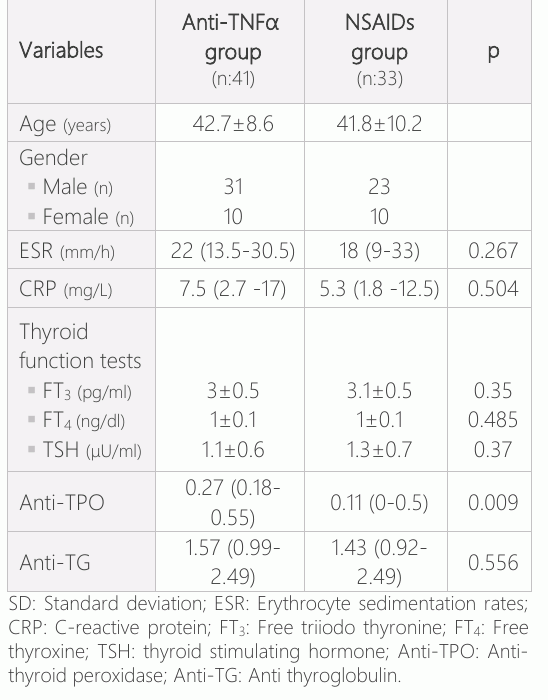
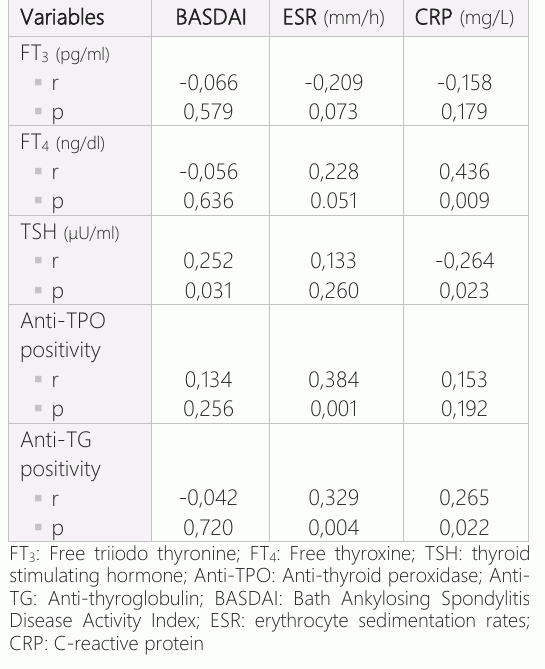
The mean age was 42.7±8.6 years in AS patients. There were 31 male, 10 females AS receiving anti-TNF α. The mean age was 41.8± 10.2 years in the NSAIDs group. There were 23 males, 10 females in the NSAIDs. There was no statistically significant difference between groups in terms of demographic features (age and sex), ESR, CRP, complete blood count (CBC), biochemical analysis, TFTs and anti-TG levels (p>0.05). Mean anti-TPO levels were significant at a high level in the AS patients receiving anti-TNF α compared to the NSAIDs group (p=0.009). Demographic and laboratory features of patients are presented in Table 1. A negative correlation was found between TSH and CRP (r=-0,264, p=0,023). A positive correlation was found between FT4 and CRP (r=0,436, p=0,009), anti-TPO positivity and ESR (r=0,384; p=0,001), anti-TG positivity and ESR and CRP (r=0,329; r=0,265; p=0,004; p=0,022) (Table 2).
Discussion
Thyroid disorders which are seen during anti- TNF α treatment can be coincidence or a paradoxical event and at the same time, they may be a marker of immunogenicity (22). The effect of anti-TNF α treatment on thyroid functions is not well known yet.
The study of Lange et al. included 22 AS patients and 22 controls (10). They investigated FT3, FT4, total triiodothyronine (TT3) levels, and anti-thyroid antibodies. As a result of their study, the prevalence of anti-thyroid antibodies was significantly higher in AS patients. Peluso et al. (23) evaluated TFTs and antithyroid anti bodies in 357 spondylarthritis SpA and 318 controls. They announced that thyroid auto immunity was significantly higher in SpA. Acay et al. (24) evaluated TFTs, anti-thyroid anti-bodies in 122 controls, and well-defined 201 patient (including AS). FT4, TSH, and anti-thyroid antibodies were higher in well-defined patients. Subclinical hypothyroidism was found in 3 patients. The study by Emmungil et al (25) investigated TFTs levels and anti-thyroid antibody positivity in 80 AS patients, 62 Sjögren syndrome (SjS) patients, and 80 healthy controls. The positivity of at least one of thyroid antibodies was significantly more frequent in AS patients (p=0.017). Tarhan et al. (26) studied TFTs and anti-thyroid antibodies. Their study included 44 AS patients receiving anti-TNF α and 64 patients receiving other drugs. As a result of the study anti-TPO level was higher in 23 patients receiving other drugs(p<0.05). They announced that autoimmune thyroid disease was lower in patients receiving anti-TNF α. Tumour necrosis factor α (TNF α) and TNF α receptors have been found in human thyroid tissue (27). This can explain why autoimmune thyroid disorders are seen during anti-TNF α treatment (23). And the frequency of thyroid disorders which are seen during anti-TNF α treatment could be explained by this common pathology.
In our study, we aimed to evaluate TFTs and autoantibodies in AS patients receiving anti- TNF α and NSAIDs. As a result, we found higher anti-TPO levels in AS patients receiving anti- TNF α. Also, we found a negative correlation between TSH and CRP values, while a positive correlation between FT4 and CRP, anti-TPO positivity and ESR, anti-TG positivity and ESR, and CRP. The frequency of thyroid disorder in patients with AS receiving anti-TNF α was lower compared to the NSAIDs group. As a result of our study, anti-TNF α treatment could reduce autoimmune thyroid diseases and had a positive effect on thyroid functions. We can consider that when AT disease developed in AS patients receiving anti-TNF α, this treatment could improve thyroid disease. ATPO and ATG The study has some limitations. The general ability of our findings is limited because of the relatively small sample size. Also, we have not data about anti-TPO and anti-TG values at baseline and at a time after treatment. There is a need for further research with larger samples and long-term follow-up to replicate the findings of this study.
Conclusion
According to our study, we can consider that FT4, anti-TPO and anti-TG values can be used as inflammatory markers in AS patients. However, we believe that more studies are needed for this research.
Declarations
- Author contributions (CRediT)
- All authors contributed equally to all 14 CRediT roles (Conceptualization, Data curation, Formal analysis, Funding acquisition, Investigation, Methodology, Project administration, Resources, Software, Supervision, Validation, Visualization, Writing – original draft, Writing – review & editing).
- Funding
-
Funding information was not reported in the published version of this article.
- Conflicts of interest
- The authors have declared no conflict of interest for the present article.
- Ethics approval
- This study was approved by the ethics committee and carried out from July 2016 to December 2016. All participants signed the informed consent form (Approval: 2017-1046).
- Data availability
- A data availability statement was not reported in the published version of this article.
References (27)
18 of 27 references are linked to their DOI.
- Moreno M, Gratacós J, Torrente-Segarra V, Sanmarti R, Morlà R, Pontes C, Llop M, Juanola X; REMINEA study Group. Withdrawal of infliximab therapy in ankylosing spondylitis in persistent clinical remission results from the REMINEA study.Arthritis Res Ther. 2019;2:88 DOI Crossref PubMed Google Scholar
- Van der Linden S, Valkenburg HA, Cats A.Evaluation of diagnostic criteria for ankylosing spondylitis.A proposal for modification of the New York criteria.Arthritis Rheum. 1984; 27: 361-8 DOI Crossref PubMed Google Scholar
- Rudwaleit M, van der Heijde D, Landewe R, Listing J, Akkoc N, Brandt J, et al.The development of Assessment of Spondylo Arthritis international Society classification criteria for axial spondyloarthritis (part II): validation and final selection. Ann Rheum Dis.2009;68:777-83 DOI Crossref PubMed Google Scholar
- Akbaryan M, Soltani Z.Overlap of Ankylosing Spondylitis and Systemic Lupus Erythematosus: A case report.International Journal of Medical Research & Health Sciences, 2016;4:100-3 PubMed Google Scholar
- Ye C, Li W.Cutaneous vasculitis in a patient with ankylosing spondylitis: A case report.Medicine (Baltimore).2019;98:e14121 DOI Crossref PubMed Google Scholar
- Ferdoutsis M, Bouros D, Meletis G, Patsourakis G, Siafakas NM. Diffuse interstitial lung disease as an early manifestation of ankylosing spondylitis. Respiration.1995;62:286-9 PubMed Google Scholar
- El Ouazzani FZ, Tahiri L, Akasbi N, Kadi N, Harzy T. Sarcoidosis and ankylosing spondylitis: a rare association. Pan Afr Med J.2011;8:23 PubMed Google Scholar
- Fominykh V, Shevtsova T, Arzumanian N, Brylev L. Coexistence of multiple sclerosis and ankylosing spondylitis: report of four cases from Russia and review of the literature. J Clin Neurosci.2017;44:230-3 DOI Crossref PubMed Google Scholar
- Katalin KE, István B, Enikő G, Julianna BA.Primary Biliary Cirrhosis and Ankylosing Spondylitis, A Rare Association. Internal Medicine.2018;6:43-9 PubMed Google Scholar
- Carbone M, Neuberger JM.Autoimmune liver disease, autoimmunity, and liver transplantation.Journal of Hepatology. 2014;60:210-23 DOI Crossref PubMed Google Scholar
- Robazzi TC, Adan LF. Autoimmune thyroid disease in patients with rheumatic diseases.Rev Bras Reumatol.2012;52:417-30 PubMed Google Scholar
- Lazúrová I, Jochmanová I, Benhatchi K, Sotak S.Autoimmune thyroid disease and rheumatoid arthritis: relationship and the role of genetics. Immunol Res.2014;60:193-200 DOI Crossref PubMed Google Scholar
- Appenzeller S, Pallone AT, Natalin RA, Costallat LT. Prevalence of thyroid dysfunction in systemic lupus erythematosus. J Clin Rheumatol. 2009;15:117-9 DOI Crossref PubMed Google Scholar
- Sun X, Lu L, Li Y, Yang R, Shan L, Wang Y. Increased risk of thyroid disease in patients with Sjogren's syndrome: a systematic review and meta-analysis.PeerJ.2019;7:e6737 DOI Crossref PubMed Google Scholar
- Lange U, Boss B, Teichmann J, Klett R, Stracke H, Bretzel RG, et al.Thyroid disorders in female patients with ankylosing spondylitis.Eur J Med Res. 1999;4:468-74 PubMed Google Scholar
- J Braun, J Davis, M Dougados, J Sieper, S van der Linden, D van der Heijde. First update of the international ASAS consensus statement for the use of anti-TNF agents in patients with ankylosing spondylitis.Ann Rheum Dis 65:316-20 DOI Crossref PubMed Google Scholar
- Altan L, Sivrioğlu Y, Ercan İ. Can Bath Ankylosing Spondylitis Disease Activity Index be Affected by Accompanying Fibromyalgia or Depression? Arch Rheumatol. 2015; 30:34-9 PubMed Google Scholar
- Singh AS, Atam V, Yathish BE, Das L, Koonwar S. Role of erythrocyte sedimentation rate in ischemic stroke as an inflammatory marker of carotid atherosclerosis.J Neurosci Rural Pract. 2014;5:40-5 DOI Crossref PubMed Google Scholar
- Kim JM, Park DS. Evaluation of analytical measurement ranges of three full-range C-reactive protein tests using immunoturbidimetric assay. Korean J Lab Med. 2010; 30:9-16 PubMed Google Scholar
- Shim C, Chong R, Lee JH. Enzyme-free chemiluminescence immunoassay for the determination of thyroid-stimulating hormone.Talanta.2017 15;171:229-35 DOI Crossref PubMed Google Scholar
- Sriphrapradang C, Bhasipol A.Differentiating Graves' disease from subacute thyroiditis using the ratio of serum-free triiodothyronine to free thyroxine. Annals of Medicine and Surgery. 2016;10:69-72 DOI Crossref PubMed Google Scholar
- Pascart T, Ducoulombier V, Roquette D, Perimenis P, Coquerelle P, Maury F, et al.Autoimmune thyroid disorders during anti-TNF alpha therapy: coincidence, paradoxical event or marker of immunogenicity?Joint Bone Spine.2014;81:369-70 DOI Crossref PubMed Google Scholar
- Peluso R, Lupoli GA, Del Puente A, Iervolino S, Bruner V, Lupoli R, et al. Prevalence of thyroid autoimmunity in patients with spondyloarthropathies. J Rheumatol 2011;38:1371-7 DOI Crossref PubMed Google Scholar
- Acay A, Ulu MS, Ahsen A, Eroglu S, Ozuguz U, Yuksel S, et al.Assessment of thyroid disorders and autoimmunity in patients with rheumatic diseases. Endocr Metab Immune Disord Drug Targets. 2014; 14:182-6 DOI Crossref PubMed Google Scholar
- Emmungil H, Erdogan M, Kalfa M, Karabulut G, Kocanaogulları H, Inal V, et al.Autoimmune thyroid disease in ankylosing spondylitis.Clin Rheumatol. 2014;33:955-61 DOI Crossref PubMed Google Scholar
- Tarhan F, Orük G, Niflioğlu O, Ozer S.Thyroid involvement in ankylosing spondylitis and relationship of thyroid dysfunction with anti-TNF α treatment.Rheumatol Int.2013;33:853-7 DOI Crossref PubMed Google Scholar
- Zubelewicz B, Muc-Wierzgon M, Wierzgon J, Romanowski W, Mazurek U, Wilczok T, et al.Genetic dysregulation of gene coding tumor necrosis factor α receptors (TNF α Rs) in follicular thyroid cancer-preliminary report. Journal of Biological Regulators and Homeostatic Agents. 2002;16:98-104 PubMed Google Scholar
Read the full text
Open the PDF here
Loading the PDF…
If the PDF does not show here, use the download button above.
How to cite this article
Sargin B, Gurer G. Thyroid Function Tests in Ankylosing Spondylitis Patients on Anti-Tumour Necrosis Factor Treatment. Ulutas Med J. 2020;6(2):53-58. doi:10.5455/umj.20200212024921
Sargin, B., & Gurer, G. (2020). Thyroid Function Tests in Ankylosing Spondylitis Patients on Anti-Tumour Necrosis Factor Treatment. The Ulutas Medical Journal, 6(2), 53–58. https://doi.org/10.5455/umj.20200212024921
Sargin, B. and Gurer, G. (2020) 'Thyroid Function Tests in Ankylosing Spondylitis Patients on Anti-Tumour Necrosis Factor Treatment', The Ulutas Medical Journal, 6(2), pp. 53–58. doi: 10.5455/umj.20200212024921.