The Ulutas Medical Journal · ISSN 2149-0430 (印刷版), 2149-388X (在线版) · https://www.ulutasmedicaljournal.com/?mno=188729
原创研究 · 开放获取
在检查前列腺癌中,使用自由前列腺特定抗原比率的男性有特定前列腺特定抗原
标题、摘要和全文为机器翻译。 英文原文
- Medical Laboratory Science Department, Ebonyi State University, Abakaliki, Ebonyi State, Nigeria ROR
- Physiology Department , Nnamdi Azikiwe University, Awka, Nnewi Campus Anambra State, Nigeria ROR
- Dept. of Community Medicine, Enugu State University of Science and Technology, Enugu, Nigeria ROR
- Nursing Science Deptment, Ebonyi State University, Abakaliki, Ebonyi Nigeria. ROR
- Department of Physiotherapy, University of Nigeria Teaching Hospital, Enugu, Nigeria. ROR
- 开放获取
- CC BY-NC 4.0
- ORCID
- 资助
- 伦理批准
- 数据可用性
摘要
目标: 以总的PSA > 4.0纳克/毫升作为男性前列腺癌诊断的截断标准,评估免费总的PSA比的诊断性能. 方法:尼日利亚Ebonyi州Abakaliki国家产科瘘管病中心癌症科共招聘了60名病人(平均年龄58.03±9.82岁)。 所有患者的PSA总值均高于4.0纳克/毫升. 免费和总的PSA估计是使用Enzyme Linked Immunosorbent Assay(ELISA)原理进行的. 结果:免费总的PSA比率显示,在0.25和0.19的切分时,检测未诊断的前列腺癌的敏感度(98.2%)、特异性(87.9%和82.9%)和正预测值(93.3%,90%)。 高灵敏度(97.6%)和中度特异性(61.7%)和正预测值(70.0%)在0.10的切除时观察到。 采用前列腺癌免费总PSA比0.10的截断法,70%的试验对象被诊断为前列腺癌,而当使用大于0.25的截断法时,6.7%的试验对象被诊断为可能的良性静脉高血压. 结论:免费总的PSA比是用于检测未诊断的前列腺癌的PSA总分析的高度敏感,具体和有用的诊断工具. 此外,它还高度预测了发展前列腺癌在具体切入水平上的风险.
关键词
全文
全文为机器翻译;以英文原文为准。 英文原文
导言
前列腺特异性抗原(PSA),一种由前列腺细胞产生的蛋白质(正常细胞和癌细胞都产生PSA),用于筛选男性前列腺增殖是良性还是恶性. (1)血清PSA以自由形式和复杂形式存在,并配有多种蛋白质抑制剂 (2–6). 多数PSA与Alpha-1-antichymotripsin(ACT)结合,对总PSA的检测既测量这个绑定分数,又测量自由的PSA (4, 7)前列腺癌男性的复合血清PSA比例较大,或有约束性血清PSA比例较低,与无前列腺癌男性相比是免费的(免费PSA). (3, 4)经验证据表明,癌症患者必须接受青蒿素综合疗法的百分率高于正常控制(4.8,9)。
虽然前列腺特定抗原(PSA)测定被广泛认为是检测癌症最有用的肿瘤标记,但是,使用前列腺癌作为有效检测手段一直存在争议. 美国癌症协会和美国尿道协会的临床实践建议,每年进行癌症筛查,同时进行PSA和数字直肠检查。 (10, 11)另一方面,一些咨询小组,如国家癌症研究所、美国医生学院和美国预防服务工作队,最近建议不使用PSA测试来检查前列腺癌,因为如果好处很小,而且伤害可能很大。 (12–14)例如,在筛选中使用PSA测试,可以帮助检测不会引起症状的小肿瘤. 检测不威胁生命的肿瘤称为“过度诊断”,而治疗这些肿瘤称为“过度治疗”。 (1)第二,PSA测试缺乏具体性,可能导致虚假负结果的假阳性,从而导致许多不必要的前列腺生物检查,特别是对于PSA值在4.0至10.0纳克/毫升之间 (1, 2)最近的一项研究表明,一些正常的PSA水平低于4.0纳克/毫升的男性患有前列腺癌,而其他水平较高的男性则没有前列腺癌,但证明患有良性前列腺增生(BPH) (15)此外,没有证据表明PSA检测降低了疾病特有的发病率或死亡率。 (13, 14)。 。 。
上述事实要求需要制定能够改进《公共服务协定》具体性的战略。 大多数调查员建议使用免费-总-总-PSA比率,从免费和总的PSA的测量中计算,以取代总的PSA,用于前列腺癌筛查 (6, 9, 16)不同机构的一些研究评估了相当多的不同化验结果,证实百分率免费的PSA在检测未丧失敏感性的前列腺癌方面有能力提高特异性。 (17–20)最近的研究还表明,在临床实践中可以使用免费-总的PSA比率来区分PSA二级至良性静脉病和前列腺癌,从而对前列腺癌的风险作出更好的决定。 (17, 18)在PSA总数增加的患者中,免费总的PSA比率优于总的PSA测定,以区分前列腺原发性癌(CaP)和良性前列腺高血压(BPH)。 此外,其价值可有效降低总的PSA高于4纳克/毫升的男子不必要的生物检查率。 (21)研究表明,接受免费总PSA比率筛查的男性前列腺癌死亡率较低。 (22)在这项跨部门研究中,我们旨在评估免费总的PSA比率的诊断性能(敏感性、特异性、正预测值),使用总的PSA > 4.0纳克/毫升作为在尼日利亚埃博尼州国家产科瘘管病中心前列腺癌筛查单位报告的男子前列腺癌诊断的切除标准。 我们还确定了这一疑似男子群体不同风险水平的未诊断前列腺癌发病率(PSA水平 > 4纳克/毫升)。
学习设计
在尼日利亚埃邦伊州阿巴卡利基国家产科瘘管病中心癌症检查室报告的60名40岁及以上男子被招募参加这项研究。 研究中作为试验科目的男性患者是40岁时参加诺非氏症前列腺癌筛查的男性患者,在PSA估计后总的PSA值大于4.0纳克/毫升。 在参加研究之前征求了所有科目的同意。 在任何研究阶段都允许主体退出。 该研究得到了医学实验室科学部伦理委员会EBSU的批准.
样本收集和分析
大约5毫升的血样被采集到平原的容器中,这些血样来自情绪放松的受体,没有事先任何前列腺操纵. 血液被离心机和血清用于PSA分析。 同一天,血清被用于分析,没有血清在使用前24小时被储存。 自由与总的PSA估计是使用Enzyme Linked Immunosorbent Assay(ELISA)原理进行的,由BioCheck Inc: Cat number BC1019. 计算了PSA免费总比率。
数据分析
描述性数据是连续变量的平均值+标准差,是绝对变量的百分比。 利用独立的T测试样本进行了涉及两个变量的比较分析。 利用皮尔逊的双变量关联性测试确定了变量之间的关联性分析。 ROC曲线分析被用来确定用于检测前列腺癌的免费总PSA比的诊断性能. 统计意义定为P<0.05。 所有统计都使用IBM-SPSS统计软件进行(第20版 简况) (中文(简体) ).
结果
表1显示了总PSA,免费PSA和免费总PSA比例的平均值. 表2根据前列腺癌的风险水平,显示测试对象的频率分布. 数据显示,在被问及的前列腺癌的60个学科中,42个(70%)的免费总PSA比值为0.10;12个(20%)的免费总PSA比值为0.11至0.18;2个(3.3%)的免费总PSA比值为0.19至0.25,4个(6.7%)的免费总PSA比大于0.25。
数值为0.19。 在0.10的限值水平上,42个表-3显示检测未诊断的前列腺癌的敏感性、特异性和正预测值,自由总的PSA比率分别为0.25、0.19和0.10。 随着自由总的PSA比的截断水平的降低,灵敏度,特异性和正预测值都有所增加. 同样,患前列腺癌的相对风险也随着自由总PSA比截断水平的降低而降低,并表明在所有截断水平上与未诊断的前列腺癌有重大关联(p<0.001)。

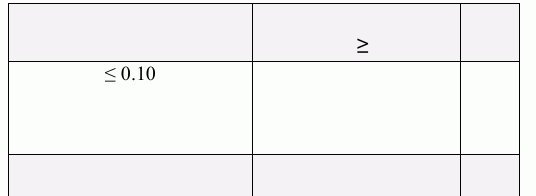

免费总的PSA比率表明,在截断时间分别为0.25(98.2%;87.9%;93.3%)和0.19(98.2%;82.9%和90%)时,检测未诊断的前列腺癌的灵敏度、特异性和阳性预测值都很高。 高灵敏度(97.6%)和中度特异性(61.7%)和正预测值(70.0%)在0.10的切除时观察到。 进一步调查显示,在0.25级断电时,56个测试科目的免费总PSA比率 < 0.25,4人为0.25。 在0.19的截止水平上,54个测试科目的数值为 < 0.19,6个测试科目的数值为 < 0.10,18个测试科目的皮尔逊双变量线性关系表明,自由总的PSA比与总PSA之间有重大和反向关系(R=-0.296;p=0.005)。
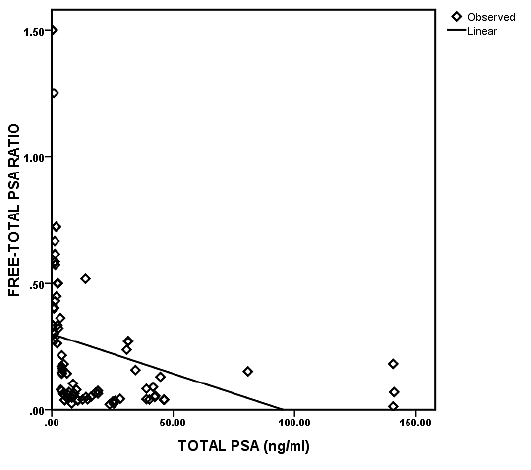
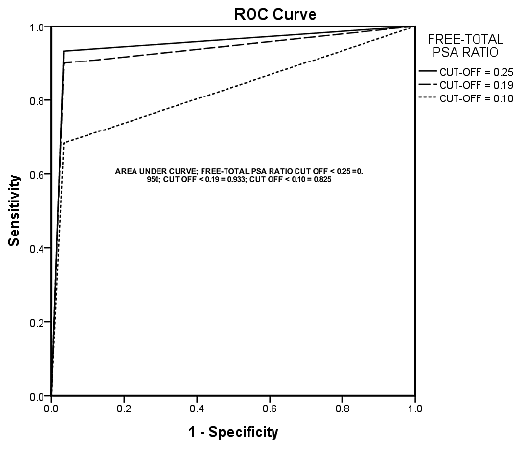
图2为自由总PSA比的ROC图案,作为每个可能的自由总PSA比截断水平上未诊断的前列腺癌的诊断指标. 曲线下的区域(AUC)在截断0.25,AUC=0.950;0.19,AUC=0.933;0.10,AUC=0.825时,在检测未诊断的前列腺癌时,自由总PSA比的预测值较高.
讨论情况
PSA测定被认为是检测前列腺癌最有用的肿瘤标记,直到咨询小组拒绝推荐它作为前列腺癌的常规筛查测试. 这是因为:没有证据表明PSA测试降低了疾病特有的发病率或死亡率。 (13, 14)同样,PSA测试缺乏具体性,导致不必要的前列腺生物检查,是临床医生关注的另一个重大问题。 前一次研究表明,PSA测试的正预测值非常差 (23)。 。 。
在这项研究中,我们证明免费总的PSA比率对于检测未诊断的前列腺癌既敏感又具体。 ROC图案曲线下的区域揭示了自由总PSA比的高性能,作为在不同切片时检测未诊断的前列腺癌的有用诊断工具. 我们的数据进一步表明,自由总的PSA比率值与前列腺癌的存在之间存在重大关联,从而表明自由总的PSA比率对前列腺癌的预测能力。 百分率免费PSA在检测前列腺癌方面提高了敏感性和特异性. 这与先前的研究一致,即自由-总的PSA比可用于减少血清PSA水平为4.0至10.0纳克/毫升的患者的前列腺生物检查次数. (17–20, 24, 25) 目前的调查结果表明,在前列腺癌的诊断和筛查中采用免费总的PSA比率,是区分前列腺癌与良性和炎症的改进方法. 使用PSA检测前列腺癌的特异性在于自由总的PSA比,这进一步抵消了缺乏特异性,不必要的前列腺生物检查以及经常与PSA测试相关的伤害. (12–14)。 。 。
值得注意的是,0.25和0.19的免费总PSA比截断表明,在研究人群中,有很大一部分人患有未诊断的前列腺癌,极有可能患上前列腺癌(RR=28;95%CI,6.82-153.8和RR=27;95%CI,6.31-150.6)。 18个具有初始PSA水平的测试科目 4纳克/毫升在使用 < 10 自由总PSA比截断时被发现没有前列腺癌. 这些调查结果表明,免费总的PSA比率在临床上有助于检测那些患有前列腺癌和反之亦然的PSA水平较高的男性。
自由总的PSA比 < 0.25是前列腺癌的标记,而自由总的PSA比 → 0.25是良性前列腺增生的指标. 良性疾病的概率见于免费总PSA比率为0.25,而恶性疾病的概率见于免费总PSA比率为0.10。 (26)在NOFIC中前列腺癌单位的60个前列腺癌疑似前列腺癌试验科目中,70%的科目有前列腺癌风险(免费总的PSA比率为0.10),6.7%的科目呈良性静脉高血压,由免费总的PSA比率大于0.25确定。 评估免费性病诊断表现的多中心研究小组对1081名男子进行了评估,发现在被诊断患有前列腺癌的男子中,4%的免费性病总比率大于0.25,而只有2%的男子免费性病总比率低于0.07。 (24),这表明对免费总的PSA比率的潜在临床用途。
结论
免费总的PSA比是一种高度敏感,具体和有用的诊断工具,可以替代总的PSA测定法来检查未诊断的前列腺癌. 在0.25和0.19之间切断的免费总的PSA可以识别出更多患有未诊断的前列腺癌,极有可能发展前列腺癌的人. 前列腺癌的免费总PSA比率为0.10,使用这一比率,70%的试验对象被诊断为前列腺癌风险。 在使用大于0.25的截断时,6.7%的试验对象被诊断为可能为良性静脉增生。
声明
- 作者贡献(CRediT)
- 所有作者对全部 14 项 CRediT 角色贡献均等(Conceptualization, Data curation, Formal analysis, Funding acquisition, Investigation, Methodology, Project administration, Resources, Software, Supervision, Validation, Visualization, Writing – original draft, Writing – review & editing)。
- 资助
-
Funding information was not reported in the published version of this article.
- 利益冲突
- The authors declare that no conflict of interest exists in publishing this article.
- 伦理批准
- This study was approved by the ethical committee of Medical Laboratory Science Department, EBSU.
- 数据可用性
- A data availability statement was not reported in the published version of this article.
参考文献 (26)
26 条参考文献中有 15 条已链接 DOI。
- National Cancer Institute. Prostate specific antigen test. Reviewed 2012. Accessed from http:// www.cancer.gov/PSA on 11th May, 2014. PubMed Google Scholar
- Hoffman RM, Clannon DL, Littenberg B, Frank JJ, Pierce JC. Using the free to total prostate specific antigen ratio to detect prostate cancer in men with non-specific elevations of prostate specific antigen level. J Gen Intern Med. 2000; 15 (10):739-748. DOI Crossref PubMed Google Scholar
- Lilja H, Christensson A, Dahlén U, et al. Prostate-specific antigen in serum occurs predominantly in complex with α1-antichymotrypsin. Clin Chem. 1991; 37:1618-25. DOI Crossref PubMed Google Scholar
- Stenman UH, Leinonen J, Alfthan H, Rannikko S, Tuhkanen K, Alfthan O, et al. A complex between prostate-specific antigen and α1-antichymotrypsin is the major form of prostate-specific antigen in serum of patients with prostatic cancer: assay of the complex improves clinical sensitivity for cancer. Cancer Res. 1991; 51:222-6. PubMed Google Scholar
- Christensson A, Laurell CB, Lilja H, et al. Enzymatic activity of prostate-specific antigen and its reactions with extracellular serine proteinase inhibitors. Eur J Biochem. 1990;194:755-63. DOI Crossref PubMed Google Scholar
- McCormack RT, Rittenhouse HG, Finlay JA, et al. Molecular forms of prostate-specific antigen and the human kallikrein gene family: a new era. Urology. 1995; 45:729– 44. DOI Crossref PubMed Google Scholar
- Lilja H, et al. Regulation of the enzymatic activity of prostate-specific antigen and its reactions with extracellular protease inhibitors in prostate cancer. Scand J Clin Lab Invest Suppl. 1995; 220:47–56. PubMed Google Scholar
- Leinonen J, Lövgren T, Vornanen T, Stenman UH, et al. Double-label time-resolved immunofluorometric assay of prostate-specific antigen and of its complex with α1-antichymotrypsin. Clin Chem. 1993; 39:2098– 103. DOI Crossref PubMed Google Scholar
- Christensson A, Björk T, Nilsson O, Dahlén U, Matikainen MT, et al. Serum prostate specific antigen complexed to alpha 1-antichymotrypsin as an indicator of prostate cancer. J Urol.1993; 150(1):100– 105.. DOI Crossref PubMed Google Scholar
- Mettlin C, Jones G, Averette H, Gusberg SB, Murphy GP, et al. Defining and updating the American Cancer Society guidelines for the cancer related check-up: prostate and endometrial cancers. CA Cancer J Clin. 1993; 43:42–6. DOI Crossref PubMed Google Scholar
- American Urological Association. Early detection of prostate cancer and use of transrectal ultrasound. Baltimore, Md: Williams & Wilkins; 1992. In: American Urological Association 1992 Policy Statement Book. PubMed Google Scholar
- PDQ. (Physician Data Query) [Database online]. Bethesda, Md: National Cancer Institute: 1984 – [updated 9/99]. Screening for prostate cancer. Available from: National Cancer Institute; National Library of Medicine, Bethesda, Md: CDP Technologies, Inc., New York, NY; Lexis-Nexis, Miamisburg, Ohio. PubMed Google Scholar
- American College of Physicians. Screening for prostate cancer. Ann Intern Med. 1997; 126:480–4. PubMed Google Scholar
- U.S. Preventive Services Task Force. Guide to clinical preventive services. 2nd ed. Baltimore: Williams & Wilkins; 1996. PubMed Google Scholar
- Thompson IM, Pauler DK, Goodman PJ, et al. Prevalence of prostate cancer among men with a prostate-specific antigen level < or =4.0 ng per milliliter. New England Journal of Medicine. 2004; 350(22):2239-2246. DOI Crossref PubMed Google Scholar
- Vessella RL, Lange PH, et al. Issues in the assessment of prostate-specific antigen immunoassays. An update. Urol Clin North Am. 1997; 24:261–8. DOI Crossref PubMed Google Scholar
- Walz J, Haese A, Scattoni A, et al. Percent Free Prostate-Specific Antigen (PSA) is an accurate predictor of prostate cancer risk in men with serum PSA 2.5 ng/mL and Lower. Cancer. 2008; 113 (10):2695-2703. DOI Crossref PubMed Google Scholar
- Demura H, Nakamura M, Hasumi H, et al. Effectiveness of percent free prostate specific antigen as a predictor of prostate cancer detection on repeat biopsy. Int J Urol. 2004; 11(7):494-500. PubMed Google Scholar
- Mitrunen K, Pettersson K, Piironen T, et al. A novel dual-label one-step immunoassay for simultaneous measurement of free and total PSA concentrations and ratios in serum. Clin Chem 1995; 41:1115-1120. PubMed Google Scholar
- Demura T, Shinohara N, Tanaka M, et al. Ratio of free and total prostate-specific antigen: A method of detecting prostate cancer in the cases with PSA levels of 10ng/mL or lower. J Urol. 1996; 155(suppl):S368A. PubMed Google Scholar
- Mione R, Barioli P, Barichello M, Zattoni F, Prayer-Galetti T, Plebani M, Aimo G, Terrone C, Manferrari F, Madeddu G, Caberlotto L, Fandella A, Pianon C, Vianello L, Gion M. Prostate cancer probability after total PSA and percent free PSA determination. Int J Biol Markers. 1998; 13(2):77-86. DOI Crossref PubMed Google Scholar
- Schröder FH, Hugosson J, Roobol MJ, et al. Prostate-cancer mortality at 11 years of follow-up. New England Journal of Medicine. 2012; 366(11):981-990 DOI Crossref PubMed Google Scholar
- Catalona WJ, Richie JP, Ahmann FR, et al. Comparison of digital rectal examination and serum prostate specific antigen in the early detection of prostate cancer: results of a multicenter clinical trial of 6,630 men. J Urol. 1994; 151:1283–90. DOI Crossref PubMed Google Scholar
- Thiel RE, Oesterling JE, Wojno KJ, et al. A multicenter comparison of the diagnostic performance of free PSA. Urology 48(6A suppl):S45-S50, 1996. PubMed Google Scholar
- Bangma CH, Rietbergen BW, Kranse R, et al. The free-to - total prostate specific antigen ratio improves the specificity of prostate specific antigen in screening for prostate cancer in the general population. J Urol. 1997; 157:2191-2196. DOI Crossref PubMed Google Scholar
- Oesterling JE, Jacobsen SJ, Klee GG, et al. Free, complexed and total serum prostate specific antigen: the establishment of appropriate reference ranges for their concentrations and ratios. J Urol. 1995; 154:1090-1095. DOI Crossref PubMed Google Scholar
阅读全文
在此打开 PDF
正在加载 PDF…
若 PDF 未在此显示,请使用上方的下载按钮。
如何引用本文
Ewenighi C, Dimkpa U, Onyeanusi J, Onoh L, Onoh G, Oti N, et al. The Use of Free-Total Prostate Specific Antigen Ratio in Screening Prostate Cancer in Men with Specific Elevations of Prostate Specific Antigen. Ulutas Med J. 2015;1(2):31-35. doi:10.5455/umj.20150518015721
Ewenighi, C., Dimkpa, U., Onyeanusi, J., Onoh, L., Onoh, G., Oti, N., Obasi, L., & Ezeugwu, U. (2015). The Use of Free-Total Prostate Specific Antigen Ratio in Screening Prostate Cancer in Men with Specific Elevations of Prostate Specific Antigen. The Ulutas Medical Journal, 1(2), 31–35. https://doi.org/10.5455/umj.20150518015721
Ewenighi, C. et al. (2015) 'The Use of Free-Total Prostate Specific Antigen Ratio in Screening Prostate Cancer in Men with Specific Elevations of Prostate Specific Antigen', The Ulutas Medical Journal, 1(2), pp. 31–35. doi: 10.5455/umj.20150518015721.