The Ulutas Medical Journal · ISSN 2149-0430 (مطبوع), 2149-388X (إلكتروني) · https://www.ulutasmedicaljournal.com/?mno=27789
مقالة أصلية · وصول مفتوح
Effects of Preoperative Laboratory Findings to the Risk of Re-exploration after Coronary Artery Bypass Graft Surgery
ترجمة آلية للعنوان والملخص والنص الكامل. الأصل الإنجليزي
- Department of Anesthesiology and Reanimation, Sanko University School of Medicine, Gaziantep, Turkey ROR
- Feragat, Uygur, Department of Cardiovascular Surgery, Sanko University School of Medicine, Gaziantep, Turkey ROR
الملخص
Background: Coronary artpass grafting (CABG) operation is a surgical procedure commonly used in the treatment of patients with ischemic heart disease.In some cases, there is a need for re-exploration after CABG.This is a retrospective study conducted to determine the characteristics and risk factors of patients who underwent re-exploration because of bleeding after CABG operations in our center.Materials and Method: In the present study, patients who underwent coronary artpass grafting (CABG) operation with open heart wound and required re-exploration in Sanko University, Medicine Faculty Hospital Cardiovascular Surgery Clinic between December 2016 and May 2018 were evaluated retrospectively.وسُجلت البيانات الديمغرافية، والنتائج المختبرية، وطول مدة الإقامة في وحدة العناية المركزة، ومجموع طول مدة الإقامة في المستشفى لجميع المرضى.The patients were divided into two groups as patients who underwent and those who did not undergo re-exploration.النتائج: أدرج في هذه الدراسة ما مجموعه 200 مريض، و 131 (65.5 في المائة) ذكور و 69 (34.5 في المائة) إناث.ومن بين المرضى، كان 13 مريضا (6.5 في المائة) قد تعرضوا لعملية إعادة الاستغلال بسبب النزيف الذي أصاب اللجنة.ولم يكن هناك فرق كبير من الناحية الإحصائية بين المجموعتين من حيث العمر ونوع الجنس ومدة الإقامة في وحدة العناية المركزة وطول مدة الإقامة في المستشفى.It was seen that 2 (15.4%) of the patients who underwent re-exploration were female and 11 (84.6%) were male.ولم يكن هناك فرق كبير بين المرضى من حيث فترة ما قبل التشغيل: المعهد الوطني للبحث والتدريب من أجل الطفل، ومكتب الأمم المتحدة المعني بنقل التكنولوجيا، والكراتين، والجلوكوز، ومستويات الكولسترول، ونتائج CBCT، وإحصاءات الدم الكاملة (p of0.05).الاستنتاج: It was determined that the clinical features and laboratory parameters of patients who underwent CABG operation were inadequate for being used to predict the re-exploration to be implemented because of bleeding in these patients.ومن المعتقد أن الدراسات المرتقبة التي تتضمن بيانات أكثر تفصيلا ومشاركة أكبر من المرضى ضرورية لهذا الموضوع.
الكلمات المفتاحية
النص الكامل
ترجمة آلية للنص الكامل؛ النسخة المعتمدة هي الأصل الإنجليزي. الأصل الإنجليزي
مقدمة
عملية استئصال الشريان الأوّلي هي إجراء جراحي شائع الاستخدام في علاج المرضى المصابين بأمراض القلب الكيميائي (1)تواتر مرض الشريان التاجي آخذ في الازدياد مؤخرا، وهذا يزيد من معدلات جراحة القلب المفتوحة. In some cases, patients can be reoperated within the first 24 hours after wound due to bleeding, hypotension, and arrhythmia (revision /reexploration wound). (2)وقد يعزى ذلك إلى أسباب تشغيلية، وإلى عيوب في قيم الدم قبل العملية.
وعلى الرغم من أوجه التقدم التي تحققت مؤخرا في مجال الرعاية الذاتية خلال العقد الماضي، لا تزال عملية إعادة الانتشار مضاعفا متواترا مع زيادة الوفيات والأمراض بعد الطرق الجراحية، ونظم التدريب خارج نطاق القانون، واستراتيجيات حفظ الدم، وعملية جراحة القلب. In studies conducted before 1990, the rate of re-exploration increased to 14%, while this rate has been reported as 3% in recent studies (3)- لا بد من إعادة الانتشار بسبب النزيف في 2-6 في المائة من المرضى الذين تعرضوا لـ (CABG). ومع ذلك، فإن العقم بسبب النزيف، بعد أن تكون اللجنة مصدرا حيويا للاعتلال في العديد من الوحدات القلبية. وقد وصفت عمليات إعادة الاستغلال في العديد من الدراسات بأنها عامل خطر مستقل للاعتلال والوفاة في مرحلة مبكرة من مراحل التشغيل. ويرتبط في الدراسات التي أجريت في السنوات الأخيرة بزيادة معدل الوفيات في المستشفيات بين 2 و 4.7 مرة في المرضى الذين يحتاجون إلى إعادة الاستغلال (2, 4, 5).
وتؤثر العوامل، بما في ذلك النزيف اللاحق، والوضع الديناميكي للمريض، ونتائج الرسوم البيانية الصدرية، وخبرة الجراح المسؤول، على قرار إعادة الاستغلال (6, 7)واستناداً إلى ذلك، أجريت دراسة استعراضية لتحديد خصائص المرضى الذين تعرضوا لإعادة الاستغلال وعوامل الخطر بسبب النزيف بعد عمليات الفريق في مركزنا.
المواد والأساليب
اختيار المرضى
In the present study, patients who underwent coronary artafting (CABG) operation with open heart wound and required re-exploration in Sanko University, Medicine Faculty Hospital Cardiovascular Surgery Clinic between December 2016 and May 2018 were evaluated retrospectively. وسُجلت البيانات الديمغرافية، والنتائج المختبرية، وطول مدة الإقامة في وحدة العناية المركزة، ومجموع طول مدة الإقامة في المستشفى لجميع المرضى. The patients were divided into two groups as patients who underwent and those who did not undergo re-exploration.
وأدرجت معايير الإدماج والاستبعاد المرضى المصابين بمرض الشريان التاجي الذين تتراوح أعمارهم بين 18 و85 سنة، الذين اتخذت قراراتهم اللجنة الاستشارية لشؤون الإدارة والميزانية والذين لم يخضعوا للاختبار إلا في ظروف انتخابية. ولم يُدرج في الدراسة المرضى الذين اقترنوا بإصلاح الصمامات القلبية/استبدالها، وإعادة تقطيع الأوعية الدموية غير الجراحية، فضلا عن المرضى الذين تم تشغيلهم في ظروف الطوارئ، الذين استخدموا أدوية مضادة للصدمات الكهربائية قبل التشغيل، وكان لديهم تاريخ من جراحة القلب السابقة.
جميع المرضى كانوا متفوقين بـ 0.05 ملغم/كغم من الوسطازوم (Demizolam)SR. 5mg/5 ml, Dem Ilac, Istanbul, Turkey) intravenously. The patients were monitored by 5-lead electro cardiography (EKG) and pulse oximetry. أُدخل قمرة الشريان الإشعاعي لرصد الضغط الشرياني الغازي. Following monitorization, the anesthesia induction was performed intravenously using propofol 200mg, 0.1 mg/kg midazolam, rocuronium (Esmeron, Organon, USA) 0.5 mg/kg and 5 mcg/kg fentanyl (Fentanium, 0.05 mg/mazon, Johnson, Istanbul, Turkey) with se Following the patients were intubated with endotracheal intubation tubes suitable for their weights, 8F central venous catheters were placed in their internal jugular veins. تم توفير التهوية مع خليط الهواء الأكسجين في نمط الضغط، مع ارتفاع ضغط المجرى الجوي لا يتجاوز 30 سنتيمتراً2O and in a way to create 8- 10 ml/kg tidal volume.
Heparinization and extracorporeal circulation Antiplatelet medications were discontinued 7 days before the operation and anticoagulant medications were discontinued at least 3 days before the operation in patients who underwent elective CABG. جميع المرضى المشمولين بالدراسة تم تشغيلهم بإستعراض وسطي بواسطة نفس فريق الجراحين After the sternotomy and the opening of the pericardium, 300 U/kg heparin iv. was administered before the CABG procedure and the operationald coagulation time (ACT) was set as 480 sec and above. Heparin was neutralized with protamine after CABG.
في عيادةِنا، نفس بروتوكولِ الارتباكِ يُطبّقُ على كُلّ المرضى البالغينِ الذين خضعتْ لجراحة قلبِ مفتوحةِ. وطبقت نفس الطريقة الجراحية على جميع المرضى.
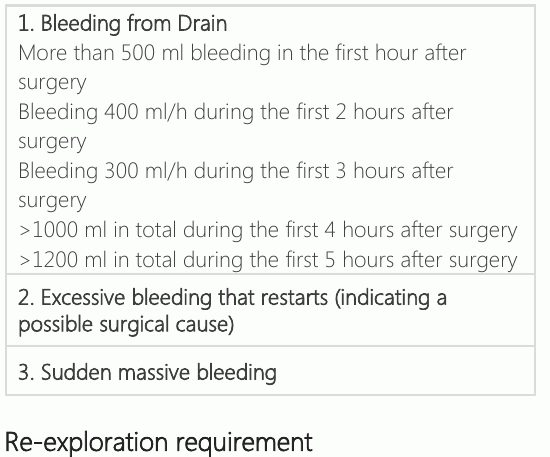
In the postoperative period, the amounts of bleeding of the patients taken to the ICU were calculated as from the time when they were taken to the ICU. In our clinic, the clinical approach based on the re-exploration criteria of Barratt Boyes is used for the re-exploration decision (Table-1).
استعملت شركة SPSS v25 (IBM Corporation, Armonk, New York, United States) لتحليل المتغيرات. The conformity of the data to normal distribution was assessed by the Shapiro-Wilk test and variation homogeneity by the Levene test. The Independent-SamplesT-test was used with the Bootstrap results, while the Mann- Whitney U test was used with the Monte Carlo simulation method in the comparison of two independent groups according to quantitative data. واستُخدم اختبار " مصايد الأسماك " مع نتائج " Exact " في مقارنة المجموعات وفقا للمتغيرات القاطعة. وأُظهرت المتغيرات الكمية على أنها " الانحراف الحاد " (Standard Deviation) ووسطها (Maximum/Minimum)، في حين أُظهرت المتغيرات القاطعة في الجداول بأنها غير (%). وجرى تحليل المتغيرات بنسبة 95 في المائة من مستوى الثقة، وقُبلت القيمة بوصفها ذات أهمية عندما كانت أقل من 0.05.
النتائج
وفي الدراسة، جرى تقييم الخصائص الديمغرافية للمرضى. وتشمل الدراسة ما مجموعه 200 مريض، و 131 (65.5 في المائة) ذكور، و 69 (34.5 في المائة) إناث. وقد تعرض ثلاثة عشر مريضا (6.5 في المائة) لعملية إعادة الاستغلال بسبب النزيف الذي أصاب اللجنة. The mean age of the patients under re-exploration after CABG was 60.928.63 (43/73) years, while the mean age of patients for whom the re-exploration was not required was 61.639.18 (32/85) years. ولم يكن هناك فرق كبير من الناحية الإحصائية بين المجموعتين من حيث العمر ونوع الجنس ومدة الإقامة في وحدة العناية المركزة، وطول مدة الإقامة في المستشفى (الجدول 2).
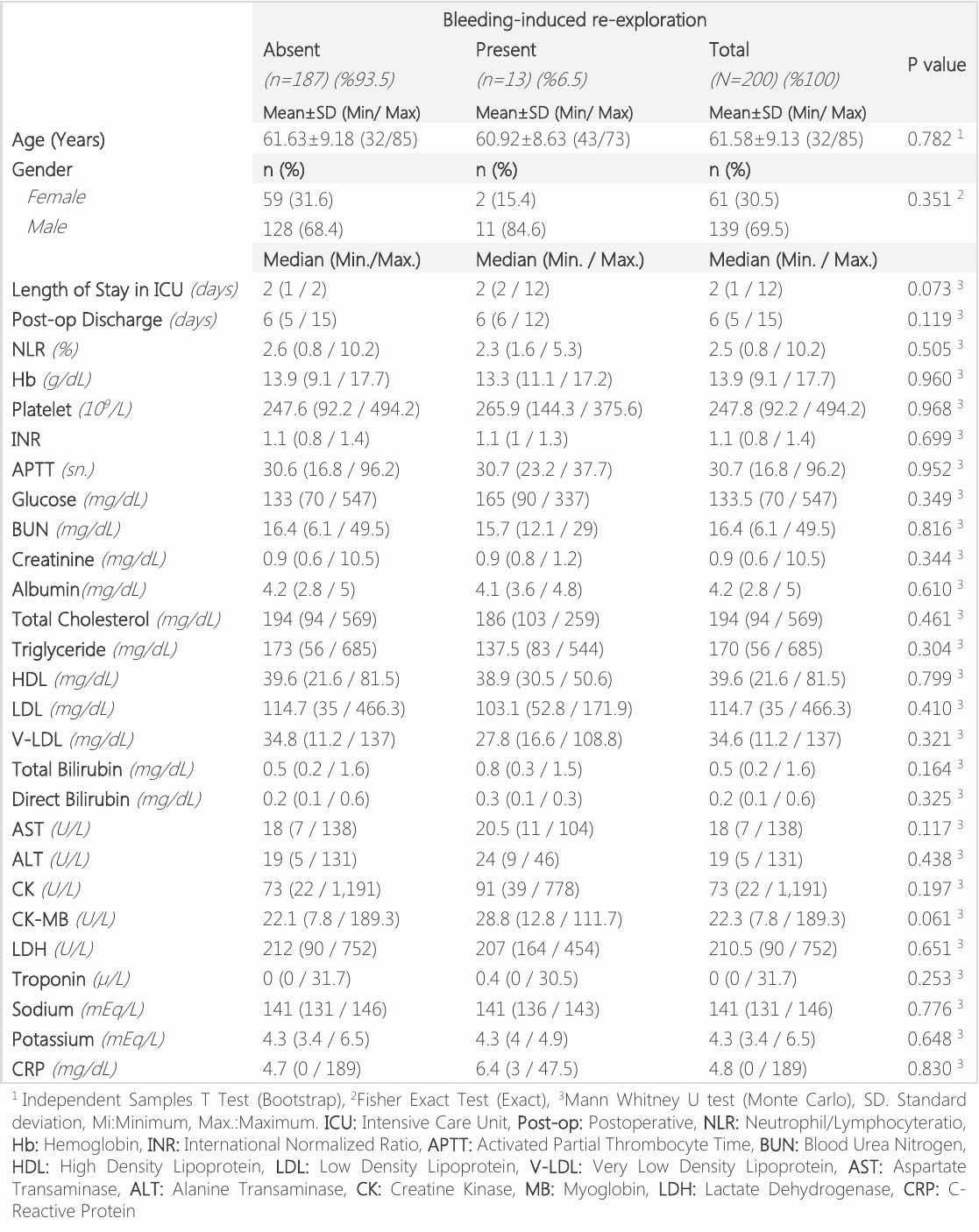
It was seen that two (15.4%) of the patients who underwent re-exploration were female, and 11 (84.6%) were male. ويعزى كل عمليات إعادة الاستغلال التي أجريت إلى النزيف. ونُفذت عملية إعادة الانتشار مرتين في مريض واحد، وتوفي مريض واحد أجرى عملية مراجعة. There was no significant difference between the patients in terms of preoperative period INR, APTT, BUN, creatinine, glucose, cholesterol levels, CBCT results, and blood count (Table-2).
المناقشة
ويزيد النزيف اللاحق من الحاجة إلى إعادة الاستغلال ويؤثر تأثيراً كبيراً على طول فترة بقاء المستشفى وتواتر الاعتلال والوفيات. وتواجه المرضى الذين يحتاجون إلى إعادة جراحة مخاطر كبيرة بسبب تدخلات جراحية لمضاعفات مثل ردود فعل نقل الدم، والاصابات الفيروسية، وقمع النظام المناعي، والاضطرابات الناجمة عن الاضطرابات. وانخفض معدل إعادة الاستخدام إلى 2-6 في المائة مع التقدم المحرز في الرعاية في الفترة المحيطة، والأساليب الجراحية، ودعم التداول خارج نطاق القانون، واستراتيجيات نقل الدم(9–11)- وكانت عملية إعادة الاستخدام المفاجئة موضوع عدد كبير من الدراسات في أدبيات جراحة القلب. ويرتبط إعادة الانتشار المستحثة بازدياد حالات التطهير البري، ومستويات حرق المصل، وطول فترة بقاء وحدة العناية المركزة الدولية، وتواتر الإصابة بالإصابة بالجرح في منطقة التعقيم (12–14)- والتنبؤ بالزيادة في خطر إعادة الاستغلال بسبب النزيف في المرضى الذين يخضعون لعملية اللجنة الاستشارية لشؤون الإدارة والميزانية أمر أساسي للجراحين في فترة ما قبل التشغيل. وقد تبين في هذه الدراسة أن البارامترات الحالية لا تكفي للتنبؤ بالحاجة إلى إعادة الاستغلال. ويرتبط النزيف في فترة ما بعد انعقاد اللجنة الاستشارية لشؤون الإدارة والميزانية عموماً بالذرات، ومواقع العزل (النزيف الجراحي) أو ممر الكواغولو (النزيف غير الجراحي). بيانكاري وآخرون (3) والتشديد على أن تجربة الجراح ونهجه قد يؤثران على النزيف اللاحق، ومن ثم فإن الأسلوب الجراحي السافر قد يقلل من الحاجة إلى إعادة الاستغلال أثناء فصل الرذاذ والتمزق.
ويرتبط النزيف الافتراضي بالأضرار الجراحية التي تلحق بسفن الدم والاضطرابات في الآليات الوبائية. وقد تبين أن معظم العيوب الوبائية مرتبطة بالتعرض المطول لخلايا الدم لـ " سي بي بي بي بي بي بي " تسبب انخفاضا في مستويات معامل التخصيب، وتحفز التحلل، وتتسبب في خلايا الدم وعطل الطبق. وينبغي أيضا مراعاة آثار الهيبارين والبروتامين في التداول.
In a study by Karthik وآخرون. (15) وأفيد بأن معدل إعادة الاستغلال بلغ 3.1 في المائة. وفي هذه الدراسة، تم التأكيد على أن المتغيرات من قبيل السن المتقدمة، وانخفاض مستوى العمر المتوقع، والجراحة الطارئة، وأكثر من استخدامين مكثفين، زادت معدلات إعادة الاستغلال. Kristensen وآخرون. (2) ووجد أن انخفاض قيمة BMI، وارتفاع قيمة اليوروسكور، ومستوى الفشل الكلوي قبل التشغيل، والمرض السكري، ومدة طويلة من بروميد الميثيل يرتبط بزيادة معدلات إعادة الاستغلال. In the study by Choong et al. (16)وقد تبين أن العمر المتقدم، والمستوى المنخفض للتراكم البيولوجي، والاستخدام الجاهز للجرعات أو الأسبرين، ونوع الجراحة، ومدة أطول من هذه العملية، عوامل خطر مستقلة لإعادة الاستخدام بسبب النزيف.
In some studies, the bleeding-induced re-exploration was found to be an independent risk factor for stern wound infection (17, 18)- في دراسة مستفيضة قام بها كوبوتا وآخرون.(5) In 2013, it was reported that bleeding-induced re-exploration led to an increase in the incidence of a deep sternal wound infection, which significantly increases mortality. في الدراسات التي أجراها كارثيك (15) وتشونج (16)وقد تبين أن قرار إعادة الانتشار المبكر يرتبط بنتائج سريرية أفضل.
Ruel et al. (12) وأظهرت أن إعادة انتشار المرضى نتيجة النزيف المبكر لم تسفر عن نتائج سريرية هامة بعد أن لم يكن للفريق تأثير كبير على البقاء. غير أن شونج وآخرون (16) وأظهرت أن التأخير في إعادة الانتشار أدى إلى بقاء وحدة العناية المركزة على نطاق أوسع، وإلى زيادة الحاجة إلى دعم مضخة البالونات داخل البلد، ويرتبط ذلك بزيادة الوفيات. In the present study, the frequency of re-exploration due to bleeding after CABG (6.5%) was higher than ones reported by recent studies. وأهم سبب لذلك هو أن يكون النهج العدواني لإعادة الانتشار في عيادتنا.
In the present study, only one of the patients under re-exploration died due to graft dysfunction and heart failure on the 5thيوم المستشفى ولذلك، يعتقد أن النهج المتبع في عيادتنا لا يزيد من النتائج السلبية. ومع ذلك، ينبغي تقييم المرضى الذين يُعاد توظيفهم ببيانات أكثر تفصيلاً.
In this study, there are general limitations of retrospective observational studies, including the difficulties in identifying the variables affecting re-exploration and the risk of inevitably bias in patient selection.
وكانت هناك صعوبات في تحديد عوامل الخطر الناجمة عن النتائج المتصلة بعملية اللجنة الاستشارية لشؤون الإدارة والميزانية (عدد العنب، ونوع الطيف، وتوقيت التشغيل، ومدة العملية المختلطة)، وكمية النزيف، واحتياجات نقل الدم. There are difficulties in the determination of the risk factors because the findings of the patients related to the CABG operation (like the number of grafts, type of graft, duration ofurg, duration of CPB), amount of bleeding and blood transfusion needs cannot be obtained retrospectively.
خاتمة
وفي الختام، تبين في الدراسة الرجعية التي أجريت في عيادتنا أن تواتر إعادة الاستخدام المسببة للنزيف بعد عملية اللجنة الاستشارية لشؤون الإدارة والميزانية ما زال مرتفعا بدرجة كبيرة (6.5 في المائة). It was determined that the clinical features and laboratory parameters of patients who underwent CABG operation were inadequate for being used to predict the re-exploration to be implemented because of bleeding in these patients. ومن المعتقد أن الدراسات المرتقبة التي تتضمن بيانات أكثر تفصيلا ومشاركة أكبر من المرضى ضرورية لهذا الموضوع.
الإقرارات
- مساهمات المؤلفين (CRediT)
- ساهم جميع المؤلفين بالتساوي في جميع أدوار CRediT الأربعة عشر (Conceptualization, Data curation, Formal analysis, Funding acquisition, Investigation, Methodology, Project administration, Resources, Software, Supervision, Validation, Visualization, Writing – original draft, Writing – review & editing).
- التمويل
-
Funding information was not reported in the published version of this article.
- تضارب المصالح
- None of the authors has a conflict of interest with the present article.
- الموافقة الأخلاقية
- Ethics approval details were not reported in the published version of this article.
- إتاحة البيانات
- A data availability statement was not reported in the published version of this article.
المراجع (18)
16 من أصل 18 مرجعًا مرتبطة بمعرّف DOI.
- Reece TB, Cleveland JCJ. Noteworthy Literature in Cardiac Surgery in 2015. Semin Cardiothorac Vasc Anesth. 2016 Mar;20(1):34– 9 DOI Crossref PubMed Google Scholar
- Kristensen KL, Rauer LJ, Mortensen PE, Kjeldsen BJ. Reoperation for bleeding in cardiac surgery. Interact Cardiovasc Thorac Surg. 2012 Jun;14(6):709–13 DOI Crossref PubMed Google Scholar
- Biancari F, Mikkola R, Heikkinen J, Lahtinen J, Kettunen U, Juvonen T. Individual surgeon’s impact on the risk of re-exploration for excessive bleeding after coronary artery bypass surgery. J Cardiothorac Vasc Anesth. 2012 Aug;26(4):550–6 DOI Crossref PubMed Google Scholar
- Mehaffey JH, Hawkins RB, Byler M, Charles EJ, Fonner C, Kron I, et al. Cost of individual complications following coronary artery bypass grafting. J Thorac Cardiovasc Surg. 2017 DOI Crossref PubMed Google Scholar
- Kubota H, Miyata H, Motomura N, Ono M, Takamoto S, Harii K, et al. Deep sternal wound infection after cardiac surgery. J Cardiothorac Surg. 2013 May;8:132 DOI Crossref PubMed Google Scholar
- Ruel M, Chan V, Boodhwani M, Mcdonald B, Ni X, Gill G, et al. How detrimental is reexploration for bleeding after cardiac surgery ? J Thorac Cardiovasc Surg [Internet]. 2015;154(3): 927–35 PubMed Google Scholar
- Frojd V, Jeppsson A. Reexploration for Bleeding and Its Association With Mortality After Cardiac Surgery. Ann Thorac Surg. 2016 Jul;102(1):109– 17 DOI Crossref PubMed Google Scholar
- Canádyová J. Re-exploration for bleeding or tamponade after cardiac operation. 2012;14(March):704– 7 DOI Crossref PubMed Google Scholar
- Dacey LJ, Munoz JJ, Baribeau YR, Johnson ER, Lahey SJ, Leavitt BJ, et al. Reexploration for hemorrhage following coronary artery bypass grafting: incidence and risk factors. Northern New England Cardiovascular Disease Study Group. Arch Surg. 1998 Apr;133(4):442 –7 DOI Crossref PubMed Google Scholar
- Unsworth-White MJ, Herriot A, Valencia O, Poloniecki J, Smith EE, Murday AJ, et al. Resternotomy for bleeding after cardiac operation: a marker for increased morbidity and mortality. Ann Thorac Surg. 1995 Mar;59(3):664–7 PubMed Google Scholar
- Sellman M, Intonti MA, Ivert T. Reoperations for bleeding after coronary artery bypass procedures during 25 years. Eur J Cardiothorac Surg. 1997 Mar;11(3):521– 7 DOI Crossref PubMed Google Scholar
- Ruel M, Chan V, Boodhwani M, McDonald B, Ni X, Gill G, et al. How detrimental is reexploration for bleeding after cardiac surgery? J Thorac Cardiovasc Surg. 2017 Sep;154(3):927– 35 DOI Crossref PubMed Google Scholar
- Ranucci M, Bozzetti G, Ditta A, Cotza M, Carboni G, Ballotta A. Surgical Reexploration After Cardiac Operations: Why a Worse Outcome? Ann Thorac Surg. 2008;86(5):1557–62 DOI Crossref PubMed Google Scholar
- Ismail MF, El- Mahrouk AF, Hamouda TH, Radwan H, Haneef A, Jamjoom AA. Factors influencing postoperative atrial fibrillation in patients undergoing on-pump coronary artery bypass grafting, single center experience. J Cardiothorac Surg. 2017;12(1):40 DOI Crossref PubMed Google Scholar
- Karthik S, Grayson AD, McCarron EE, Pullan DM, Desmond MJ. Reexploration for bleeding after coronary artery bypass surgery: risk factors, outcomes, and the effect of time delay. Ann Thorac Surg. 2004 Aug;78(2):527– 34 DOI Crossref PubMed Google Scholar
- Choong CK, Gerrard C, Goldsmith KA, Dunningham H, Vuylsteke A. Delayed re-exploration for bleeding after coronary artery bypass surgery results in adverse outcomes. Eur J Cardiothorac Surg. 2007 May;31(5):834–8 DOI Crossref PubMed Google Scholar
- Moulton MJ, Creswell LL, Mackey ME, Cox JL, Rosenbloom M. Reexploration for bleeding is a risk factor for adverse outcomes after cardiac operations. J Thorac Cardiovasc Surg. 1996 May;111(5):1037– 46 DOI Crossref PubMed Google Scholar
- Lu JCY, Grayson AD, Jha P, Srinivasan AK, Fabri BM. Risk factors for sternal wound infection and mid-term survival following coronary artery bypass surgery. Eur J Cardiothorac Surg. 2003 Jun;23(6):943–9 DOI Crossref PubMed Google Scholar
اقرأ النص الكامل
افتح ملف PDF هنا
جارٍ تحميل ملف PDF…
إذا لم يظهر ملف PDF هنا، استخدم زر التنزيل أعلاه.
كيف تقتبس هذه المقالة
Şimşek BK, Uygur F. Effects of Preoperative Laboratory Findings to the Risk of Re-exploration after Coronary Artery Bypass Graft Surgery. Ulutas Med J. 2019;5(2):142-148. doi:10.5455/umj.20190124064729
Şimşek, B. K., & Uygur, F. (2019). Effects of Preoperative Laboratory Findings to the Risk of Re-exploration after Coronary Artery Bypass Graft Surgery. The Ulutas Medical Journal, 5(2), 142–148. https://doi.org/10.5455/umj.20190124064729
Şimşek, B.K. and Uygur, F. (2019) 'Effects of Preoperative Laboratory Findings to the Risk of Re-exploration after Coronary Artery Bypass Graft Surgery', The Ulutas Medical Journal, 5(2), pp. 142–148. doi: 10.5455/umj.20190124064729.