The Ulutas Medical Journal · ISSN 2149-0430 (print), 2149-388X (online) · https://www.ulutasmedicaljournal.com/?mno=37952
Original Article · Open access
The Collection of Epidemiological Data of the Women Undergoing Mammography in Suburban Area of Mersin
- Mersin City Training and Research Hospital, Department of Radiology, Turkey ROR
Abstract
- Background
- The study aimed to evaluate the epidemiologic data of our patients with mammography examinations, pre-examinations, and evaluation of them.
- Materials and Methods
- This cross-sectional study was conducted by asking specific questions by face-to-face interviewing 500 female patients who lived in the suburban areas of Mersin between April 2011 and November 2011 and who applied to the maternity branch hospital for mammography surveys. The data are evaluated proportionally; numerical values are given in percent and n=n1/total number.
- Results
- The majority of the cases (87%, n=435/500) consisted of women aged 40-60 years. The majority of cases (80%, n=400/500) reported that the education level was primary school graduate or lower. In our patients, 54% (n=270/500) had no previous mammography screening, 43% (n=215/500) had irregular mammography screening, 3% (n=15/500) had a regular mammography scan. 55% (n=275/500) did not know what the mammography was and why it was withdrawn; 45% (n=225/500) did not know enough. Our cases of 12% (n=60/500) had a history of breast cancer in the family.
- Conclusion
- Collection of epidemiologic data belonging to the patient before the mammography screening will benefit the planning of future surveys, and it is seen that they are also contributing to the reporting of mammography.
Keywords
Full text
Introduction
Breast cancer constitutes 25% of cancers in women, and one out of nine women is confronted with breast cancer in one part of their lives (1). The distribution of these women, according to the age group, shows that 85% are over 40 years of age (2). The World Health Organization (WHO) recommends screening mammography for women over 40 years of age, and screening programs vary from country to country (3). In the United Kingdom (4) the National Health Service Breast Screening Program, (5) the United States Preventive Services Task Force in the United States, Breast Cancer Service in Sweden (6), the country-wide mammography screening breast cancer. These programs demonstrate the usefulness of mammography (4–6). Public Health Agency by community-based breast cancer screening program was started to conduct studies in Turkey. Screening mammography has been shown to reduce the incidence of breast cancer and breast cancer mortality in long-term results (7–9). Breast cancer mortality decreases by 24% by screening mammography (10). Also, low-stage disease detection, which leads to less treatment and lower recurrence rates, is essential when evaluating the benefits of mammography screening(2).Periodic screening is not expected to have much impact on the fastest growing cancers, but detection of moderate or even slow-growing cancers saves lives (11, 12).
In this study, we aimed to collect and evaluate the epidemiological data of our cases in the suburban area of Mersin province before the mammography.
Materials and Methods
This cross-sectional study was performed in suburban areas of Mersin province between April 2011, and November 2011 and 500 women who applied for mammography examination to Mersin Woman's and Child Hospital in the region were interviewed face to face and asked specific questions. Our study was conducted according to ethical principles and the Helsinki Declaration of the World Health Organization by obtaining consent form from patients. The patients were informed about mammography procedure.
Data analysis The data were evaluated proportionally, and numerical values were given as a percentage and n=n1/total number. All analyses were done with SPSS software (version 16.0; SPSS Inc; Chicago, IL, USA).
Results
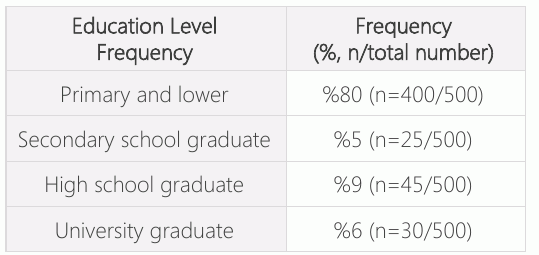
The majority of our cases (87%, n=435/500) consisted of women aged 40-60 years. The mean age was 48.8 years (range, 34.8-70 years). 67% (n=335/500) reported that they had entered menopause. The majority of cases (80%, n=400/500) reported that the education level was primary school graduate or lower (Table-1).
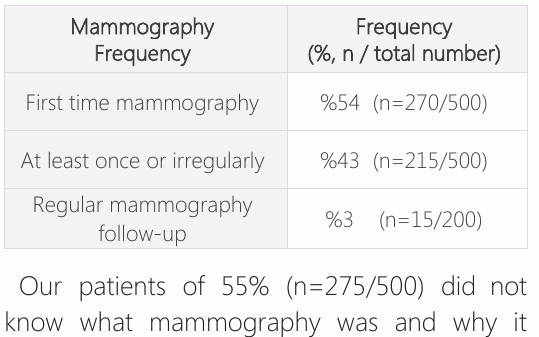
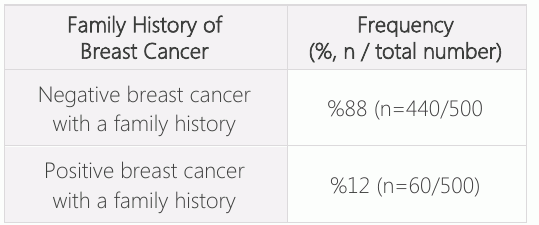
Our cases were found to be 90% (n=450/500) housewife, 7% (n=35/500) were employed in a job, 3%(n=15/500) were retired. In our patients, 54% (n=270/500) had no history of a previous mammography screening,43%(n=215/500) had irregular mammography screening, 3% (n=15/500) had a regular mammography (Table-2). was withdrawn; 45% (n=225/500) did not know enough. Our cases of 53% (n=265/500) stated that they did not perform a self-examination. Our patients of 75% (n: 375/ 500) reported that they did not use cigarettes or alcohol, and the cases of 25% (n: 125/500) reported smoking and 2.2% (n: 11/500) of the cases stated that they used both cigarettes and alcohol. We found that 94% (470/500) of the patients had consulted the doctor for regular or irregular screening mammography and 6% (n: 130/500) of the patients had consulted the physician for a palpable lesion. Our cases of 12% (n: 60/500) had a history of breast cancer in the family (such as mother, sister) (Table-3).
Discussion
Every year, breast cancer causes the death of more than 500,000 women worldwide, and breast cancer accounts for 25% of all cancers in women(1, 13). Breast cancer can be diagnosed early by a mammography. A breast cancer screening has been shown to reduce the incidence of advanced breast cancer (7). Also, breast cancer mortality has been shown to decrease with this method. The sensitivity of mammography to the detection of breast cancer (77-95%) and specificity (94-97%) was determined (14).
The inadequacy of mammography screening programs has led to the diagnosis of women with breast cancer in the late stages, and it has been found that the five-year survival rate falls to the range of 10-40% (15, 16). In 2014, the World Health Organization prepared guidelines for breast cancer, 40-49 age group, 50-69 age group, and 70-74 age group (3). Breast cancer-related mortality has been reported to decrease with mammography screening program and is estimated to be 6% for the 40-49 age group, 28% for the 50-59 age group, 34% for the 60-69 age group and 24% for all groups (10). Screening programs start earlier in women with mother or sister breast cancer (1). Self-examination helps diagnose palpable mass (1). In our study, the majority of our cases 87% (n:435/500) consisted of women between the ages of 40 and 60, and the average age was 48.8 years (range, 34-70 years). The age group of the patients attending our study conforms to the target group determined by the World Health Organization (3). 55% (n:275/500) did not know what mammography was and why it was withdrawn. Our cases of 53% (n:265/500) stated that they did not perform a self-examination. In our patients, 54% (n:270/500) had no previous mammography screening, 43% (n:215/500) had irregular mammography screening, 3%(n:15/500) had a regular graph scan. Coburn et al. (17) achieved a high mammography screening rate in the Rhode Island region and found that regular screening detected smaller and earlier breast cancer. In addition, it has been shown that deaths from breast cancer are decreased by providing more regular follow-up and high reminder rates (18, 19). According to this result, our study showing that screening cannot be performed at appropriate intervals suggests that the possibility of early diagnosis of breast cancer is reduced in our region. In addition, patients' lack of adequate information on mammography screening reduces the likelihood of regular screening. Our patients of 12% (n:60/500) of had a history of breast cancer in the family. Patients with familial or genetic predisposition were found to be 15% to 20% of all breast cancers (20). In women with a high risk of breast cancer, palpation and mammography screening is useful and allows the detection of breast cancer at an early stage when the prognosis is still good (21). Clinical information such as the age of the patient, age of the mammography scan, the presence of late menopause and the presence of palpable mass increase the quality of the evaluation (1) and compare with the previous mammograms. As a result, collecting the epidemiological data of the patient before the mammography examination would benefit the planning of the radiological evaluation, and it was found to contribute to the reporting of mammography. With the increase in the level of education, it is predicted that the habit of regular mammography control will increase. It was thought that this data would be obtained from each mammography center and sent to a more extensive evaluation center would be useful in planning the national screening programs.
Declarations
- Author contributions (CRediT)
- All authors contributed equally to all 14 CRediT roles (Conceptualization, Data curation, Formal analysis, Funding acquisition, Investigation, Methodology, Project administration, Resources, Software, Supervision, Validation, Visualization, Writing – original draft, Writing – review & editing).
- Funding
-
Funding information was not reported in the published version of this article.
- Conflicts of interest
- The author declares no conflict of interest with the present article.
- Ethics approval
- Ethics approval details were not reported in the published version of this article.
- Data availability
- A data availability statement was not reported in the published version of this article.
References (21)
18 of 21 references are linked to their DOI.
- Dahnert W. Radiology Review Manual. 4th ed. Baltimore: Williams and Wilkins, 1999;455-465 PubMed Google Scholar
- Malmgren JA, Parikh J, Atwood MK, Kaplan HG. Impact of mammography detection on the course of breast cancer in women aged 40-49 years. Radiology 2012 Mar;262(3):797- DOI Crossref PubMed Google Scholar
- WHO Position Paper on Mammography Screening Geneva: World Health Organization; 2014. ISBN-13: 978-92-4-150 793-6 PubMed Google Scholar
- Advisory Committee on Breast Cancer Screening. Screening for breast cancer in England: past and future. J Med Screen. 2006;13(2):59-61 DOI Crossref PubMed Google Scholar
- Kurth AE, Krist AH, Borsky AE, Baumann LC, Curry SJ, Davidson KW, Doubeni CA, Epling JW Jr, Fan T, García FAR, Herzstein J, Phillips WR, Pignone MP, Tseng CW, Weinstein R. U.S. Preventive Services Task Force Methods to Communicate and Disseminate Clinical Preventive Services Recommendations. Am J Prev Med. 2018 Jan;54(1S1):S81-87 DOI Crossref PubMed Google Scholar
- Haukka J, Byrnes G, Boniol M, Autier P. Trends in breast cancer mortality in Sweden before and after implementation of mammography screening. PLoS One. 2011;6(9):e22422. DOI Crossref PubMed Google Scholar
- Autier P, Héry C, Haukka J, Boniol M, Byrnes G. Advanced breast cancer and breast cancer mortality in randomized controlled trials on mammography screening. J Clin Oncol. 2009 Dec 10;27(35):5919-23 DOI Crossref PubMed Google Scholar
- Bennett RL, Blanks RG, Patnick J, Moss SM. Results from the UK NHS Breast Screening Programme 2000-05. J Med Screen. 2007;14(4):200-204 DOI Crossref PubMed Google Scholar
- Hendrick RE, Smith RA, Rutledge JH 3rd, Smart CR. Benefit of screening mammography in women aged 40-49: a new meta-analysis of randomized controlled trials. J Natl Cancer Inst Monogr. 1997;(22):87-92 DOI Crossref PubMed Google Scholar
- Fletcher SW, Black W, Harris R, Rimer BK, Shapiro S. J. Report of the International Workshop on Screening for Breast Cancer. Natl Cancer Inst. 1993; Oct 20;85(20):1644-56 DOI Crossref PubMed Google Scholar
- Tabár L, Vitak B, Chen TH, Yen AM, Cohen A, Tot T, Chiu SY, Chen SL, Fann JC, Rosell J, Fohlin H, Smith RA, Duffy SW. Swedish two-county trial: impact of mammographic screening on breast cancer mortality during 3 decades. Radiology. 2011, 260: 658 -663 DOI Crossref PubMed Google Scholar
- Kopans DB. Do not jump too quickly to conclusions. Breast Cancer Res. 2012;14(4):108 DOI Crossref PubMed Google Scholar
- Day NE. The NHS breast cancer screening programme. Br J Cancer. 2003 Jul 7;89(1):1 DOI Crossref PubMed Google Scholar
- Harding C, Pompei F, Burmistrov D, Welch HG, Abebe R, Wilson R. Breast Cancer Screening, Incidence, and Mortality Across US Counties. JAMA Intern Med. 2015 Sep;175(9):1483-9 DOI Crossref PubMed Google Scholar
- Karimi P, Shahrokni A, Moradi S. Evidence for U.S. Preventive Services Task Force (USPSTF) recommendations against routine mammography for females between 40-49 years of age. Asian Pac J Cancer Prev. 2013;14(3):2137-9 DOI Crossref PubMed Google Scholar
- Sankaranarayanan R, Ramadas K, Thara S, Muwonge R, Prabhakar J, Augustine P, Venugopal M, Anju G, Mathew BS. Clinical breast examination: preliminary results from a cluster randomized controlled trial in India. J Natl Cancer Inst. 2011 Oct 5;103(19):1476-80 DOI Crossref PubMed Google Scholar
- Coburn NG, Chung MA, Fulton J, Cady B. Decreased breast cancer tumor size, stage, and mortality in Rhode Island: an example of a well-screened population. Cancer Control. 2004 Jul-Aug;11(4):222-30 DOI Crossref PubMed Google Scholar
- Kopans DB: Beyond randomized, controlled trials: organized mammographic screening substantially reduces breast cancer mortality. Cancer. 2002, 94: 580 -581 DOI Crossref PubMed Google Scholar
- Autier P, Boniol M, Gavin A, Vatten LJ: Breast cancer mortality in neighbouring European countries with different levels of screening but similar access to treatment: trend analysis of WHO mortality database. BMJ. 2011, 343: d4411 DOI Crossref PubMed Google Scholar
- Haber G, Ahmed N.U, Pekovic V. Family History of Cancer and Its Association With Breast Cancer Risk Perception and Repeat Mammography. Am J Public Health. 2012 Dec; 102(12): 2322– 2329 DOI Crossref PubMed Google Scholar
- Tilanus-Linthorst MM, Bartels CC, Obdeijn AI, Kuenen-Boumeester V, Klijn JG, Oudkerk M. Good results in periodic screening in women with increased risk of breast cancer; retrospective study. Ned Tijdschr Gene eskd. 1995 Mar 4;139(9):445-9 PubMed Google Scholar
Respond to this article
Comments on a published article are welcome as a Letter to the Editor.
Get an e-mail when new articles in your fields are published
Read the full text
Open the PDF here
Loading the PDF…
If the PDF does not show here, use the download button above.
How to cite this article
Döğen ME. The Collection of Epidemiological Data of the Women Undergoing Mammography in Suburban Area of Mersin. Ulutas Med J. 2019;5(2):155-159. doi:10.5455/umj.20190318070023
Döğen, M. E. (2019). The Collection of Epidemiological Data of the Women Undergoing Mammography in Suburban Area of Mersin. The Ulutas Medical Journal, 5(2), 155–159. https://doi.org/10.5455/umj.20190318070023
Döğen, M.E. (2019) 'The Collection of Epidemiological Data of the Women Undergoing Mammography in Suburban Area of Mersin', The Ulutas Medical Journal, 5(2), pp. 155–159. doi: 10.5455/umj.20190318070023.