The Ulutas Medical Journal · ISSN 2149-0430 (print), 2149-388X (online) · https://www.ulutasmedicaljournal.com/?mno=27508
Original Article · Open access
The Effect of Delivery Mode on the Female Sexual Function Index
- Department of Obstetrics and Gynecology, Ahi Evran University, Faculty of Medicine, Kirsehir, Turkey ROR
- Department of Obstetrics and Gynecology, Ahi Evran University, Faculty of Medicine, Kırşehir, Turkey ROR
Abstract
- Background
- Sexual function is one of the parameters affecting female life and life quality. We aimed to examine the effect of delivery mode on female sexual functions.
- Materials and methods
- Female sexual function index scoring questionnaire (FSFI) was translated to Turkish and conducted on 184 volunteer sexually active women aged 18 - 49 years between June 2017 and January 2018 and their results were analyzed. Women included in the study were divided into three groups as only the vaginal delivery group, only cesarean delivery group, and both vaginal and cesarean delivery group. Women included in the study were divided into three groups 1 as only the vaginal delivery group, group 2 only cesarean delivery group, and group 3 both vaginal and cesarean delivery group.
- Results
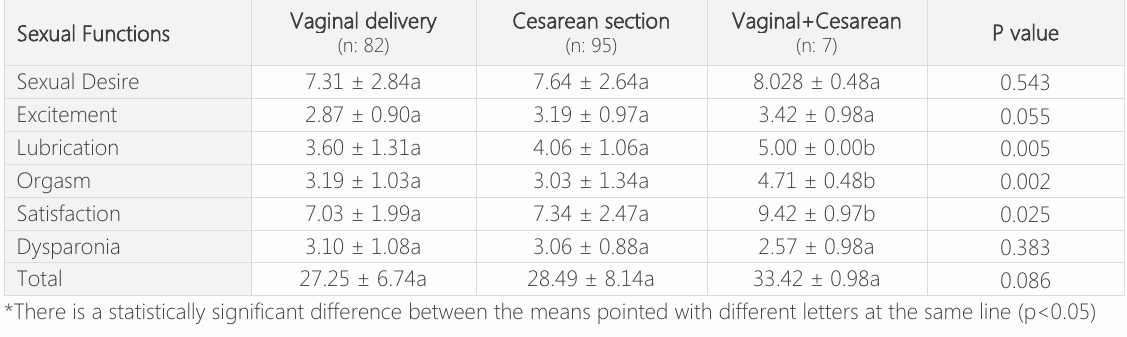
- Total FSFI scores were significantly higher in group 3. There was no significant difference between the vaginal delivery group and cesarean delivery group. Lubrication (5±0, p=0.005), orgasm (4.71±0.48, p=0.002), satisfaction (9.42±0.97, p=0.025) were significantly higher in group 3. There was no significant difference between total scores the group 1, group 2, and group 3.
- Conclusion
- Sexual functions are affected by factors such as hormones, socioeconomic status, and psychological factors. Mode of delivery does not have a significant effect on FSFI in the long term.
Keywords
Full text
Introduction
Sexual function is one of the parameters affecting female life and life quality. Sexual dysfunction has been studied mostly on males. Lauman et al. recorded the incidence of sexual dysfunction in males as 31 % and females as 43% (1). Sexual functions may be deteriorated at one or more of the levels of sexual desire, excitement, lubricity, orgasm, satiety and pain and discomfort may arise during a sexual intercourse. Sexual functions are affected by many physical, psychological and social factors. Some metabolic syndromes, chronic diseases, obesity, presence of male sexual dysfunction, age, psychological stress, menopause, urinary incontinence, may increase the possibility of female sexual dysfunction(2). One of the factors associated with sexual functions is the mode of delivery. Many parameters such as mode of delivery, number of episiotomies, the interval between deliveries are included in the research topics of former studies assessing sexual function. In this study, we aimed to examine if the mode of delivery is effective in sexual functions.
Materials and Methods
Between June 2017 and January 2018, 184 volunteer women aged 18-49 years were included in the study. Women who labored at least six months ago and who did not have any systemic diseases were included.
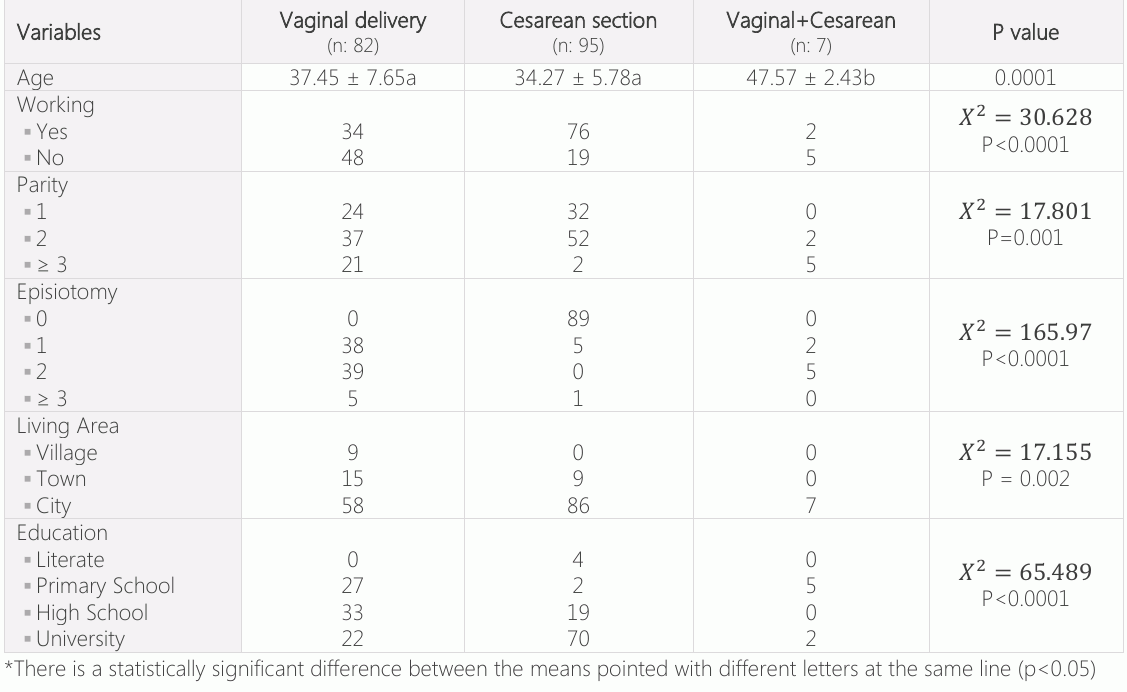
Women who were lactating or using medications for any systemic or psychiatric illness, menopausal, nulliparous, had genital system operation except cesarean were excluded from the study. The study was conducted after approval from the Ethics Committee of Ahi Evran University Faculty of Medicine was obtained (No: 2017-09/86). Women were divided into three groups as Group 1 who delivered vaginally, Group 2 who delivered by cesarean and Group 3 who delivered with both cesarean and vaginal birth. Demographic variables were recorded. Female sexual function index scoring questionnaire (FSFI) used by Rosen et al. was translated into Turkish and adapted for Turkish women and used in the study (3, 4). This form was designed to evaluate sexual desire, excitement, lubricity, orgasm, satiety, and dyspareunia. Sexual functions at last four weeks were evaluated and rated between 4 and 43. The distribution of data was analyzed by Kolmogorov-Smirnov and Shapiro Wilk tests. Descriptive statistics of continuous variables were expressed as a mean ± standard deviation. Chi-square test was used for analysis of categorical variables. The effect of mode of delivery on age, sexual desire, excitement, lubricity, orgasm, dyspareunia and satiety on the total FSFI score was analyzed by ANOVA test. Statistically different means determined by ANOVA were analyzed by DUNCAN multiple comparison and lettered. α significance level was accepted as 0.05. Statistical Package for Social Sciences (SPSS) version 21 Software for Windows program was used for statistical analysis.
Results
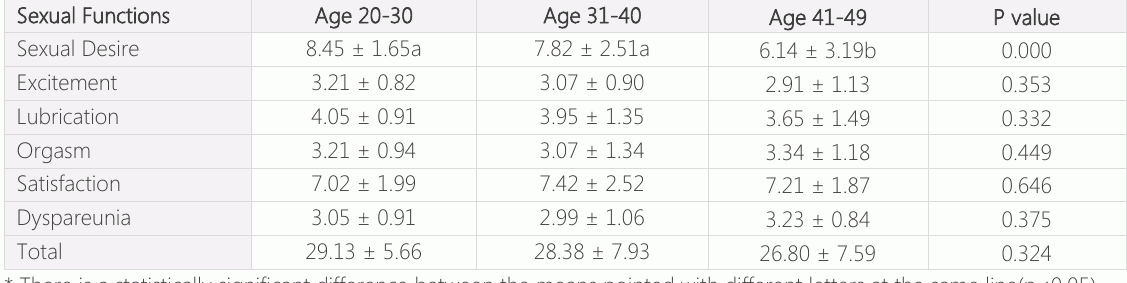
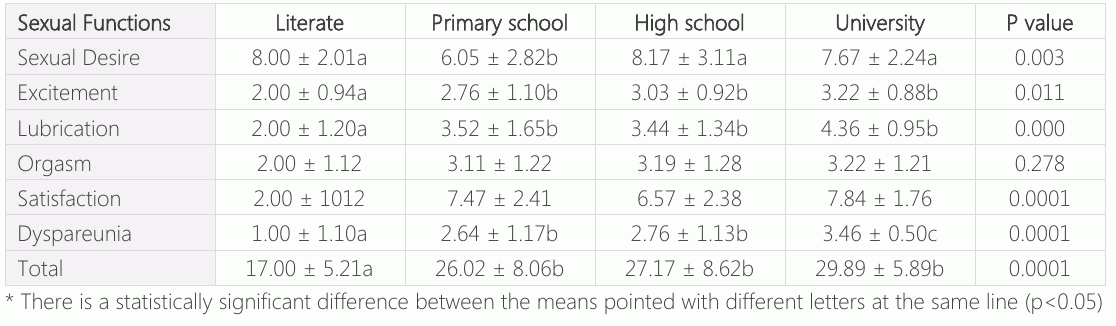
Demographic variables are shown in Table-1. The comparison of sexual functions according to the mode of delivery is presented in Table-2. There was no statistically significant difference between the groups in total FSFI scores. Lubrication, orgasm, satisfaction scores were significantly higher in group 3. The variation of FSFI according to age is presented in Table-3. In terms of total FSFI scores, there was no correlation between FSFI score and age. Sexual desire scores were significantly low at ages between 41 and 49 (6.14±3.19, p<0.0001). Variation of FSFI according to educational status is shown in Table-4. The total FSFI score of the literate group was significantly lower (p<0.0001). As the educational status advances FSFI increases, although it is not statistically significant. There was no significant difference between the groups only in terms of orgasm scores (p=0.278).
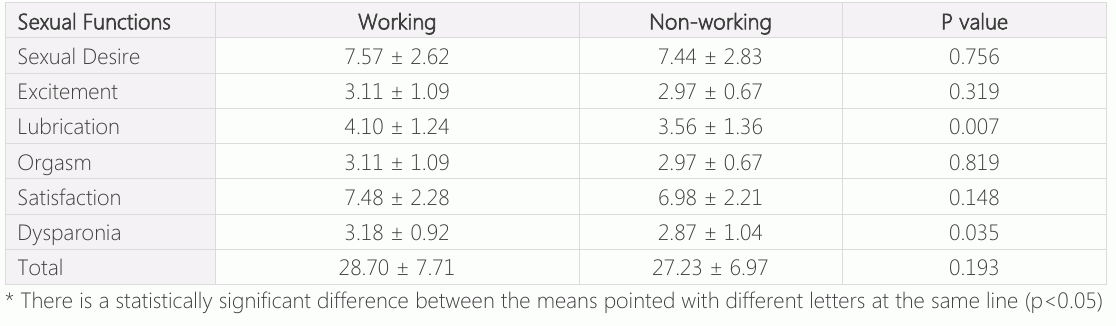
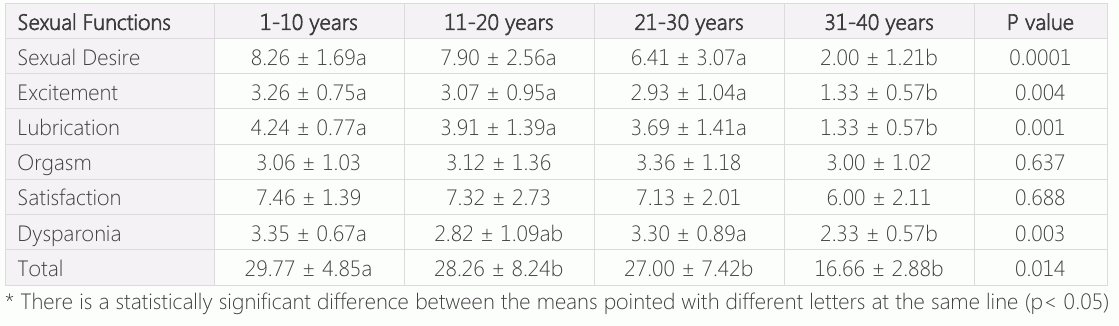
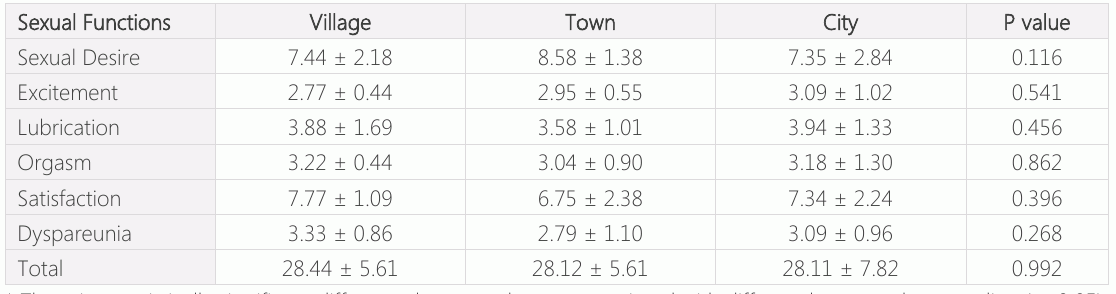
Variation of FSFI according to working status is presented in Table-5. There was no significant difference in total FSFI scores between working and nonworking women (p=0.193). Variation of FSFI according to marital status is shown in Table-6. As the duration of marriage increases FSFI scores decreases significantly (p=0.014). FSFI scores of women in the first decade of marriage were significantly higher. Variation of FSFI according to the living area is presented in Table-7. There was no effect of living area on FSFI scores (p=0.992).
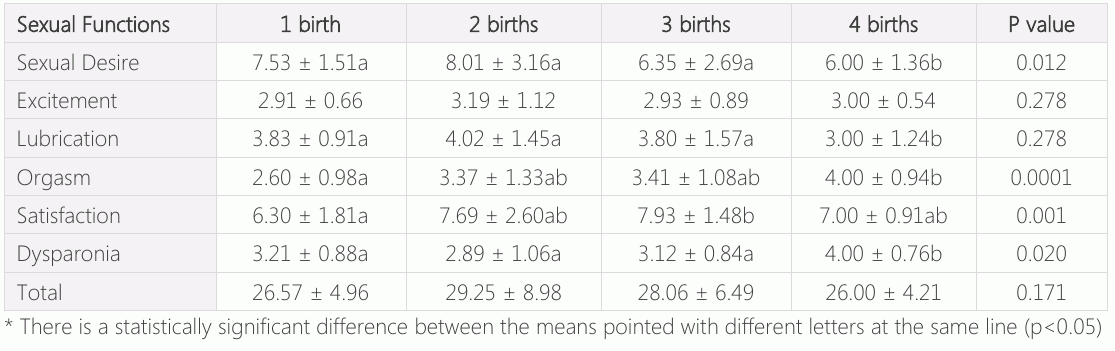
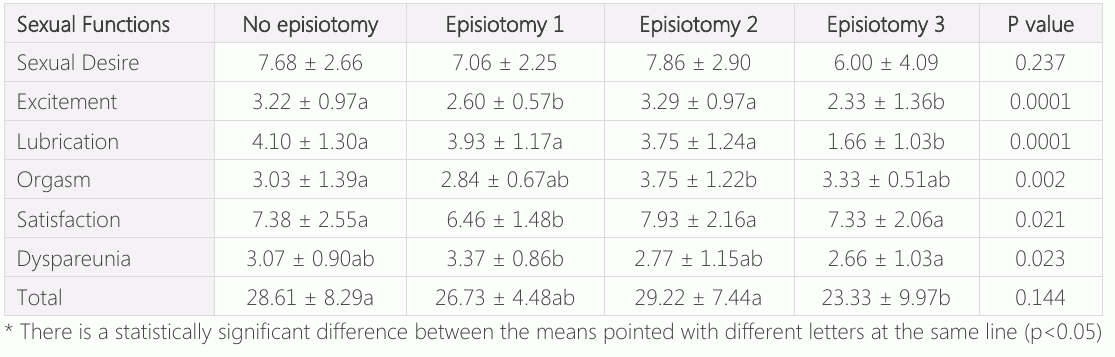
Variation of FSFI according to a number of births is presented in Table-8. There was no effect of a number of birth on FSFI total scores (p=0.171). The sexual desire scores of women with 4 births were significantly lower (p=0.012). Variation of FSFI according to episiotomies is presented in Table-9 (at most one episiotomy was performed for each delivery). There was no statistically significant difference in total FSFI scores between the groups (p=0.144). There was a significant difference in the excitement, lubrication, orgasm scores between the groups. The excitement scores of women who have no episiotomy or 2 episiotomies were significantly higher (p<0.0001). The lubrication scores of women with 3 episiotomies were significantly lower (p<0.000). The orgasm scores of women with two episiotomies were significantly higher (p<0.002).
Discussion
Sexual functions are affected by many factors such as hormones, socioeconomic status, and psychological factors. In the study, we examined the effect of mode of delivery on sexual functions in long-term. It is assumed that the pelvic floor may be damaged due to delivery, especially after vaginal births some problems like dyspareunia may arise and this is less possible after cesarean delivery (5).
Signorello et al. concluded that operative vaginal births increase dyspareunia at 3 and six-month periods after birth (6). Suntara et al. reported that sexual function disorder prevalence during the first three months of the postpartum period was 52% for vaginal delivery, 34% for cesarean delivery (7). Güngör et al. examined the primiparous women who delivered at least one year ago and found that women who delivered with cesarean had higher FSFI and lower prevalence of sexual function disorders than women who delivered vaginally with episiotomy (8). We examined women who delivered at least six months ago and concluded that the mode of delivery did not affect the FSFI score in the long term. There are conflicting results of researches evaluating the postpartum six months or later period. Buhring et al. found no difference between vaginal birth and cesarean in terms of dyspareunia whereas Safarinejad et al. found higher FSGI scores in an elective cesarean group than the vaginal birth group (9, 10). We composed a third group different from the literature that is our third group, women who delivered with both vaginally and cesarean. In this group, the lubrication, orgasm and satisfaction scores were significantly higher. The mean age of this group was 47.5±2.43, and this was significantly higher than the other groups. The difference may be due to experience and harmony between partners rather than a mode of delivery. The number of women in the third group was low, so it is necessary to make researches with ahigher number of participants. There was no significant difference in FSFI scores between groups according to age. Only sexual desire score was significantly low at ages between 41 and 49. Laumann et al. concluded that older ages had adverse effects on FSFI (1). Whereas Güvel et al. recorded that age did not affect FSFI scores (11). Our upper limit for age was 49, so there was no correlation between age and FSFI. The total FSFI score of the literate group was significantly lower (p<0.0001). As educational status advances FSFI increases, although it is not statistically significant. There was no significant difference between the groups regarding orgasm scores (p=0.278). Güvel et al. recorded that duration of marriage was a negative risk factor whereas Çayan et al. didn’t accept it like that (11, 12). We found that as the duration of marriage increases FSFI scores decrease. Klein et al. concluded that the median episiotomy detoriated sexual function (13). We found that existence and number of episiotomy do not effect FSFI scores.
In conclusion, our study shows that the mode of delivery does not affect FSFI scores in the long term.
Declarations
- Author contributions (CRediT)
- All authors contributed equally to all 14 CRediT roles (Conceptualization, Data curation, Formal analysis, Funding acquisition, Investigation, Methodology, Project administration, Resources, Software, Supervision, Validation, Visualization, Writing – original draft, Writing – review & editing).
- Funding
-
Funding information was not reported in the published version of this article.
- Conflicts of interest
- The authors declared no conflict of interest with the present article.
- Ethics approval
- The study was conducted after approval from the Ethics Committee of Ahi Evran University Faculty of Medicine was obtained (No: 2017-09/86).
- Data availability
- A data availability statement was not reported in the published version of this article.
References (13)
11 of 13 references are linked to their DOI.
- Laumann EO, Paik A and Rosen RC. Sexual dysfunction in the United States: prevalence and predictors. Jama 1999; 281: 537-544 DOI Crossref PubMed Google Scholar
- Veronelli A, Mauri C, Zecchini B, Peca MG, Turri O, Valitutti MT, Dall'Asta C and Pontiroli AE. Sexual dysfunction is frequent in premenopausal women with diabetes, obesity, and hypothyroidism, and correlates with markers of increased cardiovascular risk. A preliminary report. The journal of sexual medicine 2009; 6: 1561-1568 DOI Crossref PubMed Google Scholar
- Rosen CB, J. Heiman, S. Leiblum, C. Meston, R. Shabsigh, D. Ferguson, R. D'Agostino, R. The Female Sexual Function Index (FSFI): a multidimensional self-report instrument for the assessment of female sexual function. Journal of Sex &Marital Therapy 2000; 26: 191-208 DOI Crossref PubMed Google Scholar
- Oksuz E and Malhan S. Kadin cinsel fonksiyon indeksi. Sendrom 2005; 7: 54-59 PubMed Google Scholar
- Song M, Ishii H, Toda M, Tomimatsu T, Katsuyama H, Nakamura T, Nakai Y and Shimoya K. Association between sexual health and delivery mode. Sexual medicine 2014; 2: 153-158 Delivery Mode and Sexual Function Dagli et al. DOI Crossref PubMed Google Scholar
- Signorello LB, Harlow BL, Chekos AK and Repke JT. Postpartum sexual functioning and its relationship to perineal trauma: a retrospective cohort study of primiparous women. American Journal of Obstetrics & Gynecology 2001; 184: 881-890 DOI Crossref PubMed Google Scholar
- Suntoro S and Kayika IPG. Female Sexual Function at Three Months Post-delivery in Spontaneous Labor and Cesarean Section. Indonesian Journal of Obstetrics and Gynecology (INAJOG) 2016 DOI Crossref PubMed Google Scholar
- Gungor S, Baser I, Ceyhan S, Karasahin E and Acikel C. Mode of delivery and subsequent long-term sexual function of primiparous women. International journal of impotence research 2007; 19: 358 DOI Crossref PubMed Google Scholar
- Buhling KJ, Schmidt S, Robinson JN, Klapp C, Siebert G and Dudenhausen JW. Rate of dyspareunia after delivery in primiparae according to mode of delivery. European journal of obstetrics and gynecology and reproductive biology 2006; 124: 42-46 DOI Crossref PubMed Google Scholar
- Safarinejad MR, Azma K and Kolahi AA. The effects of intensive, long- term treadmill running on reproductive hormones, hypothalamus–pituitary–testis axis, and semen quality: a randomized controlled study. Journal of Endocrinology 2009; 200: 259-271 DOI Crossref PubMed Google Scholar
- Güvel S, Yaycioğlu Ö, Bağiş T, Savaş N, Bulgan E and Özkardeş H. Evli kadinlarda cinsel fonksiyonlara etkin faktörler. Turkish J Urology 2003; 29: 43-48 PubMed Google Scholar
- Çayan S, Akbay E, Bozlu M, Canpolat B, Acar D and Ulusoy E. The prevalence of female sexual dysfunction and potential risk factors that may impair sexual function in Turkish women. Urologia internationalis 2004; 72: 52-57 DOI Crossref PubMed Google Scholar
- Klein MC, Gauthier RJ, Robbins JM, Kaczorowski J, Jorgensen SH, Franco ED, Johnson B, Waghorn K, Gelfand MM and Guralnick MS. Relationship of episiotomy to perineal trauma and morbidity, sexual dysfunction, and pelvic floor relaxation. American Journal of Obstetrics & Gynecology 1994; 171: 591-598 DOI Crossref PubMed Google Scholar
Respond to this article
Comments on a published article are welcome as a Letter to the Editor.
Get an e-mail when new articles in your fields are published
Read the full text
Open the PDF here
Loading the PDF…
If the PDF does not show here, use the download button above.
How to cite this article
Dagli SS, Canturk FK. The Effect of Delivery Mode on the Female Sexual Function Index. Ulutas Med J. 2019;5(1):7-13. doi:10.5455/umj.20190122071414
Dagli, S. S., & Canturk, F. K. (2019). The Effect of Delivery Mode on the Female Sexual Function Index. The Ulutas Medical Journal, 5(1), 7–13. https://doi.org/10.5455/umj.20190122071414
Dagli, S.S. and Canturk, F.K. (2019) 'The Effect of Delivery Mode on the Female Sexual Function Index', The Ulutas Medical Journal, 5(1), pp. 7–13. doi: 10.5455/umj.20190122071414.