The Ulutas Medical Journal · ISSN 2149-0430 (print), 2149-388X (online) · https://www.ulutasmedicaljournal.com/?mno=16646
Case Report · Open access
Splenic Infarction Due to Sickle Cell Trait while Visiting a Hill Station
- Department of Internal medicine, Iqraa international hospital and research centre, Calicut, Kerala, India.
- Department of Radiology, Iqraa international hospital and research centre, Calicut, Kerala, India.
- Department of Pathology, Iqraa international hospital and research centre, Calicut, Kerala, India.
- Department of Psychiatry, Iqraa International Hospital and Research Centre, Calicut.
Abstract
- Background
- Sickle-cell trait (SCT) is a common genetic abnormality in the Indian population. Though SCT is largely a benign disorder, it can rarely present with complications such as splenic infarction.
- Case Presentation
- Here, we report the case of a 27-year-old Muslim male developed acute left upper quadrant abdominal pain and constipation while visiting a hill station, Ooty (Tamil Nadu, India). The patient had a history of similar complaint while visiting the same hill station while he was a student and was hospitalized and treated as acute gastritis. He also gave a history of abdominal pain while traveling in the airplane to Qatar where he works.
- Conclusion
- Our patient had multiple episodes of abdominal pain while flying and visiting hill station, but the diagnosis of SCT was not suspected probably due to the above reasons. However, it is very important to evaluate patients with recurrent abdominal pain in higher altitudes for SCT as it can result in its early diagnosis of splenic infarction and timely initiation of appropriate management, which can lead to good prognosis.
Keywords
Full text
Introduction
Sickle cell disease (SCD) is an autosomal recessive blood condition that is most common among people of African, Arabian and Indian origin (1). Sickle-cell trait (SCT) is heterozygous form of the disease, which is mostly a benign disorder. However, SCT has been occasionally associated with several complications such as renal medullary cancer, splenic infarction, renal papillary necrosis, hematuria, exertional rhabdomyolysis,exercise-related sudden death, venous thromboembolism, stroke, priapism and osteonecrosis (2, 3). Studies have shown that patients with SCT have a higher risk for splenic infarction, especially when exposed to high altitude (4).
In India, SCD is seen mainly in the tribal belts of central India (5). In this case report, we describe a healthy non-tribal Muslim young male from Southern India with sickle cell trait and no co-morbid risk factors who developed splenic infarction spontaneously while visiting a hill station.
Case Presentation
A 27-year-old Muslim male developed acute left upper quadrant abdominal pain and constipation while visiting a hill station, Ooty (Tamil Nadu, India). He also had a fever two days back. He was hospitalized in a local hospital and treated as acute gastritis. The investigations have done there are unavailable. He presented to our hospital after two days with continued severe abdominal pain. He had no other known co-morbid medical illness. The patient had a history of similar complaint while visiting the same hill station while he was a student and was hospitalized and treated as acute gastritis. He also gave a history of abdominal pain while traveling in the airplane to Qatar where he works. There was no history of any substance abuse. There was no family history of any significant medical or surgical illness. On examination, his vitals were normal. There was mild diffuse tenderness in the left upper quadrant of the abdomen. His blood investigations revealed leukocytosis with neutrophil predominance (85%), elevated C reactive protein and ESR. Ultrasonography of abdomen found hepatomegaly with grade one fatty liver and splenomegaly with a predominantly hypoechoic spleen. A contrast-enhanced CT of the abdomen and pelvis showed splenic infarct involving approximately 90% of the parenchyma (see figure-1).
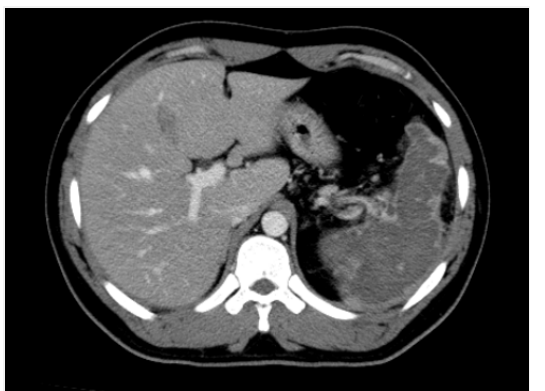
Hb electrophoresis showed 39.3% HbS along with 51.2% normal Hb. His Hb was normal, and the sickling test was positive. Considering the clinical picture and investigation findings, he was diagnosed as acute splenic infarction with sickle cell traits. He was managed with intravenous antibiotics, proton pump inhibitors, laxatives, antiemetics, intravenous fluids and other supportive measures. His 48 hours of blood culture and sensitivity was sterile. Patient symptomatically improved with the above treatment and discharged the following day.
Discussion
Sickle Cell Trait occurs in approximately 300 million people worldwide (6). The 20 million people of India are known to suffer from sickle cell disease and is seen mainly in the tribal belts of central India (5). SCD is also commonly found among the tribal population of Southern India, and clinical experience suggests its existence among other populations including Muslims (7). However, there are no systematic attempts to study SCD/SCT prevalence among non-tribal populations in South India. Our patient belongs to the non-tribal Muslim population of South India. From the history available, he might have had multiple episodes of splenic infarction, which went undetected probably due to the lack of clinical suspicion.
A typical adult hemoglobin consists of a combination of 2-globin protein chains with 2- globin chains and heme. Whereas, the SCT is characterized by the inheritance of a normal hemoglobin gene (HbA) from one parent and an abnormal mutated beta-globin gene, the sickle hemoglobin gene (HbS), from the other parent (8). Unlike SCD, increased red cell sickling and polymerization only happens in SCT under severe tissue hypoxia, increased viscosity, dehydration or acidosis, and severity is proportional to the HbS concentration. In higher altitude, the alveolar partial pressure of oxygen (pO2) can drop significantly resulting in polymerization and deformability of the HbS molecule resulting in sickling, which clinically manifests as vasoocclusive, sequestration, hemolytic, and aplastic crises (9).
While splenic infarction is more commonly seen in patients with SCA, there are few case reports of splenic infarcts in SCT patients, mainly in adults exposed to high altitudes, usually 10,000 feet (about 3,000 m), with or without vigorous exercise (4). Morishima et al. described the case of a 41-year-old African American female with a history of alcoholism who developed splenic infarction after climbing Mt. Fuji due to SCT (4). Abeysekera et al. described a similar case of a Sri Lankan male with undetected sickle cell trait who presented with acute massive splenic infarction with splenic vein thrombosis following altitude exposure (10). Gupta et al. described the case of a young Indian 21-year-old male who developed splenic infarction while climbing (for the first time) at Nanda devi, Garhwal Himalayas (Uttarakhand), with an altitude of 5025m above sea level due to undetected SCT (11).
There are reports of splenic infarction in patients with SCT at relatively lower altitudes also. A past study by Seegars and Brett reported the case of an 18-year-old woman with sickle cell trait with no other co-morbid risk factors for hypoxemia or vascular injury, who had developed splenic infarction while residing near sea level (2). The authors also reviewed the past literature and found 12 previously published cases of low-altitude splenic infarction in patients with sickle trait; out of which seven had comorbidities such as abuse of illicit drugs, pulmonary disease with hypoxemia, surgery adjacent to spleen, other hematologic disorders and infection causing splenic enlargement that likely predisposed to splenic infarction (2). Our patient visited Ooty, a hill station that is situated amidst the Nilgiri hills at an altitude of 2,240 meters above sea level in the South Indian state of Tamil Nadu and developed splenic infarction while having no other co-morbid risk factors for hypoxemia or vascular injury.
A case of SCT with splenic infarction with abdominal pain can be a clinically confusing situation as it is usually self-limiting and clinically indistinguishable from other intra-abdominal conditions. Our patient had multiple episodes of abdominal pain while flying and visiting hill station, but the diagnosis of SCT was not suspected probably due to the above reasons. However, it is essential to evaluate patients with recurrent abdominal pain in higher altitudes for SCT as it can result in its early diagnosis of splenic infarction and timely initiation of appropriate management, which can lead to good prognosis.
Declarations
- Author contributions (CRediT)
- All authors contributed equally to all 14 CRediT roles (Conceptualization, Data curation, Formal analysis, Funding acquisition, Investigation, Methodology, Project administration, Resources, Software, Supervision, Validation, Visualization, Writing – original draft, Writing – review & editing).
- Funding
-
Funding information was not reported in the published version of this article.
- Conflicts of interest
- The authors declared no conflict of interest with the present article.
- Ethics approval
- Ethics approval details were not reported in the published version of this article.
- Data availability
- A data availability statement was not reported in the published version of this article.
References (11)
8 of 11 references are linked to their DOI.
- Serjeant GR, Ghosh K, Patel J. Sickle cell disease in India: A perspective. Indian J Med Res 2016;143(1):21-4 DOI Crossref PubMed Google Scholar
- Seegars MB, Brett AS. Splenic infarction associated with sickle cell trait at low altitude. Hematology 2015;20(10):607-9 DOI Crossref PubMed Google Scholar
- Tsaras G, Owusu-Ansah A, Boateng FO, Amoateng-Adjepong Y. Complications Associated with Sickle Cell Trait: A Brief Narrative Review. Am J Med 2009;122(6):507 -512 DOI Crossref PubMed Google Scholar
- Morishima A, Schofer JM, Pelletier P, McKee JM. Images in emergency medicine: splenic infarction due to sickle cell trait after climbing mt. Fuji. West J Emerg Med 2008;9(3):179 PubMed Google Scholar
- Kar B, Satapathy RK, Kulozik AE, Kulozik M, Sir S, Serjeant BE, et al. Sickle Cell Disease in Orissa state, India. Lancet 1986;2:1198-201 DOI Crossref PubMed Google Scholar
- World Health Organization. Sickle cell anemia. Report by the secretariat. 59th World Health, Assembly, 2006 PubMed Google Scholar
- Colah R, Mukherjee M, Ghosh K. Sickle cell disease in India. Curr Opin Hematol 2014;21:215–23 DOI Crossref PubMed Google Scholar
- Ashley-Koch A, Yang Q, Olney RS. Sickle hemoglobin (HbS) allele and sickle cell disease: a HUGE Review. Am J Epidemiol 2000;151: 839-845 DOI Crossref PubMed Google Scholar
- Harkness DR. Sickle cell trait revisited. Am J Med 1989;87: 30N–4N PubMed Google Scholar
- Abeysekera WY, de Silva WD, Pinnaduwa SS, Banagala AS. Acute massive splenic infarction with splenic vein thrombosis following altitude exposure of a Sri Lankan male with undetected sickle cell trait. High Alt Med Biol 2012;13(4):288-90. doi: 10.1089/ham.2012.1038 DOI Crossref PubMed Google Scholar
- Gupta M, Lehl SS, Singh K, Singh R. Acute splenic infarction in a hiker with previously unrecognised sickle cell trait. BMJ Case Rep 2013;2013:bcr2013008931 DOI Crossref PubMed Google Scholar
Read the full text
Open the PDF here
Loading the PDF…
If the PDF does not show here, use the download button above.
How to cite this article
Moideen S, Manoj PB, Hameed S, Khader A, Uvais N. Splenic Infarction Due to Sickle Cell Trait while Visiting a Hill Station. Ulutas Med J. 2019;5(1):103-106. doi:10.5455/umj.20191111060811
Moideen, S., Manoj, P. B., Hameed, S., Khader, A., & Uvais, N. (2019). Splenic Infarction Due to Sickle Cell Trait while Visiting a Hill Station. The Ulutas Medical Journal, 5(1), 103–106. https://doi.org/10.5455/umj.20191111060811
Moideen, S. et al. (2019) 'Splenic Infarction Due to Sickle Cell Trait while Visiting a Hill Station', The Ulutas Medical Journal, 5(1), pp. 103–106. doi: 10.5455/umj.20191111060811.