The Ulutas Medical Journal · ISSN 2149-0430 (印刷版), 2149-388X (在线版) · https://www.ulutasmedicaljournal.com/?mno=69569
原创论著 · 开放获取
局部内侧形切除术和局部内侧形切除术与治疗慢性肛门裂缝过程中的附加推进性侧形外科的比较
标题、摘要和全文为机器翻译。 英文原文
- General Surgery, Health Ministry Gebze Fatih State Hospital General Surgery Clinic, Kocaeli, Turkey ROR
- General surgery specialist, Health Ministry Gebze Fatih State Hospital General Surgery Clinic, Kocaeli, Turkey ROR
- 开放获取
- CC BY-NC 4.0
- ORCID
- 资助
- 伦理批准
- 数据可用性
摘要
导言:我们的目标是将我们接受过横向内侧切除术和横向内侧切除术的病人的结果与额外的推进性襟翼外膜切除术进行比较。 比较了两种方法的成功率和复杂率。 材料和方法: 我们追溯评估了2015年1月至2018年7月期间接受慢性肛裂手术的患者的病历。 共有123名患者被分为两组,分别是部分Lis+anoplastic(组-I,n:76)和仅部分Lis(组-II,n:47). 记录了年龄,性别,后续时间,肛门检查结果,疼痛,出血,便秘分数,患者满意度分数,休息或凳子时的VAS疼痛分数,以及患者的复发和凝血率. 结果:包括61名男性(49.59%)和62名女性(50.41%),共计123名病人。 患者的平均年龄为42,87±11,69岁. 运营时间为28,50±11,61分钟. 住院时间为1,50±0,70天。 平均后续时间为24±10个月。 在第二组患者中(15.22%),复发率高于第一组。 同样,第二组的出血率(10.87%)、疼痛率(13.04%)和不适率(15.22%)高于第一组。 在乙级联赛中,出血,便秘分数,VAS凳子和休息分数较高,而在甲级联赛中则发现满意分数较高. 两组在失禁率方面没有区别. 结论:在局部的内侧切除术中加入推进性襟翼外科手术,通过降低我们的研究和文献中的类似研究的复发率,提高了成功率.
关键词
全文
全文为机器翻译;以英文原文为准。 英文原文
导言
慢性肛裂是凹陷线下无愈合的破伤风性肛门黏膜撕裂 (1)据报道,接受结肠结肠诊疗的病人中有10%是肛门裂缝,20-39岁时更频繁。 (2)通常是由于便秘、腹泻和手术等因素造成的,所有这些都在肛门运河造成创伤。 (3)anoderm的泪水会引发内肛塞的痉挛。 这种痉挛又反过来造成疼痛和更多的眼泪,并减少阿诺德姆的血液供应. 这种疼痛,痉挛和异血症的恶性循环 可能导致非治愈性慢性肛裂 (4)长达四个多星期的纤维往往成为慢性病。 裂缝边缘内的伸缩,底部有内侧丝状纤维,有哨状多肽,或纤维-医院多肽是有利于裂缝慢性的发现. (5)在急性裂缝中,医疗和保守治疗方法可能足以无需手术就治愈;然而,在慢性裂缝中,成功率要低得多。 (3)在被认为是慢性且没有回应医疗疗法外科治疗的病人中,大多数都是必要的。
治疗率为92-100%的横向内切除术被视为金本位 (5)根据外科医生的酌处权和病人的偏好,LIS被描述为开放的、不完整的, (6, 7)此外,还介绍了外科手术方法,如切除术和采用各种方法的推进襟翼。 (8, 9)虽然据报告地雷影响调查的治愈率很高,但该程序最重要的并发症是长期或短暂的失禁和复发(10)局部内侧切除术(尾巴)的描述为失禁程度较低,治愈率相似 (11)在低肛门切除术、子宫切除术和襟翼中,建议采用方法,而不是LIS。 (12)最近,在一些研究中,公布了LIS+flap综合操作的成功率较高和复杂率低的结果(3)这项研究的目的是比较部分切除术和部分切除术的病人的结果,以及额外的推进性侧翼外科。
材料和方法
2015年1月—2018年7月间经肛裂诊断的单一外科医生手术的患者图表经过回顾审查. 出现至少6个月症状的患者或没有响应4周医疗治疗的患者,被认为有慢性肛裂患者,并进行手术. 诊断出Crohn、溃疡性结肠炎的病人和因瘘管病和痔疮等疾病而接受额外手术的病人被排除在研究之外。 审查了病人检查和诊断结果、手术说明和门诊后续报告。 接受部分LIS或部分LIS+止血术的患者被纳入研究范围. 在研究开始时,所有病人都接受了LIS. 在所有后来的病人中进行了LIS+麻醉。 后续期结束后,通过电话邀请所有患者进行门诊控制. 未到门诊就诊的病人被排除在研究之外。 130名前来接受门诊检查的病人被分为两组:部分LIS+anoplastic(第一组,n:76)和部分LIS(第一组,n:47)。 当事人对调查问卷的回答:年龄、性别、后续时间、肛门检查结果、疼痛和出血症状、韦克斯纳便秘分数 (13),病人满意分,VAS凳子,休息疼痛分数,通过使用优异程序记录检查结果. 患者满意度分在1-4分之间:完全不满意,1分;不太满意,2分;满意,3分;非常满意,4. VAS分分为两次:先是蹲床后,然后是休息状态.
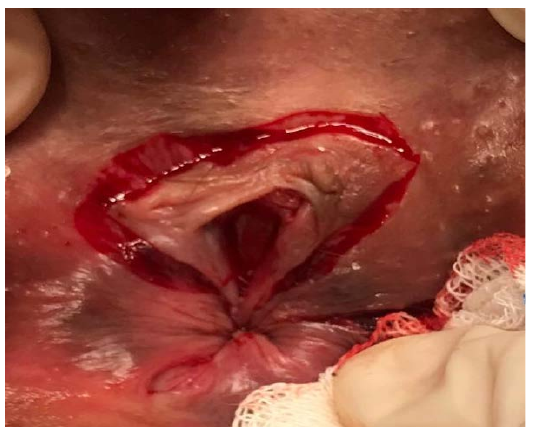
手术前使用了Rectal灌肠. 脊髓麻醉在使用预防抗生素后被应用. 经过适当的清洗,在病人处于易发状态时开始手术. 在第一组中,Sphincter被曝光,75%的Sphincter通过使用cautery设备(开放部分sphincteromy)重新解剖. 手术通过切口完成. 在第二组中,部分切除术后,切除裂道,制备皮肤和黏膜片. 做了Anoplastic(图1).
统计分析采用SPSS版本17.0程序进行. 直方图图形和科尔莫戈罗夫-斯米尔诺夫测试控制了变量与正常分布的一致性. 在进行描述性分析时使用了平均、标准偏差、中位数、最小值和最大值。 通过使用皮尔逊奇-斯夸尔和费舍尔精确测试对分类数据进行了比较. 当组间评估有非正常分布(非参数)的变量时,使用曼·惠特尼U测试. P值 < 0.05被认为具有统计意义。
结果
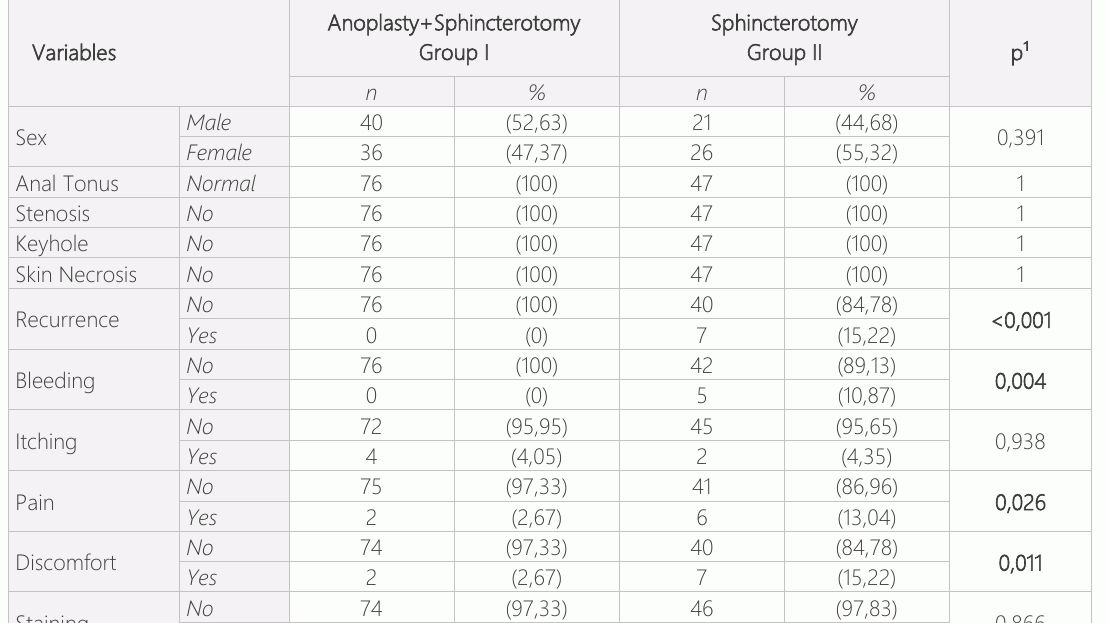
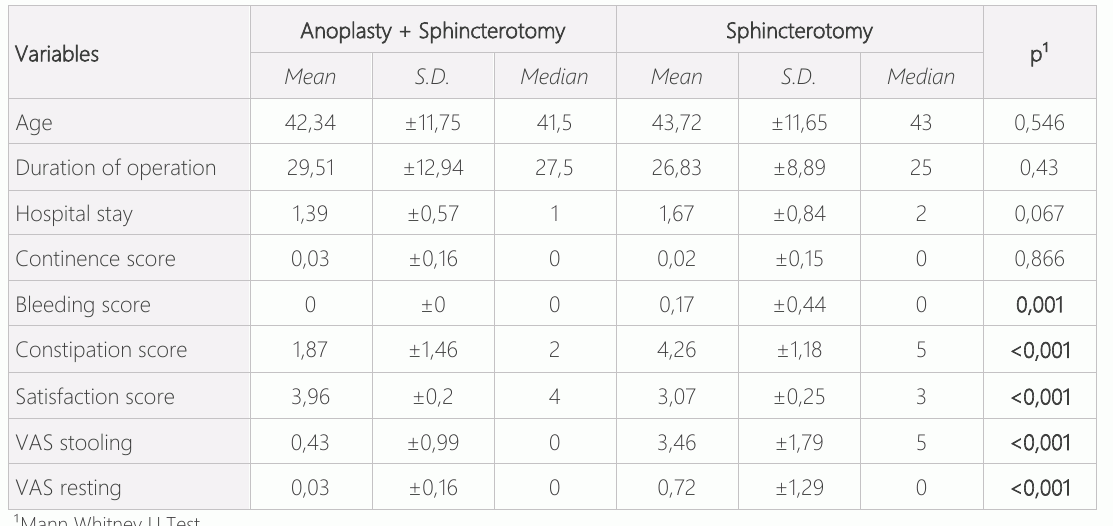
包括61名男性(49.59%)和62名女性(50.41%),共计123名病人。 患者的平均年龄为42,87±11,69岁. 平均运营时间为28,50±11,61分钟。 平均住院时间为1,5±0,7天,后续时间为24±10个月。 患者根据手术分为两类:I组;部分切除术+麻醉术76(61.79%),II组;仅部分切除术47(38.31%). 根据业务类型审查了结果。 因此,手术类型与复发,出血,疼痛和不适之间有着非常重要的关联. 在II组中,复发率(15.22%)高于I组. 同样,第二组的出血(10.87%)、疼痛(13.04%)和不适(15.22%)高于第一组(表1)。 根据手术类型,比较了年龄、手术时间、住院时间、节奏、出血分数和便秘分数、病人满意度、VAS凳子和休息分数。 因此,第二组患者的出血和便秘分数以及VAS的凳子和休息分数较高,第一组患者的患者满意度分数较高(表2)。
讨论情况
外科治疗用于慢性肛裂患者,没有回应医疗治疗. 横向内切除术是外科治疗的首选方法,治愈率在85%-95%之间. 然而,5%的患者报告复发,失禁程度在2-20%之间。(14–16)导致复杂和混乱的问题之一是无法使内侧切除区域和横向切除的等级标准化。 在法鲁克等人的一项研究中,通过内分泌的USG检查了LIS后反复出现的病人。 他们报告了除地雷影响调查等级之外的其他因素,以说明是否再度发生 (17)。 。 。
地雷影响调查的主要缺点是,除了浮肿(气体)、黏液和大便失禁之外,还可能出现腹部骨折和腹部畸形。 (18–23)由于在疾病登记后对病人的病情记录不足,无法检测出确切的失禁等级 (20–23)Lewis等人在17%的病人中发现了失禁症。 (20)这种并发症在三分之二的病人中是短暂的。 Khubchandani和Reed报告,在地雷影响调查后,22%的病人出现污渍,35.1%的病人出现扁平(通过气体)失禁。 (24)Magdy等人报告说,在接受常规地雷影响调查的人群中,失禁率为14%。 (25)在其他系列中,大便失禁率在1.3%至66%之间。 (26–29)。 。 。
采用其他程序,如缺血性推进襟翼(AAP),特别是针对大便失禁风险较高的病人,以防止潜在的螺旋损伤 (30–36)在他们的研究中,Leong等人比较了慢性肛裂中的LIS和AAP. 每组有50名病人随机排列. 所有患者在LIS组手术后都从疾病中恢复过来,而AAP组的2名患者治疗失败. 在地雷影响调查组中观察到中度肛门失禁 (37)在ACPGBI(大不列颠和爱尔兰球菌学协会)中,建议采用AAP准则,治疗有较低刺血压的病人。 威廉·钱伯斯(William Chambers)报道说,V-Y的推进襟翼可以被成功用作第一个选择的治疗方法,不受螺旋压力的影响. (35)。 。 。
从理论上讲,作为一种优势,AAP不会破坏sphincter complex,因此,它可以预防失禁的发展. 对于以前做过手术的病人或妇科并发症的病人来说,这一点特别重要。 只使用AAP的缺点可能是愈合速度较慢和复发风险较高。 将部分切除术添加到AAP中,成功率提高到96%,复发率降低到2%. 在包括150名患者的系列中,Magdy等人将患者分为三组,分别是总的LIS,V-Y进步襟翼和部分的Sphincterotomy+V-Y进步襟翼. 一年后续治疗后的治愈率报告分别为84%、48%、96%,复发率报告分别为4%、22%、2% (25)。 。 。
Hegazi等人将开放性部分切除术加V-Y推进性裂片与开放性切除术进行比较,仅在20名患者中. 在手术后早期(前两周),只有LIS的病人总数中,短暂性气体失禁和短暂性液体失禁的情况被认为极为严重。 然而,在一年的后续工作中,这两个集团没有长期失禁。 此外,伤口愈合的时间较短,部分切除术的疼痛相对较少,加上V-Y型推进襟翼组 (38)。 。 。
Elbalshy等人在一项包括100名患者的远景研究中,将常规通道开放的LIS与KIS+Mucosal推进襟翼结合进行了比较。 在组合组中,据报道,手术后早期疼痛较少,恢复率很快,可以提前恢复正常活动. 两组的失禁率没有差别(2%)(9)在Anaraki等人的研究中,共有30名有健康、高低肛门的病人进行了子宫外切除和V-Y侧翼切除。 无法在任何患者中检测出气体失禁。 复发率为5.9%。 (8)Quassi等人在26名患者中做了肌动推进性动脉动手术,经过两年的跟踪,他们报告说没有发生复发或失禁。(39)。 。 。
在对Sahabally等人的元分析中,利用总共300名患者的集合数据,比较了4项研究的推进襟翼和LIS结果,并审查了结果。 150人中有1人(0.6%)患上高血压,17人(11.3%)患上失禁症。 (12)31名AAP病人(20.6%)和14名LIS病人(9.3%)报告了无愈合裂缝。 (12)在10个(6.6%)和7个(4.6%)地雷影响调查中观察到了伤址并发症 (12)在对文献进行审查时,它观察到使用部分切除术会大大降低失禁率。 在我们的研究中,两组都有切除术。 我们检测到,在2名病人中很少出现气体失禁(Pescori得分1)。 我们得知这些患者有类似的手术前症状,手术后气体失禁没有增加. 两个团体之间的失禁没有差别。 我们发现,我国部分地雷影响调查案件的失禁率符合文献。 根据这些调查结果,我们可以建议,进行部分切除术是两个群体的预防因素。 在文献中,据报告,接受部分LIS手术或只做襟翼手术的病人的失禁率低于总LIS,但复发率较高。 在我们的研究中,与部分LIS+增强膜病患者相比,仅在LIS中群体的复发率更高. 在部分LIS+升级襟翼组中,复发率和失禁率都较低. 在两个组的比较中,出血,疼痛,不适的比例较高,患者在II组中的满意度得分较低. 在这两个群体中,都未观察到肛门激素、钥匙孔和皮肤坏死。
结论
在我们的研究和文献中的其他研究中,在慢性肛裂的外科治疗中,尽管成功率较高,但LIS与高失禁风险直接相关;然而,部分只使用血清切除法可能导致低失禁率,降低治愈率。 我们发现,在我们的研究和文献中的类似研究中,在局部内侧切除术中增加推进性裂片,提高了成功率,降低了失禁率和复发率。 然而,文献中仍然缺乏关于综合操作的研究. 今后进行大规模、多中心研究将有助于更好地澄清这一问题。
声明
- 作者贡献(CRediT)
- 所有作者对全部 14 项 CRediT 角色贡献均等(Conceptualization, Data curation, Formal analysis, Funding acquisition, Investigation, Methodology, Project administration, Resources, Software, Supervision, Validation, Visualization, Writing – original draft, Writing – review & editing)。
- 资助
-
Funding information was not reported in the published version of this article.
- 利益冲突
- The authors have declared no conflict of interest for the present article.
- 伦理批准
- Ethics approval details were not reported in the published version of this article.
- 数据可用性
- A data availability statement was not reported in the published version of this article.
参考文献 (39)
39 条参考文献中有 32 条已链接 DOI。
- Jonas M, Scholefield JH. Anal fissure. Gastroenterology Clinics of North America. 2001;30(1):167-81 PubMed Google Scholar
- Garner J, McFall M, Edwards D. The medical and surgical management of chronic anal fissure. Journal of the Royal Army Medical Corps. 2002;148(3):230-5 DOI Crossref PubMed Google Scholar
- Beaty JS, Shashidharan M. Anal fissure. Clinics in colon and rectal surgery. 2016;29(01):030-7 PubMed Google Scholar
- Smink DS. Schwartz's principles of surgery. Annals of Surgery. 2015;261(5):1026 PubMed Google Scholar
- Poh A, Tan K-Y, Seow-Choen F. Innovations in chronic anal fissure treatment: a systematic review. World journal of gastrointestinal surgery. 2010;2(7):231 DOI Crossref PubMed Google Scholar
- Acar T, Acar N, Güngör F, Kamer E, Güngör H, Candan MS, et al. Treatment of chronic anal fissure: Is open lateral internal sphincterotomy (LIS) a safe and adequate option? Asian journal of surgery. 2018 DOI Crossref PubMed Google Scholar
- Jain BK, Sharma N, Gupta H. Lateral Internal Partial Sphincterotomy Technique for Chronic Anal Fissure: an Avoidable Risk to the Surgeon's Finger. The Indian journal of surgery. 2018;80(2):203 DOI Crossref PubMed Google Scholar
- Anaraki F, Foroughifar T, Laleh SH, Etemad O. Evaluation of outcomes in fissurectomy and V–Y advancement flap for the treatment of chronic anal fissure. Journal of Coloproctology (Rio de Janeiro). 2018;38(2):132-6 DOI Crossref PubMed Google Scholar
- Elbalshy MA, Eldesouky MS. Combined mucosal advancement and lateral internal sphincterotomy in treatment of chronic anal fissure: could be an effective alternative procedure? International Surgery Journal. 2019;6(2):475-81 DOI Crossref PubMed Google Scholar
- Fernandes GOdS, Murad-Regadas SM, Regadas FSP, Rodrigues LV, Dealcanfreitas ID, Pereira JdJR, et al. Clinical, functional and morphologic evaluation of patients undergoing lateral sphincterotomy for chronic anal fissure treatment. Identification of factors that can interfere with fecal continence. Journal of Coloproctology (Rio de Janeiro). 2014;34(3):174-80 DOI Crossref PubMed Google Scholar
- Nessar G, Topbas M. Lateral internal partial sphincterotomy technique for chronic anal fissure. Indian Journal of Surgery. 2017;79(3):185-7 DOI Crossref PubMed Google Scholar
- Sahebally SM, Walsh SR, Mahmood W, Aherne TM, Joyce MR. Anal advancement flap versus lateral internal sphincterotomy for chronic anal fissure-a systematic review and meta-analysis. International Journal of Surgery. 2018;49:16-21 DOI Crossref PubMed Google Scholar
- Agachan F, Chen T, Pfeifer J, Reissman P, Wexner SD. A constipation scoring system to simplify evaluation and management of constipated patients. Diseases of the colon & rectum. 1996;39(6):681-5 DOI Crossref PubMed Google Scholar
- Rakinic J. Anal fissure. Clinics in colon and rectal surgery. 2007;20(02):133-8 PubMed Google Scholar
- Ayantunde AA, Debrah SA. Current concepts in anal fissures. World journal of surgery. 2006;30(12):2246-60 DOI Crossref PubMed Google Scholar
- Hananel N, Gordon PH. Lateral internal sphincterotomy for fissure-in-ano—revisited. Diseases of the colon & rectum. 1997;40(5):597-602 DOI Crossref PubMed Google Scholar
- Farouk R, Monson J, Duthie G. Technical failure of lateral sphincterotomy for the treatment of chronic anal fissure: a study using endoanal ultrasonography. British journal of surgery. 1997;84(1):84-5 DOI Crossref PubMed Google Scholar
- Pernikoff B, Eisenstat T, Rubin R, Oliver G, Salvati E. Reappraisal of partial lateral internal sphincterotomy. Diseases of the colon & rectum. 1994;37(12):1291-5 DOI Crossref PubMed Google Scholar
- Lund J, Scholefield J. Aetiology and treatment of anal fissure. British journal of surgery. 1996;83(10):1335-44 DOI Crossref PubMed Google Scholar
- Lewis TH, Corman ML, Prager ED, Robertson WG. Long-term results of open and closed sphincterotomy for anal fissure. Diseases of the Colon & Rectum. 1988;31(5):368-71 DOI Crossref PubMed Google Scholar
- García- Aguilar J, Montes CB, Perez JJ, Jensen L, Madoff RD, Wong WD. Incontinence after lateral internal sphincterotomy. Diseases of the colon & rectum. 1998;41(4):423-7 DOI Crossref PubMed Google Scholar
- Hsu T-C, MacKeigan JM. Surgical treatment of chronic anal fissure. Diseases of the colon & rectum. 1984;27(7):475-8 DOI Crossref PubMed Google Scholar
- Madoff RD, Fleshman JW. AGA technical review on the diagnosis and care of patients with anal fissure. Gastroenterology. 2003;124(1):235-45 DOI Crossref PubMed Google Scholar
- Khubchandani I, Reed J. Sequelae of internal sphincterotomy for chronic fissure in ano. British journal of surgery. 1989;76(5):431-4 DOI Crossref PubMed Google Scholar
- Magdy A, El Nakeeb A, Youssef M, Farid M. Comparative study of conventional lateral internal sphincterotomy, VY anoplasty, and tailored lateral internal sphincterotomy with VY anoplasty in the treatment of chronic anal fissure. Journal of Gastrointestinal Surgery. 2012;16(10):1955-62 DOI Crossref PubMed Google Scholar
- Abcarian H. Surgical correction of chronic anal fissure: results of lateral internal sphincterotomy vs. fissurectomy— midline sphincterotomy. Diseases of the Colon & Rectum. 1980;23(1):31-6 DOI Crossref PubMed Google Scholar
- Blessing H. Late results after individualized lateral internal sphincterotomy. Helvetica chirurgica acta. 1993;59(4):603-7 PubMed Google Scholar
- Pfeifer J, Berger A, Uranüs S. Surgical therapy of chronic anal fissure--do additional proctologic operations impair continence? Der Chirurg; Zeitschrift fur alle Gebiete der operativen Medizen. 1994;65(7):630-3 PubMed Google Scholar
- Sultan AH, Kamm MA, Nicholls RJ, Bartram CI. Prospective study of the extent of internal anal sphincter division during lateral sphincterotomy. Diseases of the colon & rectum. 1994;37(10):1031-3 DOI Crossref PubMed Google Scholar
- Singh M, Sharma A, Gardiner A, Duthie GS. Early results of a rotational flap to treat chronic anal fissures. International journal of colorectal disease. 2005;20(4):339-42 DOI Crossref PubMed Google Scholar
- Owen HA, Edwards DP, Khosraviani K, Phillips RK. The house advancement anoplasty for treatment of anal disorders. Journal of the Royal Army Medical Corps. 2006;152(2):87-8 DOI Crossref PubMed Google Scholar
- Samson RB, Stewart WR. Sliding skin grafts in the treatment of anal fissures. Diseases of the Colon & Rectum. 1970;13(5):372-5 DOI Crossref PubMed Google Scholar
- Nyam D, Wilson R, Stewart K, Farouk R, Bartolo D. Island advancement flaps in the management of anal fissures. British journal of surgery. 1995;82(3):326-8 DOI Crossref PubMed Google Scholar
- Kenefick N, Gee A, Durdey P. Treatment of resistant anal fissure with advancement anoplasty. Colorectal Disease. 2002;4(6):463-6 DOI Crossref PubMed Google Scholar
- Chambers W, Sajal R, Dixon A. V–Y advancement flap as first-line treatment for all chronic anal fissures. International journal of colorectal disease. 2010;25(5):645-8 DOI Crossref PubMed Google Scholar
- Giordano P, Gravante G, Grondona P, Ruggiero B, Porrett T, Lunniss PJ. Simple cutaneous advancement flap anoplasty for resistant chronic anal fissure: a prospective study. World journal of surgery. 2009;33(5):1058-63 DOI Crossref PubMed Google Scholar
- Leong A, Seow-Choen F. Lateral sphincterotomy compared with anal advancement flap for chronic anal fissure. Diseases of the colon & rectum. 1995;38(1):69-71 DOI Crossref PubMed Google Scholar
- HEGAZI T, Soliman S. Combined Tailored Lateral Internal Sphincterotomy with V-Y Advancement Flap Versus Lateral Internal Sphincterotomy Alone in Treatment of Chronic Anal Fissure. Med J Cairo Univ. 2013;81:959-6 PubMed Google Scholar
- Ouaïssi M, Giger U, Sielezneff I, Yawovi K, Pamela A, Pirro N, et al. Mucosal advancement flap anoplasty for chronic anal fissure resistant to conservative therapy. World journal of surgery. 2011;35(4):900-4 DOI Crossref PubMed Google Scholar
阅读全文
在此打开 PDF
正在加载 PDF…
若 PDF 未在此显示,请使用上方的下载按钮。
如何引用本文
Celik Y, Demircan F. Comparison of Partial Internal Sphincterotomy and Partial Internal Sphincterotomy with Additional Advancement Flap Anoplasty in the Treatment of Chronic Anal Fissure. Ulutas Med J. 2019;5(4):243-250. doi:10.5455/umj.20191014070931
Celik, Y., & Demircan, F. (2019). Comparison of Partial Internal Sphincterotomy and Partial Internal Sphincterotomy with Additional Advancement Flap Anoplasty in the Treatment of Chronic Anal Fissure. The Ulutas Medical Journal, 5(4), 243–250. https://doi.org/10.5455/umj.20191014070931
Celik, Y. and Demircan, F. (2019) 'Comparison of Partial Internal Sphincterotomy and Partial Internal Sphincterotomy with Additional Advancement Flap Anoplasty in the Treatment of Chronic Anal Fissure', The Ulutas Medical Journal, 5(4), pp. 243–250. doi: 10.5455/umj.20191014070931.