The Ulutas Medical Journal · ISSN 2149-0430 (印刷版), 2149-388X (在线版) · https://www.ulutasmedicaljournal.com/?mno=156847
原创论著 · 开放获取
Auricular 参数:尼日利亚人口结构、性别和种族特征确定工具
标题、摘要和全文为机器翻译。 英文原文
- Anatomy, Faculty of Basic Medical Sciences, College of Medicine, the University of Nigeria Enugu Campus, Enugu State, Nigeria ROR
- Anatomy, Faculty of Basic Medical Sciences, Enugu State University of Science and Technology, Enugu State, Nigeria ROR
- Anatomy, Faculty of Basic Medical Sciences, College of Health Sciences, Nile University of Nigeria, Abuja, Nigeria ROR
- Anatomy, Faculty of Basic Medical Sciences, College of Health Sciences, Benue State University Makurdi, Makurdi, Nigeria ROR
- 开放获取
- CC BY-NC 4.0
- ORCID
- 资助
- 伦理批准
- 数据可用性
摘要
背景:神经是具有面部识别、年龄估计和性别确定能力的决定性特征。 这项研究旨在确定尿道参数,作为可能的识别工具。 方法: 定向抽样方法用于随机选择150名男性和150名女性,这样尼日利亚的三个主要族裔群体:伊格博、豪萨和约鲁巴都有100名代表。 结果:除右卵形长度外,所有体积参数都确立了性二态性. 各民族群体之间差异很大。 除左侧球状长度外,所有体积参数都与体积密切相关,但体积参数和鼻参数之间没有显著的相关性。 面部高度与左右的尿道长度密切相关。 结论:尿道参数是对族裔、地位和性别的良好预测。 它们也可以用来确定一些面部参数.
关键词
全文
全文为机器翻译;以英文原文为准。 英文原文
导言
人类学测量、指纹、DNA、牙科记录,是鉴别个人的各种方法。 (1)由于各种人体测量手段的增长和进步,可以适当利用对耳朵的分析来补充用于识别个人、犯罪解决和法医学的其他人体测量。 据报告,泌尿管的大小和形状因国家、族裔、甚至个人而异。 (2),在13岁左右和12岁左右的雄性体内,阴茎达到成熟程度 (3)它也是有关性别和年龄信息的面部特征的一部分。 (4)与许多其他面部参数相比,作为法证调查的工具,在尿道形状,体型上的差异,以及表达变化对耳朵缺乏效果,使得它更有价值. 尽管在生物鉴别应用方面有先进的和广泛的选择,但在公共场所和其他不受限制的环境中确定不合作者是一项巨大的当今安全挑战 (5)在大多数情况下,试图覆盖大部分面部特征和指纹是成功的,有时只能提供部分或腐败的生物鉴别信息,例如只监视一个人部分面部的录像,但有暴露良好的神经。 许多作者认为,尿道指纹对识别人员、罪犯和自然灾害或事故至关重要。 (5)卡皮尔专 员。 。 。 (6) 注意到缺乏关于不同种族群体之间差异的数据,而这种数据是法医科学中识别人员的重要工具。 对不同人群的尿道参数进行了一些研究;然而,尼日利亚三个主要族裔群体(伊格博、豪萨和约鲁巴)的数据很少,而且这些研究均未探讨将尿道参数作为种族、族裔认同、地位和性别确定的工具。
材料和方法
研究设计和道德声明
这是在尼日利亚东南部埃努古北部地方政府地区服务的国家青年服务团成员中进行的一项有目的的研究。 对300名成年人(150名男性和150名女性)进行了研究;从尼日利亚三个主要族裔群体:伊格博、豪萨和约鲁巴各选了100名志愿人员。 年龄差距在23-38岁之间。 每个族裔群体由50名男性和50名女性组成。 所有数据都是按照《赫尔辛基生物医学道德宣言》道德收集的。 在进行研究之前,埃努古州立科技大学医学院寻求并批准了道德审查,并批准了尼日利亚埃努古州国家青年服务计划。
议定书和程序
为了获得最大程度的合作,该程序向学员们作了很好的解释,在弗兰克福特水平平面上对志愿者的头部进行了客观的测量. 使用标准化的泌尿体地标进行测量的情况见图1 (7). 从耳两侧(左右)的所有维度,如耳长(EL)、耳宽(EW)、眼长(LL)和眼宽(L)。 还测量了鼻长和宽度、唇长、面部高度和身高等面部参数。
参数
• 耳朵长度(EL): 这个维度是通过测得神经中最高点(超极极极极极极极极极极极极极极极极极极极极极极极极极极极极极极极极极极极极极极极极极极极极极极极极极极极极极极极极极极极极极极极极极极极极极极极极极极极极极极极极极极极极极极极极极极极极极极极极极极极极极极极极极极极极极极极极极极极极极极极极极极极极极极极极极极极极极极极极极极极极极极极极极极极极极极极极极极极极极极极极极极极极极极极极极极极极极极极极极最极极极极极极极极极极极极极极极极极极极极极极极极极极极极极极极极极极极极极极极极极极极极极极极极极极极极极极的微的维))而获得.
• Ear Breadth(EW):这个维度被测量为声前和声后之间的直径.
• Lobular宽度(L和R):测量为前端与后端的lobule之间的距离。
• Lobular 长度(L和R):测量为阴性下层和下层间距。 • 鼻长:测量为鼻长与子鼻长的距离。
• 鼻骨:测量为两个阿拉利之间的距离。
• 长度:以两层地标之间的距离衡量。
· 面部高度:测量为鼻部与腺体之间的距离。
· Stature:衡量为从脚底到头部的距离;排斥和包容决定剂;
统计分析
利用SPSS第20版(美国芝加哥微软公司公司)对数据进行了统计分析。 这些参数的平均值和标准偏差是推算出来的;变量之间的差异是使用配对的T测试和单向的ANOVA来确定的,然后是Scheffeʼs 后临时测试. 一个显著的差异被确定为*P<0.001。 进行了皮尔逊系数相关性测试以确定变量之间的关系. 意义级别定为p<0.05。
结果
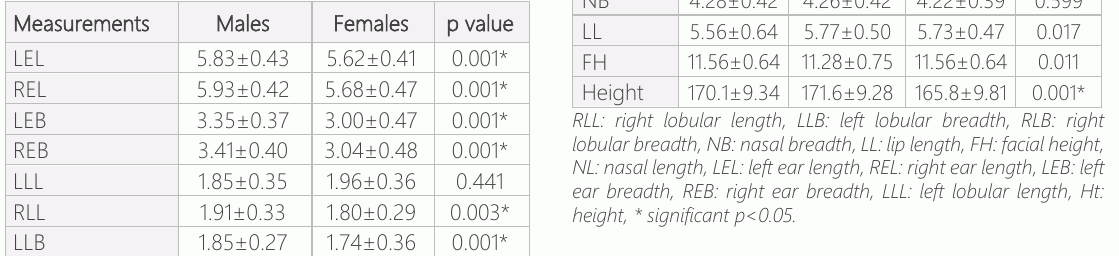
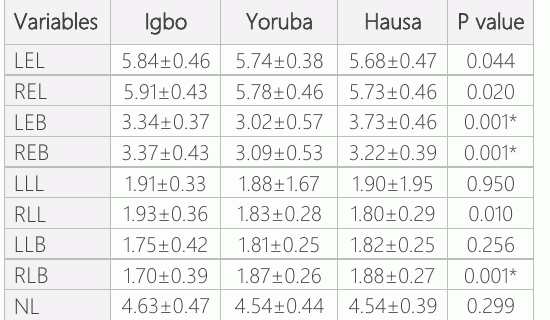
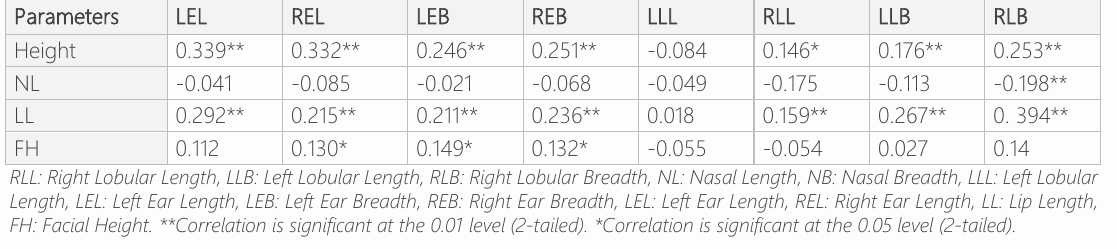
按性别分布的测量人体测量参数载于《约鲁巴岛女性》,其地位最高,右侧平均长度和宽度值最高。 豪萨妇女具有最高的劳动与就业水平和法学水平。 表3列出按族裔和性别分类的测量人类测量变量的平均分布情况。 表4概述了使用配对样本T-测试对泌尿参数的左右值所作的比较分析。 同时,对水生长度和宽度的两侧都确立了显著的区别,但对球形长度和宽度都没有确立. 表5显示具有面部和体位的动脉参数的相关性矩阵。

讨论情况
关于水生参数人体测量变化的报告 (4, 8–10)因此,必须确立跨越种族、民族和族裔的这些泌尿价值的规范价值。 在此之前,关于尼日利亚人的尿道参数的少数研究被指出侧重于生活在该国不同地区的普通人口。 (11, 12)另一些人刚刚针对与世隔绝的少数民族 (7, 13)本报告不仅确立了尼日利亚人口的规范价值。 然而,考虑到尼日利亚的多族裔复杂性,它还进一步确定了尼日利亚三个主要族裔群体的泌尿参数的规范价值。
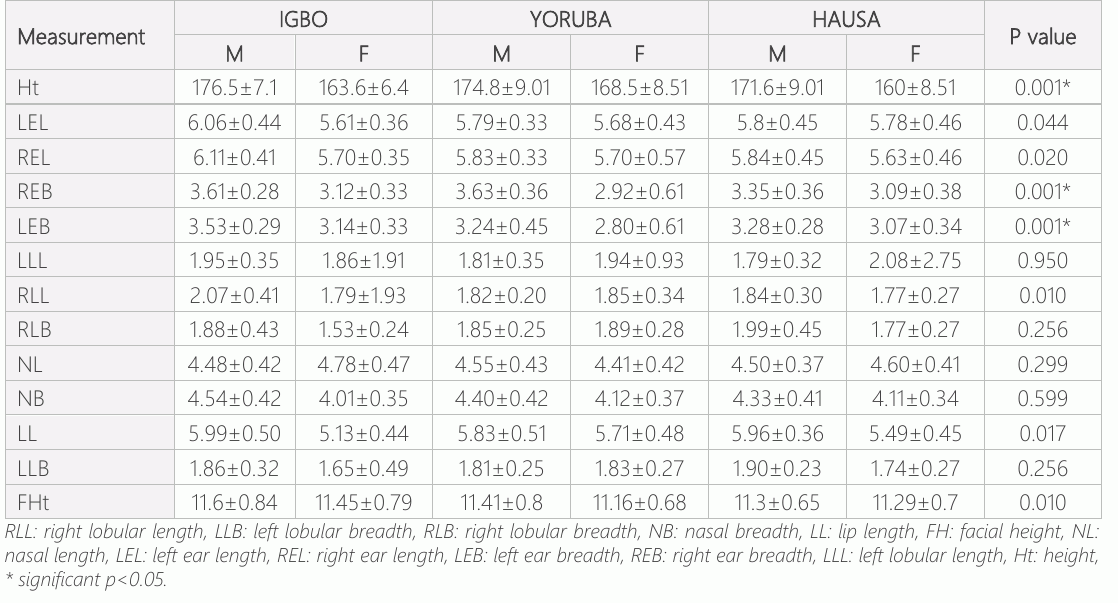
我们的报告显示,该国这些占支配地位的族裔群体的泌尿参数有很大差异。 前几份报告观察到针叶草的形态因族裔而异。 (14, 15)这项研究的平均泌尿量参数在关注的三个族裔群体之间差别很大,而且在国内对不同族裔群体进行了类似的研究。 (7, 11–13)因此,本报告将泌尿参数作为将国内这些主要群体的个人分组和识别的工具之一。
Abeysekera和Shahnavaz的报告非常清楚地表明了泌尿道参数形态上的种族歧视。 (16)他们指出,为美国男性设计的耳机只装有95%的德国人、75%的法国人、60%的意大利人、45%的日本人和10%的泰国人。 类似的报告证实了这种差异,从尼泊尔人和印度人的耳朵形态差异中可以看出。 (18)土耳其语,以及非洲学生的集合 (17)我们的研究结果表明,尼日利亚人与土耳其人相比耳朵较短但范围更广。 (17)据认为,土耳其人拥有更长和更广泛的耳机。 这与印度和尼泊尔人口相比, (17–20)4. 早先就来自意大利、欧洲、高加索、土耳其、荷兰、德国、北美等不同国家和大陆的个人的不同耳朵形态提出的报告。 (4, 8–10, 21)正如在许多人类测量测量中注意到的,在我们的研究中,同样是有效和重要的。 我们的研究注意到,除了卵形体长和宽度以外,所有族裔群体研究的所有卵形体长参数的雄性体长参数都比较广泛,对约鲁巴族女性人口而言,其宽度要高得多。 尼日利亚人以前的研究 (7, 11, 13) 在其他国家样本中 (17–20, 22) 尿道尺寸的性畸形成分
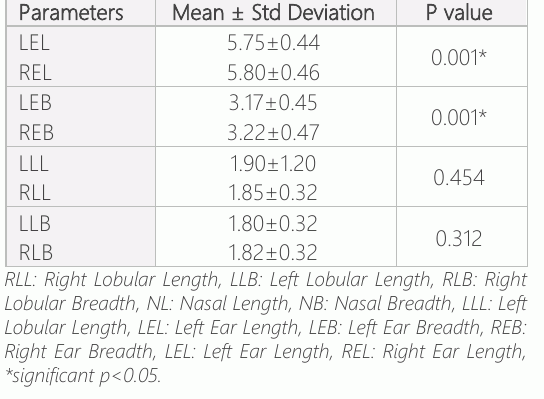
除了耳朵的性特征及其双边不对称成分外,我们的研究注意到右耳尺寸大于左耳尺寸。 在所研究的所有耳朵参数中,只有耳朵长度和宽度在左右耳朵之间有所不同. 苏醒 专 员。 。 。 (17) 还注意到被研究的男性和非洲女性的耳朵较大。 穆尔戈德 专 员。 。 。 (19) 这表明最合适的泌尿参数远远高于所研究的印度人口的左侧参数。 其他研究结果类似的研究包括Osunkwooke的报告。 专 员。 。 。(17) 尼日利亚人口12人,穆特韦和穆古提 (23) 津巴布韦的学龄儿童和其他许多儿童。 指出,尿道参数是法医鉴定的工具 (6)。 。 。
结论
卵巢是头部的显著特征,对个体具有独特性,其独特性对于人体测量分析至关重要. 这里显示的尿道参数是确定人类变化和估计地位的真正手段。
声明
- 作者贡献(CRediT)
- 所有作者对全部 14 项 CRediT 角色贡献均等(Conceptualization, Data curation, Formal analysis, Funding acquisition, Investigation, Methodology, Project administration, Resources, Software, Supervision, Validation, Visualization, Writing – original draft, Writing – review & editing)。
- 资助
-
Funding information was not reported in the published version of this article.
- 利益冲突
- A conflict of interest statement was not reported in the published version of this article.
- 伦理批准
- Ethical clearance was sought and granted by the College of Medicine, Enugu State University of Science and Technology, and approval from the National Youth Service Scheme, Enugu State-Nigeria, before the study was conducted.
- 数据可用性
- A data availability statement was not reported in the published version of this article.
参考文献 (23)
23 条参考文献中有 14 条已链接 DOI。
- Shekar BC, Reddy CVK. Role of dentist in person identification. Indian J Dent Res. 2009;20(3):356. PubMed Google Scholar
- Kumar P, Singla A. Ear biometric: sex, bilateral and ethnic differences among Brahmin and Yadav communities of Bundelkhand region using PCA technique. Int J Sci Eng Res. 2013;4(10):799-805. PubMed Google Scholar
- Ito I, Imada M, Ikeda M, Sueno K, Arikuni T, Kida A. A morphological study of age changes in adult human auricular cartilage with special emphasis on elastic fibers. Laryngoscope. 2001;111(5):881-886. DOI Crossref PubMed Google Scholar
- Bozkır MG, Karakaş P, Yavuz M, Dere F. Morphometry of the external ear in our adult population. Aesthetic Plast Surg. 2006;30:81-85. DOI Crossref PubMed Google Scholar
- Meijerman L, Van Der Lugt C, Maat GJ. Cross-sectional anthropometric study of the external ear. J Forensic Sci. 2007;52(2):286-293. DOI Crossref PubMed Google Scholar
- Kapil V, Bhawana J, Vikas K. Morphological variation of ear for individual identification in forensic cases: A study of an Indian population. Res J Forensic Sci. 2014;2(1):1. PubMed Google Scholar
- Ugochukwu EG, Ifechukwude BJ, Raymond UA, Obun OC. An anthropometric study of the normal auricle of Cross River State indigenes of Nigeria. J Anat Soc India. 2017;66(1):26-30. DOI Crossref PubMed Google Scholar
- Kalcioglu MT, Toplu Y, Ozturan O, Yakinci C. Anthropometric growth study of auricle of healthy preterm and term newborns. Int J Pediatr Otorhinolaryngol. 2006;70(1):121-127. DOI Crossref PubMed Google Scholar
- Sforza C, Dellavia C, Tartaglia GM, Ferrario VF. Morphometry of the ear in Down's syndrome subjects: A three -dimensional computerized assessment. Int J Oral Maxillofac Surg. 2005;34(5):480-486. DOI Crossref PubMed Google Scholar
- Sforza C, Grandi G, Binelli M, Tommasi DG, Rosati R, Ferrario VF. Age-and sex- related changes in the normal human ear. Forensic Sci Int. 2009;187(1-3):110.e1. DOI Crossref PubMed Google Scholar
- Garba SH. Anthropometric study of the pinna (Auricle) among adult Nigerians resident in Maiduguri metropolis. J Med Sci. 2010;10(6):176-180. PubMed Google Scholar
- Osunwoke EA, Vidona WB, Atulegwu GC. Anthropometric study on the anatomical variation of the external ear amongst Port Harcourt students, Nigeria. Int J Anat Var. 2018;11(4):143-146. PubMed Google Scholar
- Alabi AS, Adeola A, Kareem SB, Lewu SF, Olawepo A, Arogundade TT, Yawson EO. Anthropometric analysis of auricular indices for sex and stature determination among Okun and Igala ethnic groups of Kogi State, Nigeria. J Environ Toxicol Public Health. 2019;4:6-14. PubMed Google Scholar
- Alexander KS, Stott DJ, Sivakumar B, Kang N. A morphometric study of the human ear. J Plast Reconstr Aesthet Surg. 2011; 64(1):41-47. DOI Crossref PubMed Google Scholar
- Gualdi-Russo E. Longitudinal study of anthropometric changes with aging in an urban Italian population. Homo. 1998;49(3):241-259. PubMed Google Scholar
- Abeysekera JD, Shahnavaz H. Body size variability between people in developed and developing countries and its impact on the use of imported goods. Int J Ind Ergon. 1989;4(2):139-149. DOI Crossref PubMed Google Scholar
- Osunwoke EA, Vidona WB, Atulegwu GC. Anthropometric study on the anatomical variation of the external ear amongst Port Harcourt students, Nigeria. Int J Anat Var. 2018;11(4):143-146. PubMed Google Scholar
- Purkait R, Singh P. Anthropometry of the normal human auricle: a study of adult Indian men. Aesthetic Plast Surg. 2007;31:372-379. DOI Crossref PubMed Google Scholar
- Murgod V, Angadi P, Hallikerimath S, Kale A. Anthropometric study of the external ear and its applicability in sex identification: assessed in an Indian sample. Aust J Forensic Sci. 2013;45(4):431-444. DOI Crossref PubMed Google Scholar
- Sharma A, Sidhu NK, Sharma MK, Kapoor K, Singh B. Morphometric study of ear lobule in northwest Indian male subjects. Anat Sci Int. 2007;82(2):98-104. DOI Crossref PubMed Google Scholar
- Ferrario VF, Sforza C, Ciusa V, Serrao G, Tartaglia GM. Morphometry of the normal human ear: a cross-sectional study from adolescence to mid-adulthood. J Craniofac Genet Dev Biol. 1999;19(4):226-233. PubMed Google Scholar
- Gupta AK, Ambekar MN. Anthropometric Study of External Ear: A Comparative Study in Medical Students of Nepalgunj Medical College in Nepal. J Nepalgunj Med Coll. 2017;15(2):49-52. DOI Crossref PubMed Google Scholar
- Muteweye W, Muguti GI. Prominent ears: anthropometric study of the external ear of primary school children of Harare, Zimbabwe. Ann Med Surg. 2015;4(3):287-292. DOI Crossref PubMed Google Scholar
阅读全文
在此打开 PDF
正在加载 PDF…
若 PDF 未在此显示,请使用上方的下载按钮。
如何引用本文
Anyanwu GE, Didigu R, Chia T, Obasi KK, Kiekwe V. Auricular Parameters: A Tool for Stature, Gender and Ethno-facial Determination in a Nigerian Population. Ulutas Med J. 2023;9(4):227-232. doi:10.5455/umj.20230609085715
Anyanwu, G. E., Didigu, R., Chia, T., Obasi, K. K., & Kiekwe, V. (2023). Auricular Parameters: A Tool for Stature, Gender and Ethno-facial Determination in a Nigerian Population. The Ulutas Medical Journal, 9(4), 227–232. https://doi.org/10.5455/umj.20230609085715
Anyanwu, G.E. et al. (2023) 'Auricular Parameters: A Tool for Stature, Gender and Ethno-facial Determination in a Nigerian Population', The Ulutas Medical Journal, 9(4), pp. 227–232. doi: 10.5455/umj.20230609085715.