The Ulutas Medical Journal · ISSN 2149-0430 (مطبوع), 2149-388X (إلكتروني) · https://www.ulutasmedicaljournal.com/?mno=85435
مقالة أصلية · وصول مفتوح
Comparison of pre-treatment and post-treatment audity Brainstem Response Results in Children with Serous Otitis
ترجمة آلية للعنوان والملخص والنص الكامل. الأصل الإنجليزي
- Department of Otorhinolaryngology, Sutcu Imam University, Faculty of Medicine, Kahramanmaraş, Turkey ROR
- Department of Pediatrics, Giresun University, Gynecology and Child Training and Research Hospital, Giresun, Turkey ROR
- Department of Pediatrics, Sutcu Imam University, Faculty of Medicine, Kahramanmaraş, Turkey ROR
- Department of Pediatrics, Giresun University, Faculty of Medicine, Giresun, Turkey ROR
الملخص
مقدمة: The present study aimed to investigate the effect of middle ear effusion on the ABR test through a comparison of clinical auditory brainstem response (ABR) results in pre-treatment and post-treatment in patients diagnosed with otitis media with effusion (OME). المواد والأساليب: وشملت هذه الدراسة الرجعية 42 طفلاً تتراوح أعمارهم بين 3 أشهر و12 شهراً، الذين أخفقوا في اختبار الانبعاثات البوتوكية في برنامج فحص السمع وتم تشخيصهم بالتهاب الرئوي. النتائج: بعد معالجة المرضى، اجتزت الآذان اليمنى التي تبلغ 76.9 في المائة من المرضى وآذانهم اليسرى البالغة 69.04 في المائة من المرضى اختبار الانبعاثات الشاذة للمنتج. In the OAE tests post-treatment, in 23.8% of patients, the right ear, and 30.95% patients, the left ear was negative, and a decrease was seen in the hearing thresholds in clinical ABR. The latencies of the ABR 1st and 3rd waves were observed to be significantly prolonged pre-treatment compared to post-treatment in all patients. الاستنتاج: ويقضي التدخل المناسب في المرحلة المبكرة على الآثار السلبية لخسارة السمع أو يقللها. وتجنباً لفترة طويلة جداً من فترة متابعة الأطفال الذين تم تشخيصهم بوسائط التهاب الصدر في السنوات الأولى من العمر، ينبغي تطبيق العلاج الفوري على المرضى الذين لم يستجبوا للعلاج الطبي، وإذا كانت العتبات بعد العلاج أعلى من القيم العادية، ينبغي تطبيق معونة سمعية في أقرب وقت ممكن وتقديم العلاج الأسري.
الكلمات المفتاحية
النص الكامل
ترجمة آلية للنص الكامل؛ النسخة المعتمدة هي الأصل الإنجليزي. الأصل الإنجليزي
مقدمة
وتُعد وسائط الإعلام عن طريق التهاب الكبد تعريفاً عاماً لأي عملية تهاب في تجويف الأذن الوسطى وراء نغمة الأذن الصحية، وهناك نوعان رئيسيان من وسائط الإعلام ذات التهاب الرئوي الحاد ووسائط التهاب الرئوي المزودة بالدفء. يمكن تعريف أوتوماتيكياً على أنه جدول تلتهاب سائل يتسم بتراكم سائل خلف حمّام أبيض صحي دون أن تصاحب ذلك نتائج العدوى الحادة المحلية أو النظامية (1–3).
As it is generally seen in child, the main challenges in diagnosis are technical difficulties in the physical examination and very young children cannot verbalize their complaints, so symptoms may not be noticeable and reduced hearing may remain hidden. Otomicroscopy, otoscopy, or pneumatic otoscopy are the most important diagnostic methods. والأساليب السمعية هي اختبارات الدايبازون، والاختناق، والتردد الصوتي، والمقاييس الصوتية البحتة، والمقياس الصوتي لجذع الدماغ، والانبعاثات الصوتية الصوتية (4, 5)- يعد القياس طريقة مفيدة في تشخيص OME في الأطفال الذين تتراوح أعمارهم بين 2 و 24 شهراً، ولكن مع بلوغهم سناً أصغر، هناك انخفاض في حساسية الطريقة. وعلى الرغم من صعوبة الاستخدام، ينبغي استخدام القياس العالي التردد في تقييم الأذن الوسطى للولود الجدد. ويُنظر في العلاج في ثلاث مجموعات رئيسية من المحافظين والطبيين والجراحة. تحدد طريقة العلاج وفقاً لظاهرة الأوتوماتسكوبيك، ونوع الكيمياء، والاستجابة للعلاج المتحفظ، ومستوى السمع (2, 6).
The auditory brainstem response (ABR) test records the electrical activity occurring as a result of the response of the VIII symptom and brainstem neurons to an auditory stimulus (7)- عند تحديد عتبات السمع وتشخيص فقدان السمع والإيذاء الرجعي في المسنين والمرضى غير الموعيين والأطفال الصغار، يُستخدم العلاج المضاد للفيروسات البيرفلورية، لأن امتثال المرضى ليس ضروريا. وفي هاتين الحالتين، من المهم حدوث تأخيرات في الذروة وتأخرات في الموجات التي تشكل الاستجابة. كلاسيكياً، تم تشكيل "إي بي آر" من 7 ذروة شوهدت في أول 10 دقائق ولكن في العيادة (8–10).
This study aimed to comparison the clinical ABR results taken pre and post-treatment to determine the effect on the ABR test of effusion in the middle ear in patients with no response to OAE in the neonatal hearing screening who was then diagnosed with OME from clinical examination and tympanometric examination.
المواد والأساليب
In this retrospective study, the records were examined of patients applied with a hearing test in the neonatal hearing screening program in our clinic between January 2015 and June 2017. Of the patients followed up because of the neonatal hearing screening, the files were reviewed of patients diagnosed with OME and applied with clinical ABR before and after treatment. وأدرج ما مجموعه 100 آذان من 48 مريضا (26 من الذكور و 22 من الإناث) للتقييم.
البيان الأخلاقي
ووافقت على الدراسة اللجنة الأخلاقية التابعة لجامعة سوتكو إمام، كلية الطب (الجلسة رقم 2017/04، القرار رقم 03، المؤرخ 15.03-2017). واستبعد ما مجموعه 16 مريضا من الدراسة بسبب تشخيص متلازمة، أو مشكلة سمع الأسرة، أو شذوذ مسار مراجعة الحسابات، أو عدم اكتمال المعلومات. وأجري التقييم النهائي لـ 84 آذانا من 42 مريضا (28 ذكرا و 14 امرأة). وقد أجري تشخيص للخسائر الناجمة عن فقدان الأعضاء التناسلية وتاريخ فقدان السمع في امتحانات الأذن بفحص النسيج (Hine Beta 100 otoscope, Germany) لظهور ماتي في الميمبراين الطاغية، والتعميم، والتدفق الجوي خلف الميمبراين، والنوع B أو نوع tympanogram (Interacoustics, AT235, Denmark). When the hearing screening was required, distortion product otoacoustic emissions (DPOAE) and transient-evoked oto acoustic emission(TEOAE) otoacoustic emission tests and screening ABR tests (Madsen Capella GN Otometrics, Denmark) were negative. The OME diagnosis was made and to determine hearing thresholds in cases thought to have advanced hearing loss, clinical ABR was applied (Neurosoft, Neuro-Audio, Ivanovo, Russia). وبعد أن استرجعت المنظمة مع العلاج الطبي و/أو الجراحي، طبقت المنظمة مرة أخرى. The ABR tests were applied using adhesive electrodes with patient supine on a comfortable bed in a silence, dark room that would not have any visual stimuli, in the Audiology Laboratory. The negative electrodes were placed on the two mastoid regions, the positive electrode on the vertex and the earth electrode on the forehead. تم الاعتناء بنوبات الجلد الكهربائي كانت أقل من 5 كيلو مترات وقد طُبقت الاختبارات بحافز نقي على تردد يبلغ 27/1، و100 ميكروغرام متناوب. وبالنسبة لكل من الأذنين، أُعد سجلان على الأقل في الكثافة المطبقة، وأُبديت عناية بأن المتأخرات في الأمواج تتفق مع بعضها البعض. وكلاء المهدئات لم يستخدموا في أي طفل. The tests were applied during natural sleep. The pre and post-treatment ABR latency data of the patients were recorded on a standard data form, then transferred to statistics program and analyzed.
التحليل الإحصائي
The data obtained in the study were analyzed using IBM SPSS for Windows v22 software (IBM statistics Windows, IBM Corporation, Armonk, New York, USA). وجرى فحص مطابقة البيانات للتوزيع العادي (التاريخ) باستخدام أساليب تحليلية. ووردت تحليلات وصفية للتوزيع العادي على أنها انحراف معياري متوسط، وحددت أهمية على مستوى P0.05. وبالنسبة للعلاقة بين مجموعتين، حُسب معامل حرق بيرسون. In the comparison of two groups, Wilcoxon t-test and the Independent Samples t-test were used. وأُحرزت نتائج في فترة ثقة قدرها 95 في المائة، وقُبلت قيمة البرنامج الفرعي 0.05 باعتبارها ذات أهمية إحصائية.
النتائج
In all the patients who did not pass the OAE tests in the hearing screening program follow-up and who were diagnosed with serious otitis, the latencies of the clinical ABR waves were prolonged before treatment. وعندما جرى تقييم الفرق السابق للمعاملة في حالة الطوارئ حسب نوع الجنس كان أكبر في الذكور. In the right ear examination of 3 patients and the left ear examination of 4 patients, the otoscopic examination and tympanogram were normal, so OAE was not applied and the hearing thresholds on clinical ABR recovered during follow-up. In 82% of the patients, the middle ear recovered with medical treatment and follow-up, and 18% with surgical treatment. In all the patients surgically applied with grommet tubes, glue-type liquid was aspirated from the middle ear after parasynthesis. One patient had postoperative complaints of otorrhea but recovered in a short time after removal of the tube.
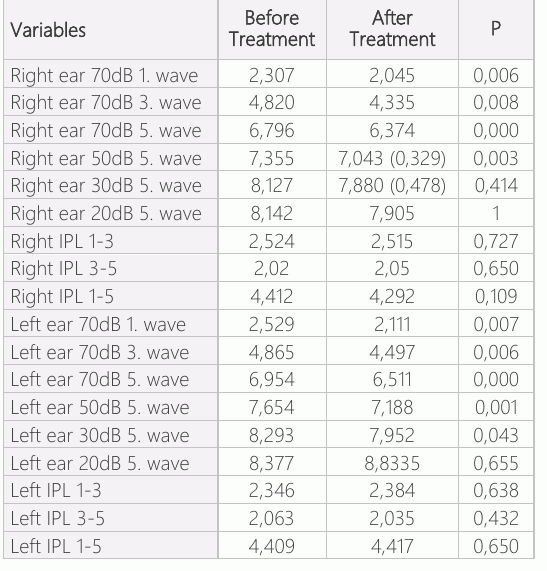
وعقب علاج المرضى، اجتزت الآذان اليمنى لـ 32 مريضا (76.9 في المائة) والأذن اليسرى لـ 29 مريضا (69.04 في المائة) اختبار DPOE، وكانت عتبات السمع ضمن الحدود العادية للجهاز الطبي للفحص الرئوي. In the OAE tests post-treatment, in 10 (23.8%) patients, the right ear, and in 13(30.95%) patients, the left ear was negative, and a decrease was seen in the hearing thresholds in clinical ABR. وعقب هذه النتائج، أوصي بتقديم معونة سمعية. In the results of the clinical ABR applied before OME treatment, a mean 45dB was observed, with the highest 60dB and lowest 40dB in the right ear, and mean 40dB with highest 70dB and lowest 30dB in the left ear. After treatment, these values were highest 50dB, lowest 15dB in the right ear, and highest 60dB, and lowest 40 dB in the left ear. وكما هو الحال في انخفاض العتبات قبل العلاج وبعده، لوحظ انخفاض كبير من الناحية الإحصائية في متأخرات الموجات الأولى والثالثة والخامسة من سداسي كلور البنزين وموجات الـ 50dB الخامسة و30dB (p0.05)(Table-1). No significant difference was observed between the pre and post-treatment interpeak latencies (IPL 1-3, IPL 3-5, IPL 1-5). وأُخذت إدارة الرعاية الصحية قبل العلاج في الأذن اليمنى لـ 6 مرضى (24 مريضاً لا يمكن أخذهم) وفي الأذن اليسرى لـ 5 مرضى (25 مريضاً لا يمكن أخذهم)، ولم يكن من الممكن تناول العلاج بعد ذلك في الأذن اليمنى لـ 4 مرضى والأذن اليسرى لثلاثة مرضى. The change in DPOAE from before medical treatment to after was found to be significant in both ears. The clinical ABR threshold values were determined to have significantly reduced post-treatment compared to pre-treatment.
المناقشة
ويُعتبر هذا المرض واحداً من الأمراض التي كثيراً ما تُشاهد في مرحلة الطفولة مما يؤدي إلى انخفاض عدد السمع. وهذه حالة تتطلب التصحيح والمتابعة بسبب أهمية الاتصال، والتنمية النفسية - الاجتماعية والعقلية في هذا العمر. وينظر إلى أوجه الأذن المتوسطة في 50 في المائة من جميع الأطفال في السنة الأولى من العمر وهذا شيء يمكن تجاهله في كثير من الأحيان (11)ولا تتأثر بدرجة كبيرة لأن القياس لا يمكن أن يتم من قناة الأذن الخارجية عندما يكون هناك سوائل أمنية أو حطام أو سوائل أذن متوسطة في قناة الأذن الخارجية. غير أنه نظراً إلى أن الحفازات تُقدم من قناة المراجعة الخارجية للحسابات، إذا كانت مشكلة الأذن الخارجية والمتوسطة كبيرة بما يكفي لإحداث فقدان سمعي، فإن نتائج الامتحانات التنافسية تؤثر على طول فترة الرطوبة في الموجة الأولى (12)عطلات الأذن الوسطى تحول دون تسجيل الانبعاثات الظاهرية من خلال التأثير سلباً على الممرات المتناثرة حتى تسجيل انبعاثات الكوليار على الميكروفونات (13)- وفي الدراسة الحالية، لم يكن من الممكن أن يؤخذ من مرضى OME. وعندما تكون الأذن المتوسطة ممتلئة بالدفوف، يكون الامتثال منخفضا، وكانت الطاغية التي تم الحصول عليها مسطحة، وبعبارة أخرى، الشكل باء وفقا لتعاريف جيغر. (14) In the determination of OME, a type B curve obtained on tympanometry has been reported to have .80% sensitivity. وهكذا لا يمكن أن يشير منحنى من النوع باء إلى وجود المنظمة في جميع الظروف. أما بالنسبة للنوع ألف، فإن وجود المشاريع الصغيرة والمتوسطة الحجم مخصوما منه لأنه لا يوجد سوى احتمال بنسبة 5 في المائة. غير أنه في حالة الأطفال الذين تقل أعمارهم عن 7 أشهر، نظراً لأن قناة المراجعة الخارجية للحسابات شديدة الرطوبة ولم يتم بعد تطوير الخاتم الإسباني بشكل كامل، يمكن الحصول على أشعة نمطية عادية حتى إذا كان مكتب المشاريع الصغيرة والمتوسطة الحجم حاضراً. (15, 16) - وفي الدراسة الحالية، طُبِّق 3 مرضى من النوع ألف من البامبوغرامات والآفات السلبية من نوع OAE بفحص مفصل، وجرى تشخيص حالة OME. واستُخدمت مادة " إيبفانوغرام " في جميع الحالات.
OME is a disease requiring close follow-up and has a high rate of spontaneous resolution. وفي التشخيص والمتابعة، يجري التقييم مع فحص الأوتوماتسكوبيك، وفحص الأوتوماتيوماتيكي، والإبتامبانوغرام، والمكتب معا. In cases with a high degree of hearing loss that does not respond to medical treatment, the application of a ventilation tube should be considered(11)- وفي الدراسة، طُبِّق أنبوب تهوية على 9 مرضى من ذوي العتبات السمعية العالية الذين لا يستجيبون للعلاج الطبي.
The ABR test is the most frequently used objective test that plays a major role in the evaluation of hearing in child. ويعد المرض أحد أهم البيانات في تحديد العتبة (17)- أبلغت الدراسات السابقة عن حدوث تأخيرات في الموجات الأولى والثالثة والخامسة وطوال 3-5 لافوري و 1-5 لافوري في المرضى المصابين بالمنظمة مقارنة بمجموعات المراقبة (12, 13)وفي هذه الدراسة، لوحظت حالات التأخير الطويلة في الموجات والقيم التي حددها القانون الدولي في مرحلة ما قبل المعاملة. أظهرت الأدلة حدوث تغييرات كبيرة في تنظيم الدماغ بسبب مشاكل الأذن المتوسطة في المراحل المبكرة من الحياة (18, 19)- ماتشكي وآخرون Reported 39 human brains were studied from the 29th أسبوع الحمل حتى سن السبعين، وكشف أن النضج الوظيفي اللازم للخيال يتوقف على الحوافز الكافية في السنة الأولى من العمر (18)- ومن الناحية الفيزيائية، تنعكس الفترات الفاصلة بين موجات طويلة في تباطؤ معدل الانتقال المركزي في جذع الدماغ السفلي (19).
In our clinic, to determine the thresholds of all patients diagnosed with OME who have not passed OAE, ABR is applied as soon as possible and thresholds are determined with wave latencies and IPL. وبعد العلاج، إذا كانت العتبات أعلى من المعتاد، حتى ولو بدرجة ضئيلة جدا، يوصى بمعونة سمعية للمريض. أما الأشخاص الذين لديهم عتبات في الحدود العادية والتأخرات فوق معايير عياداتنا، فهم يبقون تحت المتابعة الدقيقة والعلاج الأسري. وفي الدراسات السابقة، في حين لوحظت حالات تأخير موجة أولى وثالثة وخامسة في مرضى المنظمة، أفيد بأنه لم يحدث تغيير في العتبات. (12, 13, 20).
وفي هذه الدراسة الحالية، لوحظ انخفاض كبير في عتبات الاستماع لجميع مرضى المنظمة بعد العلاج. A limitation of the study can be said to be that because of the low number of patients, there was little variability in the hearing loss of the children with OME. وفي حالة المرضى الذين يعانون من سوء السلوك، يمكن أن يؤدي إطالة فترات التأخير في الموجات وانخفاض السمع إلى تأثير سلبي على نظام الاستماع. وتجنباً لفترة طويلة جداً من فترات متابعة الرضع الذين تم تشخيصهم لدى المنظمة في السنوات الأولى من العمر، ينبغي أن تُطبَّق المعالجة الفورية على المرضى الذين لم يستجبوا للعلاج الطبي، وإذا كانت العتبات بعد العلاج أعلى من القيم العادية، ينبغي تطبيق معونة سمعية في أقرب وقت ممكن وتقديم العلاج الأسري.
خاتمة
والخسائر الناجمة عن السمع هي مشكلة صحية غير مرئية، ومهما كانت كمية فقدان السمع، فإنها تؤدي إلى تأخيرات في الكلام، والتنمية المعرفية والاجتماعية في الرضع والأطفال. ومع التدخل المبكر المناسب، يمكن تخفيض الآثار السلبية لفقدان السمع أو القضاء عليها. ولذلك، ينبغي تطبيق فحص السمع عن المواليد الجدد في الشهر الأول، وينبغي إتمام الفحوص التشخيصية للرضع الذين لا يُجرى الفحص في غضون ثلاثة أشهر لتشخيص فقدان السمع الدائم، وإلى أن يبلغ سن 6 أشهر، ينبغي تطبيق الرضّع بمعونة سمعية وإعادة تأهيل السمع. وإذا تم تحديد فقدان سمع دائم وتدخل على النحو المناسب في غضون الأشهر الستة الأولى، فثمة فرصة متزايدة بأن يصل الطفل إلى نفس مستوى الكلام وتطوير اللغات الذي يصل إليه السمع العادي. وإذا كان مكتب المشاريع الصغيرة والمتوسطة الحجم موجوداً أيضاً لدى الرضع الذين يعانون من فقدان سمعي، فمن المهم تطبيق معاملة المشاريع الصغيرة والمتوسطة الحجم وتحديد العتبات الحقيقية قبل استخدام المعونة السمعية. وبالإضافة إلى ذلك، من المهم بالنسبة لنماء الطفل أن يستمر فحص السمع وفقاً لحالة الخطر التي يتعرض لها الطفل أثناء رصد الرعاية الصحية في مرحلة الطفولة (في مرحلة ما قبل المدرسة والسن المدرسية).
الإقرارات
- مساهمات المؤلفين (CRediT)
- ساهم جميع المؤلفين بالتساوي في جميع أدوار CRediT الأربعة عشر (Conceptualization, Data curation, Formal analysis, Funding acquisition, Investigation, Methodology, Project administration, Resources, Software, Supervision, Validation, Visualization, Writing – original draft, Writing – review & editing).
- التمويل
-
Funding information was not reported in the published version of this article.
- تضارب المصالح
- A conflict of interest statement was not reported in the published version of this article.
- الموافقة الأخلاقية
- Approval for the study was granted by the Ethic Committee of Sutcu Imam University, Medical Faculty (session no: 2017/04, decision no: 03, dated 15.03.2017).
- إتاحة البيانات
- A data availability statement was not reported in the published version of this article.
المراجع (20)
13 من أصل 20 مرجعًا مرتبطة بمعرّف DOI.
- Williamson I. Otitis media with effusion in children. BMJ Clinical Evidence. 2011:05-02 PubMed Google Scholar
- Rosenfeld RM, Shin JJ, Schwartz SR, Coggins R, Gagnon L, Hackell JM, et al. Clinical practice guideline: otitis media with effusion. Otolaryngol Head Neck Surg 2016;154:1-41 DOI Crossref PubMed Google Scholar
- Zhang Q, Wei J, Xu M, Zhang Q, Zhang X, Zhang Z, et al. Prevalence of otitis media with effusion among children in Xi'an, China: A randomized survey in China's mainland. Ann Otol Rhinol Laryngol. 2011:120:617–621 DOI Crossref PubMed Google Scholar
- Linsk R, Blackwood A, Cooke J, Harrison V, Lesperance M, Hildebrandt HM. University of Michigan Health System Otitis Media Guideline for Clinical Care. UMHS Otitis Media Guideline, 2013 PubMed Google Scholar
- Muderrıs T, Yazıcı A, Bercın S, Yalcıner G, Sevıl E, Kırıs M. Consumer acoustic reflectometry: accuracy in diagnosis of otitis media with effusion in children. Int J Pediatric Otorhino laryngology. 2013;77(10):1771–1774 PubMed Google Scholar
- Handler SD, Magardino TM. Otitis Media with effusion. in: Canalis RF, Lambert PR, eds. The Ear. Philadelphia: Lippincott Williams & Wilkins, 2000:383-396 PubMed Google Scholar
- Silva DD, Lopez P, Mantovani JC. Auditory brainstem response in term and preterm infants with neonatal complications: the importance of the sequential evaluation. International Arch Otorhinol. 2015;19 (2):161-165 DOI Crossref PubMed Google Scholar
- Ferraro JA, Durrant JD. Auditory evoked potentials: overview and basic principals. In: Katz J. Handbook of clinical Audiology. 4th edition 1994. p.317-338 PubMed Google Scholar
- Liang S, Soli SD, Zheng Y, Li G, Meng Z. Initial classification of pediatric hearing impairment using behavioral measures of early prelingual auditory development. Int J Audiol. 2016;55 (4):224–231 DOI Crossref PubMed Google Scholar
- Farias VB, Sleifer P, Pauletti LF, Krimberg CFD. Correlation of the findings of auditory steady-state evoked potential and of beha- vioral hearing assessment in infants with sensorineural hearing loss. CoDAS. 2014;26(03):226–230 DOI Crossref PubMed Google Scholar
- Robb PJ, Williamson I. Otitis media with effusion in children: current management. Paediatr Child Health. 2016;26.1: 9-14 DOI Crossref PubMed Google Scholar
- Conijn EAJG, Van Der Drift JFC, Brocaar MP, Van Zanten GA. Conductive hearing loss assessment in children with otitis media with effusion. A comparison of pure tone and BERA results. Clin Otolaryngol Allied Sci. 1989;14.2: 115-120 DOI Crossref PubMed Google Scholar
- Kumral TL, Veyseller B, Ulusan M, Açıkalın RM, Cengiz K, Kablan N. [Value of otoacoustic emission tests in the diagnosis and follow-up of the otitis media with effusion]. Kulak Burun Bogaz Ihtis Derg. 2010;20:123-128 PubMed Google Scholar
- Jerger J. Clinical experience with impedance audiometry. Arc Otolarygol. 1970;92:311-324 DOI Crossref PubMed Google Scholar
- Gaihede M, Bramstoft M, Thomsen LT, Fogh A. Accuracy of tympanometric middle ear pressure determination in secretory otitis media: dose-dependent overestimation related to the viscosity and amount of middle ear fluid. Otol Neurotol. 2005;26:5-11 DOI Crossref PubMed Google Scholar
- Gates GA, Avery CA, Prihoda TJ, Cooper JC Jr. Effectiveness of adenoidectomy and tympanostomy tubes in the treatment of chronic otitis media with effusion. N Engl J Med. 1987;317: 1444-1451 DOI Crossref PubMed Google Scholar
- Baldwin M, Watkin P. Predicting the degree of hearing loss using click auditory brainstem response in babies referred from newborn hearing screening, Ear Hear. 2013;34:361-369 DOI Crossref PubMed Google Scholar
- Matschke RG, Stenzel C, Plath P, Zilles K. Maturational aspects of the human auditory pathway: anatomical and electro physiological findings. ORL J Otorhinolaryngol Relat Spec. 1994;56:68-72 PubMed Google Scholar
- Maruthy S, Mannarukrishnaiah J. Effect of early onset otitis media on the brainstem and cortical auditory processing. Behav Brain Funct. 2008,2;4:17 DOI Crossref PubMed Google Scholar
- Suzuki HG, Dewez JE, Nijman RG, Yeung S. Clinical practice guidelines for acute otitis media in children: a systematic review and appraisal of European national guidelines. BMJ Open. 2020; 10(5):035343 DOI Crossref PubMed Google Scholar
اقرأ النص الكامل
افتح ملف PDF هنا
جارٍ تحميل ملف PDF…
إذا لم يظهر ملف PDF هنا، استخدم زر التنزيل أعلاه.
كيف تقتبس هذه المقالة
Sarica S, Argama HI, Kirik S, Bulut M. Comparison of Pre-treatment and Post-treatment Auditory Brainstem Response Results in Children with Serous Otitis. Ulutas Med J. 2021;7(3):203-208. doi:10.5455/umj.20210603085155
Sarica, S., Argama, H. I., Kirik, S., & Bulut, M. (2021). Comparison of Pre-treatment and Post-treatment Auditory Brainstem Response Results in Children with Serous Otitis. The Ulutas Medical Journal, 7(3), 203–208. https://doi.org/10.5455/umj.20210603085155
Sarica, S. et al. (2021) 'Comparison of Pre-treatment and Post-treatment Auditory Brainstem Response Results in Children with Serous Otitis', The Ulutas Medical Journal, 7(3), pp. 203–208. doi: 10.5455/umj.20210603085155.