The Ulutas Medical Journal · ISSN 2149-0430 (print), 2149-388X (online) · https://www.ulutasmedicaljournal.com/?mno=95158
Original Article · Open access
Fetal Macrosomia: Ultrasonographic Parameters and Associated Risk Factors in Pregnancies with and without Gestational Diabetes Mellitus
- Obstetrics and Gynecology, Okmeydani Training and Research Hospital, Prof. Dr. Cemil Tascioglu City Hospital, Istanbul, Turkey ROR
Abstract
- Introduction
- Fetal macrosomia is a clinical condition that significantly affects maternal and fetal health. The objective of this study is to determine the frequency and the associated risk factors of fetal macrosomia in pregnant women with and without gestational diabetes mellitus (GDM).
- Materials and Methods
- Our study was carried out by retrospectively examining the records of pregnant women who delivered babies with birth weights of ≥4000 g, after the 37th gestational week in the Gynecology Department of Okmeydani Training and Research Hospital between January 1, 2014, and December 31, 2020. Pregnant women were divided into 2 groups as those did not receive (Group 1, n:311) and did (Group 2, n:98) the diagnosis of GDM during their pregnancy.
- Results
- Frequencies of preeclampsia, polyhydramnios, and shoulder dystocia were statistically significantly higher in the GDM(+) group relative to the GDM(-) group (p=0.007, p=0.006, and p=0.004, respectively). Receiver operator characteristic (ROC) curves were formed to determine cut-off values for age, parity, BPD, FL, and AC. Age (>35 years), FL (≤77 mm), AC (>356 mm), polyhydramnios, and shoulder dystocia were determined as effective factors on fetal macrosomia (p=0.0001, p=0.025, p=0.023, p=0.045, and p=0.009, respectively).
- Conclusion
- Polyhydramnios, shoulder dystocia, preeclampsia, and an increase in AC but a decrease in BPD and FL values are more common in macrosomia associated with GDM compared to the non-GDM patient group.
Keywords
Full text
Introduction
Fetal macrosomia is a clinical condition that significantly affects maternal and fetal health and is encountered in 3-15% of all births (1). The American College of Obstetricians and Gynecologists (ACOG) defined macrosomia as the birth weight over 4000 g irrespective of gestational age or greater than 90th percentile for gestational age (2).
Maternal and perinatal complications such as infection, postpartum hemorrhage, prolonged labor, high degree perineal tears, cesarean delivery, thromboembolic event, and anesthetic accidents are more frequently seen with fetal macrosomia. In addition, the incidence rates of fetal complications such as shoulder dystocia, brachial plexus injury, skeletal injuries, aspiration of meconium, prenatal asphyxia, hypoglycemia, and fetal death increase (3, 4). All factors affecting fetal weight can be enumerated as gestational diabetes, obesity, ethnic factors, postmaturity, and high parity (5). Macrosomic infants are in the risk group in their adulthood concerning the development of hypertension, obesity, and type 2 diabetes mellitus (6). Although its exact mechanism is not known, it can be said that a multifactorial interaction between genetic, environmental, and fetal nutrition factors determine fetal development.
Maternal insulin is known to be the primary hormone responsible for independently intra uterine fetal growth suboptimal glycemic control of pre-pregnancy body mass index (BMI) is an important risk factor in development of macrosomia. However, any risk factor was not found in approximately 60% of macrosomic fetuses (7).
The objective of this study is to determine the frequency and the associated risk factors of fetal macrosomia in pregnant women with and without gestational diabetes mellitus (GDM).
Materials and Methods
Our study was carried out by retrospectively examining the records of pregnant women who delivered babies with birth weights higher than 4000g, after the 37th gestational week in the Gynecology Departmentof Okmeydani Training and Research Hospital between January 1, 2014, and December 31, 2020. The study was initiated after the approval of the Ethic Committee was obtained. The vaginal examination was performed in all patients in the study group at the time of admission to the hospital, and the presence of cervical effacement and dilatation was recorded. An external monitoring was performed to determine uterine contractions, and obstetric ultrasonography to be able to see fetal development.
Standard biometric parameters as biparietal diameter (BPD), abdominal circumference (AC), femur length (FL), were recorded. Blood was taken from the patients for complete blood count and fasting blood glucose measurement. Gestational age was calculated according to the last menstrual period or findings of ultrasound performed before 20 weeks of gestation.
Pregnant women below 37th week of gestation, under 18 years of age, and those who delivered babies with a birth weight below 4000 gr, and multiple gestations were not included in the study. A total of 409 pregnant women, whose complete records were available, were included in the study. Pregnant women were divided into 2 groups as those did not receive (Group 1, n:311) and did (Group 2, n:98) the diagnosis of gestational diabetes mellitus (GDM) during their pregnancy. Demographic characteristics of the patients were recorded. Comparisons were made as for the gestational week of delivery, delivery type, cesarean indications, gender, birth weight, gravida, parity, abortion, use of Assisted Reproductive Technology (ART), maternal anemia, and need for neonatal intensive care. Besides, diseases such as maternal thyroid diseases, heart disease, and asthma were recorded and evaluated. Maternal and obstetric outcomes were compared between groups.
The presence of preeclampsia, premature membrane rupture (PROM), oligohydramnios, polyhydramnios, shoulder dystocia, need for newborn intensive care was investigated. The diagnosis of gestational diabetes mellitus (GDM) was made in 2 steps as recommended by the American College of Obstetrician and Gynecologist (AGOC)(8). Glucose tolerance test was performed between the 24th and 28 gestational weeks using 100g glucose for pregnant whose blood glucose level was 140 mg/dl one hour after a glucose tolerance test performed with 50 g glucose. and the diagnosis of GDM was made when higher glycemic levels were found on 2 or more than 2 occasions. Premature rupture of membranes (PROM) is defined as a rupture of fetal membranes before the onset of labor. Polyhydramnios is defined as the amount of the amniotic fluid above 8 cm in the single quadrant or above 20 cm as the sum of all four quadrants in ultrasonographic measurements. Oligohydramnios is described as the amount of amniotic fluid below 2 cm in the single quadrant or 5 cm below the total of 4quadrants in ultrasonographic measurements. The diagnosis of preeclampsia was made according to the criteria determined by the International Society for Study of Hypertension in Pregnancy (9). Preeclampsia is defined as the presence of systolic blood pressure of ≥140 mm Hg and/or diastolic blood pressure of ≥90 mm Hg in blood pressure measurements performed twice at 4h intervals after the 20th gestational week in a previously normotensive pregnant woman in addition to ≥300 mg protein in 24- hour urine samples or 2+ proteinuria detected on two occasions.
Ethical Statement
The study was performed in line with the Declaration of Helsinki. Approval was granted by the Ethics Committee of the University of Health Sciences, Prof. Dr.Cemil Tascioglu City Hospital (Okmeydanı Training and Research Hospital) (05/05/2021-48670771-514.10/187).
Statistical Evaluation
Statistical analysis in this study was performed using the NCSS (Number Cruncher Statistical System) 2007 Statistical Software (Utah, USA) package program. In the evaluation of the data, in addition to descriptive statistical methods (mean,standard deviation, median, interquartile range), the distribution of variables was examined with the Shapiro - Wilk normality test. The independent t-test for the comparison of the normally distributed variables in binary groups and the Mann Whitney U test for the comparison of the variables with non-normal distribution were used. The chi-square test was used in comparing qualitative data. Logistic regressionanalysis was performed to distinguish the factors affecting the presence of GDM in macrosomic babies. The areas under the ROC curve were calculated for differential diagnosis in the presence of GDM in macrosomic babies, sensitivity specificity, positive predictive value, negative predictive value, and LR(+) values, and the cut-off values of the variables were determined. The results were evaluated at the significance level of p<0.05.
Results
Pregnant women who had macrosomic babies were divided into 2 groups as those with gestational diabetes (GDM+) and those without gestational diabetes (GDM-). Maternal and obstetric outcomes were examined (Table 1). In this patient group, 23.96% of pregnant women had GDM and 76.03% of them had not GDM. The mean age and the average fasting blood glucose of the GDM(+) were higher than the GDM(-) (p=0.0001,and p=0.0001, respectively). No significant difference was observed between the type of delivery and cesarean indications of the GDM(-) and GDM(+)(p=0.651, and p=0.056, respectively).
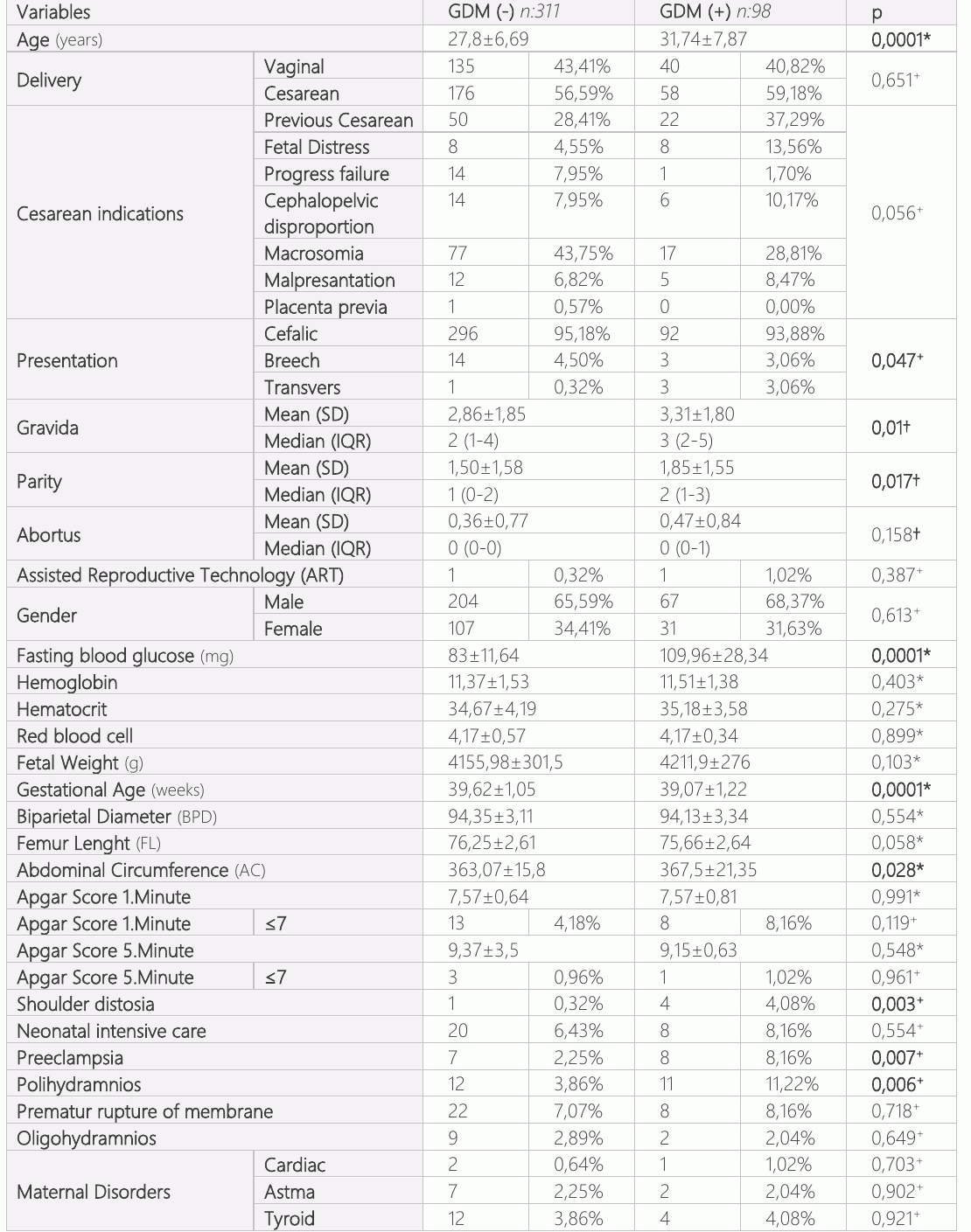
However, transverse presentation in the GDM (+) was significantly higher than in the GDM(-) group (p=0.047). Gravida and parity values of the GDM(+) group were found to be statistically significantly higher than GDM(-)(p=0.01, and p=0.017, respectively). However, no significant difference was observed for the frequency of miscarriages (p=0.158). A statistically significant intergroup difference was not observed as for distributions of ART applications, genders of the babies born in GDM(-) and GDM(+), average values of fetal weights, maternal hemoglobin, hematocrit, and RBC (p=0.387,p=0.613,p=0.103, p=0.403, p=0.275, and p=0.899, respectively). The birth week averages of the GDM(+) group were found to be statistically significantly lower than the GDM(-) group (p=0.0001).
A significant difference was not observed in BPD, FL between the GDM(-) and GDM(+) (p=0.554, and p=0.058, respectively). However, the AC average of the GDM(+) were statistically significantly higher than the GDM(-) (p=0.028). No significant difference was observed between the 1st, and 5 minute of Apgar Score and NICU stay between the GDM(-) and GDM(+) groups (p=0.991, p=0.548, and p=0.554, respectively) Any significant difference was not observed in the frequency of maternal disorders, PROMand oligohydramnios between both groups.
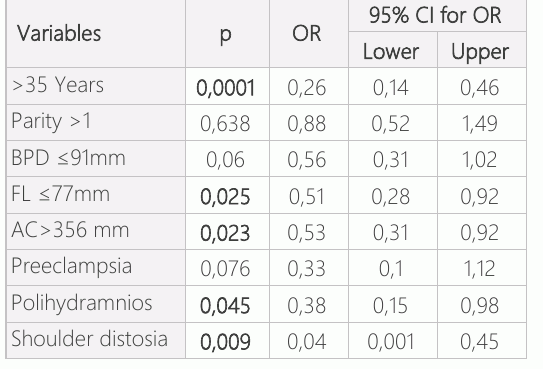
Frequencies of preeclampsia, polyhydramnios, and shoulder dystocia were significantly higher in the GDM(+) group relative to the GDM(-) (p=0.007, p=0.006, and p=0.004, respectively). Receiver operator characteristic (ROC) curves were formed to determine cut-off values for age, parity, BPD, FL, and AC. In the presence of GDM, cut-off values were determined with the area under the ROC curve (AUC) analysis for age (>35), parity (>1), BPD (≤91mm), FL (≤77 mm), and AC (>356 mm) as indicated (Table 2). In the present study, the multivariate analysis was performed to adjust the effect of some confounding variables related to macrosomia with GDM. The results of regression analysis showed that indicated cut-off values for age (>35 years), FL (≤77 mm), and AC (>356 mm), and the presence of polyhydramnios and shoulder dystocia could be associated with diabetic mothers who delivered macrosomic babies (Table 3). Age (>35), FL (≤77 mm), AC (>356 mm), polyhydramnios, and shoulder dystocia were determined as effective factors on fetal macrosomia (p=0.0001, p=0.025, p= 0.023, p=0.045, and p=0.009, respectively).

Discussion
Macrosomia is a condition that may lead to maternal and fetal adverse obstetric outcomes. In our study, we aimed to investigate the effect of gestational diabetes on maternal and fetal outcomes in macrosomia. Therefore, we compared the pregnant women with and without GDM. We found that maternal age, parity, and fetal ultrasonographic measurement during delivery are important parameters for GDM. Moreover, we observed the frequency of preeclampsia, polyhydramnios, and shoulder dystocia increased significantly with GDM. The prevalence of macrosomia varies in studies. In the study of Vinturache et al., the prevalence of fetal macrosomia in pregnant women has been reported as 6%-10%(10). In a retrospective study with Turkish women, the rate of delivering macrosomic babies was 6.21% and the rate of delivering babies weighing ≥4500g was 1.04% (11). In our study, the rate of macrosomia among all deliveries was found to be 2 % Some metabolic changes occur with increasing age, and hormonal factors stimulate fetal development in older pregnant women. This condition may lead to fetal macrosomia. Maternal age is correlated with anthropometric measurements, and fetal macrosomia increases 3 times in women over 35 years of age (11). In our study, in the GDM group 38.78%, and the non-GDM group 12.54% of the pregnant women were older than 35 years and when 35 years of age was accepted as the cut-off value in the ROC curve, the frequency of GDM in macrosomia increased significantly. Also in logistic regression analysis, this cut-off value was determined as an effective factor in GDM [OR 0.26, 95% CI (0.14-0.46), p:0001], Many studies have shown that the risk of giving birth to macrosomic babies increases with multiparity. In a study conducted in Cameroon, the researchers showed that the risk increased in those with parity 3 and above (12). In our study, we found the risk of GDM increased in pregnant women who had macrosomic babies when the parity was above 1. It is known that macrosomia is more common in male babies (13). In the study of Kraïem et al., 70% of babies with a birth weight of >4500 g were found to be male, whereas 51% of all newborns were male(14). In our study, following literature data, male gender was significantly more common in macrosomic newborns delivered in both non- GDM, and GDM groups. However, it was found that GDM did not increase the incidence of giving birth to male babies.
Macrosomia is 4 times more encountered in deliveries occurring after 40th gestational weeks (15). In our study, the gestational week at delivery was prolonged in the pregnant without GDM. Relatively shorter gestational week at delivery in the GDM group can be explained by the fact that earlier induction or cesarean decision can be made by being afraid of increasing risk factors in GDM.
Many studies have demonstrated the close relationship between gestational diabetes and macrosomia, and gestational diabetes has been indicated as the most important predictor for macrosomia. In the study of Hyperglycemia and Adverse Pregnancy Outcomes (HAPO), the researchers reported a relationship between maternal blood glucose levels and increased birth weight (3, 16).
In studies conducted in Iran and China, fasting blood glucose levels were found to be significantly higher in those who gave birth to macrosomic babies (17, 18). In our study, fasting blood glucose levels were found to be significantly higher in mothers with GDM who gave birth to a macrosomic baby compared to the group without GDM (p:0.0001). Biri et al. stated that moderate hyperglycemia poses a risk for fetal macrosomia, as well as neonatal hypoglycemia and hyperbilirubinemia (19). The incidence of cesarean deliveries increases significantly in macrosomic fetuses (20). Elective induction of labor before or near term has been proposed to prevent macrosomia and its complications. Also in our study rates of cesarean deliveries were markedly higher. However, pulmonary maturity is delayed in fetuses of diabetic mothers, and maturity is achieved at nearly 38.5 weeks of gestation Therefore, the timing of labor induction should be determined very precisely (21). Elective cesarean option can be offered to the mother when we think that it is a macrosomic fetus. However, it may not always be possible to diagnose macrosomia by determining fetal weight accurately using ultrasonography(22). In the study of Lee et al. abdominal circumference (AC) of the fetus especially when measured in the third trimester has been stated as a risk factor determinant for macrosomia irrespective of the severity of maternal glucose intolerance (23). In our study, fetal AC was higher in patients with GDM when compared with those without GDM group. (p:0.028). Bethune et al. suggested that the combined use of abdominal fat mass and AC measurements may improve the prediction of fetal macrosomia in pregnancies complicated with GDM (24).
In the study by Stanirowski et al., the predictive value of AC for GDM was emphasized, and higher values of BPD, and FL were obtained in the group without GDM compared to the patients with GDM and type-1 DM whose glycemic levels were controlled with diet (25). Our study results are also consistent with this study data. In our study, unlike previous studies, we calculated cut-off values for macrosomia in mothers with GDM using BPD, FL, and AC values measured just before delivery. In the presence of GDM, using the area under the ROC curve (AUC) analysis, cut-off values for BPD (≤91mm), FL (≤77mm), and AC (>356 mm) were specified as indicated. The incidence of shoulder dystocia, birth trauma, and asphyxia increased when the birth weight was ≥4000 g and birth weights of ≥4500 g were associated with significantly increased rates of morbidity and mortality due to shoulder dystocia (11, 26). In our study shoulder dystocia was significantly more frequent in the group with GDM. In the logistic regression analysis, shoulder dystocia was found to be an effective factor in patients with GDM (p:0.009). In the study of Weissmann- Brenner et al., the risk of shoulder dystocia increased 7.6 times if birth weight was ≥4500g (27). In a study comparing newborns with birthweights ≥4000 g, and <4000 g, has been demonstrated that the incidence of shoulder dystocia and brachial plexus injury increased 6- 7 times in the macrosomics in nondiabetics, while it increased 10 times in DM (28).
Neonatal intensive care is more frequently required for macrosomics. Hyperbilirubinemia and hypoglycemia are common in these babies (17). In the study of Opati et al., respiratory distress was found to be the most common morbidity affecting 52.6% of the diabetics, and 40.7% of the nondiabetic mothers who gave birth to macrosomic babies (29). In our study hospitalization in the NICU was required by 6.43%, and 8.16% of the cases in the non- GDM, and GDM groups, respectively without any statistically significant intergroup difference. In many studies preeclampsia seen in mothers who had macrosomic babies was associated with GDM (3, 30). Following the literature data, in our study, we encountered preeclampsia more often in mothers with GDM than those without (8.16% vs 2.25%).
We acknowledge that this study has some limitations. Data related to socioeconomic status, education status of the mother, maternal body mass index, pre-pregnancy weight, nutritional status werenot analyzed in the study. Macrosomic baby is an important risk factor in pregnant women with or without GDM. Most of the macrosomic newborns are delivered by non-GDM pregnant women. In cases where fetal weight is thought to be over 4000 gr, the mode of delivery should be decided considering perinatal morbidity. Maternal age, fasting blood glucose concentration, parity are important in pregnant women with GDM. Also, adverse obstetric outcomes such as shoulder dystocia, polyhydramnios, and preeclampsia are more common in macrosomia associated with GDM. One of the most striking points in our study is an increase in AC but a decrease in BPD and FL values in macrosomic fetuses born to mothers with GDM compared to the macrosomic non-GDM patient group. Early identification of macrosomia is important to prevent maternal and fetal complications. Our study was conducted with a remarkably higher number of pregnant women, but multicenter prospective studies are needed to better evaluate perinatal outcomes.
Declarations
- Author contributions (CRediT)
- All authors contributed equally to all 14 CRediT roles (Conceptualization, Data curation, Formal analysis, Funding acquisition, Investigation, Methodology, Project administration, Resources, Software, Supervision, Validation, Visualization, Writing – original draft, Writing – review & editing).
- Funding
-
All authors declare that there are no sources of funding.
- Conflicts of interest
- All authors declare no conflict of interest.
- Ethics approval
- The study was performed in line with the Declaration of Helsinki. Approval was granted by the Ethics Committee of the University of Health Sciences, Prof.
- Data availability
- A data availability statement was not reported in the published version of this article.
References (30)
26 of 30 references are linked to their DOI.
- Asplund CA, Seehusen DA, Callahan TL, Olsen C. Percentage change in antenatal body mass index as a predictor of neonatal macrosomia. Ann Fam Med. 2008;6(6): 550-4 DOI Crossref PubMed Google Scholar
- Ng SK, Olog A, Spinks AB, Cameron CM, Searle J, McClure RJ. Risk factors and obstetric complications of large for gestational age births with adjustments for community effects: results from a new cohort study. BMC Public Health. 2010;6; 10:460 DOI Crossref PubMed Google Scholar
- Abolfazl M, Hamidreza TS, Narges M, Maryam Y. Gestational diabetes and its association with unpleasant outcomes of pregnancy. Pak J Med Sci 2008;24(4):566-70 PubMed Google Scholar
- Ahmed SR, Ellah MA, Mohamed OA, Eid HM. Prepregnancy obesity and pregnancy outcome. Int J Health Sci (Qassim). 2009;3(2):203-8 PubMed Google Scholar
- Bamberg C, Hinkson L, Henrich W. Prenatal detection and consequences of fetal macrosomia. Fetal Diagn Ther. 2013;33 (3):143-8 DOI Crossref PubMed Google Scholar
- Hermann GM, Dallas LM, Haskell SE, Roghair RD. Neonatal macrosomia is an independent risk factor for adult metabolic syndrome. Neonatology. 2010;98(3):238-44 DOI Crossref PubMed Google Scholar
- Strehlow S, Uzelac P. Complications of labour and delivery. Current Obstetrics and Gynecology, Diagnosis and Treatment. New York: The McGraw-Hill Companies Inc; 2007. pp. 432–40 PubMed Google Scholar
- Committee on Practice Bulletins—Obstetrics. ACOG Practice Bulletin No. 190: Gestational Diabetes Mellitus. Obstet Gynecol. 2018;131(2):e49 -e64 DOI Crossref PubMed Google Scholar
- Brown MA, Lindheimer MD, de Swiet M,etal.The classification and diagnosis of the hypertensive disorders of pregnancy: Statement from the International Society for the Study of Hypertension in Pregnancy (ISSHP). Hypertens Pregnancy 2001;20:9 -14 DOI Crossref PubMed Google Scholar
- Vinturache AE, Chaput KH, Tough SC. Pre-pregnancy body mass index (BMI) and macrosomia in a Canadian birth cohort. J Matern Fetal Neonatal Med. 2017;30(1):109-116 DOI Crossref PubMed Google Scholar
- Oral E, Cağdaş A, Gezer A, Kaleli S, Aydinli K, Oçer F. Perinatal and maternal outcomes of fetal macrosomia. Eur J Obstet Gynecol Reprod Biol. 2001;99(2):167-71 DOI Crossref PubMed Google Scholar
- Nkwabong E, Nzalli Tangho GR. Risk Factors for Macrosomia. J Obstet Gynaecol India. 2015;65(4):226-9 DOI Crossref PubMed Google Scholar
- Fuchs F, Bouyer J, Rozenberg P, Senat MV. Adverse maternal outcomes associated with fetal macrosomia: what are the risk factors beyond birthweight? BMC Pregnancy Childbirth. 2013;8;13:90 DOI Crossref PubMed Google Scholar
- Kraïem J, Chiha N, Bouden S, Ounaïssa F, Falfoul A. L'accouchement du macrosome de 4500 g et plus. A propos de 61 cas -The delivery of macrosomic infants weighing 4500g and more. A report of 61 cases. Tunis Med. 2004;82(7):656-61 180 77 Fetal Macrosomia Genc et al. PubMed Google Scholar
- Ju H, Chadha Y, Donovan T, O'Rourke P. Fetal macrosomia and pregnancy outcomes. Aust N Z J Obstet Gynaecol. 2009; 49(5):504-9 DOI Crossref PubMed Google Scholar
- HAPO Study Cooperative Research Group, Metzger BE, Lowe LP, Dyer AR, Trimble ER, Chaovarindr U, Coustan DR, Hadden DR, McCance DR, Hod M, McIntyre HD, Oats JJ, Persson B, Rogers MS, Sacks DA. Hyperglycemia and adverse pregnancy outcomes. N Engl J Med. 2008;358(19):1991-2002 DOI Crossref PubMed Google Scholar
- Mohammadbeigi A, Farhadifar F, Soufi Zadeh N, Mohammad salehi N, Rezaiee M, Aghaei M. Fetal macrosomia: risk factors, maternal, and perinatal outcome. Ann Med Health Sci Res. 2013;3(4):546-50 DOI Crossref PubMed Google Scholar
- Shi P, Yang W, Yu Q, Zhao Q, Li C, Ma X, Jin L, Han X, Zhang Y, Yan W. Overweight, gestational weight gain and elevated fasting plasma glucose and their association with macrosomia in chinese pregnant. Matern Child Health J. 2014;18(1):10-15 DOI Crossref PubMed Google Scholar
- Biri A, Korucuoglu U, Ozcan P, Aksakal N, Turan O, Himmetoglu O. Effect of different degrees of glucose intolerance on maternal and perinatal outcomes. J Matern Fetal Neonatal Med. 2009;22(6):473-8 DOI Crossref PubMed Google Scholar
- Navti OB, Ndumbe FM, Konje JC. The peri -partum management of pregnancies with macrosomic babies weighing > or =4,500 g at a tertiary University Hospital. J Obstet Gynaecol. 2007;27(3):267-70 DOI Crossref PubMed Google Scholar
- Friesen CD, Miller AM, Rayburn WF. Influence of spontaneous or induced labor on delivering the macrosomic fetus. Am J Perinatol. 1995;12(1):63-6 DOI Crossref PubMed Google Scholar
- Combs CA, Rosenn B, Miodovnik M, Siddiqi TA. Sonographic EFW and macrosomia: is there an optimum formula to predict diabetic fetal macrosomia? J Matern Fetal Med. 2000;9(1):55- DOI Crossref PubMed Google Scholar
- Lee BH, Park TC, Lee HJ. Association between fetal abdominal circumference and birthweight in maternal hyperglycemia. Acta Obstet Gynecol Scand. 2014;93(8):786-93 DOI Crossref PubMed Google Scholar
- Bethune M, Bell R. Evaluation of the measurement of the fetal fat layer, interventricular septum and abdominal circumference percentile in the prediction of macrosomia in pregnancies affected by gestational diabetes. Ultrasound Obstet Gynecol. 2003;22(6):586-90 DOI Crossref PubMed Google Scholar
- Stanirowski PJ, Majewska A, Lipa M, Bomba-Opoń D, Wielgoś M. Ultrasound evaluation of the fetal fat tissue, heart, liver and umbilical cord measurements in pregnancies complicated by gestational and type 1 diabetes mellitus: potential application in the fetal birth-weight estimation and prediction of the fetal macrosomia. Diabetol Metab Syndr. 2021;13(1):22 DOI Crossref PubMed Google Scholar
- Zhang X, Decker A, Platt RW, Kramer MS. How big is too big? The perinatal consequences of fetal macrosomia. Am J Obstet Gynecol. 2008;198(5):517.e1-6 DOI Crossref PubMed Google Scholar
- Weissmann-Brenner A, Simchen MJ, Zilberberg E, Kalter A, Weisz B, Achiron R, Dulitzky M. Maternal and neonatal outcomes of macrosomic pregnancies. Med Sci Monit. 2012; 18(9):77-81 DOI Crossref PubMed Google Scholar
- Esakoff TF, Cheng YW, Sparks TN, Caughey AB. The association between birthweight 4000g or greater and perinatal outcomes in patients with and without gestational diabetes mellitus. Am J Obstet Gynecol. 2009;200(6):672-4 DOI Crossref PubMed Google Scholar
- Opati P, Zheng R, Wang J, Xin Y, Zhao H, Bi D. Comparison of neonatal outcomes in macrosomic infants of diabetic and non-diabetic mothers. J Neonatal Perinatal Med. 2015 Mar 10 DOI Crossref PubMed Google Scholar
- Hermann GM, Dallas LM, Haskell SE, Roghair RD. Neonatal macrosomia is an independent risk factor for adult metabolic syndrome. Neonatology. 2010;98(3):238-44 DOI Crossref PubMed Google Scholar
Read the full text
Open the PDF here
Loading the PDF…
If the PDF does not show here, use the download button above.
How to cite this article
Genc S, Sahin O. Fetal Macrosomia: Ultrasonographic Parameters and Associated Risk Factors in Pregnancies with and without Gestational Diabetes Mellitus. Ulutas Med J. 2021;7(3):172-180. doi:10.5455/umj.20210710071617
Genc, S., & Sahin, O. (2021). Fetal Macrosomia: Ultrasonographic Parameters and Associated Risk Factors in Pregnancies with and without Gestational Diabetes Mellitus. The Ulutas Medical Journal, 7(3), 172–180. https://doi.org/10.5455/umj.20210710071617
Genc, S. and Sahin, O. (2021) 'Fetal Macrosomia: Ultrasonographic Parameters and Associated Risk Factors in Pregnancies with and without Gestational Diabetes Mellitus', The Ulutas Medical Journal, 7(3), pp. 172–180. doi: 10.5455/umj.20210710071617.