The Ulutas Medical Journal · ISSN 2149-0430 (print), 2149-388X (online) · https://www.ulutasmedicaljournal.com/?mno=82248
Original Article · Open access
Evaluation of Poisoning Cases Admitted to the Emergency Service of a District State Hospital
- Bigadic State Hospital, Balikesir Turkiye ROR
- Firat University Medical School, department of Public health ROR
Abstract
- Introduction
- Poisoning is the emergence of unwanted signs and symptoms in an organism after exposure to potentially harmful chemical, physical, or organic materials. We performed this study to evaluate the cases admitted to the emergency service due to poisoning.
- Materials and Methods
- This descriptive study included 167 poisoning cases who were admitted to Bigadic State Hospital Emergency Service. We retrospectively assessed the patients by using forms of poisoning after obtaining the necessary permits.
- Results
- The gender of 56.3% of the cases were female. Besides, 53.5% of the patients admitted within a day during the study period were women. The poisoning incident was for suicidal purposes in 17.4% of patients. However, %80.8 of poisoning cases were accidental.
- Conclusion
- As a result, our study is remarkable for demonstrating poisoning events to be seen as more frequent and to have a critical place, especially in forensic cases in our region. The higher frequency of suicide attempts by self-poisoning among young women was striking. We, moreover, determined accidental poisoning cases to be more prevalent in childhood.
Keywords
Full text
Introduction
Poisoning has been one of the critical problems which are closely related to societies since ancient times (1). Since any chemical, physical, or organic matter ingested, inhaled, absorbed, or injected, even in small quantities, can damage structures of the tissues and destroy functions of them, this substance and the event are then called poison and poisoning (2). The term "poison" was first described in the literature as drugs and elixirs prepared from deadly substances in 1230 BC. The history of poisons and poisoning, however, dates back to thousands of years and is thought to be based on Ebers Papyrus, written circa 1550 BC. For centuries, from political assassinations of the Romans to contemporary environmental health, poisons played an essential role in the history of humanity (3). Poisonings can result in severe consequences, depending on the toxic agent and the duration of the time to hospital presentation (4).
Poisonings, constituting a significant part of the emergency service admissions occur with accidental or suicidal purposes, as a result of taking medications and other chemicals by oral intake, inhalation, or injection. Different disciplinary approaches may be required in association with the way of the intake. Early and correct intervention is essential in all poisonings. Epidemiological studies in Turkey reveals that poisoning cases constitute 0.7-5% of all the emergency service admissions (5–7). We more frequently encounter accidental poisoning under six years of age, whereas suicidal poisoning is more frequently observed during puberty, where the spiritual changes become evident.
Poisoning cases can clinically have clinical features ranging from gastrointestinal symptom (nausea, vomiting, abdominal pain, diarrhea) to cardiac (arrhythmia, chest pain, cardiac arrest) and neurological symptoms (changes in consciousness, seizure,coma). These symptoms and findings may present variability with the structure, effectiveness of the toxic substance, and duration of time to start an intervention. Poisoning cases show regional differences in terms of demographic characteristics and poisoning type, and toxic agents they are exposed (8). These toxic agents leading to poisoning may also show variability depending on the region been lived, the customs and traditions of the society, the level of education, and the seasons (9).
This study was performed to examine cases that were admitted to the Emergency Service of Balıkesir Bigadic District State Hospital due to poisoning. We also aimed to determine the characteristics of the region about poisoning.
Materials and Methods
This descriptive study included all 167 cases admitted to the Emergency Department of Balıkesir Bigadic District State Hospital, as a result of poisoning, between June 2012 and June 2013, when a total of 35752 admissions were made.
Emergency service poisoning forms were reviewed by obtaining necessary permissions retrospectively. Cases were evaluated in terms of age, gender, time of hospital presentation, cause, and type of poisoning, complaints at hospital presentation, interventions performed for preventing poisoning and clinical outcomes in the emergency service (discharge, referred, hospitalization, death, etc.). Statistical analysis of the data was done by the SPSS v19 (Statistical Package for Social Science) package program. Percentage, average, and chi-square tests were used to evaluate the data.
Results
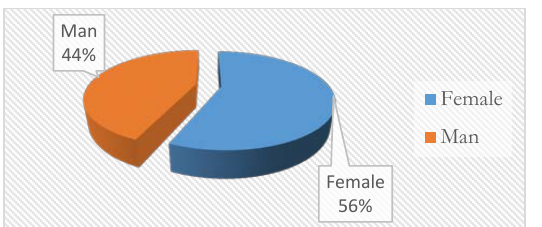
The ratio of poisoning cases admitted to the emergency room to total patients was found to be 0.5%. During the study period, of 167 poisoning cases, 56.3%(n:94) were women, and 43.7% (n:73) were men (Figure-1).
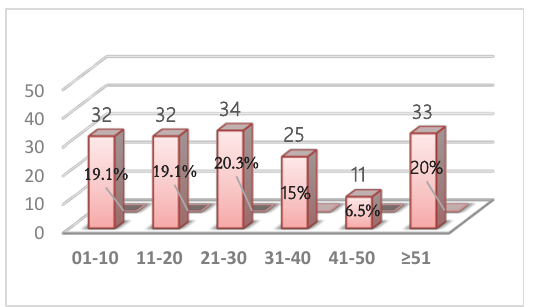
The mean age of the cases was 29.46± 19.6 years (lowest: 1 year, highest: 85 years). Age distributions are given in Figure-2. It was determined that 17.4% (n:29) of the poisoning cases were caused by suicidal, 80.8% (n:135) of exposure - accident, 1.8% (n:3) of unknown reason. The mean age of the patients who presented with the reason for exposure-accident was 30.74±21.3.
As seen in Figure-3, poisoning cases emerged from animal bites ranked first among the causes of poisoning, with 37.1% (n:62). We observed that scorpion stings, in poisoning cases due to animal bites, instituted an essential group with 80.65% (n:50) of admission, and 84% (n:42) of those occurred in the summer months. When poisoning cases were evaluated according to the time of hospital presentation, 59.3% (n:99) of them were determined to present at night. Of the patients who presented during the daytime, 53.5% (n:53) and 46.5% (n:46) were women and men, respectively.
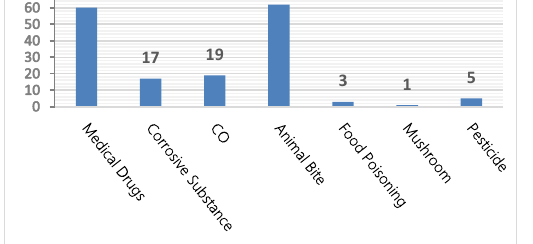
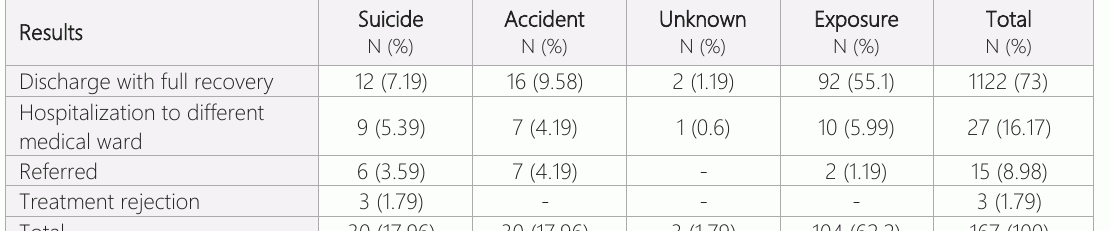
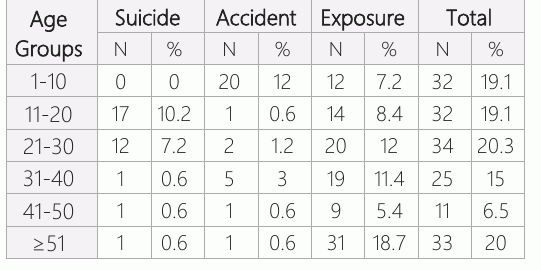
Medical drugs ranked first with 90.6% (n:29) among the toxic agent exposures in poisonings with suicidal purposes. The mean age was 20.09±3.6 for women and 18.71±1.9 for men in suicidal poisonings. The causes of poisoning, according to age groups, are shown in Table-1. We identified the time of hospital presentation to be at night in 72% (n:18) of women in poisoning cases with suicidal purposes. Hospital presentations were occurred most commonly in spring-summer with 70.1% (n:117), while at least in winter, with 29.9% (n:50). In 10.8% (n:18), 24.5% (n:41), 6% (n:10), 36.5% (n:61), 4.8% (n:8), 6% (n:10) and, 11.4% (n:19) of poisoning cases, respectively, vomiting, nausea, abdominal pain-diarrhea, pain (bite site), blurring of conscious ness, dyspnea-palpitations, and hypotension were detected to be as complaints at hospital presentation. In the emergency department, 73.06% (n:122) of the cases were discharged with full recovery, 16.1% (n:27) were admission to different service, 8.98% (n:15) were referred to a higher level hospital. 1.79% (n:3) of cases refused treatment (Table-2).
Discussion
Poisoning is accepted as a crucial public health problem that constitutes an important part of emergency service admissions, requires a serious approach, and strongly responds to treatment.
Although the rate of emergency service admission due to poisoning shows differences in several studies performed in our country, this rate varies between 0.7-5% (1, 5). Yavuz et al. reported poisoning cases to constitute 1.2% of emergency cases and 22.53% of forensic cases. Of those cases, 228 (63.2%) were female, and 133 (36.8%) were male. Male/female ratio was 0.58 (10). In the study of Özköse et al., it was demonstrated that for 180 cases of acute poisoning admitted to the emergency department within a year, the ratio of women to men had been 3: 1 and percentage of the patients under 25 years had been 63.6. Besides, medical drugs were found to be a major cause of acute poisoning, with a rate of 75.9% (11). Deniz et al. stated the ratio of poisoning cases admitted to the emergency department to the total patients, to be 1.78% in their survey; also a total of 497 poisoning cases, including 262 women and 235 men, were admitted to the emergency service during the study period (12). Following the studies mentioned above, poisoning cases constituted 0.5% (n: 167) of the emergency service admissions in our study. Our hospital’s rate of emergency service admission due to the poisoning during a one-year-period, so, did not differ from the rate of other hospitals.
In studies conducted in our country, it was also observed that poisoning cases admitted to the emergency department had been mostly women, and their mean age had been below 25 years (13–15). In our study, women created 56.3% (n:94) of the study patients. The mean age of them was 31.22±19. Gender and age distribution of poisoning cases in our study is, therefore, similar to those studies performed in our country. Yeşil et al.'s research involved cases where 83 were female (56.5%), and 64 (43.5%) were male. The ages of them ranged between 18 and 74, and the mean age was 34.91±14.64. Besides, the mean age of women was 35.47±13.71, while that of men was 34.19±15.85 (2). In another study conducted by Çetin et al., poisoning cases constituted 1.7% of total hospital admissions, and 71 of them were female (71%), and 29 (29%) were male (16). Several studies performed from different regions of our country also reported that women and younger age groups created the majority of the cases, similar to our study findings (2, 3, 6, 7).
The three most frequent causes of poisoning were drugs, CO inhalation, and nutrients in the study of Özköse et al. (11); drugs, nutrients, and CO inhalation in the study of Kavalcı et al. (13); drugs, food, and mushroom poisoning in the study of Yılmaz et al. (17); and those were drugs, organic phosphorus, and corrosive substances in the study of Ok et al. (18). Eliaçık et al., moreover, reported that the most frequent causes of poisoning had been medical drugs (50.6%, n:212), drinking corrosive substances (20.1%, n:91), carbon monoxide poisoning (16.6%, n:75), scorpion stings and snake bites (7.3%, n:33), hydrocarbons (2.4%, n:11) and pesticides (1.5%, n:7) (19). In our study, animal bites with 37.1%, drugs with 35.9%, and carbon monoxide with 11.4% ranked in the first three orders.
Karabulut et al.'s study included cases, of whom 40.5% admitted during daytime and 59.5% at night (20). In similar to that study, we, too, determined that 59.3% of poisoning cases had been admitted at night. Additionally, in our survey, among the patients admitted during the daytime, 53.5% (n: 53) were women, and 46.5% (n:46) were men.
In our study, when poisonings related to drug intake for suicidal purposes were evaluated, 17.4% of poisoning cases (n:29) had suicidal attempts and, 75.9% (n:22) were women. The assessment of poisoning cases with suicidal purposes revealed these results: The mean age of women was 20.09±3.6, and the time of hospital presentation was at night 90.9% (n:20). Yeşil et al. notified that the mean age of poisoning patients admitted to the emergency service due to suicide attempts were 29.89± 11.1, and 54 (68%) of them were female, and 25 (32%) were male. 40 (50.6%) cases and 39 (49.4%) cases were admitted during the daytime and at night, respectively (2). In the study of Deniz et al., 23.3% of all poisonings were with suicidal purposes, while 76.7% were accidental (12). Schwarz et al. found 114 (74%) of 155 patients with suicidal poisoning as female and 41 (26%) as male (21). Bille-Brahe et al. found the male/female ratio between 0.41 and 0.85 in suicides (22).
Akın et al. noted the most frequent clinical findings as follows:headache, dizziness, nausea, vomiting, change of consciousness abdominal pain, irritability, respiratory depression, cardiac arrhythmia or coma(23). In the study conducted by Karabulut et al., among patients who presented to the emergency service, 27.3% had nausea, 24% had vomiting, 44.6% had consciousness, 39.7% had hypotension, and 26.4% had palpitations (20). In similar to the findings of the studies performed by Akın et al. and Karabulut et al., we observed in the present study the following complaints: vomiting (10.8% (n:18)), nausea (24.5% (n:41)), abdominal pain-diarrhea (6% (n:10)), pain (bite site) (36.5% (n:61)), blurring of consciousness (4.8% (n:8)), shortness of breath - palpitations (6% (n:10)), and hypotension (11.4% (n: 19)).
In the study of Kavalcı, 76.2% of the cases were treated as an outpatient, and 20.8% were hospitalized. Gökben et al. reported that the majority (87%) of the patients had been hospitalized to intensive care; also, 13% had been discharged after being followed up and treated in the emergency service (13). In the study of Ok et al., 62% (31) cases were treated by being outpatients, and 26% by being hospitalized to the intensive care unit (19). In our study, while 73.6% (n:122) of poisoning cases admitted to the emergency service were discharged after being treated as outpatients, 16.2% (n:27) were hospitalized, and 9.1% (n:15) were referred to a higher level hospital.
Conclusion
As a result, regardless of whether an acute poisoning is occurred accidental or for suicidal purposes, it is a significant health and social problem. The data obtained from our study are similar to the findings of previously conducted studies in Turkey.
Strikingly, the poisoning cases that occurred in our region had a significantly higher rate in forensic cases. Whereas accidental poisoning cases were more frequently seen in childhood, suicidal attempts of poisoning cases were remarkably elevated in young women. We also observed the poisoning cases due to animal bites were increased in the spring-summer. The causes of scorpion stings to be high in our study is that the scorpions in the southeast Marmara region have high toxic effects, and the public is not informed enough in this region. It can be predicted that acute poisoning cases would be decreased by the attitudes of adults with exhibiting a more sensitive approach to the problems of adolescents who have remarkable high suicide attempts and by raising awareness of the society about this issue.
Declarations
- Author contributions (CRediT)
- All authors contributed equally to all 14 CRediT roles (Conceptualization, Data curation, Formal analysis, Funding acquisition, Investigation, Methodology, Project administration, Resources, Software, Supervision, Validation, Visualization, Writing – original draft, Writing – review & editing).
- Funding
-
Funding information was not reported in the published version of this article.
- Conflicts of interest
- The authors have declared no conflict of interest for the present article.
- Ethics approval
- Ethics approval details were not reported in the published version of this article.
- Data availability
- A data availability statement was not reported in the published version of this article.
References (23)
4 of 23 references are linked to their DOI.
- Chirasirisap K, Ussanawarong S, Tassaneeyakul W, Reungsritrakool W, Prasitwatanaseree W, Sripanyawit U, et al. A study of major causes and types of poisoning in Khonkaen, Thailand. Vet Hum Toxicol 1992;34:489-492 PubMed Google Scholar
- Yeşil O, Akoğlu H, Onur Ö, Güneysel Ö. Acil servise başvuran olguların geriye dönük analizi. Marmara medical journal 2008;21(1):26-32 PubMed Google Scholar
- Wax. PM. Historica lprinciples and perspectives. In:Goldfrank LR, Flomenbaum NE, Lewin NA, WeismanRS, Howland MA, Hoffman RS, eds. Goldfrank’sToxicologic Emergencies, 7th ed., USA, The McGraw-Hill Companies. 2002. p. 1 -17 PubMed Google Scholar
- Şenol V, Yıldırım C, Sözüer E, Öztürk Y. Homisid ve suisid hastalarının acil servisteki epidemiyolojisi. Acil Tıp Dergisi 2002;2(2):18-23 PubMed Google Scholar
- Mert E, Bilgin NG. Demographical, etiological and clinical characteristics of poisonings in Mersin, Turkey. Hum ExpToxicol 2006;25:217–23 DOI Crossref PubMed Google Scholar
- Karakaya A, Vural N. Acute poisoning admissions in one of the hospitals in Ankara. Hum Toxicol 1985; 4:323-6 DOI Crossref PubMed Google Scholar
- Arisoy N, Aji DY. Poisoning. In: Onat T, ed. Child Health and Diseases. Istanbul: Eksen Publications; 1996. p. 1037 -1055 PubMed Google Scholar
- Kurt I, Erpek AG, Kurt MN, Gürel A. The poisoning cases observed at Adnan Menderes University. ADU Faculty of Medicine Journal 2004;5:37-40 PubMed Google Scholar
- Oner N, Inan M, Vatansever U, Turan C, Celtik C, Kucukugurluoglu Y, et al. (2004). Poisonings seen in children in Trakya region. Turkish Pediatry Archives 2004;39:25-30 PubMed Google Scholar
- Yavuz M Sunay, Aydin Serpil. The profile of the poisoned cases. The Turkish Journal of Toxicology 2003;1(1):47-52 PubMed Google Scholar
- Ozkose Z, Ayoglu F. Etiological and demographic characteristics of acute adult poisoning in Ankara, Turkey. Hum ExpToxicol 1999;18:614-618 DOI Crossref PubMed Google Scholar
- Deniz T, Kandis H, Saygun M, Büyükkocak U, Ulger H, Karakus A. An analysis of poisoning cases applied to Kırıkkale University Medical Faculty emergency department. Duzce Medical Faculty Magazine 2009;11(2):15-20 PubMed Google Scholar
- Kavalcı C, Durukan P, Cevik Y, Ozer M, Ikizceli I. Analysis of poisoning cases: a yearlong experience of a new hospital. Turkey Emergency Medicine Journal 2006;6:163-1664 PubMed Google Scholar
- Gunduz A, Kesen J, Topbas M, Narci H, Yandi M. Analysis of patients who applied for emergency services due to suicide poisoning. TAF Preventive Medicine Bulletin 2004;3(10):234-42 PubMed Google Scholar
- Gokben Cetin N, Beydilli H, Tomruk O. Retrospective analysis of intoxication cases applied to the emergency department. S.D.U. Faculty of Medicine. Bull 2004;11:7-9 PubMed Google Scholar
- Cetin GN, Beydili H, Tomruk O. Retrospective analysis of intoxication cases applied to the emergency department. SDU Faculty of Medicine Journal 2004;11:7-9 PubMed Google Scholar
- Yilmaz A, Kukul Guven F, Korkmaz I, Karabulut S. Retrospective analysis of acute poisonings in the emergency department. C.U.Medical Magazine 2006;28:21-26 PubMed Google Scholar
- Ok G, Erbuyun K, Mirzai T, Vatansever D, Tok D. Retrospective evaluation of poisoning cases applied to the emergency service ". Journal of Toxicology 2006;4:5-9 PubMed Google Scholar
- Eliacik K, Kanik A, Karanfil O, Rastgel H, Metecan A, Oyman G, et al. An evaluation of the admissions to a tertiary hospital pediatric emergency department with intoxication. Smyrna Tıp Dergisi 2012;2(1):41-4 PubMed Google Scholar
- Karabulut N, Celik Z, Atalay C. A Retrospective Analysis of Intoxication Cases at Artvin State Hospital. EAJM 2007;39:198- PubMed Google Scholar
- Schwarz UI, Ruder S, Krappweis J, Israel M, Kirch W. Epidemiology of attempted suicide using drugs. An inquiry from the Dresden University Clinic. Dtsch Med Wochenschr 129;(31-32):1669-1663 PubMed Google Scholar
- Bille-Brahe U, Kerkhoff A, De Leo D, Schmidtke A, Crepet P. A repetition-prediction study of European parasuicide populations: a summary of the first report from part II of the WHO/EURO Multicentre Study on Parasuicide in co-operation with the EC concerted action on attempted suicide. Acta Psychiatr Scand 1997;95(2):81-6 DOI Crossref PubMed Google Scholar
- Akin D, Tuzun Y, Cil T. Profile of the acute poisoning cases in the Southeast of Turkey. Dicle Medical Journal 2007;34:195- PubMed Google Scholar
Read the full text
Open the PDF here
Loading the PDF…
If the PDF does not show here, use the download button above.
How to cite this article
Tasdemir RA, Oguzoncul AF, Kurt O. Evaluation of Poisoning Cases Admitted to the Emergency Service of a District State Hospital. Ulutas Med J. 2020;6(1):23-29. doi:10.5455/umj.20200116102151
Tasdemir, R. A., Oguzoncul, A. F., & Kurt, O. (2020). Evaluation of Poisoning Cases Admitted to the Emergency Service of a District State Hospital. The Ulutas Medical Journal, 6(1), 23–29. https://doi.org/10.5455/umj.20200116102151
Tasdemir, R.A., Oguzoncul, A.F. and Kurt, O. (2020) 'Evaluation of Poisoning Cases Admitted to the Emergency Service of a District State Hospital', The Ulutas Medical Journal, 6(1), pp. 23–29. doi: 10.5455/umj.20200116102151.