The Ulutas Medical Journal · ISSN 2149-0430 (print), 2149-388X (online) · https://www.ulutasmedicaljournal.com/?mno=41856
Original Article · Open access
Understanding the Effects of Obesity over Polycystic Ovary Syndrome by Analyzing Insulin Resistance and Thyroid Hormone in Different BMI Levels
- Medistate Hospital Gynecology and Obstetric Clinic, Istanbul, TURKEY
- Bahçeşehir Üniversitesi Göztepe Medikal Park Hastane Kopmleksi Kadın Hastalıkları ve Tüp Bebek Kliniği ROR
Abstract
- Introduction
- Individuals with polycystic ovary syndrome (PCOS) tend to exhibit insulin resistance and circulating levels of insulin higher than controls matched to obesity levels. The present study aimed to evaluate the hormonal alterations through body mass index (BMI) on the relationship between insulin, insulin resistance (IR), and thyroid hormone levels in PCOS.
- Materials and Methods
- This study is a retrospective clinical analysis study conducted at the department of gynecology and obstetrics between January 2019 and April 2020. PCOS participants were divided into two groups: 59 obese PCOS patients whose BMI value is equal and higher than 27kg/m2; 51 normal or overweight PCOS with BMI less than 27kg/m2.
- Results
- Age factor did not differ between groups (29.8±6 vs 31±7.2; p=0.345). In hormone tests, insulin (14.2±6.8 vs 14.8±8; p=0.688), Homeostatic Model Assessment for Insulin Resistance (HOMA-IR) (3.1±1.4 vs 3.4±1.8; p=0.344), thyroxine (T4)(1.2±0.5 vs 1.2±0.4) and thyroid-stimulating hormone (TSH)(1.9±1.2 vs 1.8±0.9; p=0.848) levels did not differ for BMI groups (p>0.05). Because there was no difference in laboratory comparison for any parameter we analyzed, we could not perform multivariate analysis for further investigations in terms of BMI factor. In the hematological analysis, we did not see any significant alteration for groups.
- Conclusion
- We did not observe any difference between thyroid and IR in the patients who were grouped according to the BMI. PCOS and obesity may be directly related to hormonal interaction rather than adipose tissue.
Keywords
Full text
Introduction
In addition to being a disease that manifests itself with chronic anovulation, menstrual irregularities and hyperandrogenism, Polycystic ovary syndrome (PCOS) can also exhibit its character with metabolic abnormalities. Obesity seen in the majority of PCOS patients is the most important indicator of this situation.
Individuals with PCOS tend to exhibit insulin resistance (IR) and circulating levels of insulin higher than controls matched to (body mass index (BMI) (1, 2). In this sense, in terms of clinical results, BMI follow-up and PCOS clinic follow-up are followed in a correlation in slightly overweight and obese individuals (3, 4). In the emergence of obesity, hormone-based pictures and diseases such as many thyroid disorders come to the fore (5).
Thyroid hormones, which play a key role in metabolism, show their metabolic effects through the hormone insulin. While acting as insulin agonists in muscle tissue, on the contrary, it can act as an antagonist in the liver (4, 6). In addition to being required in normal glucose balance, missing or excess thyroid hormone may cause a break that disrupts the balance (7). Thyroid imbalances have been linked to hyperlipidemia, increased storage fat, weight gain, increased testosterone, and aromatization to estradiol (8). It has been reported that especially hypothyroidism picture may cause an imbalance with its efficiency in glucose metabolism (9), so these patients may experience both hypoglycemia and (IR)(10). Hypothyroidism may affect gonadal functions of females and cause a delay in the transition of puberty and monthly cycles (11, 12). Based on the clinical studies conducted so far, it is pointed out that insulin and related thyroid hormone changes may affect or worsen PCOS picture by triggering IR (4, 13, 14). Although the prevalence of thyroid-related diseases was higher in women with PCOS than in the general population, there was no clear relationship between IR and thyroid dysfunction. In some studies, it has been reported that there is a decrease in androgen level with hormone supplementation and it is good for PCOS (15). It has been reported that, following metformin treatment, there is a decrease in thyroid-stimulating hormone (TSH) levels and benefit in PCOS patients (16).
In the present study, we aimed to evaluate the hormonal alterations through BMI on the relationship between insulin, insulin resistance, and thyroid hormone levels in PCOS groups that we categorized according to BMI levels.
Materials and Methods
Study Design
This study is a retrospective clinical analysis study conducted at Istanbul Medistate Hospital, Department of Gynecology and Obstetrics between January 2019 and April 2020.
Ethical Statement
The presented study was started after ethical approval was obtained (Date: 22/05/2020 - No: 2020/04-14) and approved by the institute review board of Maltepe University.
Patients‘ Collection and Groups
We included PCOS patients in the presence of two following criteria at least: ultrasound analysis (ovarian volume 10 cm3 or the presence of 12 antral follicles in the ovary), absent or irregular menstrual cycles, presence of hyper androgenism. Androstenedione higher than 3 ng/mL, or serum testosterone level higher than 0.6 ng/mL. Hirsutism and acne were accepted as hyperandrogenism. Exclusion criteria for the study were: any endocrine dysfunction, hyperprolactinemia, gestational state; a history of thyroid medication/surgery, and a history of diabetes medication. PCOS participants were divided into two groups: 59 obese PCOS patients whose BMI value is equal and higher than 27 kg/m2; 51 normal or overweight PCOS with BMI less than 27 kg/m2. A comparative analysis of all the PCOS patients was performed according to these two groups, hormonally and clinically.
Laboratory Analysis
All samples were immediately centrifuged in a refrigerated centrifuge in the test tubes containing heparin solution and stored at -20°C following the cold-chain until the analysis. TSH values were analyzed by the chemiluminescent microparticle immunoassay (Abbott, Ireland). Other hormonal tests were analyzed by electro chemiluminescence method (Roche, USA).
Statistical Analysis
All data statistical analysis was performed with SPSS v22.0 Microsoft Windows-based biostatistical analysis software. When using the Kolmogorov-Smirnov test to verify whether the data followed the expected distribution, all variables were found as distributed abnormally. Hence, the data obtained from the groups were compared using the Mann-Whitney U test. Correlations between insulin hormone, Homeostatic Model Assessment for Insulin Resistance (HOMA-IR), TSH and independent variables were evaluated using Spearman's rank correlation coefficient. P<0.05 was considered significant for the study.
Results
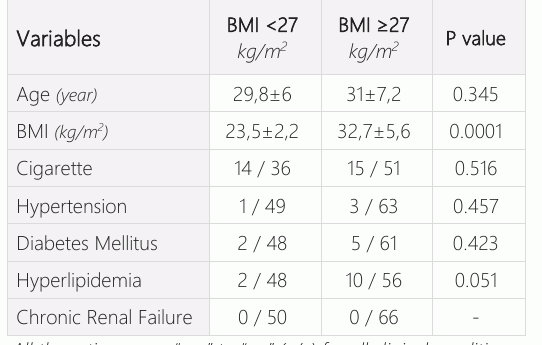
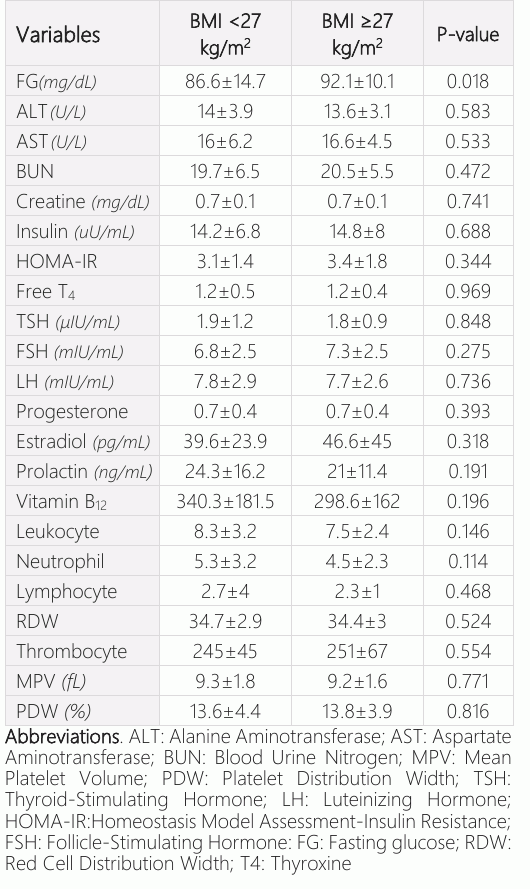
All PCOS patients were analyzed in two groups as normal weight and obese according to their BMI values that the demographic and clinical data of the patients are given in Table-1 in detail. Age factor did not differ between groups (29.8±6 vs 31±7.2; p=0.345). There was no significant difference in terms of chronic renal failure, diabetes mellitus, cigarette, hypertension, and hyperlipidemia (p>0.05). There was no laboratory sign for both groups in terms of systemic disorders in both groups. As given in Table-2, the only parameter that showed a difference was fasting glucose. In hormone tests, insulin (14.2±6.8 vs 14.8±8; p=0.688), thyroxine (T4) (1.2±0.5 vs 1.2±0.4), TSH (1.9±1.2 vs 1.8±0.9; p=0.848) and HOMA- IR (3.1±1.4 vs 3.4±1.8; p=0.344) levels did not differ for BMI groups (p>0.05). Because there was no difference in laboratory comparison for any parameter, we could not perform multivariate analysis for further investigations in terms of BMI factor. In the hematological analysis, we did not see significant alteration for groups. Mean platelet volume (MPV) and Platelet Distribution Width (PDW), known as inflammatory indicator parameters as reported in recent researches, were also similar in both groups.
Discussion
The present study analyzed the hormonal alterations through BMI on the relationship between insulin, IR, and thyroid hormone levels in PCOS. In our study, we did not observe any difference between both thyroid and IR in patients who were grouped according to BMI to understand the connection between obesity, diabetes and PCOS. Our findings suggest that PCOS and obesity may be directly related to hormonal interaction rather than adipose tissue.
Recent articles are published about the higher risk of developing coronary artery disease in individuals affected by thyroid disease (19). Tagliaferri et al. showed that thyroid hormone variations or imbalances can have effects on the reproductive endocrine system and metabolic characteristics. In their study, they found a direct significant relationship between TSH and fasting glucose level, but they could not provide sufficient explanation because few studies are showing its effect on glycemic levels (3). Ganle et al could not find any correlation between TSH and glycemia in their study on thyroid function in PCOS (23). However, Mouradian and Abourizk reported a predisposition to hypoglycemia attacks in patients with PCOS and diabetic concomitant thyroid dysfunction (24). In our study, patients with PCOS did not have diabetes and fasting glycemic levels were within the normal range.
Tagliaferri et al. showed a link between thyroid function and glucose and insulin metabolism in the PCOS group, consistent with the study by Celik and colleagues (32). In particular, they claimed that thyroid hormones may have a role in modulating glucose-stimulated insulin secretion in PCOS. They found significantly higher fasting insulin values in obese PCOS patients compared to those with normal thyroid values. Celik et al. stated that women with PCOS and subclinical hypothyroidism showed higher fasting insulin compared to controls. However, they have not yet clearly clarified whether the increase of TSH in PCOS may be a cause or a consequence of IR. This undisclosed point is that IR is a particularly interesting point because of its role in the pathophysiology of PCOS. Maratou et al. and Lupoli et al. suggested in their study that there was IR due to decreased intracellular glucose use, decreased glucose oxidation, and glycogen synthesis. In several reports, TSH normalization was achieved with the treatment of IR, and regression was shown in the PCOS clinic with thyroid treatment. While Koritschoner et al. reported that treatment with thyroid hormones increased insulin sensitivity and decreased hyperglycemia and hyper insulinemia in their study in rodents, Torrance et al. stated that thyroid hormones decrease adipose tissue mass and improve IR. In our study, we could not find any statistical relationship between thyroid function and metabolic, clinical, or hormonal parameters under evaluation in the normal weight and obese PCOS patient group. Only in overweight PCOS patients, fasting blood glucose meeting may have played a role in the effect of excess body weight.
The study had some limitations due to be a retrospective analysis. First, we could not follow the patients’ data for understanding the clinical side of PCOS and its hormonal alterations with hormones. Secondly, the study had limited patients to obtain strong statistical outputs. Third, the long-time follow-up results could not be collected for further data prediction.
Conclusion
Our findings suggest that PCOS and obesity may be directly related to hormonal interaction rather than adipose tissue. We could not find any statistical relationship between thyroid function and metabolic, clinical, or hormonal parameters under evaluation in the normal weight and obese PCOS patient group. Only in overweight PCOS, fasting glucose may have played a role in the excess body weight.
Declarations
- Author contributions (CRediT)
- All authors contributed equally to all 14 CRediT roles (Conceptualization, Data curation, Formal analysis, Funding acquisition, Investigation, Methodology, Project administration, Resources, Software, Supervision, Validation, Visualization, Writing – original draft, Writing – review & editing).
- Funding
-
Funding information was not reported in the published version of this article.
- Conflicts of interest
- The authors declared no conflict of interest for the present article.
- Ethics approval
- The presented study was started after ethical approval was obtained (Date: 22/05/2020 - No: 2020/04-14) and approved by the institute review board of Maltepe University .
- Data availability
- A data availability statement was not reported in the published version of this article.
References (16)
16 of 16 references are linked to their DOI.
- Brenta G. Why Can Insulin Resistance Be a Natural Consequence of Thyroid Dysfunction? Journal of Thyroid Research. 2011;2011:1-9 DOI Crossref PubMed Google Scholar
- Ganie MA, Laway BA, Wani TA, Zargar MA, et al. Association of subclinical hypothyroidism and phenotype, insulin resistance, and lipid parameters in young women with polycystic ovary syndrome. Fertility and Sterility. 2011;95(6):2039-43 DOI Crossref PubMed Google Scholar
- Ehrmann DA, Liljenquist DR, Kasza K, Azziz R, Legro RS. Prevalence and Predictors of the Metabolic Syndrome in Women with Polycystic Ovary Syndrome. The Journal of Clinical Endocrinology & Metabolism. 2006;91(1):48-53 DOI Crossref PubMed Google Scholar
- Moran C, Arriaga M, Rodriguez G, Moran S. Obesity Differentially Affects Phenotypes of Polycystic Ovary Syndrome. International Journal of Endocrinology. 2012;2012:1-7 DOI Crossref PubMed Google Scholar
- Lizcano F, Rodríguez JS. Thyroid hormone therapy modulates hypothalamo- pituitary-adrenal axis. Endocrine Journal. 2011;58 (2):137-42 DOI Crossref PubMed Google Scholar
- Pasquali R, Gambineri A, Pagotto U. Review article: The impact of obesity on reproduction in women with polycystic ovary syndrome. BJOG: An International Journal of Obstetrics & Gynaecology. 2006;113(10):1148-59 DOI Crossref PubMed Google Scholar
- Rotondi M, Cappelli C, Magri F, Botta R, et al. Thyroidal effect of metformin treatment in patients with polycystic ovary syndrome. Clinical Endocrinology. 2011;75(3): 378-81 DOI Crossref PubMed Google Scholar
- Ho CW, Chen HH, Hsieh MC, Chen CC, Hsu SP, Yip HT, et al. Increased Risk of Polycystic Ovary Syndrome and It's Comorbidities in Women with Autoimmune Thyroid Disease. International journal of environmental research and public health. 2020;17(7) DOI Crossref PubMed Google Scholar
- Chen HH, Chen CC, Hsieh MC, Ho CW, Hsu SP, Yip HT, et al. Graves' disease could increase polycystic ovary syndrome and comorbidities in Taiwan. Current medical research and opinion. 2020;36(6):1063-7 DOI Crossref PubMed Google Scholar
- Rochon C, Tauveron I, Dejax C et al. Response of glucose disposal to hyperinsulinaemia in human hypothyroidism and hyperthyroidism. Clinical Science. 2003;104(1):7 DOI Crossref PubMed Google Scholar
- Benetti-Pinto CL, Berini Piccolo VRS, Teatin Juliato CR. Subclinical hypothyroidism in young women with polycystic ovary syndrome: an analysis of clinical, hormonal, and metabolic parameters. Fertility and Sterility. 2013;99(2):588-92 DOI Crossref PubMed Google Scholar
- Biondi B, Cooper DS. The Clinical Significance of Subclinical Thyroid Dysfunction. Endocrine Reviews. 2007;29(1):76-131 DOI Crossref PubMed Google Scholar
- Lupoli R, Di Minno A, Tortora A, Ambrosino P, Arianna Lupoli G, Di Minno MND. Effects of Treatment With Metformin on TSH Levels: A Meta-analysis of Literature Studies. The Journal of Clinical Endocrinology & Metabolism. 2014;99(1):E143-E8 DOI Crossref PubMed Google Scholar
- Celik C, Abali R, Tasdemir N, Guzel S, Yuksel A, Aksu E, et al. Is subclinical hypothyroidism contributing dyslipidemia and insulin resistance in women with polycystic ovary syndrome? Gynecological Endocrinology. 2012;28(8):615-8 DOI Crossref PubMed Google Scholar
- Muderris II, Boztosun A, Oner G, Bayram F. Effect of thyroid hormone replacement therapy on ovarian volume and androgen hormones in patients with untreated primary hypothyroidism. Annals of Saudi Medicine. 2011;31(2):145-51 DOI Crossref PubMed Google Scholar
- Morteza Taghavi S, Rokni H, Fatemi S. Metformin decreases thyrotropin in overweight women with polycystic ovarian syndrome and hypothyroidism. Diabetes and Vascular Disease Research. 2011;8(1):47-8 DOI Crossref PubMed Google Scholar
Read the full text
Open the PDF here
Loading the PDF…
If the PDF does not show here, use the download button above.
How to cite this article
Gurbuz T, Gungor ND. Understanding the Effects of Obesity over Polycystic Ovary Syndrome by Analyzing Insulin Resistance and Thyroid Hormone in Different BMI Levels. Ulutas Med J. 2021;7(1):8-12. doi:10.5455/umj.20210108062520
Gurbuz, T., & Gungor, N. D. (2021). Understanding the Effects of Obesity over Polycystic Ovary Syndrome by Analyzing Insulin Resistance and Thyroid Hormone in Different BMI Levels. The Ulutas Medical Journal, 7(1), 8–12. https://doi.org/10.5455/umj.20210108062520
Gurbuz, T. and Gungor, N.D. (2021) 'Understanding the Effects of Obesity over Polycystic Ovary Syndrome by Analyzing Insulin Resistance and Thyroid Hormone in Different BMI Levels', The Ulutas Medical Journal, 7(1), pp. 8–12. doi: 10.5455/umj.20210108062520.