The Ulutas Medical Journal · ISSN 2149-0430 (print), 2149-388X (online) · https://www.ulutasmedicaljournal.com/?mno=205917
Case Report · Open access
Suicidal Death from Pseudoephedrine Sulfate Overdose: A Case Report
- Council of Forensic Mortuary Department, Malatya, Turkey ROR
- Department of Forensic Medicine, Inonu University, Malatya, Turkey ROR
- Council of Forensic Chemistry Department, Malatya ROR
Abstract
- Background
- Upper respiratory tract infections are common in the community and pseudoephedrine preparations are widely used in the treatment as a decongestant drug. However, pseudoephedrine has serious side effects on the central nervous system and the cardiovascular system. Although cases of infant death due to overdose have been reported in literature, pseudoephedrine toxicity has not been observed in adults as a cause of suicide in literature.
- Case Presentation
- The case is an 18-year old female who committed suicide with pseudoephedrine sulfate preparation. Care and attention must be paid as pseudoephedrine preparations are easily accessible, widely used and an overdose can cause death in adults.
Keywords
Full text
Introduction
Pseudoephedrine sulfate is a sympathomimetic agent stimulating Alpha and Beta-2 adregenergic receptors, which is widely used in upper respiratory tract infections. With the alpha adrenergic effect, there is a decrease in the findings of oedema and inflammation in the mucosa caused by vasoconstriction in the smooth muscles in the veins in the respiratory tract mucosa. The bronchodilator effect is shown by stimulation of the beta 2 adrenergic receptors in the bronchial smooth muscles (1). Daily oral doses are used as 60mg x 4/day for adults and a total of 4mg/kg/day as 4 equal doses for children (2–4). After oral intake, it is quickly and almost all absorbed from the digestive canal. After 3-6 hours, a 120mg dose reaches peak concentration of 265-314ng/ml. Less than 1% of the absorbed amount is transformed to an inactive metbolite with N-demethylation in the liver and 55-96% of the administered dose is eliminated from the body without any change together with the urine. The elimination half-life has been reported as 4.3 - 8 hours (5).
In this paper, the clinical, autopsy, histopathology and toxicology findings are presented of an adult female who committed suicide through an overdose of pseudoephedrine. To the best of our knowledge, there is no similar case in literature.
Case Report
An 18-year old female was brought to the emergency department approximately 90 mins after attempting suicide by taking 12-13 tablets each containing 120 mg pseudoephedrine sulfate and 5 mg loratadine agent. Stomach lavage was applied and the patient was admitted to the intensive care unit for monitoring and treatment. The vital signs of patient were stable up to 5 hours, then agitation developed, aggressive behaviour, tachycardia (178 bpm), hypotension (90/50 mmHg), fever (39°C) and clouded consciousness, so she was intubated. In blood gas sample which was taken, pH was determined as 7.01, HCO as 12, and PCO2 as 64. The necessary treatments were organised, transfer for hemodia filtration was planned, but 4 hours after the onset of the symptoms, the patient suffered cardiac arrest and died.
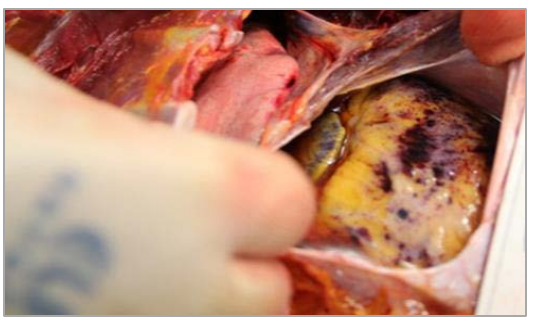
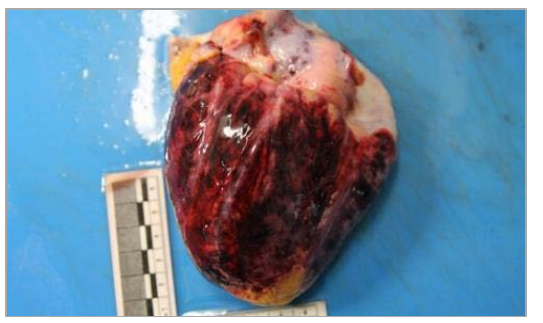
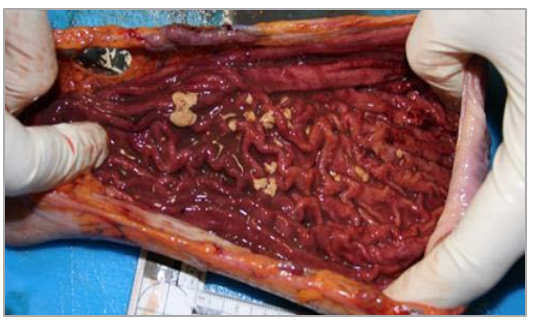
In the autopsy, external examination revealed swelling on the left side of the lower lip and a 0.2 cm area of ecchymosis abrasion on the lower part, and needle marks on the back of the hand, the wrist, inside the elbow and in the left groin area. When the head cavity was opened, areas of petechiae under the skin with hair and a hyperemic appearance of the brain, brain stem and cerebellum were determined. In chest cavity examination there was 150 ml serous fluid (Fig-1) in the pericardium and areas of widespread subpericardial and parenchymal bleeding (Fig-2) were seen. On the surface of both lungs, areas of petechial bleeding were seen. In the examination of the abdominal cavity, 50 ml dark-coloured fluid in the stomach contents was seen to contain beige-coloured solid particles (Fig-3). Petechial bleeding was seen in the superior anterior section of the liver.
For histopathological evaluation, samples were taken from the heart, brain, kidneys, liver, lungs, pancreas, oesophagus and stomach and placed in 10% formaldehyde and sent to the pathology laboratory. Following routine tissue testing, the samples taken from the tissues were stained with hematoxylin-eosin (H-E) and evaluated with a light microscoope. In the microscopic examination, focal points of bleeding were determined in the brain stem and pons parenchyma, widespread fresh bleeding in the parenchyma of the heart, no pathology of note was observed in the coronary arteries and autolysis was determined in the stomach mucosa.
Samples of the liver, kidney, stomach contents, fat tissue, bile fluid and blood were taken and sent for systematic toxicology laboratory evaluation. In the examination of the samples with a Gas Chromatography /Mass Spectometer (GC/MS) device, there was seen to be pseudoephedrine agent substance in the blood, organ parts and stomach contents. In the examination of blood made with Liquid Chromatography /Mass Spectometer (LC/MS) device, the pseudoephedrine value was determined as 13638 ng/ml. The cause of death was reported as respiratory and cardiovascular effects due to high dosage pseudoephedrine toxicity.
Discussion
Pseudoephedrine demonstrates an effect on both alpha and beta adrenergic receptors. In cases of overdose, by affecting these receptors, effects are seen which may range from depression of the central nervous system (sedation, apnea, loss of attention, cyanosis, coma, cardiovascular collapse) to stimulation (insomnia, agitation, hallucinations, tremor or convulsions) from cardiovascular effects (tachycardia, hypo-hypertension, cardiac arrythmia, myocardial infarctus), hyperthermia and death (6, 7, 9, 10).
Pseudoephedrine has been reported to have effects on cardiovascular system of arhythmia, palpitation, increased systolic blood pressure, tachycardia, cardiovascular collapse, paroxymal supra ventricular arrhythmia and to cause myocardial infarctus without any pathological change in the coronary artery structure (9, 10). In the case presented here, tachycardia and hypotension were reported during the clinical observation period. In the macroscopic findings of the autopsy, there were areas of widespread subepicardial and parenchymal bleeding in the heart and in the microscopic examination, areas of widespread fresh bleeding were seen in the parenchyma of the heart without any remarkable pathology in the coronary arteries. These findings were thought to have occurred as a result of the catecholaminergic effect associated with the sympathetic system stimulation of pseudoephedrine.
By affecting the adrenergic receptors in the central nervous system, pseudoephedrine enables the expression of neuradrenalin from the neurons. A stimulant effect is shown in the central nervous system and there is an increase in sympathetic tonus. A treatment dosage may lead to hallucinations, behavioural changes and seizures while a high dosage causes agitation, psychosis, paranoia and intercranial haemorrhage (4, 11). In the case, agitation and aggressive behaviour were reported in the clinical observation period. In the macroscopic findings of the autopsy there was a hyperemic appearance of the brain, cerebellum and brain stem and in the microscopc examination, focal points of bleeding were determined in the brain stem and pons parenchyma were seen.
Toxic dose effects of pseudoephedrine have been reported following the intake of 4-5 times more than the therapeutic dose (180-360mg)(7). In blood examination in the current case with GC/MS and LC/MS devices, the pseudoephedrine value was determined as 13638 ng/ml, which was the level of a toxic dose. Clinical, microscopic and macroscopic findings were seen to be consistent with the side-effects of pseudoephedrine and effects associated with a high dose intake as described in literature (3, 4, 8–11).
Conclusion
Cases of pseudo ephedrine-related deaths have generally been reported as occurring in infants when the treatment dose has been exceeded. Although there have been several reported cases of side-effects seen in adults taking pseudoephedrine, to the best of our knowledge there have been no reported cases of the death of an adult as a result of a high dose of pseudoephedrine taken with the aim of suicide. Therefore, this can be considered as of importance as the first reported case of pseudoephedrine-related suicide.
Declarations
- Author contributions (CRediT)
- All authors contributed equally to all 14 CRediT roles (Conceptualization, Data curation, Formal analysis, Funding acquisition, Investigation, Methodology, Project administration, Resources, Software, Supervision, Validation, Visualization, Writing – original draft, Writing – review & editing).
- Funding
-
Funding information was not reported in the published version of this article.
- Conflicts of interest
- The authors declare that no conflict of interest exists in publishing this article.
- Ethics approval
- Ethics approval details were not reported in the published version of this article.
- Data availability
- A data availability statement was not reported in the published version of this article.
References (11)
3 of 11 references are linked to their DOI.
- Kayaalp O, Akılcıl Tedavi Yönünden Tıbbi Farmakoloji 2012; 2 (13): 1022-1023. Ankara. Pelikan Kitabevi. PubMed Google Scholar
- Gülhan B, Bayrakcı B, Babaoglu M Ö, Bal B, Beken S. Biphasic reatin kinase elevation in pseudoephedrine overdosage. Br J Clin Pharmacol 2008; 67:139–140. PubMed Google Scholar
- Soyer T, Göl IH, Eroğlu F, Cetin A. Acute urinary retention due to pseudoephedrine hydrochloride in a 3-year-old child. Turk J Pediatr. 2008; 50:98-100. DOI Crossref PubMed Google Scholar
- Roberge RJ, Hirani KH, Rowland PL 3rd, Berkeley R, Krenzelok EP. Dextromethorphan- And Pseudoephedrine-Induced Agitated Psychosis And Ataxia. J Emerg Med. 1999 Mar-Apr;17:285-8. PubMed Google Scholar
- Brunton L, Chabner B, Knollman B, eds. Goodman& Gilman’s The Pharmacological Basis Of Therapeutics. 12th edn. China: The McGraw Hill Company; 2011. PubMed Google Scholar
- Marinetti L, Lehman L, Casto B, Harshbarger K, Kubiczek P, Davis J, Over-the-Counter Cold Medications – Postmortem Findings in Infants and the Relationship to Cause of Death. Journal of Analytical Toxicology. 2005; 29:738-743. DOI Crossref PubMed Google Scholar
- Olson K. R, Lange Zehirlenmeler & ilaç Aşırı Dozu. Istanbul: Nobel Tıp Kitapevi. 2012. PubMed Google Scholar
- Kutluhan S. Özen A. Gökalp O. Gültekin F. Psödoefedrin ile Tetiklenen Epileptik Nöbet. Türk Nöroloji Dergisi. 2008;14:357-359. PubMed Google Scholar
- Aypak C,Türedi Ö,Yüce A, Görpelioğlu S. A Serious Adverse Effect of Pseudoephedrine Used For Common Cold Treatment: Ventricular Arrhythmia. Cukurova Med J 2013; 38: 506-510. PubMed Google Scholar
- Tahmaz M, Kumbasar B, Ozturk S,Kazancioglu R. Pseudoephedrine-induced Ventricular Tachycardia. Eur J Gen Med 2013; 10:77-80. DOI Crossref PubMed Google Scholar
- Loizou LA, Hamilton JG, Tsementzis SA. Intracranial hemorrhagein association with pseudoephedrine overdose (letter). J Neurol, Neurosurg Psychiatr 1982;45:471–2. PubMed Google Scholar
Read the full text
Open the PDF here
Loading the PDF…
If the PDF does not show here, use the download button above.
How to cite this article
Petekkaya S, Ayaz N, Dogan M, Oruc M, Oner BS, Gokturk C, et al. Suicidal Death from Pseudoephedrine Sulfate Overdose: A Case Report. Ulutas Med J. 2015;1(4):119-121. doi:10.5455/umj.20151110010021
Petekkaya, S., Ayaz, N., Dogan, M., Oruc, M., Oner, B. S., Gokturk, C., Celebi, A., Budak, A. E., Soylu, O., & Celbis, O. (2015). Suicidal Death from Pseudoephedrine Sulfate Overdose: A Case Report. The Ulutas Medical Journal, 1(4), 119–121. https://doi.org/10.5455/umj.20151110010021
Petekkaya, S. et al. (2015) 'Suicidal Death from Pseudoephedrine Sulfate Overdose: A Case Report', The Ulutas Medical Journal, 1(4), pp. 119–121. doi: 10.5455/umj.20151110010021.