The Ulutas Medical Journal · ISSN 2149-0430 (print), 2149-388X (online) · https://www.ulutasmedicaljournal.com/?mno=201961
Original Article · Open access
Prevalence of Brucella Melitensis and Brucella Abortus in Raw Milk and Dairy Product by Real Time PCR Technique
- Acquired Immunodeficiency Research Center, Isfahan University of Medical Sciences, Isfahan, Iran. ROR
- Nosocomial Infection Research Center, Isfahan University of Medical Sciences, Isfahan, Iran. ROR
- Infectious Diseases and Tropical Medicine Research Center, Isfahan University of Medical Sciences, Isfahan, Iran. ROR
- Isfahan University of Medical Sciences, Isfahan, Iran. ROR
- Infectious Diseases and Tropical Medicine Research Center, Isfahan University of Medical Sciences, Isfahan, Iran ROR
Abstract
- Introduction
- Brucellosis is a public health problem with a high incidence. The main causes of acquiring brucellosis are through the consumption of unpasteurized milk and dairy products. In this study we described a real-time PCR assay for more sensitive, rapid detection and differentiation of Brucella.abortus and Brucella.melitensis in raw milk and dairy products in Isfahan province.
- Materials and Methods
- A Taq Man analysis and single step PCR (BruAb2_0168BMEII0466 genes) has performed in total of 132 unpasteurized milk samples and 65 dairy products. Samples were selected from various markets and animal farms located in different cities of Isfahan province. The duration period of sample collection was nearly two months (May to June 2012).
- Results
- By real-time PCR 4 of 132 milk specimens (3%) were positive for B. melitensis. Also one oil sample between 65 different dairy products (1.5%) was positive for B. melitensis. None of the specimens were positive for B. abortus. We detected direct and incomplete correlation between brucella infected milk and different cities(r=0.024, p value >0.05).
- Conclusion
- Results of present study indicated a relative high presence of this pathogen in raw milk. Real-time PCR is technically more simple, accurate, and rapid than current standard methods for identification of Brucella species .One of the most effective routes to control the disease includes pasteurization or boiling of milk and other dairy products for human consumption.
Keywords
Full text
Introduction
Brucellosis is a widespread zoonotic disease for both humans and livestock animals, associated with infection by Brucella species (1). This disease in human causes fever, malaise, myalgia and can later lead to subacute or chronic disease affecting various tissues and organs (2). In animals, causes abortion, fetal death, and genital infections (3). Among the six species of Brucella identified currently, B.melitensis and B.abortus are considered to be potentially pathogenic to humans (4). B.melitensis and B.abortus can infect most domestic animals (e.g, goat, sheep and cattle). Transmission to humans occurs through direct and indirect contact with infected animals or by consumption of contaminated milk or milk products such as yoghurt and icecream (5, 6). Brucellosis is a high incidence public health problem and consumption of raw milk is the main cause of acquiring brucellosis (7). In recent decades, epidemiology of human brucellosis has severely changed due to socioeconomic or political reasons and different hygienic status (2). While eradication programs are being applied in most developed countries such as Europe, Australia, Canada, Japan and New Zealand but brucellosis remains an important health problem especially in developing countries (4, 8).
Brucellosis has emerged especially in central Asia and is still highly prevalent in the Mediterranean basin, Syria, Saudi Arabia, Egypt, Libya and Iran (8–10). Iran is an endemic region for brucellosis (11). The prevalence rates of brucellosis in our country in animals’ milk in 1980 and 1991 were 6.4% and 10.18% respectively (12). A previous similar study that was performed in Urmia examined milk for B.abortus antibodies with milk ring test (MRT). It was concluded from their results the prevalence of brucellosis in cattle was low (about 1.2% in both autumn and spring seasons) in this region (9). Other various recent studies of brucellosis in several parts of Iran such shahrekord (29.8%), East Azarbayjansarab (2.2%) and khoy city, nearby the Urmia (about 29.7% in spring 2008) were shown different prevalence in our country (8, 9, 13).
In another similar recent research that was carried out on 200 milk samples (from cattle herds and milk sellers) in Nigeria a total of 13.5% were positive for Brucella antibodies (14). Brucella infections in animals have a significant economic impact particularly in developing nations as they cause abortion in the pregnant animals and diminished milk production (2). The disease is unusual in industrialized countries because of ordinary screening of animal and domestic livestock vaccination programs (15). Anyway, routine apply of vaccines against brucellosis is no longer permitted, despite vaccination could interact with the surveillance program, several approaches have been developed to solve this difficulty (16). The phenotypic traits are usually employed for routine identification and differentiation of Brucella species but it is associated with a high risk of infection in laboratory workers and great much time consuming. Also the rate of false negative in these tests are high e.g MRT with a sensitivity of 87.5% (3, 9). Most recently, molecular diagnostic techniques such as real-time PCR assays (An accurate, definitive and rapid tool for early diagnosis of the disease) have been established for the detection of Brucella species (9). These easy to perform measurements are highly sensitive and provide more specificity for detection of micro-organisms (17).
The aim of the current study was direct detection of B.melitensis and abortus by B.
real-time PCR technique in raw milk and milk products of small and large processing plants and markets in Isfahan province.
Study Design
Sample collection and study area
This cross sectional study was carried out to know the prevalence of brucellosis in Isfahan, Iran. For this purpose, 132 milk samples and 65 various milk products (8 samples of traditional cheese, 21 samples of ice cream, 8 samples of curd, 13 samples of cream, 6 samples of butter 1 sample of yoghurt and 1 sample of oil) were collected randomly from various milk markets that sell unpasteurized milk and milk products and animal farms that located in 7 small cities included lenjan (n:33 milk), Freydoonshahr (n:21), Tiran (n:32), Chadegan (n:10), Fraydan (n:32), Khansar (n:17), Mobarakeh (n:2) and related villages in spring season. The duration period of sample collection was nearly two months (May to June 2012). For investigating of the presence of B. abortus and B.melitensis by the Real Time PCR technique, 15 ml of milk and were collected into sterile 25ml falcon tubes with screw caps. The samples were then taken to the laboratory of the infectious disease research center of Isfahan city in a cold chain where they were tested on the same day of collection after being allowed to rest for at least one hour.
Extraction of Genomic DNA from Milk Samples
Total genomic DNA was extracted from milk and dairy products using a modified phenol-chloroform method. One milliliter of dairy product was mixed with 50 μl 20% SDS as denaturing agent. The mixture was cooled after incubation at 72 °C for 15 min. RNase A (75μg/ml) and Proteinase K (650 μg/ml) were added and the mixture was kept at 50 °C for 1.5 h. Then, Equal volume Phenol: Chloroform: Isoamyle alcohol (25:24: 1) was added and shaken for 20 s and centrifuged at 14000 rpm for 10 min. The supernatant was transferred into a fresh tube and equal volume Chloroform: Isoamyle alcohol (24: 1) were added to all tubes, then shaked for 30s and centrifuged at 14000 rpm for 15 min. The supernatant was transferred into a fresh tube and precipitated with isopropanol. The pellets were washed with 70% ethanol three times, dried and suspended in 50 μl of TE buffer (4).
Real-time PCR Assay
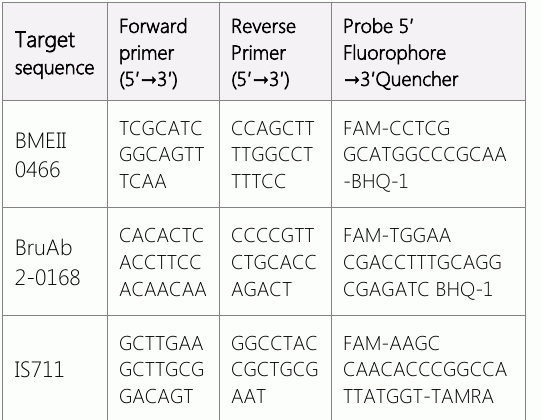
Real-time amplification was carried out in a total reaction volume of 25μl containing 12.5μl TaqMan® Universal PCR Master Mix (Metabion International AG Germany), a 300 nM concentration of each forward and reverse primer (Metabion International AG Germany), a 200 nM concentration of the probe (Metabion International AG Germany), 5μl of DNA. The real-time PCR was carried out in a Real Time PCR system (Qia Gen) according to the manufacturer's protocol (18). BMEII0466 gene for B.melitensis and BruAb2_0168 gene for B.abortus were chosen for the construction of primers and TaqManR probes for species differentiation (unique genetic loci of B.Melitensis and B.abortus )(Table 1).
Results
In the current study, 132 unpasteurized milk samples and 65 unpasteurized milk product specimens were tested by using real time PCR method for identification and differentiation of B.melitensis and B.abortus. The presence of Brucella DNA was detected by IS711 in 4 of 132 milk (3%) and 1 of 65 milk products samples (1.5%). The results of the prevalence of Brucella genus in milk samples of Lenjan and Khansar cities were 3 and 1 specimens respectively. The only positive dairy product was an traditional oil that was from Lenjan. After real-time PCR with the BMEII0466 and BruAb2-0168 genes all of the 4 positive samples recognized as B. melitensis. None of the specimens were positive for B. abortus. We detected direct and incomplete correlation between brucella infected milk or milk products and different cities (r:0.024, p:0.78).
Discussion
In our country many cases of Brucellosis caused by B.abortus and B. melitensis that arise from occupational or contact with infected animals. The major sources of human brucellosis for common world population are unpasteurized milk or dairy products prepared from raw milk and its derivatives (9). Veterinary sanitation has an important role in the fight against brucellosis and eradication of this zoonotic disease in the animals because it is an essential step to control the disease in people (19).
Results of the present study have shown that the overall prevalence of brucella in raw milk samples and other milk product in our province were 3% and 1.5% respectively. There was no significant relation between the places of sample gathering (different small cities or animals farm) and infected milks (p>0.05). These results revealed an important and serious public health problem. However the disease prevalence in cattle has been reported to be quite high in our country, reported different prevalence rates of brucellosis in different regions (ranges between 1.2% in urmia to 29.8% in shahekord) had no significance relation with weather condition in different seasons (13). It has been reported that the consumption of raw milk or dairy products prepared in unsuitable conditions is responsible for about 40% of human brucellosis cases in Turkey (9).
B.melitensis is the major origin of human outbreaks of brucellosis worldwide. For example in some countries including Italy 99% of human brucellosis is caused by B. melitensis (2). In accordance with these studies in the present study we couldn’t find any positive B.abortus strain. The prevalence of human brucellosis obtained from milk or milk products in some countries is seasonal and in some seasons especially after kidding and lambing reaching a peak (2). We couldn’t investigate this subject because of limited period of the sampling that is one of the restrictions of the current study. Although serological diagnosis of brucellosis needs the use of more than one test, indirect milk ELISA could not be performed due to nonavailability of the test kits. Other tests such as RBPT, CFT and SAT are used only for testing serum samples and are therefore not appropriate for testing milk. The sensitivity of MRT was 87.5% while its specificity was 98.6% (14).
Molecular techniques are hopeful alter-natives for the problematic culturing pathogens such as brucella (8). In most of the previous similar studies that were performed on dairy products especially in Iran MRT is performed that may produce false positive or negative results. This is the first report of detection of brucella infection in milk and other milk products by highly sensitive method (RT-PCR) in our country. Consumption of unpasteurized dairy products or unboiled fermented milk is a main cause of infection with brucellosis because the milk and other unpasteurized dairy products of infected animals may contain large numbers of viable and infectious organisms (9, 14).
Results of various epidemiological studies on human brucellosis have mentioned that raw dairy product consuming is the most probable source of Brucella infection and significant risk factor in urban region for human brucellosis (20). The prevalence of human brucellosis in different parts of Iran varied from 1.5 up to 107.5 per100, 000(in Hamadan) in 2003 therefore it could be a threat to the health of the producers in rural areas particularly women and children (8).
So pasteurize of milk and dairy products, learning to avoid consuming unpasteurized milk and milk products, vaccination of herds and removal of infected animals should be highly recommended (9). Also for a successful brucellosis control program surveillance to determine prevalence of brucellosis in herd is necessary. These arrangements will create the base line information for supervision the progress of the following control programs.
Conclusion
From this study it can be concluded that the prevalence of infected milks in Isfahan province is nearly high, therefore more described studies (such as investigation of more dairy products in different seasons) should be carried out in this region to make proper and effective control means. Also our results suggest that real-time PCR could be a powerful tool for diagnosis of brucellosis and differentiation of B. melitensis and B. abortus.
Declarations
- Author contributions (CRediT)
- All authors contributed equally to all 14 CRediT roles (Conceptualization, Data curation, Formal analysis, Funding acquisition, Investigation, Methodology, Project administration, Resources, Software, Supervision, Validation, Visualization, Writing – original draft, Writing – review & editing).
- Funding
-
Funding information was not reported in the published version of this article.
- Conflicts of interest
- The authors declare that there is no conflict of interests to publish this article.
- Ethics approval
- Ethics approval details were not reported in the published version of this article.
- Data availability
- A data availability statement was not reported in the published version of this article.
References (20)
11 of 20 references are linked to their DOI.
- Baddour M M, Alkhalifa DH. Evaluation of 3 PCR techniques for detection of Brucella DNA in peripheral human blood. Can J Microbiol, 2008; 54(5):352-7. PubMed Google Scholar
- Seleem MN, Boyle SM. Brucellosis: a reemerging zoonosis. Vet Microbiol, 2010,27;140(3-4):392-8. DOI Crossref PubMed Google Scholar
- Doosti A, Moshkelani S. The First Prevalence Report of Direct Identification and Differentiation of B.abortus and B. melitensis using Real Time PCR in House Mouse of Iran. WASET 2011,50:84 -7 PubMed Google Scholar
- Rijpens NP, Jannes G, Van Asbroeck M, Rossau R, Herman LM. Direct detection of Brucella spp. in raw milk by PCR and reverse hybridization with 16S-23S rRNA spacer probes. Appl Environ Microbiol. 1996; 62(5):1683-8. DOI Crossref PubMed Google Scholar
- Young, EJ. Human B rucellosis. Rev Infect Dis1983;5:821-42. PubMed Google Scholar
- Arimi SM, Koroti E, Kang'ethe EK, Omore AO, McDermott JJ. Risk of infection with Brucella abortus and Escherichia coli O157:H7 associated with marketing of unpasteurized milk in Kenya. Acta Trop. 2005; 96(1):1-8. DOI Crossref PubMed Google Scholar
- Minas M, Minas A, Gourgulianis K. Epidemiological and clinical aspects of human brucellosis in Central Greece. Jpn J Infect Dis. 2007;60(6):362-6. DOI Crossref PubMed Google Scholar
- Doosti A, G hasemi Dehkordi P. Application of REAL-TIME PCR for identification and differentiation of Brucella abortus and Brucella melitensisin cattle. Bulgar J Vet Med, 2011; 14(2): 109−115. PubMed Google Scholar
- Akbarmehr J. The prevalence of Brucella abortus and Brucella melitensis in local cheese produced in Sarab city, Iranand its public health implication. African J MR, 5(12), 1500-1503, 18, 2011 DOI Crossref PubMed Google Scholar
- Pappas G, Papadimitriou P, Akritidis N, Christou L, Tsianos EV. The new global map of human brucellosis. Lancet Infect Dis, 2006; 6(2):91-9. DOI Crossref PubMed Google Scholar
- Bokaie S, Heydari Latibari S, Abbaszadeh S, Mousakhani H, Rabbani M, SharifiL. Ecological study of brucellosis in humans and animals in Khoy, a mountainous District of the IR of Iran. IJM, 2009;1(4):14-17. PubMed Google Scholar
- Refai M. Incidence and control of brucellosis in the Near East region. Vet Microbiol, 2002; 90(1-4):81-110. DOI Crossref PubMed Google Scholar
- Maadi H, Moharamnejad M, Haghi M.Prevalence of Brucellosis in Cattle in Urmia, Iran. Iran Pak Vet J, 2010; 31(1): 81-82. PubMed Google Scholar
- Bertu WJ, Dapar M, Gusi AM, N gulukunS, Leo S. Prevalence of brucella antibodies in marketed milk in Jos and environs. Afr J Food Sci, 2010; 4(2): 62-64. PubMed Google Scholar
- Corbel MJ. Brucellosis: an overview. Emerg Infect Dis 1997; 3:213-21. PubMed Google Scholar
- Blasco JM. Control and eradication strategies for brucella melitensis infection in sheep and goats. Prilozi. 2010; 31(1):145-65. DOI Crossref PubMed Google Scholar
- Leal-Klevezas DS, Martínez-Vázquez IO, López-Merino A, Martínez-Soriano JP. Single-step PCR for detection of Brucella spp. from blood and milk of infected animals. J Clin Microbiol. 1995; 33(12):3087-90. DOI Crossref PubMed Google Scholar
- Hinić V, Brodard I, Thomann A, Cvetnić Z, Makaya PV, Frey J, Abril C. Novel identification and differentiation of Brucella melitensis, B. abortus, B. suis, B. ovis, B. canis, and B. neotomae suitable for both conventional and real-time PCR systems. J Microbiol Methods. 2008; 75(2):375-8. DOI Crossref PubMed Google Scholar
- Shareef JM, 2006. A Review of serological investigations of brucellosis among farm animals and humans in Northern provinces of Iraq (1974-2004). J Vet Med B, 53: 38-40. DOI Crossref PubMed Google Scholar
- Sofian M, Aghakhani A, Velayati AA, Banifazel M, Eslamifar A, Ramezani A. Risk factors for human brucellosis in Iran. Int J Infec Dis. 2008,12:157-161. PubMed Google Scholar
Read the full text
Open the PDF here
Loading the PDF…
If the PDF does not show here, use the download button above.
How to cite this article
Majid Y, Somayeh N, Parisa S, Behrooz A, Reza FN, Javad R, et al. Prevalence of Brucella Melitensis and Brucella Abortus in Raw Milk and Dairy Product by Real Time PCR Technique. Ulutas Med J. 2016;2(1):7-11. doi:10.5455/umj.20151004054235
Majid, Y., Somayeh, N., Parisa, S., Behrooz, A., Reza, F. N., Javad, R., Mehdi, F., Nasrin, A. A., & Marzieh, K. (2016). Prevalence of Brucella Melitensis and Brucella Abortus in Raw Milk and Dairy Product by Real Time PCR Technique. The Ulutas Medical Journal, 2(1), 7–11. https://doi.org/10.5455/umj.20151004054235
Majid, Y. et al. (2016) 'Prevalence of Brucella Melitensis and Brucella Abortus in Raw Milk and Dairy Product by Real Time PCR Technique', The Ulutas Medical Journal, 2(1), pp. 7–11. doi: 10.5455/umj.20151004054235.