The Ulutas Medical Journal · ISSN 2149-0430 (print), 2149-388X (online) · https://www.ulutasmedicaljournal.com/?mno=14201
Original Article · Open access
The Effectiveness of Ganciclovir Comparing with Combination Therapy of Oxytetracycline HCI and Polymyxin B Sulfate in Herpetic Epithelial Keratitis
- Special Internal Medicine Clinic, Adana, Turkey
- Department of Ophthalmology, Adana Ortadogu Hospital, Adana, Turkey ROR
Abstract
- Introduction
- Herpes simplex virus is a common keratitis agent. There are two different types of virus, type 1 and 2. Type 1 shows three main clinical pictures in cornea: epithelial herpetic keratitis, stromal keratitis, disciform keratitis. The aim of this study is to reduce the duration of herpetic keratitis treatment and eliminate the risk of complications. Material and Methods: Between January 2017 and January 2018, 29 patients with herpetic keratitis were included in the study. In the first group, the herpetic membrane was removed by a single shot on the herpetic lesion with the yag laser. Then, topically oxytetracycline hydrochloride+polymyxin B sulfate was applied. The second group was treated with topical antiviral therapy (Ganciclovir). After treatment, daily follow-up of patients, vision, tonus, fundus diameters and recovery times were noted and the data were compared statistically.
- Results
- In group I and group II, the age of the patients did not differ significantly (p> 0.05). In group I and group II, the gender distribution of the patients did not differ significantly (p>0.05). In Group I and Group II, the degree of vision did not differ significantly (p>0.05). In group I and group II, the examination findings were not significant (p>0.05). In group I and group II, recovery time was significantly different (p<0.05).
- Conclusion
- Oxytetracycline HCl + polymyxin B sulfate may be superior to ganciclovir for treating herpetic epithelial keratitis.
Keywords
Full text
Introduction
The herpes simplex virus (HSV) is a DNA virus that is a member of the herpesviridae family, and naturally, it can only infect humans. Herpes simplex is an enveloped virus that contains lipid and glycoprotein structures. With this feature, envelopes can be broken with chemical factors. HSV type 1 is seen in the face and eyes, HSV type 2 causes herpetic disease in the genital area. HSV type 1 causes infection 6 months-5 years between the periods of kissing. HSV is transmitted through close contact and saliva and cause primary infection. Primary infection is subclinical with general symptoms of viral diseases in 85-99% of cases. HSV type 1 can form 3 main clinical pathologies in cornea: a) epithelial herpetic keratitis (EHK), b) stromal keratitis, c) disciform keratitis. The incidence of ocular herpes is reported as 5.9 -12% and the majority of these are EHC. Herpes simplex virus-induced keratitis (HSK) is one of the leading causes of corneal blindness in the world (1). The primary infection occurs after direct contact of the mucosal membrane with herpes simplex virus-1 (HSV-1). Clinical pictures of the virus occur as a result of the destruction of the cornea (2, 3). The virus then latent in the trigeminal ganglion and leads to recurrent infections (1, 4). There are factors such as age, poor hygiene and socioeconomic class in the etiology (5). Ocular HSV-1 infection is associated with a wide range of ocular pathologies like conjunctivitis, keratitis, irido cyclitis and acute retinal necrosis (6). HSV is a common viral cause of corneal disease (etc. keratitis) and is one of the leading causes of infectious corneal blindness in developed countries (5). Visual loss is most commonly seen in more severe cases with stromal opacification and corneal ulceration (6).
Antiviral agents are the most preferred treatment for HSV epithelial keratitis. Both topical and oral agents are available. Regarding topical agents, both the ganciclovir gel and the trifluridine solution were approved by the FDA (5). Acyclovir and trifluridine ointment have similar efficacy (5) and the same efficacy has been demonstrated when acyclovir ointment compared with ganciclovir (5). Recommended treatment for HSV stromal keratitis includes an oral antiviral agent in combination with a topical corticosteroid agent for at least 10 weeks.
The aim of this study is to reduce the duration of herpetic keratitis treatment and eliminate the risk of complications.
Materials and Methods
Between January 2017 and January 2018, 29 patients with herpetic keratitis were included in the study. The patients were recruited from our hospital. There are 14 patients in the first group, and there are 15 patients in the second group. In group I, herpetic membrane was removed by a single shot on the herpetic lesion with the Yag laser. Then, oxytetracycline hydrochloride+ polymyxin B sulfate was applied topically. The second group was treated with topical antiviral therapy (Ganciclovir). After the treatment, daily follow-up of patients, vision, tonus, fundus diameters and recovery times were noted, and the data were compared statistically.
Statistical Method
Mean, standard deviation, median lowest, highest, frequency and ratio values were used in descriptive statistics of the data. The distribution of the variables was measured with the Kolmogorov Smirnov test. Independent samples t-test, Mann-Whitney U test were used for the analysis of quantitative independent data. Chi-square test was used for the analysis of qualitative independent data. SPSS program was used in the analysis.
Results
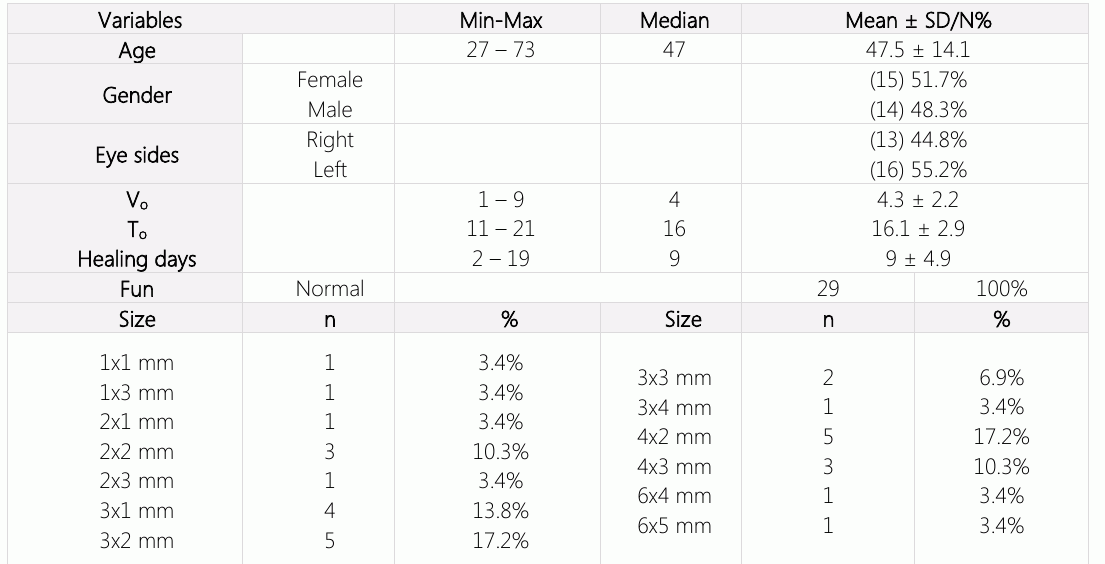
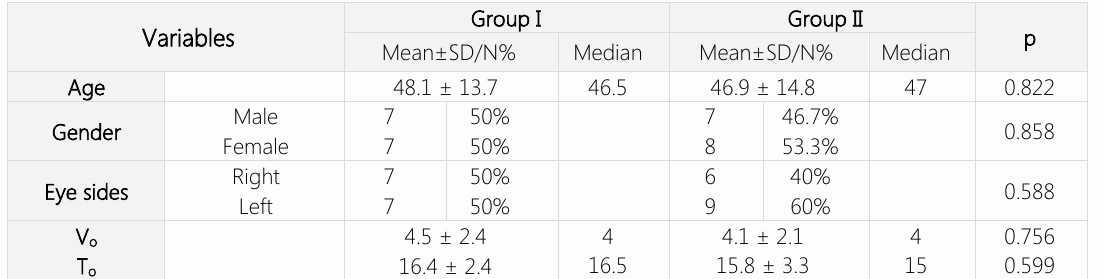
Demographic information of the study sample is shown in Table 1. There are 14 patients in the group I, and there are 15 patients in group II. In group-I and II, the age of the patients did not differ significantly (p>0.05). In group-I and II, the gender distribution of the patients did not differ significantly (p>0.05).
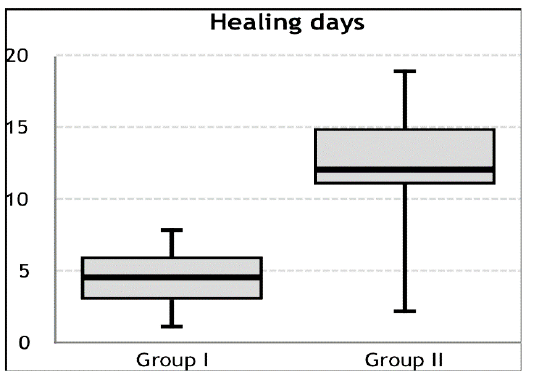
Group-I and II showed no significant difference in terms of age and gender (p>0.05). In Group I and II, the vision value did not differ significantly (p>0.05). In group I and II, the diagnostic value was not significant (p>0.05). In group I and group II, recovery time was significant (p <0.05) (Table 2)(Figure 1).
Discussion
This study compared combined use of Oxytetracycline HCl and Polymyxin B Sulfate with ganciclovir for the treatment of herpetic epithelial keratitis. This study aimed to reduce the duration of herpetic epithelial keratitis treatment, eliminate the risk of complications like blindness, or infections, minimize the cost of treatment, and increase the satisfaction and quality life of patients.
HSV is known to cause several medical conditions that mostly include central nervous system, eye, mouth, and genitalia. HSV-1 is the most common cause of infectious keratitis around the world, and it usually impairs the quality of life (1, 2). HSV epithelial keratitis can be primary or secondary (recurrent). Primary epithelial keratitis may occur with or without blepharoconjunctivitis. Recurrent keratitis can be due to the reactivation of previous epithelial or non-epithelial HSV (3, 4). Primary infection is seen in early childhood. HSV-1 moves into the mucous membrane and epithelial cells by direct contact. The virus goes retrograde through axons to reach trigeminal ganglia, and it develops. On the other hand, the cornea has also been reported to be an area of latency. Although there have been debates on the reactivation of the virus, fever, ultraviolet light, contact lens, surgery, and immunosuppressive therapy have been linked to the reactivation of epithelial keratitis. Reactivation may induce different types of keratitis different from the initial presentation (9).
HSV epithelial keratitis is usually the most painful type of keratitis. It has vesicles and causes itching. Other symptoms include photophobia, blurred vision, redness, burning, foreign body sensation, tearing, and decreased vision. These findings refer the patient to an ophthalmologist. The diagnosis is made by slit-lamp examination. Dendritic and geographic ulcers are two types of HSV epithelial keratitis. They are merely recognizable with the typical pattern after fluorescein staining. This characteristic feature usually eliminates further tests like culture, PCR, immunofluorescence assay (IFA), an immunochromatographic assay, which may be used for the other types of herpetic eye disease (9). Currently, trifluridine (TFT), ganciclovir (GCV), and acyclovir (ACV) are available topical medications, and ACV, valacyclovir (VACV), and famciclovir (FCV) are the most accessible systemic antivirals. Oral ACV, TFT, and topical GCV have been equally effective to treat HSV epithelial keratitis. After being phosphorylated and activated by viral thymidine kinase, all of these medications inhibit viral DNA replication. Based on the disease condition, either topical or systemic antivirals are used for the treatment of HSV epithelial keratitis. Topical antivirals and oral ACV have shown almost similar therapeutic effects for years. A combination of topical and systemic antivirals or even augmenting treatment with epithelial debridement was reported. It is unclear whether these modalities can fortify the treatment (9).
In a study, Komoto et al. (10) compared the effects of ACV ointment, oral VACV, and oral FCV for the treatment of HSV epithelial keratitis on mice. Tear cultures showed that HSV-1 was not detectable in the local ACV group and oral VACV group on day 4, and in the oral FCV group on day 6. The authors declared that a 5- day treatment with these medications would be enough for the treatment. In another study on humans concerning the administration of VACV for the treatment of HSV epithelial keratitis, Sozen et al. (11) showed that VACV was better than topical ACV because faster epithelial healing and lower photophobia were reported in the VACV group. FCV has never been studied for the treatment of HSV epithelial keratitis on humans, but it was sufficient for this purpose in an animal model (12). Compared to these studies, in our study, the duration of herpetic keratitis treatment was very short as four days on humans.
There are different recommendations on the necessity of debridement in ophthalmology books in the treatment of the disease, which is important cause of blindness,such as herpetic keratitis. In some books, it is recommended to start treatment with topical antiviral drugs (bromovinyldeoxyuridine, trifluorothymidine, acyclovir, ganciclovir) in the treatment of EHC. There is a consensus that tropical antiviral agents such as trifluridine, acyclovir and recently ganciclovir have improved herpetic epithelial keratitis by up to 90% within two weeks.
The current treatment guidelines spread the herpetic keratitis treatment over a long period of 10 weeks (5), but the sociocultural levels of patients were generally low for ten weeks, and the length of the treatment period reduced the rate of treatment use in patients and increased likelihood of recurrence. Therefore, a treatment method and treatment agent are needed for herpetic keratitis to be effective in a shorter time (7, 8).
In our study, the duration of herpetic keratitis treatment was very short as four days, and no significant difference was observed between control vision, tonus, fundus diameter parameters, and topical antiviral treatment. Although this result of the treatment with the same efficacy as the antiviral treatment, we proved this effectiveness in a concise time.
Declarations
- Author contributions (CRediT)
- All authors contributed equally to all 14 CRediT roles (Conceptualization, Data curation, Formal analysis, Funding acquisition, Investigation, Methodology, Project administration, Resources, Software, Supervision, Validation, Visualization, Writing – original draft, Writing – review & editing).
- Funding
-
Funding information was not reported in the published version of this article.
- Conflicts of interest
- None of the authors has a conflict of interest with the submission.
- Ethics approval
- Ethics approval details were not reported in the published version of this article.
- Data availability
- A data availability statement was not reported in the published version of this article.
References (12)
11 of 12 references are linked to their DOI.
- Darougar S, Wishart MS, Viswalingam ND. Epidemiological and clinical features of primary herpes simplex virus ocular infection. Br J Ophthalmol. 1985;69(1):2–6 DOI Crossref PubMed Google Scholar
- Liesegang TJ, Melton LJ, Daly PJ, Ilstrup DM. Epidemiology of ocular herpes simplex: incidence in Rochester, Minn, 1950 through 1982. Arch Ophthalmol. 1989;107(8):1155–1159 DOI Crossref PubMed Google Scholar
- Tang Q, Chen W, Hendricks RL. Proinflammatory functions of IL-2 in herpes simplex virus corneal infection. J Immunol. 1997;158(3):1275– 1283 DOI Crossref PubMed Google Scholar
- Tsatsos M, MacGregor C, Athanasiadis I, Moschos MM, Hossain P, Anderson D. Herpes simplex virus keratitis: an up-date of the pathogenesis and current treatment with oral and top- ical antiviral agents. Clin Exp Ophthalmol. 2016;44(9):824– 837 DOI Crossref PubMed Google Scholar
- White ML, Chodosh J. Herpes simplex virus keratitis; A Treatment Guideline. 2014. Massachusetts Eye and Ear Infir-mary Department of Ophthalmology, Harvard Medical School. Reviewed and endorsed by the Ocular Microbiology and Immunology Group PubMed Google Scholar
- Farooq AV, Shukla D. Herpes simplex epithelial and stromal keratitis: an epidemiologic update. Surv Ophthalmol. 2012;57(5):448– 62 DOI Crossref PubMed Google Scholar
- Miserocchi E, Modorati G, Galli L, Rama P. Efficacy of valacyclovir vs. acyclovir for the prevention of recurrent herpes simplex virus eye disease: A pilot study. Am J Ophthalmol. 2007;144(4):547– 51 DOI Crossref PubMed Google Scholar
- Chong DY, Johnson MW, Huynh TH, Hall EF, Comer GM, Fish DN. Vitreous penetration of orally administered famciclovir. Am J Ophthalmol. 2009;148(1):38– 42 DOI Crossref PubMed Google Scholar
- Roozbahani M, Hammersmith KM. Management of herpes simplex virus epithelial keratitis. Curr Opin Ophthalmol. 2018; 29(4): 360-364 DOI Crossref PubMed Google Scholar
- Komoto S, Higaki S, Fukuda M, et al. Effects of antiviral medications on herpetic epithelial keratitis in mice. Jpn J Ophthalmol 2015; 59:194-200 DOI Crossref PubMed Google Scholar
- Sozen E, Avunduk AM, Akyol N. Comparison of efficacy of oral valacyclovir and topical acyclovir in the treatment of herpes simplex keratitis: a randomized clinical trial. Chemo therapy 2006; 52:29-31 DOI Crossref PubMed Google Scholar
- Loutsch JM, Sainz B Jr, Marquart ME, et al. Effect of famciclovir on herpes simplex virus type 1 corneal disease and establishment of latency in rabbits. Antimicrob Agents Chemother 2001; 45:2044-2053 DOI Crossref PubMed Google Scholar
Read the full text
Open the PDF here
Loading the PDF…
If the PDF does not show here, use the download button above.
How to cite this article
Guvenmez O, Kayiklik A. The Effectiveness of Ganciclovir Comparing with Combination Therapy of Oxytetracycline HCI and Polymyxin B Sulfate in Herpetic Epithelial Keratitis. Ulutas Med J. 2019;5(1):60-64. doi:10.5455/umj.20191024045517
Guvenmez, O., & Kayiklik, A. (2019). The Effectiveness of Ganciclovir Comparing with Combination Therapy of Oxytetracycline HCI and Polymyxin B Sulfate in Herpetic Epithelial Keratitis. The Ulutas Medical Journal, 5(1), 60–64. https://doi.org/10.5455/umj.20191024045517
Guvenmez, O. and Kayiklik, A. (2019) 'The Effectiveness of Ganciclovir Comparing with Combination Therapy of Oxytetracycline HCI and Polymyxin B Sulfate in Herpetic Epithelial Keratitis', The Ulutas Medical Journal, 5(1), pp. 60–64. doi: 10.5455/umj.20191024045517.