The Ulutas Medical Journal · ISSN 2149-0430 (print), 2149-388X (online) · https://www.ulutasmedicaljournal.com/?mno=103116
Case Report · Open access
A Rare Case: Hyperacute Anterior MI Following Plant-Based Drug Use
- Department of Cardiology, Yedikule Chest Diseases and Surgery Training and Research Hospital, Istanbul, Turkey
Abstract
- Introduction
- Acute myocardial infarction (AMI) is one of the foremost reasons of cardiovascular diseases, which may be fatal in a lack of early diagnosis and treatment. Risk factors associated with the disease among the elderly population are fairly straight forward, however among the under-40 age group; they are yet to be unveiled in its completeness. AMI patients under 40 years of age should be questioned especially about cocaine addiction and other drug use in addition to the classic risk factors for coronary artery disease.
- Case Presentation
- In this case report, we discuss a 35-year-old patient who had Acute anterior myocardial infarction as a result of uncontrolled use of ginseng, lepidium, and epimedium containing herbal medicines due to infertility and who had no other apparent risk factor.
Keywords
Full text
Introduction
Acute myocardial infarction (AMI) is one of the foremost reasons of cardiovascular diseases, which may be fatal in lack of early diagnosis and treatment. Risk factors associated with the disease among the elderly population are fairly straight forward, however among the under-40 age group; they are yet to be unveiled in its completeness. AMI patients under 40 years of age should be questioned especially about cocaine addiction and other drug use in addition to the classic risk factors for coronary artery disease. It has been reported that ginseng-containing herbal components boost cardiac activity when used in heart failure and that its chronic use might cause ginseng abuse syndrome with hypertension (1). However, it has also been reported to have hypotensive effects (1, 2). Lepidium extracts, known to be commonly used in the treatment of infertility, are also reported to be cardioprotective (3). Another herbal agent, Epimedium, used especially in Chinese and Korean medicine against many diseases, particularly infertility and cardiovascular diseases, is reported to be cardioprotective and antihypertensive (4).
In this case report, we discuss a 35-year-old patient who had AMI as a result of uncontrolled use of ginseng, Lepidium, and epimedium containing herbal medicines due to infertility and who had no other apparent risk factor.
Case Presentation
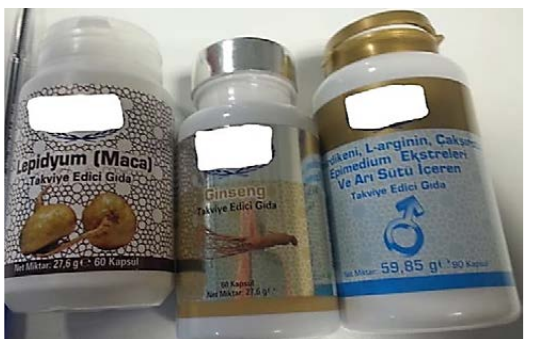
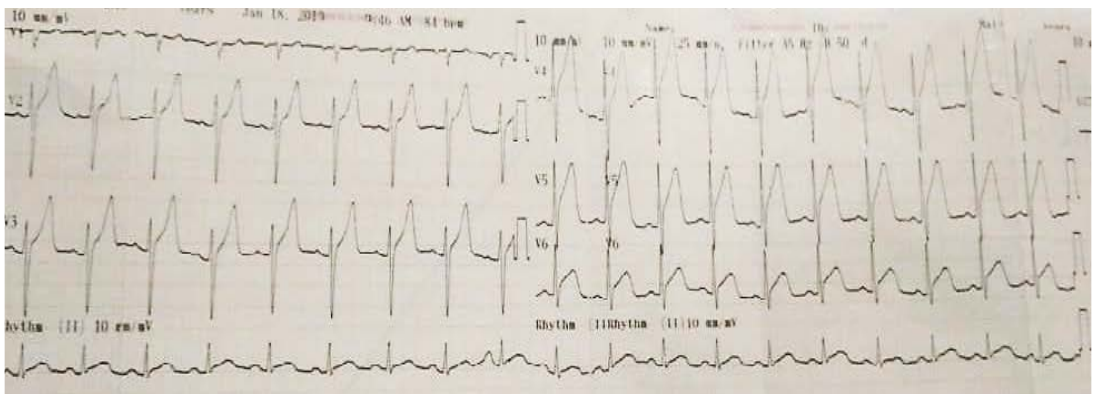
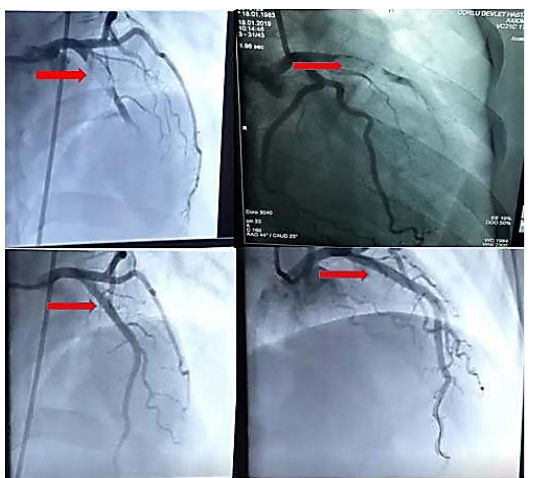
A 35-year-old male patient was admitted to the ER with the complaint of pressure-like pain which began about half an hour ago and spread to the anterior chest, left arm, and lower jaw. According to the anamnesis of the patient, he had no known disease, had no risk factors for CAD, and did not smoke. Upon questioning regarding drug use, it was learned that he had been using 3 different herbal products containing Lepidium, Ginseng, Epimedium + L-arginine for about a month due to infertility (Figure 1). The patient took these drugs on his initiative under no doctor's control. The patient's ECG was compatible with hyperacute anterior MI (Figure 2). Biochemical tests found out Troponin I as 0.631 ng/ml. Other lab test results were within normal reference values. After basal blood values were taken, the patient was taken to the coronary angiography laboratory for primary percutaneous coronary intervention. Coronary angiography showed LAD: total occlusion before DI and CX and RCA to be normal. The LAD lesion was passed with a 0.014-inch floppy wire. When the lesion was passed, it was observed to be with intense thrombus. The patient was administered Ticagrelor 180 mg, acetylsalic acid 300 mg, and heparin 7500 units IV. Intra-coronary abciximab was performedafterintense thrombus persisted after balloon (3.5x20mm) predilatation and then stent (4.0x24mm) was implanted at 12 atm (Figure-3).
The patient with no complication or complaint in the follow-up was determined to have trans thoracic echocardiography within normal limits and was discharged.
Discussion
AMI is a rare condition in patients under 40 years of age without any risk factors. Drug use should be questioned in this patient group as in our case. It is reported that the herbal agents Lepidium, ginseng, and epimedium, also used in our case, are cardioprotective (1–4). Besides, it is reported that depending on the dosage, ginseng has such cardiovascular side effects as stent thrombosis and AMI (5, 6). In another study, it was stated that the epidemic reduced reperfusion injury and rehabilitated myocardial functions (7). In light of all this information, we should bear in mind that besides their cardioprotective effect, these herbal agents might have cardiac side effects and we should use them with caution. Especially Panax ginseng is known for its hypotensive effect, however in its chronic use and depending on the dosage, it might trigger what is called “ginseng abuse syndrome” with hypertension, behavior change, and diarrhea. Coronary angiography in our case showed that acute coronary syndrome developed based on dissection in LAD, which led us to consider that labile hypertension might have caused the shear-stress (8, 9). Moreover, in our country, the data, whether these drugs are adequately controlled during the certification and production phases, is insufficient and it is not clear whether the indicated doses are correct or not. Studies on the concomitant use of these agents, widely used in infertility, are insufficient. As with this case, we think that the combined use of these herbal agents might be associated with an increased risk of cardiac side effects.
Conclusion
Acute myocardial infarction is rare in patients under 40 years of age without the risk factors. As in our case, drug use should be questioned in patients without any risk factors. In this case, the absence of classical risk factors led us to the conclusion that these herbal agents might have caused the AMI. This case is significant in the sense that it demonstrates the possibly deadly consequences of treatments which are not advised by doctors and are not in line with rational drug use.
Declarations
- Author contributions (CRediT)
- All authors contributed equally to all 14 CRediT roles (Conceptualization, Data curation, Formal analysis, Funding acquisition, Investigation, Methodology, Project administration, Resources, Software, Supervision, Validation, Visualization, Writing – original draft, Writing – review & editing).
- Funding
-
Funding information was not reported in the published version of this article.
- Conflicts of interest
- The author declares no competing interests.
- Ethics approval
- Ethics approval details were not reported in the published version of this article.
- Data availability
- A data availability statement was not reported in the published version of this article.
References (10)
8 of 10 references are linked to their DOI.
- Schoenenberger AW, Radovanovic D, Stauffer JC, Windecker S, Urban P, et al. Acute coronary syndromes in young patients: Presentation, treatment and outcome International Journal of Cardiology. 2011;148:304-308 DOI Crossref PubMed Google Scholar
- Gillis CN. Panax ginseng pharmacology: a nitric oxide link? Biochem Pharmacol 1997;54:1-8 DOI Crossref PubMed Google Scholar
- Ding DZ, Shen TK, Cui YZ. Effects of red Ginseng on the congestive heart failure and its mechanism. Article in Chinese Zhongguo Zhong Xi Yi Jie He Za Zhi 1995;15:325-7 DOI Crossref PubMed Google Scholar
- Yi F, Tan XL, Yan X, Liu HB, In silico profiling for secondary metabolites from Lepidium meyenii by the pharmacophore and ligand-shape-based joint approach, Published online. Chin Med. 2016;11:42 DOI Crossref PubMed Google Scholar
- Arief ZM, Munshi AH, Shawl AS, Evaluation of medicinal value of Epimedium elatum on the basis of pharmacologically active constituents, Icariin and Icariside- II, Pak J Pharm Sci. 2015;28(5):1665-9 PubMed Google Scholar
- Gunes H, Kucukdurmaz Z, Karapinar H, Gul I. Acute anterior myocardial infarction presented with cardiogenic shock in a patient on herbal medication. Turk Kardiyol Dern Ars, 40, 262- DOI Crossref PubMed Google Scholar
- Martínez-Mir I, Rubio E, Morales-Olivas FJ, Palop-Larrea V. Transient ischemic attack secondary to hypertensive crisis related to Panax ginseng. Annals of Pharmacotherapy, 38, 1970–1970 PubMed Google Scholar
- Zhai M, He L, Ju X, Shao L, Li G, Zhang Y, Liu Y, Zhao H, Icariin Acts as a Potential Agent for Preventing Cardiac Ischemia/ Reperfusion Injury. Cell Biochem Biophys. 2015;72(2):589-97 DOI Crossref PubMed Google Scholar
- Han KH, Choe SC, Kim HS, Sohn DW, Nam KY, Oh BH, et al. Effect of red ginseng on blood pressure in patients with essential hypertension and White coat hypertension. Am J Chin Med 1998;26:199-209 DOI Crossref PubMed Google Scholar
- Siegel RK. Ginseng abuse syndrome. Problems with the panacea. JAMA 1979;241:1614-5 DOI Crossref PubMed Google Scholar
Read the full text
Open the PDF here
Loading the PDF…
If the PDF does not show here, use the download button above.
How to cite this article
Boyuk F. A Rare Case: Hyperacute Anterior MI Following Plant-Based Drug Use. Ulutas Med J. 2020;6(2):87-90. doi:10.5455/umj.20200504101042
Boyuk, F. (2020). A Rare Case: Hyperacute Anterior MI Following Plant-Based Drug Use. The Ulutas Medical Journal, 6(2), 87–90. https://doi.org/10.5455/umj.20200504101042
Boyuk, F. (2020) 'A Rare Case: Hyperacute Anterior MI Following Plant-Based Drug Use', The Ulutas Medical Journal, 6(2), pp. 87–90. doi: 10.5455/umj.20200504101042.