The Ulutas Medical Journal · ISSN 2149-0430 (印刷版), 2149-388X (在线版) · https://www.ulutasmedicaljournal.com/?mno=228942
原创研究 · 开放获取
海岸测量对室内肥料循环成功的影响
标题、摘要和全文为机器翻译。 英文原文
- Yildirim Beyazit University, Faculty of Medicine, Ankara/Turkey ROR
- GATA faculty of Medicine, Department of Obstetrics and Gynecology, Istanbul/Turkey ROR
- Mustafa Kemal University, Faculty of Medicine, Department of Obstetrics and Gynecology, Antakya/Hatay/Turkey ROR
- Cengiz Gokcek Public Hospital, Department of Obstetrics and Gynecology, Gaziantep/Turkey ROR
- Zeynep Kamil Education and research hospital, Department of Obstetrics and Gynecology, Istanbul/Turkey ROR
- Zeynep Kamil Education and research hospital, Department of Embriology, Istanbul/Turkey ROR
- 开放获取
- CC BY-NC 4.0
- ORCID
- 资助
- 伦理批准
- 数据可用性
摘要
引言:"凝血"(英語:Coasting)是一种在维特罗肥料化(IVF)循环中用于预防奥华超刺激综合征(OHSS)的方法. 海岸化是指在高风险循环中不使用外源性腺素,推迟使用HCG,直到血清乙二醇水平降至可接受的范围。 我们的研究旨在评估对E2水平为4000-5000比克的病人的IVF结果的海岸效应。 方法 : 这项研究是单中心、回顾性、个案控制研究。 研究人口是从2003年1月至2013年12月期间向Zeynep Kamil研究医院IVF部门提出申请的妇女中挑选出来的(n=7850)。 研究对象包括服用GnRH激动剂或对抗药的患者,其BMI在23-28千克/平方米,E2水平在4000-5000比克图之间,年龄在 < 43岁. 患者被分为两个组:一个控制组(第1组,n=48)和一个海岸组(第2组,n=34),根据是否进行了海岸测量. 海岸前的峰值E2水平,卵巢计数前的卵巢采集,采集M2卵巢计数,受精卵细胞计数,OHSS发生率,怀孕发生率在群体之间进行比较. 利用学生对连续变量的t测试和对绝对变量的chi-square测试进行了统计分析. 结果:2组的大多数病人需要不到2天的海岸;只有2个需要4天。 在hCG当日,第2组的E2水平明显低于第1组(分别为4332.6±256.6和3180.8±702.9;p <0.0001). 在卵泡计数、收集M2卵泡计数、受精卵泡计数、怀孕率或OHSS发病率之前,没有观察到在统计学上明显的差异。 结论:共同esting是高风险妇女降低OHSS发生率的有效方法。 它可以安全地应用,特别是在最优叶片大小和乙二醇水平为4000-5000的患者中.
关键词
全文
全文为机器翻译;以英文原文为准。 英文原文
导言
辅助生殖技术中使用的受控卵巢刺激可能导致卵巢超刺激综合征(OHSS). 外源性人类铬化甘油(hCG)通过增加毛细渗透性在OHSS开发中起着主要作用. (1)。有许多治疗的变体,如周期取消、老化的HCG、海岸化、静脉注射和多巴敏激动剂,以减少高危病人中OHSS的偏执和严重性。 (2)海岸测量是最常用的方法之一,指的是不再使用外来的淋巴松,推迟在高风险循环中使用HCG,直到乙二醇血清降入可接受的范围(通常小于2500至3000皮克/毫升) (2–7)海岸化会降低FSH水平,导致颗粒素细胞病变,并通过润滑剂抑制扩散 (2, 6)作为后果,海岸防患于未然 (2, 8)此外,它允许在这种循环中使用胚胎,而不是胚胎冻结,并减少了病人的焦虑和费用。 许多研究显示,海岸ı能有效减少OHSS的隐性 (7)许多研究表明,海岸病人的怀孕率与没有海岸的妇女相似。 (9)在Cochrane系统审查中,对13项研究中仅有一项研究进行了评价,据报告,与控制组相比,沿海地区有类似的OHSS和怀孕率。 (2, 10)一些研究指出,海岸间隔可能会改变体外受精结果。 (11)尚未解释不会对怀孕率产生不利影响的海岸间隔期 (2, 7, 8, 12, 13)。 。 。
关于海岸对静脉输卵管结果的影响存在争议,如摘取的卵细胞减少、植入率降低和怀孕率降低 (2)我们的研究的目的是评估对患有E型病毒的病人的静脉注射器的海岸效应。2个 浓度为4 000-5000皮科格拉姆。
学习设计
这项研究是一次单一的中心、回顾和个案控制研究。 2003年1月至2013年12月,研究人口从不育妇女中选取Zeynep Kamil研究医院IVF科(第7850号)。 患者,23至43岁,体重指数为23-28公斤/米2个,具有正常血清激素剖面,定期月经周期,第一或第二周期IVF被包括在内. 根据世界卫生组织(世卫组织)2010年标准,排除了男性不孕症 (14)患有子宫病的妇女也被排除在外。 有82名病人达到了包容标准。 患者被分为2组,分别是康罗尔组(第1组,n:48)和海岸组(第2组,n:34),根据海岸是否进行. 所有妇女都接受了病史、妇科检查和基本不孕症检查。 所有患者在早期卵泡期和HCG日均进行毒血取样,以检测FSH和乙酰丙醇(E)2个)水平。 已进行外腔超声波测量,以检测早期卵泡阶段的角卵球计数。
通过激动剂或对抗剂协议进行的排卵诱导、100毫克阿司匹林和400毫克叶片杀灭剂被施用。 GnRH激动剂始于21年编号 前一周期的第一天和重组(rec)FSH [rec-FSH, Gonal-f®(土耳其默克塞罗诺)或Puregon®(Shering Ploug)]在周期的第三天被添加在长激动剂协议中. fSH(150 IU, rec FSH)在周期的第二天或第三天开始,在周期的第六天增加了GnRH antogonis。 根据患者的年龄、BMI、角质卵泡计数和玄武质的FSH水平,开始给定RFSH剂量。 之后,在两项协议中,RegFSH剂量都按照电视USG和血清E中的胶囊直径排列。2个 水平。 当主要卵泡直径达到18毫米或2个卵泡直径大于16毫米时,就会在肌肉内注入10,000 IU hCG(Pregnyl®,Shering Ploug)或250 mcg 矩-hCG,在下切入。 在E峰值妇女中,停止了对Gonodopopines的管理2个 继续管理第2组和GnRH模拟中超过4000的浓度水平。
在静脉注射(IV)镇静剂下,在电视USG的指导下,在HCG注射35.5小时后进行了Oocyte拾取。 在行动股期间,给所有病人发放了单剂Cefazolin sodyum(四、一克)。 Doxycycline(100毫克,每日2次,po)和甲基普丁尼苏酮(16毫克,每日1次,po)被给予患者4天的时间. 从OPU日开始,所有患者都开始接受90毫克丙烯酮(%8 crinone gel, Serono)的润滑相支持。 根据Veeck的分类,Oocyte 成熟度得分为0-4 (15). 亲核积分在细胞内质粒喷射(ICSI)后16-18小时被评价. 根据ET之前胚胎分裂的形态,胚胎质量被评为1-5 (16)。 。 。
在2至5天后,通过USG指导进行了单一胚胎转移。 经过12天的检测,检测出血清β-HCG水平. Beta-HCG水平 > 20 IU/l被命名为生化怀孕,在USG观察到的经过6周ET后胎儿心脏活动被称为临床怀孕. 利用Windows 15.0软件的社会科学统计包进行了统计分析(SPSS、芝加哥、美国国际法学会)。 描述性统计数字是平均值、标准差、频率和百分比。 为了比较参数连结变量,采用了学生T测试;为了比较非参数连续变量,采用了Mann-Whitney U测试;为了比较绝对变量,采用了chi平方测试. P值 < 0.05被认为表明统计意义。
结果
在这项研究中,对7,850名病人进行了追溯评估。 共有173名病人接受了海岸测量。 91名不符合研究纳入标准的患者被排除在外,82名患者完成了研究. 82名病人被分为两组,分别是海岸航行是否进行;48名病人(58.5%)作为研究组(Group-1)和34名病人(41.5%)作为凝固组(Group-2)。 控制组和海岸组的平均年龄(分别为30.8±4.9对30.4±3.9,p:0.730)和BMI(分别为24.85±1.5对25.25±2.02,p:0.297)类似。
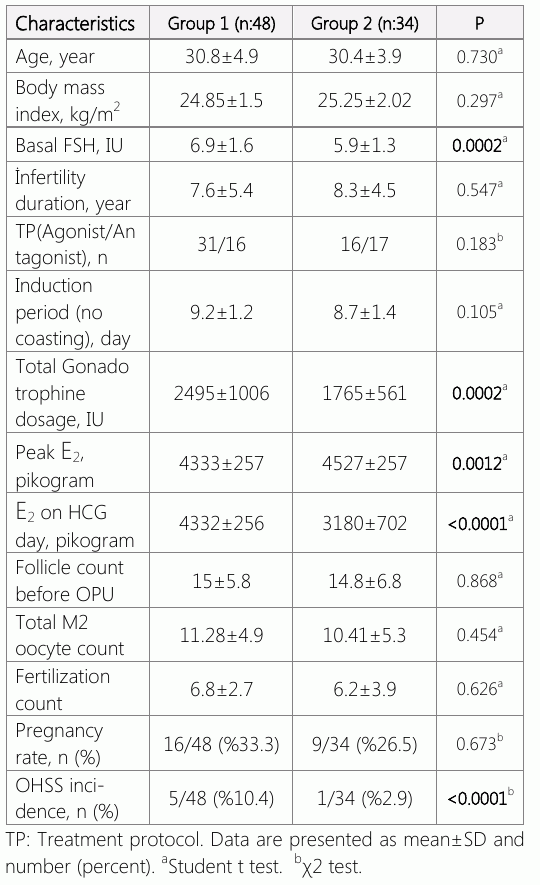
Basal FSH水平的海岸化组比控制组低(分别为5.9±1.3 vs 6.9±1.6, p:0.0002),但并未达到统计标志. 平均不孕期和上岗期(海岸期除外)在群体之间类似(日数9.2±1.2对8.7±1.4,第0.105页)。 与控制组(分别为1765.8±561.7对2495.4±1006.1,第0.0002页)相比,沿海组使用的Gonadorphine剂量总量较低。 东2个 在HCG日的水平低于控制组(分别为3180.8±702.9对4332.6±256.6, p <0.0001)。 没有一个病人有E2个 水平低于海岸群中Hcg注射日的2000比克。
平均海岸日为1.97±0.72,只有2名患者有4天的海岸日. 根据OPU之前的Follicle计数、M2卵细胞计数、受精率和怀孕率,各组没有统计标志性差异。 OHSS在海岸群中的发生率低于控制(分别为%2.08对%8.82,p<00001”) (表1)。
讨论情况
我们的研究结果显示, 女性与E海岸2个 IVF周期中为4000-5000皮克/毫升的电位. 脊髓灰质炎发病率降低,在卵泡细胞采集、采集M2卵泡细胞计数、受精卵泡细胞计数和怀孕率前进行盘点。 OHSS是排卵诱导的一个重要复杂因素。 据报告,在病媒综合防治周期中,职业安全和健康处的缺勤率为1-10%。 (17)尚未完全理解OHSS的起源。 人类胆固醇(hCG)刺激在引发综合征方面发挥关键作用 (18)年轻病人更有可能发展OHSS (1, 19, 20)这可能与卵巢对外源性淋病的反应较高有关。 我们的研究中海岸病人的平均年龄类似于控制组(分别为30.4±3.9对30.8±4.9,p:0.730)。 许多研究报告,BMI和OHSS之间没有关联性 (21, 22)在我们的研究中,BMI在两个组中也是类似的。 关于最大血清E的预测值的数据2个 与OHSS的开发水平有冲突。 D ' Angelo等人发现血清E的切除值2个 卵巢刺激第11天的电位(3346皮克/毫升)可以发现85%的处于OHSS风险的妇女 (10)与之相反的是,Morris等人报告说血清E2个 职等并不是发展业务支助和支助事务的准确预测因素 (23)Mathur等人指出,不同研究的结果不同可能归因于许多因素,如血清E方法的变化。2个 分析、参与每项研究的患者人数少、OHSS的生物变化以及OHSS在早期和晚期的出现 (24)。 。 。
取消HCG注射可防止OHSS的发展,但成本效益不高,可能会加剧不孕夫妇的焦虑。 (7)海岸测量OHSS的另一种预防方法并不要求取消循环,但也不能完全防止循环的取消。 首先,Sher等人描述了病媒综合防治周期的沿海情况。 (6). 20多年来,仍然没有通用的沿海准则。 通过降低FSH水平而海岸化会导致较小的叶片选择性回归,这些叶片的受体密度较低,更容易发生FSH水平的变化. (25)。在文献中,没有E的截断水平。2个 进行海岸和E作业2个 不同诊所的浓度水平在2500-6000皮克/毫升之间 (26)。除此之外,在海岸后管理高氯酸盐的安全乙酰丙醇水平在不同诊所可能改变为<3000皮克/毫升或<4000皮克/毫升> (27, 28)已显示,E的下降率2个 海岸期间水平不影响病媒综合防治结果 (29)在本次研究中,我们向有E型病的患者进行了海岸航行。2个 Goup-2和HCG的4000-5000皮克/毫升水平在E之后管理。2个 平均值降至3180.8±702.9皮克/毫升。 本研究报告中E节2个 在海岸群中的水平也没有改变 IVF oucomes。 因此,我们认为海岸化是降低OHSS风险的有效方法,特别是对于有E的病人来说。2个 含量介于4000至5000皮克之间。
长时间的海岸(4天以上)被发现与小细胞数量或质量下降有关 (1, 13, 30)在我们的研究中,平均海岸测量持续时间不到4天,海岸测量组的卵细胞数量与控制组相似。 一些研究报告说,海岸化不会降低怀孕率。 (30)。 。 。
因此,我们的研究表明,沿海病人的总怀孕率为26.5%,与控制组相似(33.3%)。 事实证明,在GnRH激动剂和激动剂协议中海岸化也有类似的IVF结果 (31)我们的学习人口包括服用GnRH激动剂或激动剂的病人。
结论
有时,卵巢被激素过度刺激,严重的OHSS可能威胁到生命. 最后,海岸测量是高危患者的一种可用方法,可以开发OHSS,以防止循环取消。 在高危险病人中,在使用HCG之前可以安全地进行海岸测量,这些病人具有最佳的体型和E型。2个 浓度在4000到5000之间,直到乙二醇水平下降到微妙水平。 虽然海岸化不能提高怀孕率,但可以降低病媒综合征的风险。
声明
- 作者贡献(CRediT)
- 所有作者对全部 14 项 CRediT 角色贡献均等(Conceptualization, Data curation, Formal analysis, Funding acquisition, Investigation, Methodology, Project administration, Resources, Software, Supervision, Validation, Visualization, Writing – original draft, Writing – review & editing)。
- 资助
-
There is no funding for the current study.
- 利益冲突
- The authors declare that there is no conflict of interests to publish this article.
- 伦理批准
- Ethics approval details were not reported in the published version of this article.
- 数据可用性
- A data availability statement was not reported in the published version of this article.
参考文献 (31)
31 条参考文献中有 25 条已链接 DOI。
- Aljawoan FY, Hunt LP, Gordon UD. Prediction of ovarian hyperstimulation syndrome in coasted patients in an IVF/ICSI program. J Hum Reprod Sci 2012; 5(1): 32–36. DOI Crossref PubMed Google Scholar
- Vitthala S, Bouaziz J, Tozer A, Zosmer A, Al-Shawaf T. Serum FSH Levels in Coasting Programmes on the hCG Day and Their Clinical Outcomes in IVF±ICSI Cycles. Int J Endocrinol 2012: 540681 DOI Crossref PubMed Google Scholar
- Mathur R, Evbuomwan I, Jenkins J. Prevention and management of ovarian hyperstimulation syndrome. Current Obstetrics & Gynaeco-logy 2002; 12: 111–116. DOI Crossref PubMed Google Scholar
- Abulghar MA, Mansour RT. Ovarian hyperstimulation syndrome: Classifications and critical analysis of preventive measures. Hum Reprod Update 2003; 9(3): 275–289 PubMed Google Scholar
- Al-Shawaf T, Zosmer A, Hussain A et al. Prevention ofsevere ovarian hyperstimulation syndrome in IVF with orwithout ICSI and embryo transfer: a modified coasting”strategy based on ultrasound for identification of high-riskpatients. Hum Reprod 2001; 16(1): 24–30 DOI Crossref PubMed Google Scholar
- Sher G, Zouves C, Feinman M, and Maassarani G. Prolonged coasting: an elective method for preventing severe ovarian hypersti-mulation syndrome in patients undergoing in-vitro fertilization. Hum Reprod 1995; 10(12): 3107–3109 DOI Crossref PubMed Google Scholar
- Benadiva CA, Moomjy M, Davis O, Liu HC, Kligman I, and Rosenwaks Z. Withholding gonadotropin administration is an elective alternative for the prevention of ovarian hyperstimulation syndrome. Fertil Steril 1997; 67(4): 724– 727 DOI Crossref PubMed Google Scholar
- Tortoriello DV, McGovern PG, Colon JM, Skurnick JH, Lipetz K, Santoro N. “Coasting” does not adversely affect cycle outcome in a subset of highly responsive in vitro fertilization patients. Fertil Steril 1998; 69(3): 454–460 DOI Crossref PubMed Google Scholar
- Lukaszuk K, Liss J, Jakiel G. "Internal coasting" for prevention of ovarian hyperstimulation syndrome (OHSS) in IVF/ICSI. Ginekol Pol 2011; 82(11): 812– 816 PubMed Google Scholar
- D’Angelo A, Amso N. Coasting (withholding gonadotrophins) for preventing ovarian hyperstimulation syndrome. Cochrane D atabase Syst Rev 2011 15; (6) DOI Crossref PubMed Google Scholar
- Grochowski D, Wołczyński S, Kuczyński W et al. Timed coasting reduces the risk of ovarian hyperstimulation syndrome and gives good cycle outcome in an in vitro fertilization program. Gynecol Endocrinol 2001; 15(3): 234–238 DOI Crossref PubMed Google Scholar
- Ulug U, Bahceci M, Erden HF, Shalev E, Ben-Shlomo I. The significance of coasting duration during ovarian stimulation for conception in assisted fertilization cycles. Hum Reprod 2002; 17(2): 310–313 DOI Crossref PubMed Google Scholar
- Nardo LG, Cheema P, Gelbaya TA et al. The optimal length of “coasting protocol” in women at risk of ovarian hyperstimulation syndrome undergoing in vitro fertilization. Hum Fertil (Camb) 2006; 9(3): 175–180 Coasting on Success of In-Vitro Fertilization Cycles Dilek BENK SILFELER, et al. DOI Crossref PubMed Google Scholar
- Cao XW, Lin K, Li CY, Yuan CW. A review of WHO Laboratory Manual for the Examination and Processing of Human Semen (5th edition). Zhonghua Nan Ke Xue 2011; 17(12): 1059–1063 PubMed Google Scholar
- Veeck LL. Oocyte assessment and biological performance. Ann N Y Acad Sci 1988; 541: 259-74. DOI Crossref PubMed Google Scholar
- Gardner DK, Lane M, Stevens J. Non-invasive assessment of human embryo nutrient consumption as a measure of developmental potential. Fertil Steril 2001; 76(6): 1175– 1180 DOI Crossref PubMed Google Scholar
- D’Angelo A, Amso N. Coasting (withholding gonadotropins) for preventing ovarian hyperstimulation syndrome. Cochrane Database Syst Rev 2002; (3): CD002811 DOI Crossref PubMed Google Scholar
- García-Velasco JA, Zúñiga A, Pacheco A et al. Coasting acts through downregulation of VEGF gene expression and protein secretion. Hum Reprod 2004; 19(7): 1530–1538 DOI Crossref PubMed Google Scholar
- Lyons CA, Wheeler CA, Frishman GN. Hackett RJ, Seifer DB, Haning RV Jr. Early and late presentation of the ovarian hypersti-mulation syndrome: two distinct entities with different risk factors. Hum Reprod 1994; 9(5): 792–799 PubMed Google Scholar
- Navot D, Bergh PA, Laufer N. Ovarian hyperstimulation syndrome in novel reproductive technologies: prevention and treatment. Fertil Steril 1992; 58(2): 249–261 PubMed Google Scholar
- Asch RH, Li HP, Balmaceda JP, Weckstein LN. Severe ovarian hyperstimulation syndrome in assisted reproductive technology: Definition of high risk groups. Hum Reprod 1991; 6(10):1395-1939 DOI Crossref PubMed Google Scholar
- Delvigne A, Dubois M, Batthe B et al. The ovarian hyper - stimulation syndrome in in-vitro fertilization: A Belgian multicentric study. II. Multiple discriminant analysis for risk prediction. Hum Reprod 1993; 8(9): 1361– 1366 DOI Crossref PubMed Google Scholar
- Morris RS, Paulson RJ, Sauer MV, Lobo RA. Predictive value of serum oestradiol concentrations and oocyte number in severe ovarian hyperstimulation syndrome. Hum Reprod 1995; 10(4): 811–814 DOI Crossref PubMed Google Scholar
- Mathur R, Evbuomwan I, Jenkins J. Prevention and management of ovarian hyperstimulation syndrome. Obstet Gynaecol Reprod Med 2008; 18: 18– 22 DOI Crossref PubMed Google Scholar
- Fluker MR, Hooper WM, Yuzpe AA. Withholding gonadotropins ("coasting") to minimize the risk of ovarian hyperstimulation during superovulation and in vitro fertilization-embryo transfer cycles. Fertil Steril 1999; 71(2): 294–301 DOI Crossref PubMed Google Scholar
- Abdallah R, Kligman I, Davis O, Rosenwaks Z. Withholding gonadotropins until human chorionic gonadotropin administration. Semin Reprod Med. 2010; 28(6): 486–492 DOI Crossref PubMed Google Scholar
- Levinsohn-Tavor O, Friedler S, Schachter M, Raziel A, Strass-burger D, Ron -El R. Coasting-what is the best formula? Hum Reprod 2003; 18(5): 937–940 DOI Crossref PubMed Google Scholar
- Moon HS, Joo BS, Moon SE, Lee SK, Kim KS, Koo JS. Short coasting of 1 or 2 days by withholding both gonadotropins and gonadotropin-releasing hormone agonist prevents ovarian hyper-stimulation syndrome without compromising the outcome. Fertil Steril 2008; 90(6): 2172– 2178 DOI Crossref PubMed Google Scholar
- Ulug U, Ben-Shlomo I, Bahceci M. Predictors of success during coasting period in high-responder patients undergoing controlled ovarian stimulation for assisted conception. Fertil Steril 2004; 82(2): 338–342 DOI Crossref PubMed Google Scholar
- Juan A, Veronica I, Guillermo Q, Antonio P. Coasting for the prevention of ovarian hyperstimulation syndrome: Much ado about nothing. Fertil Steril 2006; 85(3): 547–554 PubMed Google Scholar
- Farhi J, Ben-Haroush A, Lande Y, Sapir O, Pinkas H, Fisch B. In vitro fertilization cycle outcome after coasting in gonadotropin-releasing hormone (GnRH) agonist versus GnRH antagonist protocols. Fertil Steril 2009; 91(2):377–382 To submit your manuscript, please click on http://ulutasmedicaljournal.com DOI Crossref PubMed Google Scholar
阅读全文
在此打开 PDF
正在加载 PDF…
若 PDF 未在此显示,请使用上方的下载按钮。
如何引用本文
Silfeler DB, Gun I, Kurt RK, Ovayolu A, Sofuoglu K, Kutlu T, et al. Effect of Coasting on Success of In-Vitro Fertilization Cycles. Ulutas Med J. 2016;2(2):101-106. doi:10.5455/umj.20160703095058
Silfeler, D. B., Gun, I., Kurt, R. K., Ovayolu, A., Sofuoglu, K., Kutlu, T., & Arat, N. (2016). Effect of Coasting on Success of In-Vitro Fertilization Cycles. The Ulutas Medical Journal, 2(2), 101–106. https://doi.org/10.5455/umj.20160703095058
Silfeler, D.B. et al. (2016) 'Effect of Coasting on Success of In-Vitro Fertilization Cycles', The Ulutas Medical Journal, 2(2), pp. 101–106. doi: 10.5455/umj.20160703095058.