The Ulutas Medical Journal · ISSN 2149-0430 (print), 2149-388X (online) · https://www.ulutasmedicaljournal.com/?mno=228942
Original Research · Open access
Effect of Coasting on Success of In-Vitro Fertilization Cycles
- Yildirim Beyazit University, Faculty of Medicine, Ankara/Turkey ROR
- GATA faculty of Medicine, Department of Obstetrics and Gynecology, Istanbul/Turkey ROR
- Mustafa Kemal University, Faculty of Medicine, Department of Obstetrics and Gynecology, Antakya/Hatay/Turkey ROR
- Cengiz Gokcek Public Hospital, Department of Obstetrics and Gynecology, Gaziantep/Turkey ROR
- Zeynep Kamil Education and research hospital, Department of Obstetrics and Gynecology, Istanbul/Turkey ROR
- Zeynep Kamil Education and research hospital, Department of Embriology, Istanbul/Turkey ROR
Abstract
- Introduction
- "Coasting" is a method used in the prevention of Ovarian Hyperstimulation Syndrome (OHSS) during In Vitro Fertilization (IVF) cycles. Coasting refers to withholding exogenous gonadotropin use and delaying the administration of hCG in high-risk cycles until serum estradiol levels fall into an acceptable range. Our study aims to evaluate the coasting effect on IVF outcomes in patients with E2 levels of 4000-5000 picograms.
- Method
- This study was a single-center, retrospective, case-control study. The study population was selected from women who applied to the Zeynep Kamil Research Hospital IVF department between January 2003 and December 2013 (n=7850). The study included patients taking a GnRH agonist or antagonist protocol, with a BMI between 23-28 kg/m2, E2 levels between 4000-5000 picograms, and an age <43. Patients were divided into 2 groups: a control group (Group 1, n=48) and a coasted group (Group 2, n=34), based on whether coasting was performed. Peak E2 levels before coasting, follicle count before oocyte pick-up, collected M2 oocyte count, fertilized oocyte count, OHSS incidence, and pregnancy incidence were compared between groups. Statistical analysis was performed using Student's t test for continuous variables and chi-square test for categorical variables.
- Results
- Most patients in group 2 needed less than 2 days of coasting; only two needed 4 days. On the day of hCG, E2 levels in group 2 were significantly lower than in group 1 (4332.6±256.6 and 3180.8±702.9; p<0.0001, respectively). No statistically significant differences were observed between groups in follicle count before oocyte pick-up, collected M2 oocyte count, fertilized oocyte count, pregnancy rate, or OHSS incidence.
- Conclusion
- Co-esting is an effective method in high-risk women to lower OHSS incidence. It can be applied safely, especially in patients with optimal follicular size and estradiol levels of 4000-5000.
Keywords
Full text
Introduction
Controlled ovarian stimulation used in assisted reproductive techniques may cause ovarian hyperstimulation syndrome (OHSS). Exogenous human chorionic gonadotrophin (hCG) has a major role in OHSS development via increasing capillary permeability (1). There are many treatment varients such as cycle cancel, witholding HCG, coasting, intravenous albumin and dopamin agonist administration to reduce incidince and severity of OHSS in high risk patient (2). Coasting, one of the most used methods, refers to witholding exogenous gonodotropine usage and delaying the administration of hCG in high risk cycles until serum estradiol falls into an acceptable range (typically less than 2500 to 3000 pg/mL) (2–7). Coasting decreases FSH levels and causes granulosa cell apoptosis and inhibition of proliferation via luteinazition (2, 6). As a conse-quence, coasting prevent onset of OHSS (2, 8). Moreover it allows usage of embryos in that cycle instead of embryo freezing and it decreases patient anxiety and cost. Many studies demonstrated that coastıng reduced OHSS incidince effectively (7). Many studies have shown that pregnancy rate in coasted patients is similar to women with no coasting (9). In Cochrane systematic Reviews, only one study from 13 studies were evaluated and it was reported that coasting had similar incidence of OHSS and pregnancy rate compared to control group (2, 10). Some studies stated that coasting interval may change in vitro fertilization (IVF) outcomes (11). Coasting interval that will not change pregnancy rate adversely has not been explained yet (2, 7, 8, 12, 13).
There are controversies about coasting effects on IVF outcomes such as decreased picked oocyte, decreased implantation rate and decreased pregnancy rate (2). The aim of our study is to evaluate coasting effect on IVF oucomes in patients having E2 levels of 4000- 5000 pikogram.
Study Design
This study was a single centered, retrospective and a case-control study. The study population was selected from infertile women applied Zeynep Kamil research hospital IVF department between January 2003 and December 2013 (n:7850). Patients, between 23 to 43 years and with a body mass index (BMI) of 23 -28 kg/m2, having normal serum hormone profile, regular menstrual cycle, first or second cycle of IVF were included. Male infertility was excluded according to World Health Organization (WHO) 2010 criteria (14). Women having uterine pathology were also excluded. There were 82 patients who fulfilled inclusion criteria. Patients were divided in 2 groups as conrol group (Group 1, n:48) and coasting group (Group 2, n:34) according to whether coasting performed or not. Medical history, gynecology examination and basic infertility tests had been performed all women. All patients had venous blood sampling in early follicular period and on the day of HCG to detect FSH and estradiol (E2) levels. Transvaginal ultrasonography had been performed to detect antral follicle count in early follicular phase.
Ovulation induction via agonist or antagonist protocol, 100 mg aspirine and 400 mcg folic acide had been administered patients. GnRH agonist had been started in 21th Day of previous cycle and recombinant(rec) FSH [rec- FSH, Gonal-f® (Merck Serono, Turkey) or Puregon® (Shering Ploug)] had been added on third day of cycle in long agonist protocol. rec-FSH(150 IU, rec FSH) had been started on second or third day of cycle and GnRH antogonist had been added on the sixth day of cycle in antagonist protocol.Starting dosage of rec-FSH was made according to patients’ age, BMI, antral follicle count and basal FSH levels. Following, in both protocols recFSH dosage had been arranged according to follicle diameter in TV USG and serum E2 levels. When the leading follicle diameter reached to 18 mm or two follicle diameter were greater than 16 mm, 10,000 IU hCG (Pregnyl®, Shering Ploug) intramuscularly or 250 mcg rec-hCG subcutenously were enjected. Gonodotropines administration were stopped in women having peak E2 levels greater than 4000 in group 2 and GnRH analogs were continued to administer.
Oocyte pick-up (OPU) were performed 35.5 hours after HCG administration under intravenous (IV) sedation and with guidance of TV USG. Single dose Cefazolin sodyum (iv, 1 gram) were given all patients during OPU. Doxycycline (100 mg, two times daily,po) and methyl prednisolone (16 mg, one daily, po) were given patients for 4 days. Intravaginal 90 mg progesterone (%8 crinone gel, Serono) for luteal phase support were started all patients from OPU day. Oocyte maturation scoring were made according to Veeck`s classification as 0-4 (15). Pronuclear scoring was evaluated 16-18 hours after Intracytoplasmic Sperm Enjection (ICSI). Embryo quality was scored as 1-5 according to morphology of embryo splitting before ET (16).
Single Embryo transfer (ET) were performed via USG guidance after 2-5 days. After 12 days, serum Beta-HCG levels were measured for pregnancy detection. Beta-HCG levels >20 IU/l were named as biochemical pregnancy and fetal cardiac activity observed in USG after 6 weeks of ET was called as clinical pregnancy. Statistical analyses were performed using the Statistical Package for the Social Sciences for Windows 15.0 software (SPSS, Chicago, IL., USA). Descriptive statistics were given as mean, standard deviation, frequency and percentage. To compare parametric con-tinuous variables, the Student T-test was used; to compare nonparametric continuous variables, the Mann-Whitney U test was used; and to compare categorical variables, the chi-square test was used. P values <0.05 were considered to indicate statistical significance.
Results
In this study, 7850 patients were evaluated retrospectively. There were 173 patients to whom coasting was performed. 91 patients, who did not meet the inclusion criteria of the study, were left out and the study was completed with 82 patients. 82 patients were divided into two groupsaccording to whether coasting performed or not; 48 patients (58.5%) as study group (Group-1) and 34 patients (41.5%) ascoasting group (Group-2).Mean age (30.8±4.9 vs 30.4±3.9, p:0.730, respectively) and BMI (24.85±1.5 vs 25.25±2.02, p:0.297, respectively) of control group and coasted group were similar.
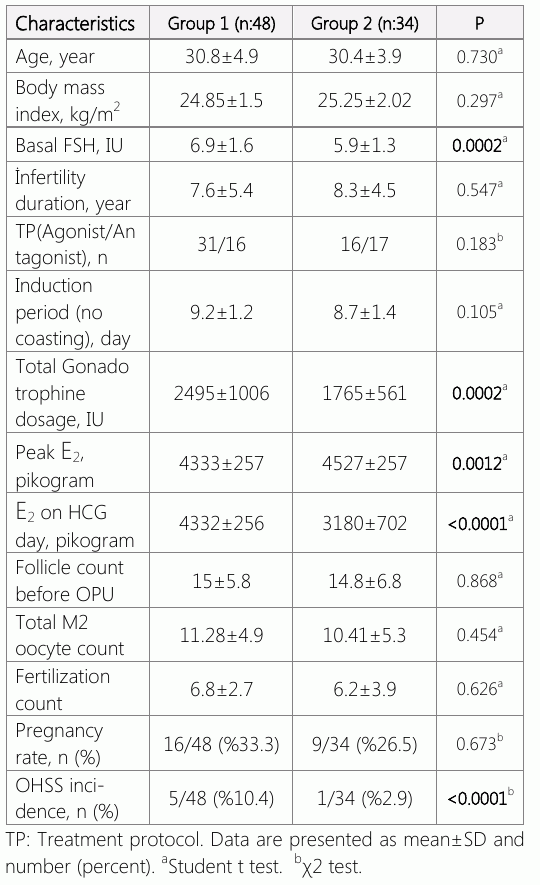
Basal FSH level of coasted group were lower than control group (5.9±1.3 vs 6.9±1.6, p:0.0002, respectively) but it was not reached statistically significiance. The mean infertility duration and induction period except coasting duration were similar in between groups (9.2±1.2 vs 8.7±1.4 in days, p:0.105). Total Gonadotrophine dosage used were lower in coasted group compared to control group (1765.8±561.7 vs 2495.4±1006.1, p:0.0002, respectively). E2 level on HCG day was lower in coasted group than control group (3180.8 ±702.9 vs 4332.6±256.6, p<0.0001, respectively). None of the patient had E2 level lower than 2000 pikogram at the day of hcg injection in the coasting group.
The mean coasting day was 1.97±0.72 and only 2 patients had four days of coasting. There were no statistically significiant difference in groups according to Follicle count before OPU, total M2 oocyte count, fertilization rate and pregnancy rate. OHSS incidence was lower in coasted group than control (%2.08 vs %8.82,p<0,0001, respectively) (Table-1).
Discussion
Our study results revealed that Coasting in women with E2 level of 4000-5000 pg/ml in IVF cycles. OHSS incidence reduced and IVF cycle results such as follicle count before oocyte pick up, collected M2 oocyte count, fertilized oocyte count and pregnancy rate. OHSS is an important complication of ovulation induction. The incidece of OHSS is reported as 1-10% in IVF cycles (17). Etiopat-hogenesis of OHSS have not been completely understood yet. Human chorionic gonadotrophin (hCG) stimulation plays a key role in triggering syndrome (18). Younger patients are more likely to develop OHSS (1, 19, 20). This might be associated with higher response of the ovaries to exogenous gonadotrophins. The mean age of coasted patients in our study was similar to control group (30.4±3.9 vs 30.8±4.9, p:0.730, respectively). Many studies reported no correlation between BMI and OHSS (21, 22). In our study BMI was also similar in both groups. The data about the predictive value of maximum serum E2 level on the development of OHSS is conflicting. D’Angelo et al. found a cut-off value of serum E2 level (3346 pg/mL) on Day 11 of ovarian stimulation could detect 85% of women at risk for OHSS (10). In contrast to that Morris et al. reported that serum E2 level is not an accurate predictive factor for OHSS development (23). Mathur et al. stated that different results between studies may be attributed to many factors such as variations in the methods of serum E2 assays, the small number of patients involved in each of these studies, the biological variability of OHSS and occurrence of OHSS as early and late onset (24).
Cancellation of HCG injection prevent OHSS development but it is not cost effective and it may increse anxiety of infertile couples (7). Coasting another preventive method of OHSS does not require cycle cancellation but it can not completely prevent from cycle cancellation either. Firstly, Sher et al described coasting in IVF cycles (6). For More than 20 years, there are still no universal coasting guidelines. Coasting by decreasing FSH levels leads to the selective regression of smaller follicles which have lower density of FSH receptors and are more prone to changing FSH levels (25). In the literature there is no cut-off level of E2 to perform coasting and E2 levels ranges between 2500-6000 pg/ml in different clinics (26). In addition to, safe estradiol level to administer HCG after coasting may change in different clinics as<3000 pg/ml or<4000 pg/ml (27, 28). It has been shown that the rate of decrease in E2 levels during coasting does not affect the IVF outcomes (29). In the present study we performed coasting to patients having E2 levels between 4000-5000 pg/ml in Goup-2 and HCG was administered after E2 levels decreased to 3180.8±702.9 pg/ml as mean. In the present study decrese in E2 level in coasting group also did not change IVF oucomes. Therefore, we suppose that coasting is an effective method to lower OHSS risk especially in patients having E2 levels ranging 4000 to 5000 pg.
Prolonged coasting (more than 4 days) was found to related with reduced numbers or quality of oocytes (1, 13, 30). In our study mean coastig duration was less than 4 days and oocyte number in coasting group was similar to control group. Some studies reported that coasting does not reduce pregnancy rate (30).
In accordance with that, our study demonstrates an overall pregnancy rate of 26.5% in coasted patients which is similar to control group (33.3%). It was shown that coasting in GnRH agonist and antogonist protocol had similar IVF outcomes (31). Our study population consist of patients who take GnRH agonist or antogonist protocol.
Conclusion
Sometimes, ovaries are overstimulated by hormones and severe OHSS may be life threatening. In conclusion, coasting is a usable method in patients who have high risk to develop OHSS so it prevent cycle cancellation. Coasting can be performed safely before HCG administration in high risk patients who have optimal follicular size and E2 levels ranging 4000 to 5000, until estradiol levels decrease to delicate levels. Although coasting could not increase pregnancy rate, it can decrease IVF complication risks.
Declarations
- Author contributions (CRediT)
- All authors contributed equally to all 14 CRediT roles (Conceptualization, Data curation, Formal analysis, Funding acquisition, Investigation, Methodology, Project administration, Resources, Software, Supervision, Validation, Visualization, Writing – original draft, Writing – review & editing).
- Funding
-
There is no funding for the current study.
- Conflicts of interest
- The authors declare that there is no conflict of interests to publish this article.
- Ethics approval
- Ethics approval details were not reported in the published version of this article.
- Data availability
- A data availability statement was not reported in the published version of this article.
References (31)
25 of 31 references are linked to their DOI.
- Aljawoan FY, Hunt LP, Gordon UD. Prediction of ovarian hyperstimulation syndrome in coasted patients in an IVF/ICSI program. J Hum Reprod Sci 2012; 5(1): 32–36. DOI Crossref PubMed Google Scholar
- Vitthala S, Bouaziz J, Tozer A, Zosmer A, Al-Shawaf T. Serum FSH Levels in Coasting Programmes on the hCG Day and Their Clinical Outcomes in IVF±ICSI Cycles. Int J Endocrinol 2012: 540681 DOI Crossref PubMed Google Scholar
- Mathur R, Evbuomwan I, Jenkins J. Prevention and management of ovarian hyperstimulation syndrome. Current Obstetrics & Gynaeco-logy 2002; 12: 111–116. DOI Crossref PubMed Google Scholar
- Abulghar MA, Mansour RT. Ovarian hyperstimulation syndrome: Classifications and critical analysis of preventive measures. Hum Reprod Update 2003; 9(3): 275–289 PubMed Google Scholar
- Al-Shawaf T, Zosmer A, Hussain A et al. Prevention ofsevere ovarian hyperstimulation syndrome in IVF with orwithout ICSI and embryo transfer: a modified coasting”strategy based on ultrasound for identification of high-riskpatients. Hum Reprod 2001; 16(1): 24–30 DOI Crossref PubMed Google Scholar
- Sher G, Zouves C, Feinman M, and Maassarani G. Prolonged coasting: an elective method for preventing severe ovarian hypersti-mulation syndrome in patients undergoing in-vitro fertilization. Hum Reprod 1995; 10(12): 3107–3109 DOI Crossref PubMed Google Scholar
- Benadiva CA, Moomjy M, Davis O, Liu HC, Kligman I, and Rosenwaks Z. Withholding gonadotropin administration is an elective alternative for the prevention of ovarian hyperstimulation syndrome. Fertil Steril 1997; 67(4): 724– 727 DOI Crossref PubMed Google Scholar
- Tortoriello DV, McGovern PG, Colon JM, Skurnick JH, Lipetz K, Santoro N. “Coasting” does not adversely affect cycle outcome in a subset of highly responsive in vitro fertilization patients. Fertil Steril 1998; 69(3): 454–460 DOI Crossref PubMed Google Scholar
- Lukaszuk K, Liss J, Jakiel G. "Internal coasting" for prevention of ovarian hyperstimulation syndrome (OHSS) in IVF/ICSI. Ginekol Pol 2011; 82(11): 812– 816 PubMed Google Scholar
- D’Angelo A, Amso N. Coasting (withholding gonadotrophins) for preventing ovarian hyperstimulation syndrome. Cochrane D atabase Syst Rev 2011 15; (6) DOI Crossref PubMed Google Scholar
- Grochowski D, Wołczyński S, Kuczyński W et al. Timed coasting reduces the risk of ovarian hyperstimulation syndrome and gives good cycle outcome in an in vitro fertilization program. Gynecol Endocrinol 2001; 15(3): 234–238 DOI Crossref PubMed Google Scholar
- Ulug U, Bahceci M, Erden HF, Shalev E, Ben-Shlomo I. The significance of coasting duration during ovarian stimulation for conception in assisted fertilization cycles. Hum Reprod 2002; 17(2): 310–313 DOI Crossref PubMed Google Scholar
- Nardo LG, Cheema P, Gelbaya TA et al. The optimal length of “coasting protocol” in women at risk of ovarian hyperstimulation syndrome undergoing in vitro fertilization. Hum Fertil (Camb) 2006; 9(3): 175–180 Coasting on Success of In-Vitro Fertilization Cycles Dilek BENK SILFELER, et al. DOI Crossref PubMed Google Scholar
- Cao XW, Lin K, Li CY, Yuan CW. A review of WHO Laboratory Manual for the Examination and Processing of Human Semen (5th edition). Zhonghua Nan Ke Xue 2011; 17(12): 1059–1063 PubMed Google Scholar
- Veeck LL. Oocyte assessment and biological performance. Ann N Y Acad Sci 1988; 541: 259-74. DOI Crossref PubMed Google Scholar
- Gardner DK, Lane M, Stevens J. Non-invasive assessment of human embryo nutrient consumption as a measure of developmental potential. Fertil Steril 2001; 76(6): 1175– 1180 DOI Crossref PubMed Google Scholar
- D’Angelo A, Amso N. Coasting (withholding gonadotropins) for preventing ovarian hyperstimulation syndrome. Cochrane Database Syst Rev 2002; (3): CD002811 DOI Crossref PubMed Google Scholar
- García-Velasco JA, Zúñiga A, Pacheco A et al. Coasting acts through downregulation of VEGF gene expression and protein secretion. Hum Reprod 2004; 19(7): 1530–1538 DOI Crossref PubMed Google Scholar
- Lyons CA, Wheeler CA, Frishman GN. Hackett RJ, Seifer DB, Haning RV Jr. Early and late presentation of the ovarian hypersti-mulation syndrome: two distinct entities with different risk factors. Hum Reprod 1994; 9(5): 792–799 PubMed Google Scholar
- Navot D, Bergh PA, Laufer N. Ovarian hyperstimulation syndrome in novel reproductive technologies: prevention and treatment. Fertil Steril 1992; 58(2): 249–261 PubMed Google Scholar
- Asch RH, Li HP, Balmaceda JP, Weckstein LN. Severe ovarian hyperstimulation syndrome in assisted reproductive technology: Definition of high risk groups. Hum Reprod 1991; 6(10):1395-1939 DOI Crossref PubMed Google Scholar
- Delvigne A, Dubois M, Batthe B et al. The ovarian hyper - stimulation syndrome in in-vitro fertilization: A Belgian multicentric study. II. Multiple discriminant analysis for risk prediction. Hum Reprod 1993; 8(9): 1361– 1366 DOI Crossref PubMed Google Scholar
- Morris RS, Paulson RJ, Sauer MV, Lobo RA. Predictive value of serum oestradiol concentrations and oocyte number in severe ovarian hyperstimulation syndrome. Hum Reprod 1995; 10(4): 811–814 DOI Crossref PubMed Google Scholar
- Mathur R, Evbuomwan I, Jenkins J. Prevention and management of ovarian hyperstimulation syndrome. Obstet Gynaecol Reprod Med 2008; 18: 18– 22 DOI Crossref PubMed Google Scholar
- Fluker MR, Hooper WM, Yuzpe AA. Withholding gonadotropins ("coasting") to minimize the risk of ovarian hyperstimulation during superovulation and in vitro fertilization-embryo transfer cycles. Fertil Steril 1999; 71(2): 294–301 DOI Crossref PubMed Google Scholar
- Abdallah R, Kligman I, Davis O, Rosenwaks Z. Withholding gonadotropins until human chorionic gonadotropin administration. Semin Reprod Med. 2010; 28(6): 486–492 DOI Crossref PubMed Google Scholar
- Levinsohn-Tavor O, Friedler S, Schachter M, Raziel A, Strass-burger D, Ron -El R. Coasting-what is the best formula? Hum Reprod 2003; 18(5): 937–940 DOI Crossref PubMed Google Scholar
- Moon HS, Joo BS, Moon SE, Lee SK, Kim KS, Koo JS. Short coasting of 1 or 2 days by withholding both gonadotropins and gonadotropin-releasing hormone agonist prevents ovarian hyper-stimulation syndrome without compromising the outcome. Fertil Steril 2008; 90(6): 2172– 2178 DOI Crossref PubMed Google Scholar
- Ulug U, Ben-Shlomo I, Bahceci M. Predictors of success during coasting period in high-responder patients undergoing controlled ovarian stimulation for assisted conception. Fertil Steril 2004; 82(2): 338–342 DOI Crossref PubMed Google Scholar
- Juan A, Veronica I, Guillermo Q, Antonio P. Coasting for the prevention of ovarian hyperstimulation syndrome: Much ado about nothing. Fertil Steril 2006; 85(3): 547–554 PubMed Google Scholar
- Farhi J, Ben-Haroush A, Lande Y, Sapir O, Pinkas H, Fisch B. In vitro fertilization cycle outcome after coasting in gonadotropin-releasing hormone (GnRH) agonist versus GnRH antagonist protocols. Fertil Steril 2009; 91(2):377–382 To submit your manuscript, please click on http://ulutasmedicaljournal.com DOI Crossref PubMed Google Scholar
Read the full text
Open the PDF here
Loading the PDF…
If the PDF does not show here, use the download button above.
How to cite this article
Silfeler DB, Gun I, Kurt RK, Ovayolu A, Sofuoglu K, Kutlu T, et al. Effect of Coasting on Success of In-Vitro Fertilization Cycles. Ulutas Med J. 2016;2(2):101-106. doi:10.5455/umj.20160703095058
Silfeler, D. B., Gun, I., Kurt, R. K., Ovayolu, A., Sofuoglu, K., Kutlu, T., & Arat, N. (2016). Effect of Coasting on Success of In-Vitro Fertilization Cycles. The Ulutas Medical Journal, 2(2), 101–106. https://doi.org/10.5455/umj.20160703095058
Silfeler, D.B. et al. (2016) 'Effect of Coasting on Success of In-Vitro Fertilization Cycles', The Ulutas Medical Journal, 2(2), pp. 101–106. doi: 10.5455/umj.20160703095058.