The Ulutas Medical Journal · ISSN 2149-0430 (print), 2149-388X (online) · https://www.ulutasmedicaljournal.com/?mno=262966
Original Research · Open access
Methylene Tetrahydrofolate Reductase C677T Gene Polymorphism In Male Infertility
- Department of Human Genetics and Molecular Biology, Bharathiar University, India ROR
- Department of Genetics, University of Madras, Taramani, Chennai, India ROR
Abstract
- Background
- Methylenetetrahydrofolate reductase is an important enzyme which plays a major role in folate metabolism and DNA methylation. The objective of this study was to analyze the MTHFR C677T polymorphism in infertile men.
- Study Design
- Blood samples were collected from 58 infertile men and 55 control subjects were taken which are fertile. C677T mutation analysis was done by Polymerase chain reaction-restriction fragment length polymorphism (PCR-RFLP) Method.
- Results
- The present study reveals that 23 Homozygous CC, 28 heterozygous CT, 7 TT were found in infertile men, whereas in control, the allele variations were 38 Homozygous CC, 17 heterozygous CT, but no Homozygous TT was found.
- Conclusion
- As a result, Genotypes and allele frequencies found in infertile patients and controls but mutant allele was found only in infertile men. Homozygous TT was observed only in azoospermia infertile men whereas heterozygous CT was found in both oligozoospermia and azoospermia subjects. The study has to be extended with a large number of samples.
Keywords
Full text
Introduction
Folic acid metabolism is significant for integrity and stability of the genome as it plays a major role in error free DNA synthesis, DNA methylation pattern and repair (1). Therefore, deficiency in folate intake or polymorphism(s) in the enzymes of folate pathway may result in aberrant DNA synthesis and methylation. Methylenetetrahydrofolate reductase (MTHFR) is an important enzyme of methionine and folate metabolism, crucial help for DNA synthesis and methylation. MTHFR reduces 5,10-methylene tetrahydrofolate to 5-methyl tetrahydrofolate which gives methyl group to homocysteine to form methionine. Methionine is ultimately converted to S-adenosyl methionine which acts as a ‘methyl’ donor for DNA methylation (2). Also, methylenetetra hydrofolate involved in DNA synthesis by changing uracil to thymine (3). In adult testis of a mouse than other organs the activity of MTHFR is high, representing its role in spermatogenesis (4, 5). Recent research has identified epigenetic regulation of several genes playing important role in spermatogenesis and fertility (6). Therefore, alterations in the MTHFR gene could change the process of spermatogenesis and predispose carriers to infertility (7, 8).
The length of MTHFR gene in human is 20 kb (20,336 bp) and located at 1p36.3 (OMIM 607093), having 11 exons (9). There are more than 40 polymorphisms have been identified in MTHFR, but the most severe and clinically significant common variants are C677T in exon 4 and A1298C in exon 7 but most common are C677T of MTHFR gene has been identified to affect activity of this enzyme (10–15). C677T variant replaces alanine with valine (A222V, rs1801133) and it is the most common as well as severe form of MTHFR (16–21). This substitution results in reduced MTHFR specific activity and increased thermolability (22).
Homozygous T677T variant has, 30% of remaining activity and heterozygous C677T variant has 70% of residual activity when compared to C677C variant (23). This substitution also results in enhanced level of homocysteine and low plasma folate level. The frequency of C677T polymorphism differs with environmental and ethnic place (24). It has been recommended that low level of folate related to MTHFR polymorphism would be the reason for infertility due to alteration the synthesis of DNA and RNA molecules (4, 15).
Concentration of sperm can be increased based on folic acid and zinc sulfate supplementation, this additionally suggests the importance of this pathway in spermatogenesis (14). This is also supported by study in which stimulation of low methylation by 5-aza deoxy cytidine, which inhibits the differentiation of spermatozoa to spermatocytes in murine model (25). Hence analysis of C677T polymorphism is important in infertile men to elucidate the association between allele variants and male infertility.
Methodology
Genomic DNA was extracted from the peripheral blood of patients and control samples using phenol-chloroform-isoamyl method (26, 27). Isolated DNA was dissolved in 1x (working) TE buffer with the help of thermomixer. The quantification and quality check of DNA was performed by subjecting the DNA to spectrophotometry (Nanodrop method). The nucleic acid sample was analysed at 260 nm and 280 nm by using Nanodrop Spectrophotometer (Thermo Scientific, Germany).
Pure DNA is A260/A280 ≥1.8 to 2. Value of <1.8 indicates protein and phenol contami-nation. Value of >2 indicates the possibility of RNA contami-nation. Further, the integrity of the genomic DNA was assessed by running it on 0.8% agarose gel. PCR was carried out in a total reaction volume of 20 µl each in thin walled tubes consisting of DNA 2µl, ADW (autoclaved distilled water) 7.6µl, forward primer (59CATC CCTATTGGCAGGTTACCC39) 0.2µl, reverse (59 GGGAAGAACTCAGCGAAC TCAG39) primer (28, 29) 0.2µl, mastermix 10µl. PCR cycling was carried out in Roch gradient PCR.PCR amplification conditions included denaturation at 95°C for ten minutes and then 35 cycles of denaturation at 95°C for 30 seconds, annealing at 63°C for 30 seconds and polymerization at 72°C for 40 sec, and a final stage of polymerization at 72°C for 7 minutes. After amplification, 0.5µl of Hinf I as a restriction enzyme added to 0.5µl of amplified product and kept for 4 hours. Immediately after 4 hours vial was transferred to water bath at 80°C and kept for 20minutes. Finally the product was runned in 3% agarose gel electrophoresis. The gel image was viewed using UV transilluminater.
Results
23 Homozygous CC, 28 heterozygous CT, 7 TT were found in infertile men, whereas in control, the allele variations were 38 Homozygous CC, 17 heterozygous CT, but no Homozygous TT was found in control samples. Mutant allele variation of homozygous TT was found in 7 infertile samples which belong to azoospermia and oligozoospermia category and 28 heterozygous CT was found in which majority belongs to oligozoospermia as well as azoospermia subjects but low number allele frequencies were observed in other categories of infertile subjects such as asthenozoospermia, oligoasthenoteratozoospermia.
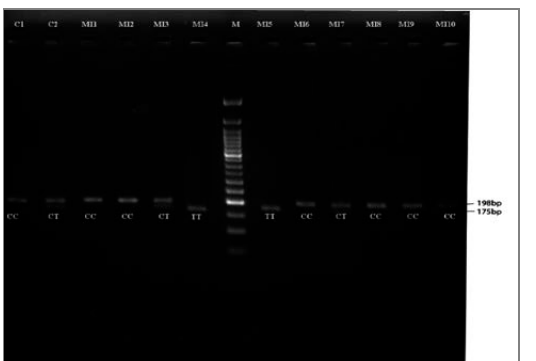
These results were also supported by meta-analysis in the previously carried out studies. The observations of our study get interesting particularly from the two previous studies shown on Indian population that have reported contradictionary outcomes for what they have been reported in a meta-analysis study by Zhu and colleagues. Their results revealed that association between MTHFR C677T polymorphism and male infertility. Additionally, MTHFR C677T was linked with a considerable high risk of azoospermia in each genetic models. Meanwhile, no significantly increased risks of oligoasthenotertozoospermia (OAT) were found in most of the genetic models (30). Another meta analysis study involving 26 studies on the association of MTHFR C677T polymorphism with male infertility has concluded that MTHFR C677T polymorphism has a strong association with increased risk of male infertility (31). Furthermore, a study involved 360 of non obstructive infertile men and reported the association of MTHFR C677T with azoospermia (32).
Conclusion
Genotypes and allele frequencies were found to be higher comparatively with the normal subjects. Since, MTHFR gene plays a major role in regulation of spermatogenesis, allele variants can disturb the process resulting in male infertility. However, a large number of samples, well-designed and high quality epidemiological studies will be required to confirm the association between MTHFR C677T polymorphism and male infertility.
Declarations
- Author contributions (CRediT)
- All authors contributed equally to all 14 CRediT roles (Conceptualization, Data curation, Formal analysis, Funding acquisition, Investigation, Methodology, Project administration, Resources, Software, Supervision, Validation, Visualization, Writing – original draft, Writing – review & editing).
- Funding
-
Funding information was not reported in the published version of this article.
- Conflicts of interest
- A conflict of interest statement was not reported in the published version of this article.
- Ethics approval
- Ethics approval details were not reported in the published version of this article.
- Data availability
- A data availability statement was not reported in the published version of this article.
References (32)
30 of 32 references are linked to their DOI.
- Ravel C, Chantot-Bastaraud S, Chalmey C, Barreiro L, Aknin -Seifer I, et al. Lack of association between genetic polymorphisms in enzymes associated with folate metabolism and unexplained reduced sperm counts. Plos One 4: e6540. DOI Crossref PubMed Google Scholar
- A ZC, Yang Y, Zhang SZ, Li N, Zhang W. Single nucleotide polymorphism 677C.T in the methylenetetrahydrofolate reductase gene might be a genetic risk factor for infertility for Chinese men with azoospermia or severe oligozoospermia. Asian J Androl 9: 57–62. 3. DOI Crossref PubMed Google Scholar
- Lee HC, Jeong YM, Lee SH, Cha KY, Song SH, et al. Association study of four polymorphisms in three folate-related enzyme genes with non- obstructive male infertility. Hum Reprod 21: 3162–3170. DOI Crossref PubMed Google Scholar
- Dhillon VS, Shahid M, Husain SA. Associations of MTHFR DNMT3b 4977bp deletion in mtDNA and GSTM1 deletion, and aberrant CpG island hypermethylation of GSTM1 in non-obstructive Infertility in Indian men. Mol Hum Reprod 13: 213–222. 5. DOI Crossref PubMed Google Scholar
- Chen Z, Karaplis AC, Ackerman SL, Pogribny IP, Melnyk S, et al. Mice deficient in methylenetethrahydrofolate reductase exhibit hyperhomocysteinemia and decreased methylation capacity, with neuropathology and aortic lipid deposition. Hum Mol Genet 10: 433–443. DOI Crossref PubMed Google Scholar
- Minocherhomji S, Madon PF, Parikh FR. Epigenetic regulatory mechanisms associated with infertility. Obstet Gynecol Int pii. 198709 p. MTHFR C677T Polymorphism In Male Infertility Papitha P Anand, et al. DOI Crossref PubMed Google Scholar
- Khazamipour N, Noruzinia M, Fatehmanesh P, Keyhanee M, Pujol P. MTHFR promoter hypermethylation in testicular biopsies of patients with nonobstructive azoospermia: the role of epigenetics in male infertility. Hum Reprod 24: 2361–2364. DOI Crossref PubMed Google Scholar
- Singh K, Singh SK, Raman R. MTHFR A1298C polymorphism and idiopathic male infertility. J Postgrad Med 56: 267–269. DOI Crossref PubMed Google Scholar
- Rai V, Yadav U, Kumar P. Prevalence of methylenetetrahydrofolate reductase C677T polymorphism in eastern Uttar Pradesh. Indian J Hum Genet 2012;18:43-6. DOI Crossref PubMed Google Scholar
- Safarinejad MR, Shafi ei N, Safarinejad S. Relationship Between Genetic Polymorphisms of Methylenetetrahydrofolate Reductase (C677T, A1298C, and G1793A) as Risk Factors for Idiopathic Male Infertility. Reprod Sci 18: 304–315. DOI Crossref PubMed Google Scholar
- Bezold G, Lange M, Peter RU. Homozygous methylenetetra hydrofolate reductase 677C.T mutation and male infertility. N Engl J Med 344: 1172– 1173. PubMed Google Scholar
- Singh K, Singh SK, Sah R, Singh I, Raman R. Mutation 677C.T in the methylenetetrahydrofolate reductase gene is associated with male infertility in Indian population. Int J Androl 28: 115–119. PubMed Google Scholar
- Park JH, Lee HC, Jeong YM, Chung TG, Kim HJ, et al. MTHFR 677C.T polymorphism associates with unexplained infertile male factors. J Assist Reprod Genet 22: 361–368. DOI Crossref PubMed Google Scholar
- Stuppia L, Gatta V, Scarciolla O, Colosimo A, Guanciali-Franchi P, et al. The methylenetethrahydrofolate reductase (MTHFR) 677C.T polymorphism and male infertility in Italy. J Endocrinol Invest 26: 620–622. DOI Crossref PubMed Google Scholar
- Ebisch IMW, van Heerde WL, Thomas CM, van der Put N, Wong WY, et al. 677C.T methylenetetrahydrofolate reductase polymorp-hism interferes with the effects of folic acid and zinc sulfate on sperm concentration. Fertil Steril 80: 1190–1194. DOI Crossref PubMed Google Scholar
- Paracchini V, Garte S, Taioli E. MTHFR 677C.T polymorphism, GSTM1 deletion and male infertility: a possible suggestion of a gene/gene interaction? Biomarkers 11: 53–60. DOI Crossref PubMed Google Scholar
- Tetik A, Aliyeva U, Cetintas VB, Semerci B, Topcuoglu N, et al. Influence of methylenetetrahydrofolate reductase (MTHFR) 677C.T and 1298 A.C gene polymorphisms on male infertility in turkish infertile men with azoospermia and oligozoospermia. Eur Urol Suppl 7: 92. DOI Crossref PubMed Google Scholar
- Gava MM, de Oliveira Chagas E, Bianco B, Christofolini DM, Pompeo AC, et al. Methylenetetrahydrofolate Reductase Poly - morphisms Are Related to Male Infertility in Brazilian Men. Genet Test Mol Biomarkers 15: 153–157. DOI Crossref PubMed Google Scholar
- Montjean D, Benkhalifa M, Dessolle L, Cohen-Bacrie P, Belloc S, et al. Polymorphisms in MTHFR and MTRR genes associated with blood plasma homocysteine concentration and sperm counts. Fertil Steril 95: 635–640. DOI Crossref PubMed Google Scholar
- Lee S, Jeong YM, Lee SK, Cha KY, Chung TG, et al. The 677 C.T polymorphism in methylenetetrahydrofolate reductase (MTHFR) gene associates with unexplained male infertility with severe OAT. Fertil Steril 80: 229. DOI Crossref PubMed Google Scholar
- Heijmans BT, Gussekloo J, Kluft C, Droog S, Lagaay AM, et al. Mortality risk in men is associated with a common mutation in the methylenetetrahydrofolate reductase gene (MTHFR). Eur J Hum Genet 7: 197–204. DOI Crossref PubMed Google Scholar
- Frosst P, Blom HJ, Milos R, Goyette P, Sheppard CA, et al. A candidate genetic risk factor for vascular disease: a common mutation in methylenetetrahydrofolate reductase. Nat Genet 10: 111–113. DOI Crossref PubMed Google Scholar
- Van der Put NM, Gabree¨ls F, Stevens EM, Smeitink JA, Trijbels FJ, et al. A second common mutation in the methylenetetrahydro folate reductase gene: An additional risk factor for Neural -Tube Defects. Am J Hum Genet 62: 1044–1051. DOI Crossref PubMed Google Scholar
- Gupta N, Gupta S, Dama M, David A, Khanna G, et al. Strong Association of 677 C.T Substitution in the MTHFR Gene with Male Infertility - A Study on an Indian Population and a Meta-Analysis. PLoS ONE 6(7): e22277. doi:10.1371/journal.pone.0022277 DOI Crossref PubMed Google Scholar
- Raman R, Narayan G. 5-Aza deoxyCytidine-induced inhibition of differentiation of spermatogonia into spermatocytes in the mouse. Mol Reprod Dev 42: 284–290. DOI Crossref PubMed Google Scholar
- Thangaraj K, Joshi MB, Reddy AG, Gupta NJ, Chakravarty B, et al. CAG repeat expansion in the androgen receptor gene is not associated with male infertility in Indian populations. J Androl 23: 815–818 DOI Crossref PubMed Google Scholar
- Gupta N, Sarkar S, David A, Gangwar PK, Gupta R, et al. Significant Impact of the MTHFR Polymorphisms and Haplotypes on Male Infertility Risk. PLoS ONE 8(7): e69180. doi:10.1371/journal.pone. 0069180. DOI Crossref PubMed Google Scholar
- Frosst P, Blom HJ, Milos R, Goyette P, et al. A candidate genetic risk factor for vascular disease: a common mutation in methylene tetrahydrofolate reductase. Nat. Genet. 10: 111-113. DOI Crossref PubMed Google Scholar
- Prospective study of MTHFR genetic polymorphisms as a possible etiology of male infertility S.-S. Li1, J. Li1, Z. Xiao2, A.-G. Ren3. DOI Crossref PubMed Google Scholar
- Zhu X, Liu Z, Zhang M, Gong R, Xu Y, Wang B. Association of the methylenetetrahydrofolate reductase gene C677T polymorphism with the risk of male infertility: a meta-analysis. Ren Fail. 2016 Mar;38(2):185-93. DOI Crossref PubMed Google Scholar
- Mancheng Gong, Wenjing Dong, Tingyu He, Zhirong Shi, Guiying Huang,Rui Ren, Sichong Huang, Shaopeng Qiu and Runqiang Yuan MTHFR 677C>T Polymorphism Increases the Male Infertility Risk: A Meta-Analysis Involving 26 Studies. PLoS One. 2015; 10(3): e0121147. DOI Crossref PubMed Google Scholar
- Han-Chul Lee, Yu- Mi Jeong, Sook Hwan Lee, Kwang Yul Cha, Seung-Hun Song,Nam Keun Kim, Kyo Won Lee and Suman Lee. Association study of four polymorphisms in three folate-related enzyme genes with non-obstructive male infertility. Hum. Reprod. 21 (12):3162-3170. DOI Crossref PubMed Google Scholar
Read the full text
Open the PDF here
Loading the PDF…
If the PDF does not show here, use the download button above.
How to cite this article
Anand PP, Arumugam VA, Samuel CR. Methylene Tetrahydrofolate Reductase C677T Gene Polymorphism In Male Infertility. Ulutas Med J. 2017;3(1):1-4. doi:10.5455/umj.20170402052343
Anand, P. P., Arumugam, V. A., & Samuel, C. R. (2017). Methylene Tetrahydrofolate Reductase C677T Gene Polymorphism In Male Infertility. The Ulutas Medical Journal, 3(1), 1–4. https://doi.org/10.5455/umj.20170402052343
Anand, P.P., Arumugam, V.A. and Samuel, C.R. (2017) 'Methylene Tetrahydrofolate Reductase C677T Gene Polymorphism In Male Infertility', The Ulutas Medical Journal, 3(1), pp. 1–4. doi: 10.5455/umj.20170402052343.