The Ulutas Medical Journal · ISSN 2149-0430 (print), 2149-388X (online) · https://www.ulutasmedicaljournal.com/?mno=227568
Original Research · Open access
High GAL-3 may be Associated with Higher Age and Low Levels of Chloride, RDW, and MCHC in Heart Failure
- Istanbul University, Cardiology Institute ROR
- Istanbul University, Istanbul Medical Faculty, Department of Biochemistry ROR
- IU Pharmacy Faculty, Biostatistician, Pharmaceutical Tecnology Department
Abstract
- Introduction
- Elevated galectin-3 (GAL-3) levels has been associated with decompensated heart failure (HF) which is a complex mechanical and neurohormonal syndrome. Many clinical and biochemical factors have been implicated in the pathophysiology of HF. In a group of patients who are referred to the emergency clinic for HF, GAL-3 levels and their association with various clinical and biochemical parameters were determined. GAL-3levels were measured with the VIDAS® automated enzyme-linked fluorescent assay (BioMérieux, France).
- Method
- Our study group consists of 70 patients (33 women and 37 men) and 25 healthy controls. All 70 patients had at least Class II or higher levels of HF according to NYHA criteria.
- Results
- GAL-3 was significantly higher in the patient's group (17.98 vs. 10.24 ng/mL; p<000,1). 53 patients had atherosclerotic heart disease, 14 patients had intracardiac cardioverter-defibrillator implantation (ICD), 37 atrial fibrillation and 25 patients had type 2 diabetes mellitus. Low levels of chloremia, low red cell width ( RDW), as a low blood count parameter low mean corpuscular hemoglobin concentration (MCHC) and higher age were associated with elevated levels of GAL-3. Statistical analysis has shown that galectin-3 was significantly associated with hypochloremia (p=0.002), MCHC (p=0.002), RDW (p=0.009). Age, hyponatremia, and anemia are clinically slightly relevant indices of decompensated HF associated with high levels of GAL-3.
- Conclusion
- The measurement of GAL-3 may represent a new alternative biomarker in decision making for HF. Clinical parameters associated with GAL-3 may illuminate new pathophysiologic mechanisms in HF.
Keywords
Full text
Introduction
Heart failure (HF) is the most common reason for hospitalization and readmission among elderly patients in Europe and USA (1). Early identification of associated risk using novel blood tests that reflect the gravity of HF may be useful in the clinical evaluation and decision making (2). An appropriate strategic plan is compensatory in patients presenting to the emergency department with acute HF in order to make a successful treatment plan. Unfortunately, the worldwide 90-day heart failure rehospitalization rate exceeds 25% (2); so that we need new strategies besides the standardized approach to stratify patients. Response to therapy, traditional biomarkers such as Natriuretic peptides, and troponin, presenting blood pressure, chest radiographs, and echocardiography determinedthe decision for in-hospital treatment lately (3). Galectin-3 (GAL-3) is a promising biomarker under these circumstances (2).
Heart failure is a neurohumoral syndrome, characterized by a presenting symptom and a single specific objective finding.The patient’scommon presenting HF symptoms are dispensed, fatigue and weakness, edema, rapid heart beat. Some of the prominent objective findings are rules, jugular venous distention, low left ventricular ejection fraction (EF) and high BNP/NTProBNP. Measurement of galectin-3 may represent a new alternative to common standard biochemical tests in HF. As a macrophage-derived mediator, GAL-3 has been implicated in cardiac fibroblast proliferation, collagen deposition, and ventricular dysfunction involving homozygous transgenic Ren-2 rats as early as 2004 (4).
Subsequently, in human subjects with severe HF requiring mechanical circulatory support devices and in patients with acute HF, elevated levels of GAL-3 was reported (5, 6).
Pioneering animal studies indicate that activated macrophages produce GAL-3 and recognize its binding sites in cardiac fibroblasts and the extracellular matrix (4). In rats, intrapericardial infusion resulted in ejection fraction decrease and myocardial collagen deposition, increase; which is an implication that GAL-3 may have pathologic role in the HF genesis (4). GAL-3may participate in the physiopathologic process leading to HF involving myocardial fibrosis, inflammation, and myocardial remodeling. High levels of GAL-3 are reported to be associated with elevated short-term mortality and 30-day re hospitalization (6, 7). GAL-3 is a roughly 30kDa member of the lectin family and has a carbohydrate– recognition-binding domain that is specific to binding of β-galactosides; this molecule is expressed in the nucleus, cytoplasm, mitochondrion, cell surface and extracellular space. It is reported to be involved in cell adhesion, activation, growth and differentiation and also apoptosis (8). Overexpression of GAL-3 is associated with heart failure, including myofiboblast proliferation, fibrogenesis, tissue repair, inflammation and ventricular remodeling (9). Serum GAL-3 is a recent biomarker in HF with strong prognostic implications. Normal levels of GAL-3 are reported to be less than 11.0 ng/ml in the general population (10).
Mechanical and neurohumoral factors in heart failure cause macrophages to secrete GAL-3, which stimulates fibroblasts to secrete procollagen I, which causes irreversible fibrosis in myocardium. High GAL-3 levels measured in the plasma have been associated with mortality and heart failure, also progressive loss of renal filtration. Even though GAL-3 has been shown as a predictor of mortality (2, 5), its usefulness to predict rehospitalization has been less described (1). Recognition of clinical parameters associated with high levels of GAL- 3 may be relevant in this setting. Our study consists of a group of patients with clinical heart failure compared with healthy controls. Various clinical parameters associated with high levels of GAL-3 levels were investigated in this study.
Study Design
70 consecutive patients who were admitted to our emergency room with the diagnosis of HF between March-June 2014 and 25 healthy controls were included in our study. Patients and control groups were similar in terms of gender. Patients had at least Class II or higher levels of HF, according to NYHA criteria. We measured biochemical parameters GAL-3, uric acid, creatinine, electrolytes (Na+, K , Cl ) and hemogram.
Patients with MI, chronic heart failure, left ventricular hypertrophy, diastolic heart failure, and/ or diabetes mellitus 2 (T2DM) were included if they had at least Class II or higher levels of HF according to NYHA criteria.
The decompasated HF, cardiogenic shock, hypotension, 2. and 3. degree AV block, pregnancy, serious valvular disease, renal failure (creatinine>3.5mg/dL) and severe chronic obstructive pulmonary disease were exclusion criteria. Our control groups consisted of 25 young healthy people.
The study protocol was approved by the local research ethics committee. All patients gave their written informed consent.
Heart failure is defined as a complex clinical syndrome with manifestations of dyspnea and fatigue, limited exercise tolerance and, fluid retention, which may lead to pulmonary and/or splanchnic congestion and/or peripheral edema in combination with clinical findings and echocardiography. Symptoms associated with heart failure are fatigue, shortness of breath at rest or during exercise, weight gain or loss, increasing abdominal girth or bloating, loss of appetite and somnolence or diminished mental acuity. Signs commonly associated with heart failure can be listed as dyspnea, tachypnea, orthopnea, paroxysmal nocturnal dyspnea, and Cheyne- Stokes respirations (12, 13).
Baring in mind severity of their symptoms, the patients were classified according to the New York Heart Association (NYHA) functional classification on how much they are limited during physical activity. Class II is defined as patients who are comfortable at rest, but ordinary physical activity results in fatigue, palpitation, dyspnea or anginal pain (13).
Serum samples were taken after fasting 12 hours. Blood samples were centrifuged 3000 rpm x10 minutes. Then, all samples were stored at -20 C0. The levels of were measured using by Corvus' 600 biochemistry analyzer (Roche-DiagnosticGmbH, Germany). Complete blood count was performed by LH700 Bloodcounts analyzer in 4hours (Beckman Coulter-USA). GAL-3 was measured an automated test that quantitatively in human serum using the ELFA (Enzyme-Linked Fluorescent Assay) technique (BioMerieux-VIDAS®).
Patient demographic information was collected, including age, sex, qualifying criteria, current medications, cigarette smoking, height and weight and body mass index (weight in kg/height in m2) were calculated.
All patients underwent cardiac echocardiography using a standard protocol on a commercially available system (Siemens Acuson CV70, Siemens Medical solutions USA, Inc.Mountain View, CA, USA). Two-dimensional, M-mode, and Doppler echocardiography were performed with the patient at rest in the left lateral decubitus position. All measurements were conducted according to the current guidelines (14, 15). The independent samples t-test, Mann- Whitney-U test, and chi-squared test was used for statistical analysis. Comparisons between two groups were performed using the χ2 test for categorical variables. Baseline characteristics are expressed as the means±SD. For continuous variables which have normal variations, independent samples t-test was used. For continuous variables like presence of pneumonia, which have a non-normal distributions, Mann-Whitney-U test was used. p<0.05 (two tailed) was considered to be statistically significant.
The values of GAL-3 were log-transformed for normalization because of the skewed distribution. Since the group was nonhomogenous regarding age, gender, and GAL-3, the difference between two groups was calculated using covariance analysis.
Statistical analysis was carried out using the SPSS® statistical package, version 21 (SPSS Inc. Chicago, IL, USA) for Windows®.
Results
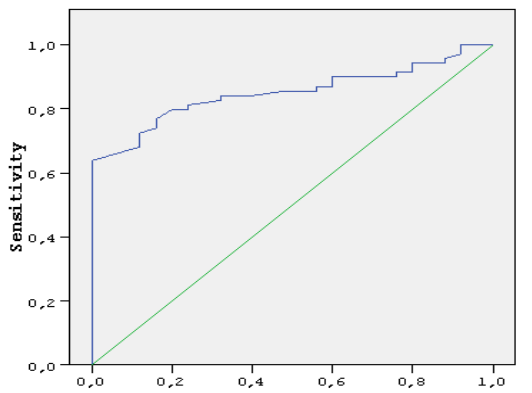
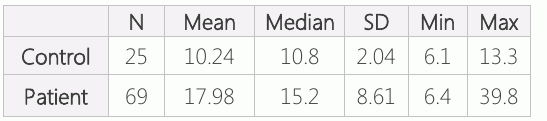
Baseline characteristics like sex, age, height, weight, BMI, use of alcohol, smoking of the patients (n=70) and control groups (n=25) were recorded. The patients (mean 69.1± 13.2) and the control group (mean 43.1±8.3) were not similar in age. In patients with HF (n=70, 33 women and 37 men) had a family history (75%), intracardiac cardioverter defibrillator (ICD) (21%), atherosclerosis (14%), pneumonia (7%), arrhythmia (54%), atrial fibrillation (82%), T2DM (48%), smoking (n=16, 22.6%) and myocard infarct (48.6%) (Table-1). In terms of drug use, the patients with HF were mostly on β-blockers (91%, p=0. 059) compared with statins (n=53,75.7%), antidiabetics (n=16, 22.9%), diuretics (n=19, 27.1%), aldesterone antagonist (n=8, 11.4%), angiotensin antagonist (n=54, 77.1%), ACE inhibitors (n=29, 41.4%), and digoxin (n=16, 22.9%). levels were significantly higher in patients with HF (patients n=70; mean 17.9±8.6 vs. controls n=25;mean 10.2±2.1; p<0.001)(Table-2). If the cutoff level for GAL-3 was taken as 11 mg/ml, presence of heart failure can be detected with a sensitivity of 84%, and specifity 60%. If the cutoff value is raised to the level of 11.5 ng/ml; the tests’ specifity increased to 81% with a sensitivity of 76% (Figure 1).
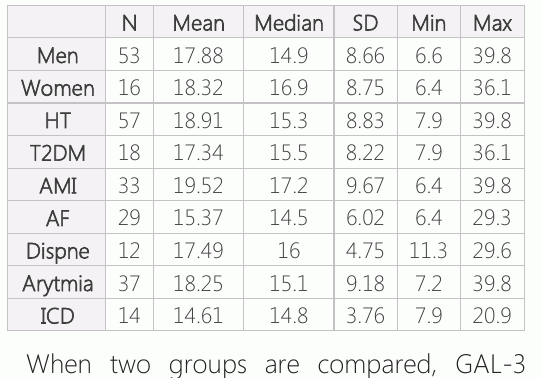
Mean left ventricular ejection fraction (EF) by transthoracic echocardiography was measured as 39.77 ±13. 84% in patients with HF.Higher age, lower EF and presence of intracardiac cardioverter-defibrillator were associated with high log GAL-3 by t-test (p=0. 019).
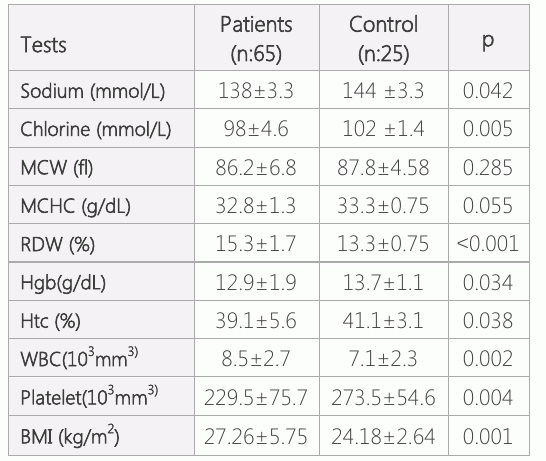
Comparison of biochemical parameters is given in Table 3. Log GAL-3 was significantly correlated with high creatinine, acid uric, red cell distribution width (RDW) levels, and low chloride and mean corpuscular hemoglobin concentration (MCHC) levels in patients of HF (p<0.001,p=0.003,p<0.001,p=0.002,p=0.0039).
Discussion
Measurement of GAL-3 has been shown to identify those with a 2 to 3 times increased risk of re-hospitalization or mortality in heart failure patients (16). Activated macrophages produce GAL-3 and recognize its binding sites in cardiac fibroblasts and the extracellular matrix (4). Elevated GAL-3 was associated with the combined endpoint of 60-day death/recurrent HF (odds ratio 14.3, p<0.001) (3). In a multicenter study on healthy individuals, GAL-3 was reported to have a normal distribution with a reference interval of 3.8– 21.0ng/ml (17).In a group of high risk patients with heart failure, Peacock (3) has identified a cutoff value in excess of 17.8 mg/ml may predict patients at high risk.To identify a specific cutoff point for the diagnosis of heart failure, a group of patients who presented with heart failure in our emergency unit and a healthy control group were included. Our results implicate thata higher cutoff value of 11.5 ng/mL has a higher sensitivity and specifity in patients with heart failure. Ho et al. (16) has reported statistically significant differences occur with age, sex, diabetes, hypertension, hypercholesterolemia, increased BMI, renal dysfunction and smoking status in GAL-3 levels in a healthy population. As a different approach, we tried to identify clinical factors associated with high GAL-3levels in a group of patients who presented with HF in our emergency unit.
Presence of dyspnea, hypertension, atrial fibrillation and use of β-Blockers, higher age, lower EF and presence of ICD were associated with high levels of GAL-3 in this population with overt heart failure. High GAL-3 levels accompanies high risk clinical factors such as hypertension and atrial fibrillation. This may be due to the fact that GAL-3 is a marker of the extent of fibrosis associated with these conditions (2). Dyspnea, use of β-blockers, higher age, lower EF and presence of intracardiac cardioverter-defibrillator all implicate grave disease. High GAL-3 levels in these conditions can be an answer in the high mortality and morbidity owing to heart failure as indicated in many studies (1).
High creatinine, uric acid, RDW levels, and low chloride and MCHC levels were the biochemical factors related to high GAL-3 levels. High creatinine levels, an indicator of renal dysfunction, has been in near relationship wih high GAL-3 in both individuals with and without existing HF in pioneering study(2).Renal failure has been associated with wor-sening of heart failure. Likewise, worsening kidney function may mediate GAL-3 effectson cardiac remodeling and HF (17–19). High uric acid levels may be explained by the fact that kidney disease elevates both creatinine and uric acid. GAL-3 concentrations, anduric acid were independent predictors of CSXin Bozcali study. This may implicate GAL-3 in micro-angiopathy associated with heart failure (20). Anemia has been repeatedly associated with heart failure (21). However, a recent study has revealed the prognostic significance of RDW independent of anemia, iron deficiency, renal dysfunction or other concomitant clinical conditions in HF (22). An underlying inflam-matory state due to proinflammatory cytokines has been found to inhibit erythropoietin-induced erythrocyte maturation, which may be reflected in part by an increase in the RDW. Supposedly, GAL-3 may reflect a similar environment with increased inflammation in the setting of high-risk HF. Bichara et al. (23) has reported low levels of chloride in an animal model that GAL- 3 may result in renal chloride loss independent of kidney disease.
Hypochromia as reflected by low MCHC in the absence of anemia has been associated with poor prognosis in HF (24). We have found high levels of Gal- 3 related to low MCHC. This may indicate a similar pathogenesis.
Conclusion
The measurement of GAL-3 may represent a new alternative biomarker in decision making for HF. Heart failure is a syndrome associated with many pathogenetic mechanisms. A specific group of patients with high risk heart failure, we tried to focus on the associated biochemical and clinical factors associated with high levels of GAL-3. GAL-3 levels are elevated in patients with HF who have certain clinical and biochemical properties. These associations need to be further evaluated by specific studies to illu-minate the pathogenic mechanisms associated with HF yet unknown to us.
Declarations
- Author contributions (CRediT)
- All authors contributed equally to all 14 CRediT roles (Conceptualization, Data curation, Formal analysis, Funding acquisition, Investigation, Methodology, Project administration, Resources, Software, Supervision, Validation, Visualization, Writing – original draft, Writing – review & editing).
- Funding
-
Funding information was not reported in the published version of this article.
- Conflicts of interest
- The authors declare that they have no conflict of interest.
- Ethics approval
- The study protocol was approved by the local research ethics committee.
- Data availability
- A data availability statement was not reported in the published version of this article.
References (24)
18 of 24 references are linked to their DOI.
- Jencks SF, Williams MV, Coleman EA. Rehospitalizations among patients in the Medicarefee- for-service program. N Engl J Med. 2009;360:1418-1428. DOI Crossref PubMed Google Scholar
- Boer RA, vanVeldhuisen DJ, Gansevoort RT, MullerKobold AC, vanGilst WH, Hillege HL, Bakker SJ,van der Harst P.The fibrosis marker galectin-3 and outcome in the general population. J Intern Med. 2012;272(1):55-64. PubMed Google Scholar
- Peacock F.How galectin-3 changes acute heart failure decision making in the emergency department. Clin Chem Lab Med. 2014; 52(10): 1409–1412. DOI Crossref PubMed Google Scholar
- Sharma UC, Pokharel S, van Brakel TJ, van Berlo JH, Schroen B, Andrè S, Crijns HJ, Gabius HJ, Maessen J, Pinto YM. Galectin-3 marks activated macrophages in failure-prone hypertrophied hearts and contributes to cardiac dysfunction.Circulation. 2004; 110(19):3121-3128. DOI Crossref PubMed Google Scholar
- Milting H, Ellinghaus P, Seewald M, Cakar H, Bohms B, Kassner A, Körfer R, Klein M, Krahn T, Kruska L, El Bnayosy A, Kramer F. J Heart LungTransplant. Plasma biomarkers of myocardial fibrosis and remodeling in terminal heart failure patients supported by mechanical circulatory devices. J Heart Lung Transplant. 2008;27(6):589-596. DOI Crossref PubMed Google Scholar
- Van Kimmenade RR, Januzzi JL Jr, Ellinor PT, Sharma UC, Bakker JA, Low AF, Martinez A, Crijns HJ, MacRae CA, Menheere PP, Pinto YM. Utility of amino grup-terminal pro-brain natriuretic peptide, galectin-3, and apelin for the evaluation of patients with acute heart failure. J Am Coll Cardiol. 2006;48(6):1217-24. DOI Crossref PubMed Google Scholar
- Jaarsma T, van der Wal MH, Lesman-Leegte I, Luttik ML, Hogenhuis J, Veeger NJ, Sanderman R, Hoes AW, van Gilst WH, Lok DJ, Dunselman PH, Tijssen JG, Hillege HL, van Veldhuisen DJ. Effect of moderate or intensive disease management program on outcome in patients with heart failure: Coordinating Study Evaluating Outcomes of Advising and Counseling in Heart Failure (COACH). Arch Intern Med. 2008;168:316-24. PubMed Google Scholar
- Filipe MD, Meijers WC, Rogiervan der Velde A, de Boer RA. Galectin-3 and heart failure: prognosis, prediction & clinical utility.Clin Chim Acta. 2015;443:48-56. DOI Crossref PubMed Google Scholar
- Zhang Y, Zhang R, An T, Huang Y, Guo X, Yin S, Wang Y, Ji S, Lv R, Zhang J, Maisel A. The utility of galectin-3 for predicting cause-specific death in hospitalized patients with heart failure. J Card Fail. 2015;21(1):51-59. DOI Crossref PubMed Google Scholar
- McCullough P, de Boer RA, Edelmann F, Lewis CM, Maisel AS.Utilization of galectin-3 in case management across the spectrum of heart failure. Rev Cardiovasc Med. 2014;15(3):197-207. DOI Crossref PubMed Google Scholar
- Zamora E, Lupón J, de Antonio M, Galán A, Domingo M, Urrutia A Troya M, Bayes-Genis A. Renal function largely influences Galectin-3 prognostic value in heart failure.Int J Cardiol. 2014;177(1):171-177. DOI Crossref PubMed Google Scholar
- http://www.nhlbi.nih.gov/health/health-topics/topics/hf. PubMed Google Scholar
- http://www.heart.org/HEARTORG/Conditions/HeartFailure /AboutHeartFailure/Classes- of-Heart-Failure_UCM_306328 Galectin-3 Levels in Heart Failure Ayşem KAYA, et al. PubMed Google Scholar
- Lang RM, Bierig M, Devereux RB, Flachskampf FA, Foster E, Pellikka PA, Picard MH, Roman MJ, Seward J, Shanewise JS, Solomon SD, Spencer KT, Sutton MS, Stewart WJ. Chamber Quantification Writing Group; American Society of Echocardiography’s Guidelines and Standards Committee; European Association of Echocardiography. Recommendations for chamber quantification: a report from the American Society of Echocardiography’s GuidelinesandStandards Committee and the Chamber Quantification Writing Group, developed in conjunction with the European Association of Echocardiography, a branch of the European Society of Cardiology. J Am Soc Echocardiogr. 2005;18: 1440 –1463. DOI Crossref PubMed Google Scholar
- Yancy CW, Jessup M, Bozkurt B, Butler J, Casey DE Jr, Drazner MH, Fonarow GC, Geraci SA, Horwich T, Januzzi JL, Johnson MR, Kasper EK, Levy WC, Masoudi FA, McBride PE, McMurray JJ, Mitchell JE, Peterson PN, Riegel B, Sam F, Stevenson LW, Tang WH, Tsai EJ, Wilkoff BL; American College of Cardiology Foundation/American Heart Association Task Force on Practice. 2013 ACCF/AHA Guideline for the Management of Heart Failure: A Report of American College of Cardiology Foundation/American Heart Association Task Force on Practice Guidelines. Circulation. 2013; 128(16):240-327. DOI Crossref PubMed Google Scholar
- Ho JE,Liu C, Lyass A, Courchesna P, Pencina MJ, Vasan RS, Larson MG, Levy D. Galectin-3, a marker of cardiac fibrosis, predicts incident heart failure in the community. J Am Coll Cardiol. 2012; 60:1249– 1256. DOI Crossref PubMed Google Scholar
- Sun RR, Lu L, Liu M, Cao Y, Li XC, Liu H, Wang J, Zhang PY. Biomarkers and heart disease. Eur Rev Med Pharmacol Sci. 2014 Oct;18(19):2927-35. PubMed Google Scholar
- Tang WH, Shrestha K, Shao Z, Borowski AG, Troughton RW, Thomas JD, Klein AL.Usefulness of plasma galectin-3 levels systolic heart failure to predict renal insufficiency and survival. Am J Cardiol. 2011;108(3):385-90. DOI Crossref PubMed Google Scholar
- Carrasco- Sánchez FJ, Aramburu-Bodas O, Salamanca-Bautista P, Morales-Rull JL, Galisteo-Almeda L, Páez-Rubio MI, Arias-Jiménez JL, Aguayo-CanelaM,Pérez-Calvo JI.Predictive value of serum galectin-3 levels in patients with acute heart failure with preserved ejection fraction.Int J Cardiol. 2013;5;169(3):177-82. DOI Crossref PubMed Google Scholar
- Bozcali E, Polat V, Aciksari G, Opan S, Bayrak IH, Paker N, Karakaya O. Serum concentrations of galectin-3 in patients with cardiac syndrome X. HellenicJ Cardiol. 2014;55(6):457-461. DOI Crossref PubMed Google Scholar
- Tseliou E, Terrovitis JV, Kaldara EE, Ntalianis AS, Repasos E, Katsaros L, Margari ZJ, Matsouka C, Toumanidis S, Nanas SN, Nanas JN. Red blood cell distribution width is a significant prognostic marker in advanced heartfailure, independent of hemoglobin levels. Hellenic J Cardiol. 2014;55(6):457-61. PubMed Google Scholar
- Huang YL, Hu ZD, Liu SJ, Sun Y, Qin Q, Qin BD, Zhang WW, Zhang JR, Zhong RQ, Deng AM.Prognostic value of red blood cell distribution width for patients with heart failure: a systematic review and meta-analysis of cohort studies.PLoSOne. 2014; 18;9(8):e104861. DOI Crossref PubMed Google Scholar
- Bichara M, Attmane-Elakeb A, Brown D, Essig M, Karim Z, Muffat-Joly M, Micheli L, Eude-Le Parco I, Cluzeaud F, Peuchmaur M, Bonvalet JP, Poirier F, Farman N. Exploring the role of galectin 3 in kidney function: a genetic approach.Glycobiology. 2006;16(1):36-45. DOI Crossref PubMed Google Scholar
- Simbaqueba C, Shrestha K, Patarroyo M, Troughton RW, Borowski AG, Klein AL, Tang WH. Prognostic implications of relative hypochromia in ambulatory patients with chronic systolic heart failure.Congest Heart Fail. 2013;19(4):180-5. DOI Crossref PubMed Google Scholar
Respond to this article
Comments on a published article are welcome as a Letter to the Editor.
Get an e-mail when new articles in your fields are published
Read the full text
Open the PDF here
Loading the PDF…
If the PDF does not show here, use the download button above.
How to cite this article
Kaya A, Ademoglu E, Yigit Z, Purisa S, Uzunhasan I. High GAL-3 may be Associated with Higher Age and Low Levels of Chloride, RDW, and MCHC in Heart Failure. Ulutas Med J. 2016;2(4):159-165. doi:10.5455/umj.20161215092108
Kaya, A., Ademoglu, E., Yigit, Z., Purisa, S., & Uzunhasan, I. (2016). High GAL-3 may be Associated with Higher Age and Low Levels of Chloride, RDW, and MCHC in Heart Failure. The Ulutas Medical Journal, 2(4), 159–165. https://doi.org/10.5455/umj.20161215092108
Kaya, A. et al. (2016) 'High GAL-3 may be Associated with Higher Age and Low Levels of Chloride, RDW, and MCHC in Heart Failure', The Ulutas Medical Journal, 2(4), pp. 159–165. doi: 10.5455/umj.20161215092108.