The Ulutas Medical Journal · ISSN 2149-0430 (مطبوع), 2149-388X (إلكتروني) · https://www.ulutasmedicaljournal.com/?mno=106884
رسالة إلى المحرر · وصول مفتوح
Daptomycin or Vancomycin Plus Ceftaroline for Methicillin-Resistant Staphylococcus Aureus bloodstream Infections
ترجمة آلية للعنوان والملخص والنص الكامل. الأصل الإنجليزي
- Department of Nursing, Kaohsiung Municipal United Hospital, Taiwan ROR
- Department of Intensive Care Medicine, Chi-Mei Medical Center, Liouying, Taiwan ROR
الملخص
The clinical outcomes of patients with MRSA bacteremia treated with ceftaroline plus vancomycin or daptomycin were similar to those treated with monotherapy with vancomycin or daptomycin. غير أن هذا التحليل له أعداد محدودة من الحالات والدراسات؛ ومن الضروري إجراء دراسات أوسع نطاقا لتأكيد هذه النتائج.
الكلمات المفتاحية
النص الكامل
ترجمة آلية للنص الكامل؛ النسخة المنشورة الرسمية هي الأصل الإنجليزي. الأصل الإنجليزي
إلى رئيس التحرير
Recently, one randomized clinical trial (RCT) by Tong et al showed that addition of an anti-staphylococcal ß-lactam to daptomycin or vancomycin alone was not associated with improve outcome of patients with MRSA bacteremia (1)وعلاوة على ذلك، حدثت إصابة كلية أكثر حدة في مجموعة مختلطة من مجموعة العلاج الأحادي في هذه الفئة من المواد الكيميائية وراثياً (1)غير أن هناك دراسة أخرى أجريت مؤخراً في قضية " جورجينسن وآخرون " قامت بالتحقيق في أثر إضافة مادة بيتا إلى مادة " دبوتسين " في معالجة مادة الميثيلين المقاومة. Staphylococcus aureus (MRSA) bloodstream infection and found that the combination of a ß-lactam and daptomycin was associated with a better outcome than daptomycin monotherapy (2)بالإضافة إلى تصميم مختلف للدراسة بين هاتين الدراستين (1, 2)وكان اختيار اللاكتام بيتا في كل منها مختلفاً اختلافاً كبيراً. In Jorgensen et al. (2)87.5 في المائة (63/72) من العلاج المختلط استخدم السفالوسبورين، ولكن معظم براءات الاختراع التي عولجت بمزج الفلوروكساسيلين أو الألبسة (1)لذلك، نتساءل عما إذا كان سيفالوسبورن، ولا سيما السوفتارولين، الذي يظهر بقوة in vitro ويمكن أن يكون النشاط المضاد لوكالة الصحة العالمية هو الخيار الأفضل للعلاج المختلط القائم على التخدير من أجل تحسين نتائج المرضى المصابين بأمراض مجرى الدم التابع للوزارة. ولتوضيح هذه المسألة، أجرينا هذا التحليل لمقارنة أثر إضافة البخارولين إلى الفانكومسين أو الدابتوميسين والعلاج الأحادي في معالجة البكتيريا.
أربع دراسات (3–6) وقد تم تحديد أثر الجمع بين اللافتات والفانكومسين/الطب الذري والعلاج المعياري من البحث الأدبي. ولخص الجدول 1 خصائص هذه الدراسات. One study was RCT (4) وكانت ثلاث دراسات استرجاعية أخرى (3, 5, 6)وكانت كل دراستين واحدة(3, 6) الدراسات المتعددة المراكز (4, 5)- سُجلت النتائج الأولية كوفاة لمدة 28 يوما للتحليل. وقد استُخرجت من الدراسات المقيدة نتيجة ثانوية تشمل الوفيات التي تبلغ 90 يوما، والانتكاسات الميكروبيولوجية، وخطر الإصابة الكلية الحادة.
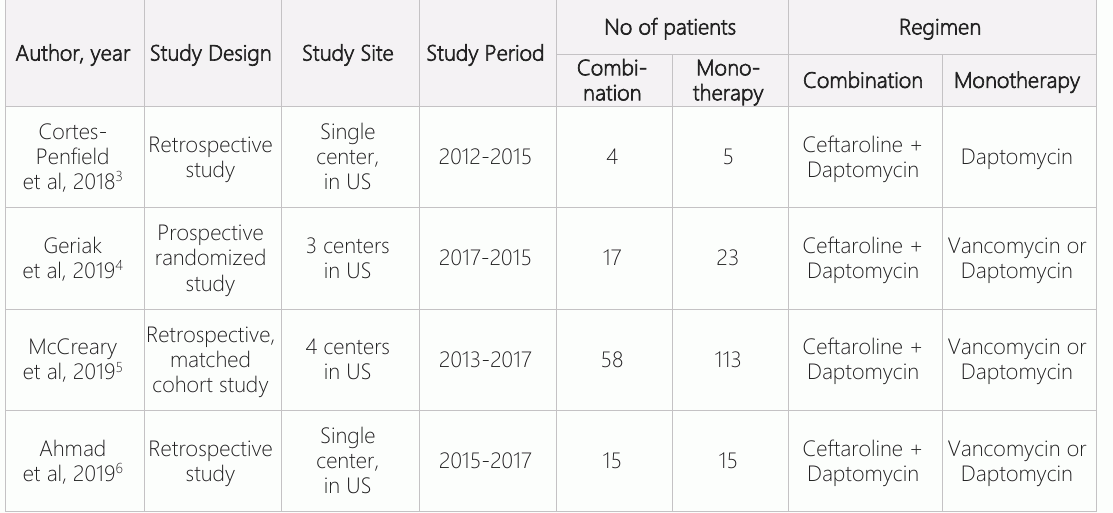
وإجمالاً، تلقى 94 و156 مريضاً علاجاً مختلطاً بداء الدابوتومسين زائداً الخنازير والعلاج الأحادي - الفانكومسين أو الدابتوميسين، على التوالي. وعلى الرغم من أن معدل الوفيات لمدة 28 يوماً في مجموعة العلاج المختلط كان رقمياً مقارنة بمجموعات العلاج الأحادي (7.4 في المائة [7/94] مقابل 14.7 في المائة [23/156])، فإن هذا الفرق لم يصل إلى الأهمية الإحصائية (فرق المخاطر، 0.07؛ 95 في المائة بين الثقة [CI]، 0.21 - 0.08). ولوحظ أيضاً وجود تشابه بين العلاج المختلط والعلاج الأحادي فيما يتعلق بوفيات الـ 90 يوماً (الفرق في المخاطر، 0.08؛ 95 في المائة فيلق العلاج، 0.77، 0.94). In addition, combination treatment was similar to monotherapy (risk difference, -0.06; 95%CI, -0.22 - 0.1) in terms of micro biological relapse. Finally, the risk of acute kidney injury was similar between combination treatment and monotherapy (risk difference,-0.21; 95% CI,-0.62~0.2).
واستناداً إلى النتائج المذكورة أعلاه، فإن النتيجة السريرية للمرضى المصابين ببكتيريا MRSA التي عولجت بمزيج من البخارولين والفانكومسين أو الدابتوميسين كانت مشابهة لتلك التي تمت بواسطة العلاج الأحادي للفانكومسين أو الدابتوميسين. غير أن عدد القضايا والدراسة محدود في هذا التحليل، ومن الضروري إجراء المزيد من الدراسة الواسعة النطاق لتأكيد هذه النتائج.
الإقرارات
- مساهمات المؤلفين (CRediT)
- ساهم جميع المؤلفين بالتساوي في جميع أدوار CRediT الأربعة عشر (Conceptualization, Data curation, Formal analysis, Funding acquisition, Investigation, Methodology, Project administration, Resources, Software, Supervision, Validation, Visualization, Writing – original draft, Writing – review & editing).
- التمويل
-
Funding information was not reported in the published version of this article.
- تضارب المصالح
- The author declared no conflict of interest.
- الموافقة الأخلاقية
- Ethics approval details were not reported in the published version of this article.
- إتاحة البيانات
- Data sharing is not applicable to this article as no new data were created or analysed in this study.
المراجع (15)
10 من أصل 15 مرجعًا مرتبطة بمعرّف DOI.
- Holick MF, Krane SM, Potts JT. Calcium, phosphorus, and bone metabolism: Calcium-regulation hormones. In: Fauci AS, Braunwald E, Isselbacher KJ, et al (Eds). Harrison's principles of internal medicine. 14th ed. New York: McGraw-Hill; 1995:2214 PubMed Google Scholar
- Thacher TD, Clarke BL. Vitamin D insufficiency. Mayo Clin Proc. 2011;86(1):50-60 PubMed Google Scholar
- Gal-Moscovici A, Sprague SM: Role of Vitamin D deficiency in chronic kidney Disease. J Bone Miner Res. 2007;22:91-94 DOI Crossref PubMed Google Scholar
- Michael F. Holick: Vitamin D for Health and in chronic kidney disease.Seminars in Dialysis - vol 18, No 4, 2005 DOI Crossref PubMed Google Scholar
- Yin K, Agrawal DK. Vitamin D and inflammatory diseases. J Inflamm Res. 2014;7:69-87 DOI Crossref PubMed Google Scholar
- Taskapan H, Wei M, Oreopoulos DG. 25(OH) Vitamin D(3) in patients with chronic kidney disease and those on dialysis: rediscovering its importance. Int Urol Nephrol. 2006;38(2): 323-329 DOI Crossref PubMed Google Scholar
- Hossein-nezhad A, Holick MF. Vitamin D for health: A Global perspective. Mayo Clin Proc. 2013;88(7):720–55 DOI Crossref PubMed Google Scholar
- Türkiye Endokrinoloji ve Metabolizma Derneği. Osteoporoz ve Metabolik Kemik Hastalıkları Tanı ve Tedavi Kılavuzu 2018: 119-27 PubMed Google Scholar
- Jean G, Souberbielle JC, Chazot C. Vitamin D in chronic kidney disease and dialysis patients. Nutrients. 2017;9(4):1-15 DOI Crossref PubMed Google Scholar
- Keung L, Perwad F. Vitamin D and kidney disease. Bone Rep. 2018;9:93-100 DOI Crossref PubMed Google Scholar
- Eknoyan G, Lameire M, Kasiske B. Kidney Disease: Improving Global Outcomes (KDIGO) CKD-MBD Update Work Group. KDIGO 2017 clinical practice guideline update for the diagnosis, evaluation, prevention, and treatment of chronic kidney disease–mineral and bone disorder (CKD-MBD). Kidney Int Suppl. 2017;7:1–59 DOI Crossref PubMed Google Scholar
- Eknoyan G,Levin NM: Bone metabolism and disease in chronic kidney disease. Am J Kidney Dis. 2003;42:1-201 DOI Crossref PubMed Google Scholar
- Gonzales EA,Sachdeva A,Oliver DA et al. Vitamin D insufficiency and deficiency in chronic kidney disease. A single center observational study. Am J Nephrol. 2004;24: 503-510 PubMed Google Scholar
- Tokmak F, Quack I, Schieren G, Sellin L, Rattensperger D, HollandLetz T, Weiner SM, Rump LC: High-dose chole calciferol to correct vitamin D deficiency in haemodialysis patients. Nephrol Dial Transplant. 2008;23:4016-4020 DOI Crossref PubMed Google Scholar
- Tentori F,Stidley C,Brown R et al:Survival does not differ among incident hemodialysis patients treated with the different vitamin D analogs, in vol (F-PO940), American Society of Nephrology Meeting, 2003 PubMed Google Scholar
اقرأ النص الكامل
افتح ملف PDF هنا
جارٍ تحميل ملف PDF…
إذا لم يظهر ملف PDF هنا، استخدم زر التنزيل أعلاه.
كيف تقتبس هذه المقالة
Lee GM, Chao CM. Daptomycin or Vancomycin Plus Ceftaroline for Methicillin-Resistant Staphylococcus Aureus Bloodstream Infections. Ulutas Med J. 2020;6(3):185-187. doi:10.5455/umj.20200513022718
Lee, G. M., & Chao, C. M. (2020). Daptomycin or Vancomycin Plus Ceftaroline for Methicillin-Resistant Staphylococcus Aureus Bloodstream Infections. The Ulutas Medical Journal, 6(3), 185–187. https://doi.org/10.5455/umj.20200513022718
Lee, G.M. and Chao, C.M. (2020) 'Daptomycin or Vancomycin Plus Ceftaroline for Methicillin-Resistant Staphylococcus Aureus Bloodstream Infections', The Ulutas Medical Journal, 6(3), pp. 185–187. doi: 10.5455/umj.20200513022718.