A hybrid algorithm learns to tell five kinds of white blood cell apart
Shape features, a neural network and a vulture-inspired search combine to read blood smears.
Counting white blood cell types under a microscope is routine lab work, yet it is slow and two observers do not always agree.
Writing in The Ulutas Medical Journal, the authors built an automated pipeline: a contourlet transform captures cell shape, a recurrent neural network learns deeper patterns, and a search method modelled on African vultures picks the most informative features before a clustering step assigns the label.
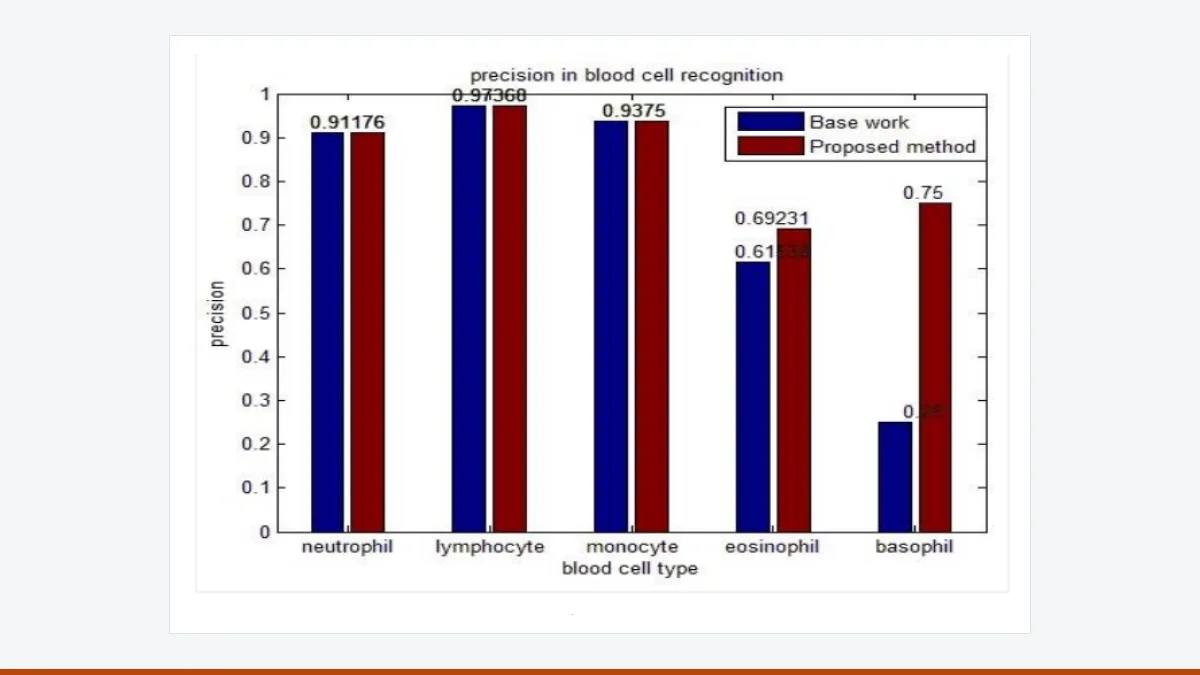
Accuracy depended on the cell type. Monocytes were recognised correctly 97% of the time, but rarer basophils only 69%, and neutrophils sat at 75%.
Why it matters: a reliable tool of this kind could take some of the routine burden off haematology staff and make smear reading more consistent.
The authors see it as a possible aid for laboratories rather than a replacement for experts.
Caveat: the results come from image datasets in a computer study; the method has not been tested in day-to-day clinical work.
Source: Omid Eslamifar et al. Multiclass Blood Cell Classification Using Contourlet Transform and Metaheuristic-Optimized Deep Features with Clustering-Based Decision Making. Ulutas Med J 2025. doi:10.5455/umj.20250424051519.
Image: Figure 4 of the article, CC BY-NC 4.0.